Mexican in Brooklyn, NYC. Husband.
Philosophy, law, and economic history ( @LSEnews ) graduate.
Sunlight is said to be the best of disinfectants. (L. Brandeis)
La historia del viejito no es una de miedo. Al revés. Es de miedo pero de los otros. Miedo de Zedillo a vetarlo. Miedo de Fox a encarcelarlo. Miedo de Peña a defender sus reformas. Miedo de los empresarios a perder sus privilegios. Miedo de la oposición a los expedientes. Miedo de los ministros a defender a la república. Miedo de los medios y universidades a decir la verdad. Miedo del pueblo a hacerse responsable. Es un historia de cobardía colectiva. Por eso precisamente es que ha crecido. Hasta destruir al país.
A Chicago philosopher wrote one book in 1940 proving that 95% of the books you have read in your life, you didn't actually read, and Charlie Munger has been telling people to read it for 50 years.
His name was Mortimer Adler.
He spent 40 years at the University of Chicago, ran the editorial board of the Encyclopædia Britannica, and built his entire career on one uncomfortable observation about the people around him.
Most adults who called themselves well-read had not actually read a book in the real sense even once. They had run their eyes over the pages, registered the words, formed a vague impression, and put it back on the shelf.
The book had passed through them without ever entering them.
In 1940 he wrote How to Read a Book. It has stayed in print for 86 years.
Charlie Munger recommends it. Naval Ravikant recommends it. Fareed Zakaria recommends it.
Every serious thinker who builds a career on absorbing information eventually finds their way to this book, and the reason is that Adler had isolated something nobody else was naming clearly.
There are four levels of reading. Almost everyone is stuck on the second one. The fourth level is so different from what most people call reading that you have probably never done it in your entire life.
Level one is elementary.
You learn it as a child. You decode the letters into words and the words into sentences. You finish the sentence and understand roughly what it said. This is reading the way a 7-year-old reads, and almost every adult on earth has stopped developing past this point in some quiet way.
Level two is inspectional.
This is skimming. You move through a book quickly to figure out what it is broadly about. You read the back cover, scan the table of contents, glance at a few paragraphs, and form an opinion. Most adults who claim to have read 50 books a year are actually doing this. They are inspecting books, not reading them. They walk away with a vague sense of the argument and almost none of the evidence that supports it.
Level three is analytical.
This is the level Adler said most people have never properly experienced. You take one book and you wrestle with it for as long as it takes. You identify the question the author is trying to answer. You map their argument from front to back. You write your disagreements in the margins. You force yourself to articulate, in your own words, what the author is claiming and why. The point is not to finish the book. The point is to argue with it as if the author were sitting across the table from you. Most people never do this once in their life, because it is exhausting and slow and feels nothing like the reading they were taught as children.
Level four is the one almost nobody knows exists. Adler called it syntopical reading. The word means "across topics," and the technique is something closer to running a small private research lab in your own head.
You pick a single question that actually matters to you. How does power corrupt people. Why do civilizations collapse. What makes a marriage last. How does a person change their own mind. Then you assemble five or ten or twenty books from different authors, different centuries, different traditions, all of them taking a swing at the same question.
You do not read any of them cover to cover. You move between them. You find the chapter in book three that addresses the same question as the chapter in book seven. You force those two authors to argue with each other inside your own head.
The book stops being the unit of reading. The question becomes the unit. And the authors become voices in a conversation you are now hosting.
This is the level where reading stops being consumption and starts being construction.
You are no longer absorbing what someone else thinks. You are building a position of your own out of the friction between people who disagreed.
Adler argued that this is the only level of reading where you stop being a passive receiver of other people's ideas and start being someone who can produce ideas of their own.
The reason Charlie Munger has been recommending this book for 50 years is that this is exactly how Munger has always thought. He calls it building a latticework of mental models. The technique he is describing is just syntopical reading applied for a lifetime.
You take the strongest insight from psychology, the strongest insight from biology, the strongest insight from economics, and you stack them against the same problem until something new falls out the bottom.
The reason most people never reach level four is not that it is intellectually difficult. It is that it is logistically uncomfortable. It requires you to keep multiple books open at once.
It requires you to take notes that nobody is going to grade. It requires you to abandon the goal of finishing books and replace it with the goal of answering questions.
This is also why AI just changed everything Adler was teaching.
NotebookLM, Claude, and tools like them let you do syntopical reading at a speed that would have looked like magic to a Chicago philosopher in 1940.
You upload 10 books on the same question. You ask the AI to surface every place those authors agree and every place they contradict each other.
The technique Adler said almost nobody on earth had reached can now be run on a Sunday afternoon by anyone with a laptop and one good question.
The technique was always the unlock. The bottleneck used to be time. The bottleneck is now curiosity.
Most people will keep reading the way they always have. A book at a time. Eyes over the pages. No question driving it. No other authors in the room. Adler called that level two for a reason.
You are not behind on your reading list.
You are behind on the level you are reading at.
Lo dijimos en su momento. Quedó a deber. Lo preocupante es que la economía no crece a tasas suficientes para garantizar que la deuda se estabilice. Dos calificadoras están en el borde de bonos basura para México. Pero los de la 4T creen que se la saben de todas todas.
¿Cuánto cuesta el socialismo en términos de crecimiento?
En este paper los autores analizan 22 países en desarrollo que adoptaron economías planificadas entre 1950 y 2020. Resultado: una caída de 2-2,5 pp anuales en el crecimiento del PIB per cápita respecto a países comparables. El efecto es similar en productividad laboral y se mantiene estable a lo largo del período socialista.
Además, los tests de placebo y diff-in-diff en dos etapas sugieren que el efecto es causal. No opera vía inversión o gasto público, sino por productividad total de los factores.
En un país en desarrollo típico, eso implica un empobrecimiento neto cada año bajo el socialismo.
"Rhetoric is now a term of abuse: at best it is something insubstantial, and at worst it is self-serving, partisan, even sinister. This modern understanding of rhetoric is in fact only a fragment of one side of a multifaceted, complex debate." Read Cicero: https://t.co/datOf51ipH
Oigan, aprovechando todo esto. Les invito a reconocer el trabajo de los miles de periodistas en el país que les están llevando info oportuna. Y eso se hace comprando diarios, suscribiéndose a portales, consumiendo medios independientes, consumiendo a sus patrocinadores.
Pero, como dije, Ibargüengoitia se encuentra en revisión, lo que es una excelente noticia porque significa que está vivo. Acá un texto reciente que critica su humor. No comulgo con él, pero reconozco que algunos chistes no me causaron gracia.
https://t.co/TXxVT8wCIx
Me parece que Manzana de la discordia no ha tenido la recepción que merece, dada la importancia de la crónica, del autor y del contexto político en que aparece el libro. Acá dejo uno de los pocos textos que han aparecido sobre él:
https://t.co/j0ObGgBzPp
There's a Mephistopheles/Faustian mood to this night photograph of a man and his shadow reminding me of these words by Goethe's Faust: "Two souls...are housed within my breast, And each will wrestle for the mastery there."
*Bocskay-ter,Budapest, 1914 photograph by André Kertész
The passion for power over others will never cease to threaten humanity, and it will always find new and unexpected allies to continue its martyrology.
–Lord Acton
La pasión por poder sobre los demás nunca dejará de amenazar a la humanidad, y siempre encontrará aliados nuevos e imprevistos para continuar su martirología.
- Lord Acton
Moving to capitalism leads to large reductions in poverty.
Consider the case of India.
Before they liberalized their economy, they were poorer than Sub-Saharan Africa. Then, in the early-2000s, capitalism let them get ahead.
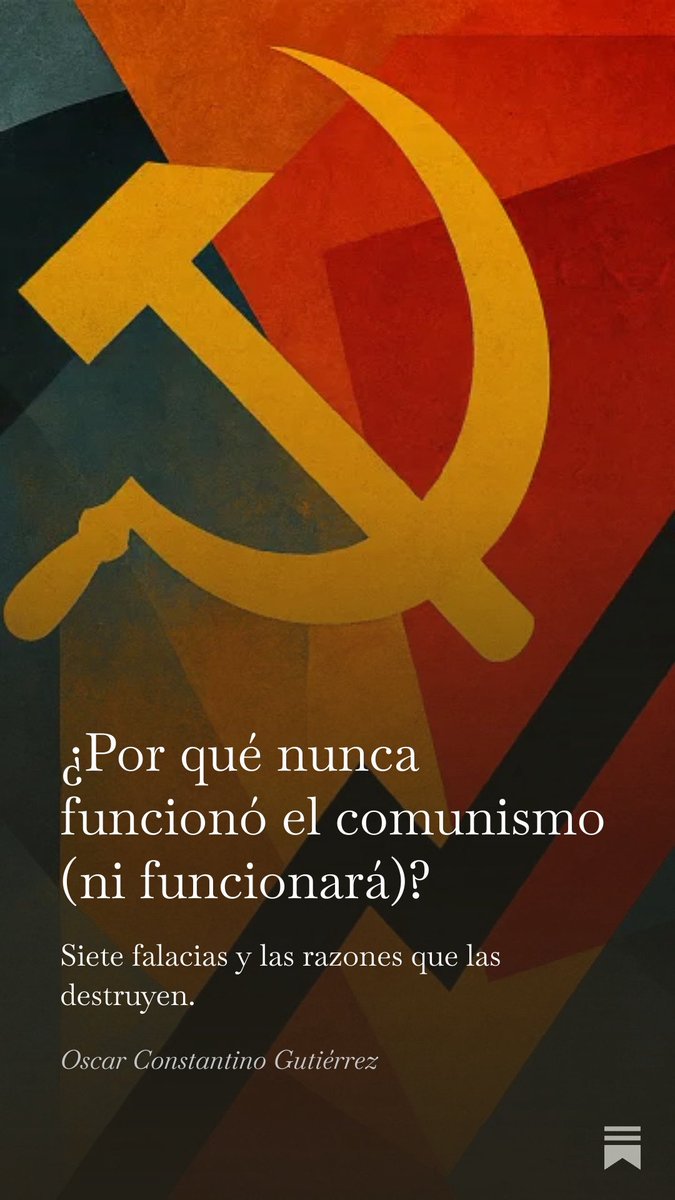
El comunismo no fracasa por accidente: fracasa por diseño.
Promete justicia y entrega represión, promete igualdad y crea castas.
👉 Siete falacias, siete razones que lo destruyen.
Quien aún lo defiende, ya eligió cadenas en lugar de libertad.
Lee aquí: https://t.co/tjUGtWt0hT
Great piece on Argentina by @grobb2000 at @MarketWatch. Argentina stands alone in Latin America in - again and again - pegging its currency to the Dollar. The rest of the region floats their currencies, which is what Argentina needs to do… https://t.co/lji0RX0Jvy
For the 1st time it will be possible to access the Suburban Baths at Herculaneum Archaeological Park during ongoing restoration work.
From September 14 to November 30, 2025, visitors will be able to discover never-before-opened rooms https://t.co/9A03cS4V20
Refugee → Entrepreneur
From fleeing war in Iraq to becoming an entrepreneur, Hamza’s journey proves that when given opportunity, refugees can thrive and give back to their communities. 🙌