AI shouldn’t belong to a few servers or a few companies.
OG LABS and DGRID AI distribute intelligence across networks, where compute is provable, participation is rewarded, and innovation flows without permission.
This is AI evolving from product to public infrastructure.
The launchpad for real decentralized AI adoption just ignited.
0G Labs' LiftOff campaign isn't another airdrop grind.
It's a deliberate invitation to explore the ecosystem they've built as the largest AI-focused L1—real applications, live tools, meaningful tasks that reward actual engagement.
Powered by Galxe and Xangle, https://t.co/yPjGTpjXvx lets anyone become a power user: test on-chain models, interact with agents, store massive datasets, and earn for contributing to the network's maturity.
This matters because adoption in this space has been bottlenecked by complexity.
0G is removing that friction, turning curiosity into hands-on mastery.
Inference Labs amplifies the impact.
Their provable frameworks mean every quest action—every inference you run, every decision an agent makes—comes with built-in auditability.
You're not just playing with toys.
You're experiencing systems where outputs can always be verified, building intuition for trustless automation.
DGrid makes the heavy lifting feel effortless.
As you run inferences across the ecosystem during these quests, their decentralized network routes them efficiently—low cost, high reliability, no single point of control.
It's the first taste for many of what scalable decentralized compute actually feels like in practice.
Astrology quietly elevates the entire experience.
By modeling user patterns and engagement flows, it helps surface the quests that match your style, predict what keeps you coming back, and shape rewards that feel earned, not gamified.
Communities form around shared discovery, not forced incentives.
This isn't about pumping metrics.
It's about onboarding the next wave of builders who will treat decentralized AI as obvious infrastructure.
The projects that matter most now are the ones lowering barriers while raising standards.
0G's LiftOff does exactly that—paired with Inference Labs' verifiability, DGrid's scale, and Astrology's human insight.
If you've been watching from the sidelines, this is your entry point.
Dive into https://t.co/yPjGTpjXvx, complete the paths, and see the stack in action.
The era of theoretical decentralized AI is ending.
Start building the muscle memory for what's next.
#MissionStarbound
Permacastapp isn't solving discovery. It's solving something harder: why podcasts die when they stop performing. Most shows collapse not from lack of audience but from lack of economic closure. Creators need feedback that persists beyond the algorithm's attention span.
The insight is architectural. Podcasts exist in temporal markets where value evaporates with the next upload cycle. Permacastapp introduces permanence into an ephemeral medium. When listeners can fund shows directly through lasting mechanisms, you get different creative behavior. People make things meant to compound, not just capture.
This matters because podcasting has always had backwards incentives. The current model rewards frequency over depth, trending over timeless. It turns every creator into a content mill chasing platform metrics. Permacasting inverts this. It asks what happens when the work itself holds value independently of its distribution moment.
The technical implementation is almost boring in its elegance. No token speculation, no artificial scarcity. Just infrastructure that lets monetary support exist as long as the content does. The result is less like Patreon and more like creating an endowment for ideas.
What changes is the time horizon. Creators stop optimizing for next week's algorithm and start building libraries. The shows that emerge from this structure won't look like current podcasts. They'll look like research that happens to have audio.
I told my mom about @RumiLabs_io like this: You watch what you already love, but this time your time has value. No data stealing. No middlemen. Just fair rewards for attention. This is how media should feel. Rumi all the way🔥🔥
The next phase of Web3 will not be won by isolated protocols solving isolated problems, but by ecosystems that collapse complexity into coherence. This is where the idea of one hub, many solutions becomes more than a slogan and starts to look like real infrastructure. Permacastapp, 0G_labs, and Dgrid_ai each approach this from different technical layers, yet together they outline a unified design philosophy for decentralized systems: modular depth without fragmented user experience.
permacastapp sits at the social and data permanence layer, rethinking how content, identity, and discourse live onchain. It treats information not as disposable feeds but as durable assets, enabling verifiable history, censorship resistance, and creator sovereignty. In an ecosystem increasingly driven by narratives and coordination, this permanence becomes infrastructure, not a feature. It is the memory layer that many decentralized systems lack.
0G_labs operates deeper in the stack, addressing the data availability and modular execution problem that limits scalability across rollups and app-chains. By separating computation from data and optimizing throughput at the base level, 0G Labs enables builders to scale without sacrificing decentralization. It is the unseen engine that allows complex applications to exist without collapsing under their own data weight.
Dgrid_ai completes the loop by turning decentralized infrastructure into an intelligent, adaptive system. By integrating AI-driven coordination, resource optimization, and community participation, Dgrid_ai transforms raw infrastructure into a responsive network. It aligns incentives, automates complexity, and ensures that decentralized systems remain usable, efficient, and community-driven rather than technically exclusive.
What makes this convergence powerful is not overlap, but complementarity. Permacastapp preserves meaning, 0G Labs moves data at scale, and Dgrid_ai orchestrates intelligence across the network. One hub, many solutions is not about doing everything in one place, but about designing systems that feel unified while remaining modular. This is how Web3 graduates from experimental protocols to real digital infrastructure.
@xmaquina RCM plays a crucial role in enabling asset specific exposure. $DEUS
PermawebDAO is quietly redefining what ownership means in the digital age.
In most online systems today, users do not truly own their data. Platforms act as temporary custodians, and when incentives change, history can be altered, access can be removed, or entire records can vanish. PermawebDAO approaches this problem from the root by anchoring data to permanence and making ownership verifiable across time.
The idea is simple but radical. When data is stored permanently, control shifts away from platforms and back to users and communities. Content, identity, and state are no longer dependent on the survival of a company or a frontend. They exist as long as the network exists.
PermawebDAO treats the permaweb as a shared memory layer for the internet. Instead of siloed databases competing for attention, applications become contributors to a collective, persistent knowledge base. Each interaction adds context rather than noise, and each contribution remains accessible for future builders to extend.
This has deep implications for governance. Decisions, proposals, and outcomes can be preserved as immutable records, allowing communities to audit their own evolution. Trust no longer relies on promises or screenshots, but on permanent, inspectable history.
It also changes how builders think about incentives. When your work is guaranteed to persist, reputation becomes cumulative. Contributions made today can still create value years later, long after hype cycles fade. This encourages thoughtful design instead of short term extraction.
PermawebDAO is not trying to replace the existing web overnight. It is building an alternative foundation beneath it, one that values continuity over convenience and memory over momentum.
In a world where digital life resets every few years, PermawebDAO is asking a different question. What if the internet could actually remember who we were, what we built, and why it mattered.
Speed matters in competitive markets
@dgrid_ai accelerates AI integration with plug-and-play decentralized APIs.
Stella Wallet on @LightLinkChain speeds up onboarding so apps focus on features, not wallet education.
Build faster. Ship smarter.
EP - 21
[DGRID x OG_LABS x CHATANDBUILD]
Future builders won’t write code, they’ll converse with intelligence.
Chatandbuild pioneers that: describe your vision, get a deployable agent or dApp instantly.
DGrid fuels it affordably: decentralized inference marketplace with quality guarantees keeps costs low and access open.
0G_labs ensures it scales forever: modular L1 tailored for AI workloads, storage, DA, and execution without Web2 bottlenecks.
This trio creates the flywheel: effortless creation and cheap verifiable compute and native chain persistence. The no-code, sovereign AI stack is quietly assembling.
AI systems gain legitimacy when their outputs can be justified.
@inference_labs enables justification through verifiable inference.
This adds structure and responsibility to computation.
A step toward mature AI systems.
Before OG Labs, Web3 intelligence was mostly static. Smart contracts executed fixed logic and anything requiring adaptation or reasoning had to be handled off chain or through centralized services. This limited how autonomous decentralized systems could really be.
After OG Labs, intelligence became dynamic within Web3. AI agents and models could operate directly inside decentralized environments, responding to context and evolving over time. This allowed applications to move beyond rigid execution into adaptive behavior.
Before OG Labs, innovation around AI in Web3 was isolated. Each project built its own approach to deployment, coordination, and scaling, creating silos that slowed collective progress. Knowledge did not easily transfer across ecosystems.
After OG Labs, intelligence became shared infrastructure. Builders could compose, extend, and integrate intelligent components across different applications. Progress in one area began to strengthen the entire ecosystem rather than remain locked in one project.
The value OG Labs brought is structural. It shifted Web3 from static logic to adaptive systems, making decentralized intelligence practical rather than experimental.
DGrid |
Before DGrid, Web3 execution faced a physical limitation. While coordination and consensus were decentralized, computation was not. Heavy workloads depended on centralized providers, creating bottlenecks and undermining decentralization.
After DGrid, computation entered the decentralized stack. Compute resources could be sourced from a distributed network, allowing execution to match the openness of coordination. This removed a major constraint on what Web3 applications could realistically do.
Before DGrid, many AI driven Web3 ideas remained theoretical. The cost and availability of compute made real world deployment difficult, especially at scale. Ambition often outpaced infrastructure.
After DGrid, execution became feasible. Distributed compute made inference, simulations, and agent operations accessible and scalable within decentralized systems. Builders could finally deploy advanced workloads without central dependence.
The importance of DGrid is in completing the Web3 stack. It connected decentralized coordination with decentralized execution, allowing Web3 to function as a full system rather than a partial one.
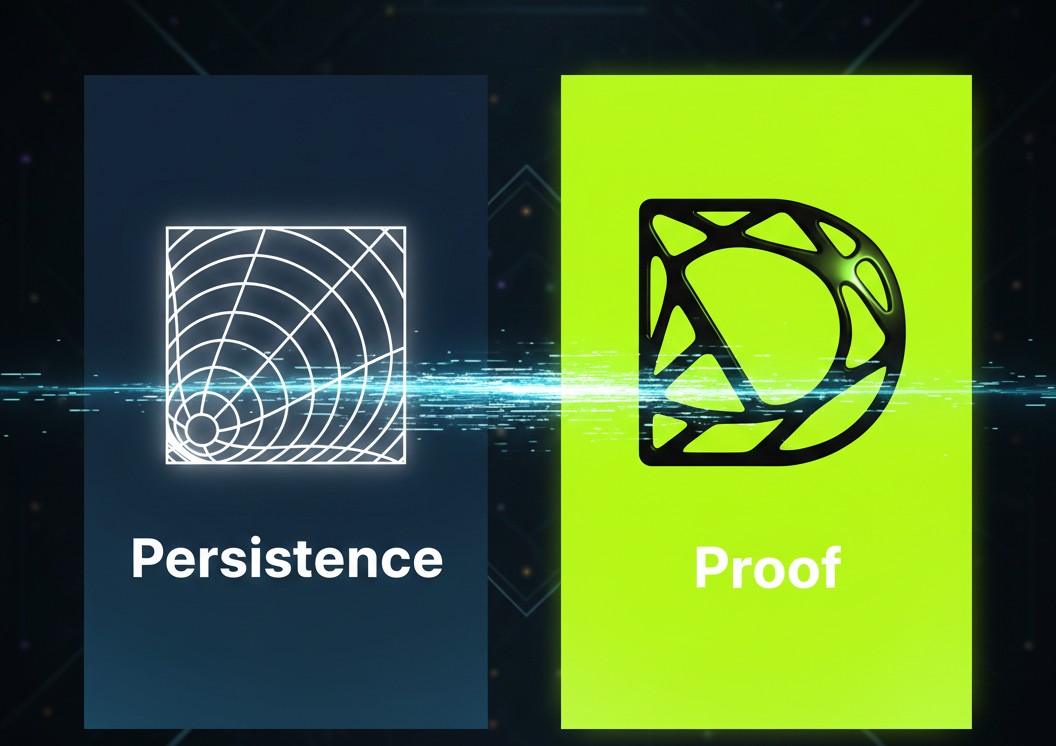
Persistence and Proof in Web3 Systems
Most Web3 conversations focus on speed, scale, or speculation.
Less attention is given to two harder problems:
• Can information last?
• Can intelligence be trusted?
PermacastApp and DGrid AI approach these questions from different layers of the stack, yet they converge on the same outcome: reliability over time.
Permacastapp :Permanent media infrastructure built on Arweave’s permaweb.
Not cloud storage.
Not subscription hosting.
Not revocable.
What this means in practice:
— Media is stored with a one-time payment model designed for indefinite availability
— Audio, video, and metadata remain accessible without platform dependence
— Creators retain ownership rather than granting custodial control to intermediaries
PermacastApp began with decentralized podcasting, but its implications extend to:
archival publishing
historical records
long-term cultural memory
Once published, the content becomes part of the permaweb_DAO resistant to deletion, link rot, or silent modification.
DGrid_AI :Decentralized AI inference infrastructure.
Instead of routing AI requests through centralized providers, DGrid AI distributes computation across a network of independent nodes.
Core elements:
— Inference execution across decentralized operators
— Output validation via Proof of Quality
— An open marketplace for AI models and agents
The result is AI that can be audited, not merely trusted.
Developers gain transparency.
Users gain accountability.
AI becomes infrastructure rather than a black box.
Where They Intersect
Different layers.
Shared philosophy.
PermacastApp focuses on data permanence.
DGrid AI focuses on computational integrity.
Together, they enable systems where:
• archived media remains accessible years later
• datasets can be processed without centralized control
• AI outputs can be verified against long-lived data
This isn’t about novelty.
It’s about durability.
TL;DR
PERMACASTAPP ensures media is stored permanently on Arweave, preserving ownership and accessibility over time.
DGRID AI provides decentralized, verifiable AI inference through distributed nodes and Proof of Quality.
Together, they represent a Web3 shift toward persistent data and trustworthy intelligence, systems designed to last, not just launch.
Decentralized AI will not succeed because it is novel, open, or ideologically appealingal. The collaboration between Inference Labs, Dgrid, and OG Labs reflects a growing recognition of this reality and a shift toward building AI systems that can stand on their own merits.