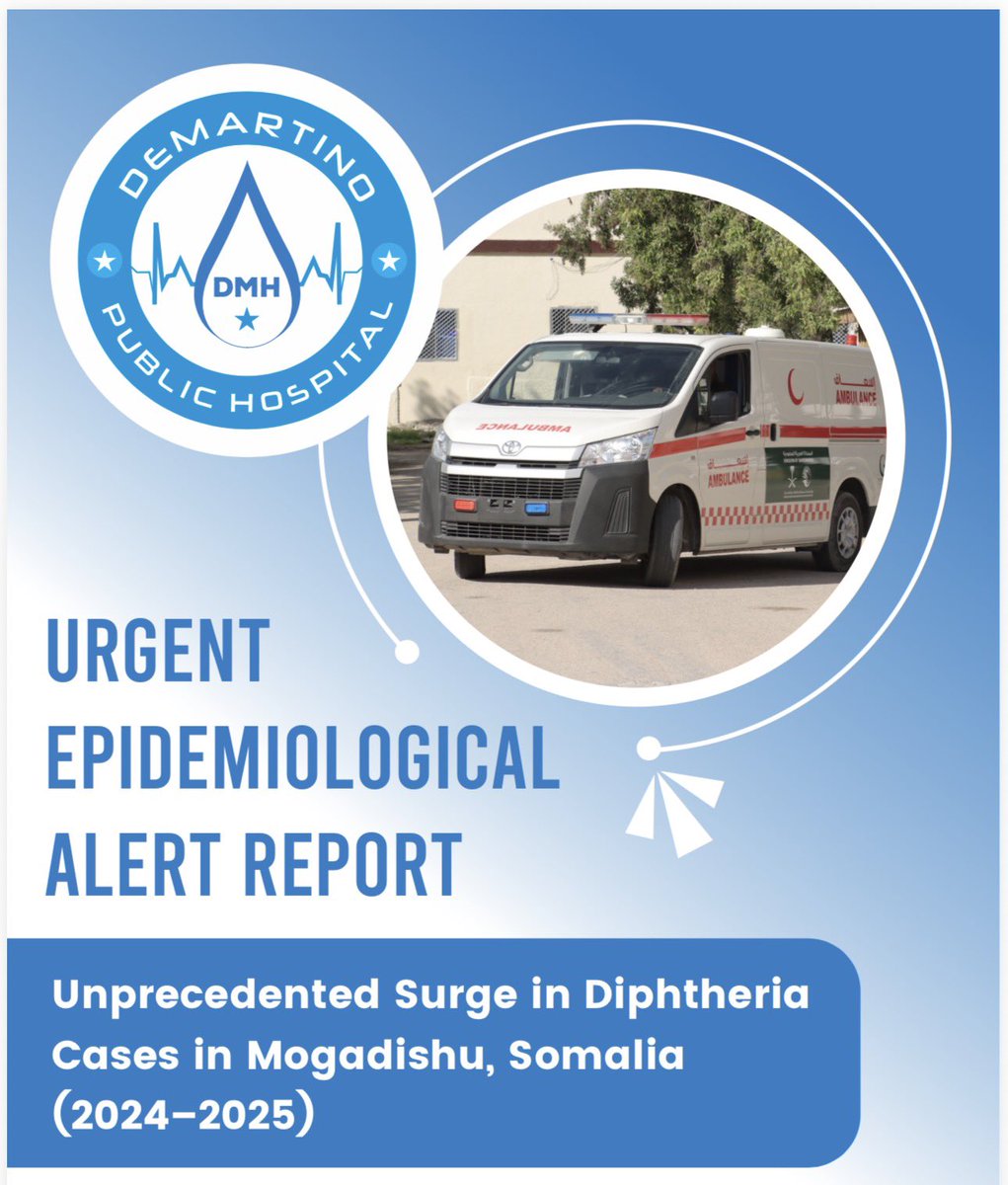
The 2024 Annual Performance Report of Demartino Public Hospital provides an in-depth review of our accomplishments, challenges, and ongoing contributions to Somalia’s healthcare landscape. As the Director General of this historic institution, I am honored to share our journey toward excellence in health service delivery. This report not only highlights our achievements but also underscores our commitment to continuous improvement, innovation, and service to the Somali people.
Demartino Public Hospital: A Legacy of Service
Founded in 1922 by Italian colonialists, Demartino Public Hospital has evolved into the largest and most comprehensive healthcare facility in Somalia. Originally named after Italian Governor Demartino, the hospital has transformed from a colonial institution into a cornerstone of Somalia’s public healthcare system. Following extensive damage during the civil war, its reopening in December 2016 under President Hassan Sheikh Mohamud marked a historic milestone in national healthcare restoration .
Vision and Mission
Demartino Hospital is committed to revolutionizing healthcare delivery in Somalia by providing compassionate, patient-centered services. Our vision encompasses not only curative care but also preventive, diagnostic, and rehabilitative services, leveraging cutting-edge technology and fostering collaboration within the healthcare community. This commitment ensures that every Somali, regardless of socio-economic status, has access to quality healthcare .
Key Milestones and Achievements
Over the past year, the hospital has continued to expand its services, manage public health emergencies, and strengthen its position as a teaching hospital. These achievements reflect the unwavering dedication of our 380-strong team of healthcare professionals who uphold the highest standards of care and innovation. The hospital’s integration of modern technologies and strategic partnerships has significantly enhanced service delivery, ensuring improved outcomes for patients across the country .
Strategic Focus for 2024
As we advance into the new year, our strategic priorities include enhancing infrastructure, expanding capacity, and deepening collaborations with local and international partners. We aim to address systemic challenges such as resource shortages and operational inefficiencies while maintaining our focus on patient-centered care and community engagement.
This report is a testament to the resilience and dedication of the Demartino family, from our staff and partners to the patients we serve. Together, we are shaping a brighter future for healthcare in Somalia, one that ensures dignity, equity, and excellence for all.
Please read the full report here
https://t.co/4lVyDU5rZ8
New publication: Patterns and Determinants of Opioid and Narcotic Use Among Youth in Mogadishu, Somalia: A Mixed-Methods Study published @tandfonline
Our study sheds light on a pressing public health concern that affects vulnerable youth.
Find it at: https://t.co/pH2R2t2hxU
Dr. Ali Hajji Adam, Minister of Health of the Federal Republic of Somalia, spoke at “Navigating Disruptions to Global Health Financing” at #DohaForum25.
In a fast-paced, isolating world, we must remember our humanity. We're not alone; we're part of a greater fabric. Acts of kindness and connection seeing others' remembering reaffirms we're meant to live together.
Find the full article 👇
https://t.co/f18BVxzKYg
المعلّم في الوجدان الصومالي. "هيبةُ رسالةٍ وضياءُ حياةٍ"
المعلم هو رائد المجتمع، وحامل همّ الحاضر وباني ملامح المستقبل. لا يكتفي بأن يلقّن العلوم، بل يهب تلاميذه أدوات التفكير الرشيد، ويغرس فيهم روح الاجتهاد،
المقال في https://t.co/unE7Uaqnfg
The article “Beyond Survival: A Somali Vision for Mental Health” authored by Dr. Abdulrazaq Yusuf Ahmed (Dr. Jalaaludiin) stands as a seminal work at the intersection of public health, social reform, and national healing. It presents a profoundly insightful exploration of Somalia’s mental health landscape tracing its historical neglect, cultural complexity, and the nascent momentum toward reform while articulating a compelling vision that redefines mental health as a pillar of nation-building rather than a peripheral concern.
Beyond Survival is a clear, compassionate and evidence-driven policy-practitioner essay by Dr. Abdulrazaq Yusuf Ahmed (Dr. Jalaaludiin) that reframes mental health in Somalia from an afterthought to a central pillar of nation-building. The piece synthesizes local data, WHO findings, and Somali lived experience to show that the mental-health crisis is not merely clinical but social, cultural, and developmental — with roughly one third of the population affected and service densities (e.g., ~0.5 psychiatric beds/100,000; extremely low psychiatrist and workforce ratios) that place Somalia among the most under-served contexts in the world.
The article moves deftly between three levels of argument. First, it documents the scale and human cost of untreated distress — delayed help-seeking, widespread reliance on traditional healers, and human-rights abuses such as chaining and confinement. Second, it interrogates cultural meanings and language (murugo, qalbi jab, waalli) to argue that effective care must be culturally attuned and rights-based rather than purely biomedical. Third, it offers pragmatic, evidence-based pathways: national mhGAP scale-up, task-sharing with trained frontline workers, QualityRights–guided institutional reform, community integration (Chain Free Initiative), and multisectoral strategies that embed mental health across education, justice and social protection.
Why this matters: the paper reframes mental health as an investment in Somalia’s human capital and stability rather than a discretionary health program. By tying mental-health reform to education, employment, and governance, the essay turns clinical statistics into a development narrative: a mentally healthier population multiplies returns across schooling, productivity and civic life. The author’s combination of data, field stories, and program examples creates a strong case for policymakers, donors, health planners and civil society to move beyond pilot projects and toward sustained, nationally-owned systems change.
My research is available on @ResearchGate: https://t.co/EOq9idAC30
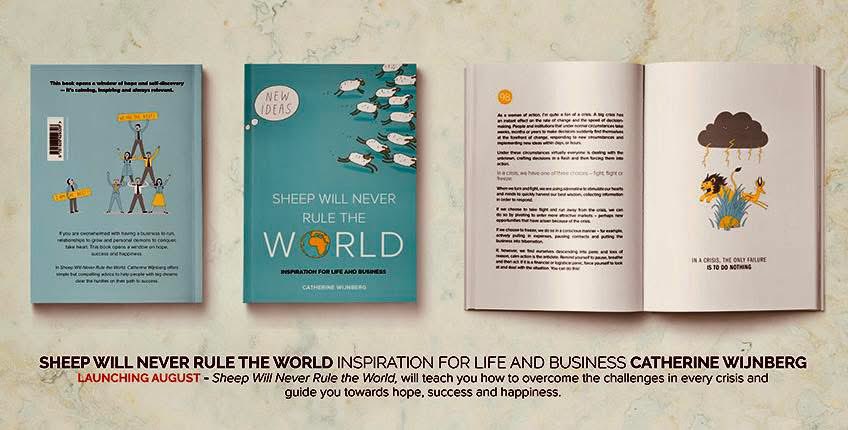
The Courage to Stand Alone ; Lessons from Sheep Will Never Rule the World
A personal reflection on Catherine Wijnberg’s compelling call to take real action
✍️: Dr. Abdulrazaq Yusuf Ahmed DrJalaaludiin Yusuf Ahmed
Leadership begins in solitude not the loneliness of isolation, but the quiet defiance of conviction. Sheep Will Never Rule the World reminds us that real progress rarely emerges from collective hesitation; it begins with individuals who dare to think differently, act decisively, and hold fast to purpose when conformity feels safer.
Catherine Wijnberg’s work is more than a book , it is a mirror that asks whether we are leading from courage or convenience, It echoes a timeless truth: leadership is not granted by position or title, but earned through integrity, authenticity, and the willingness to take the first step into uncertainty.
In my own leadership journey, from directing a national referral hospital through crisis to guiding policy and human resource reform at the Ministry of Health, I have learned that leadership is rarely a matter of comfort or consensus. Decisions that shape institutions and lives often demand solitude: the courage to stand by a conviction before others recognize its worth. During Somalia’s most challenging public health emergencies, from pandemic response to rebuilding fragile systems, progress depended less on perfect plans and more on imperfect action grounded in principle. Wijnberg’s argument resonates deeply: hesitation disguised as caution can paralyze change, while authenticity, even when contested, moves the system forward.
What separates genuine leadership from mere management is moral clarity. The temptation to conform, seek approval, or wait for “the right time” is ever-present, especially in bureaucratic systems where inertia masquerades as stability. Yet timing is not destiny conviction is. True leadership is measured not by popularity, but by persistence; not by applause, but by alignment with purpose. I have seen this truth in action in young professionals who challenge outdated norms, in health workers who innovate despite limited resources, and in communities that rebuild trust after decades of fragility.
Equally transformative is Wijnberg’s redefinition of wealth the insight that a leader’s greatest assets are not financial but relational and intellectual: credibility, empathy, and the courage to learn publicly, Where resources are scarce, these intangible forms of capital become the currency of transformation. They build the trust that sustains partnerships, the innovation that fuels systems, and the resilience that allows institutions to rise after each setback.
Perhaps most importantly, Wijnberg reframes failure not as defeat but as feedback. Every misstep in leadership , a misjudged strategy, a policy delayed, a project misunderstood , is an opportunity to learn, refine, and adapt. In my experience, the moments of greatest discomfort have often been crucibles of growth. Leadership is not a path of certainty, but of continuous self correction, guided by humility and hope.
As I reflect on Wijnberg’s message, I’m reminded that the most transformative leadership is not about commanding the crowd but empowering others to find their own voices. Standing alone, then, becomes an act of service , the first light that guides others through doubt and inertia. In decisions that demand courage, authenticity, and compassion, we act not because it is easy, but because it is right.
Sheep Will Never Rule the World is a clear summons: live truthfully, build purposefully, and move first when the world needs example more than applause.
“Rather than waiting for ideal circumstances, demonstrate leadership through courage, purpose, and integrity, and inspire others to follow your example”
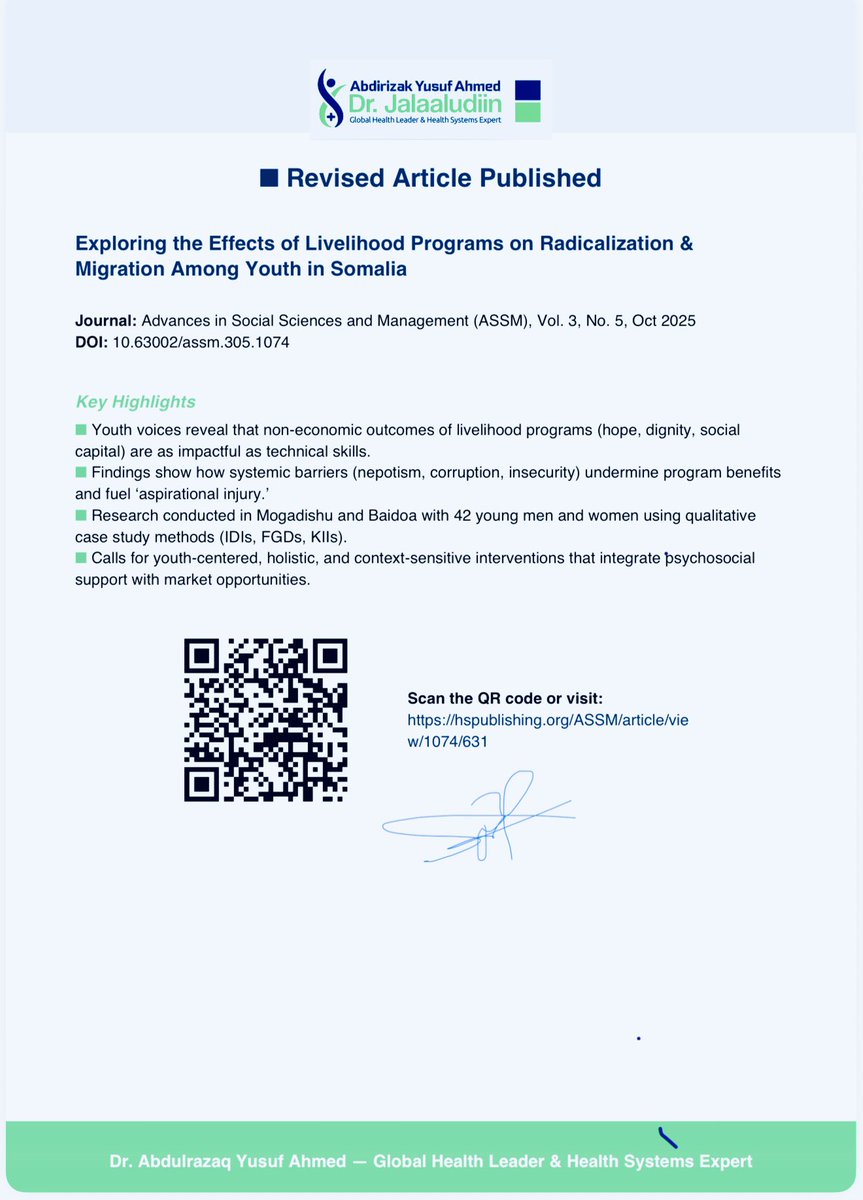
Hope, dignity & resilience matter as much as skills. Proud to share the revised version of my research on Somali youth, radicalization & migration in ASSM. Grateful for your feedback & encouragement!
🔗 https://t.co/9QyguR51J2
In a nation where fragile health systems struggle under the weight of immense challenges, true leadership emerges as more than a title it becomes a lifeline .
This is a journey of resilience, of innovation, and of human-centered governance. It is a story of determination and solidarity, where building awareness and strengthening the foundations of healthcare became the compass for survival.
The COVID-19 response is just one chapter. Beyond the pandemic, it reveals how visionary leadership can turn the darkest crises into new opportunities for hope and progress.
This film shines a light on powerful lessons in health leadership, crisis management, and system reform lessons that inspire. It carries with it the promise that, even in the most fragile contexts, communities can rise stronger, more resilient, and better prepared to withstand the storms of future epidemics.
We have an exceptional team of dedicated staff who make remarkable sacrifices. I am honored to lead a group of elite professionals who consistently achieve the impossible with their outstanding performance.
Although facing limited resources and minimal assistance, this Hospital @DemartinoPublic stands as the ultimate option for individuals requiring medical attention and a secure refuge for complex and severe medical conditions.
This can be attributed to the high standard of professional expertise, the unwavering commitment of its personnel, and a healthcare system centered around prioritizing the well-being of the public and providing optimal care for patients prior to addressing their illnesses.
I am committed to ensuring that our children receive the essential healthcare and protection they need. We strive to provide them with the best possible care and safety. May God grant us success in this endeavor.
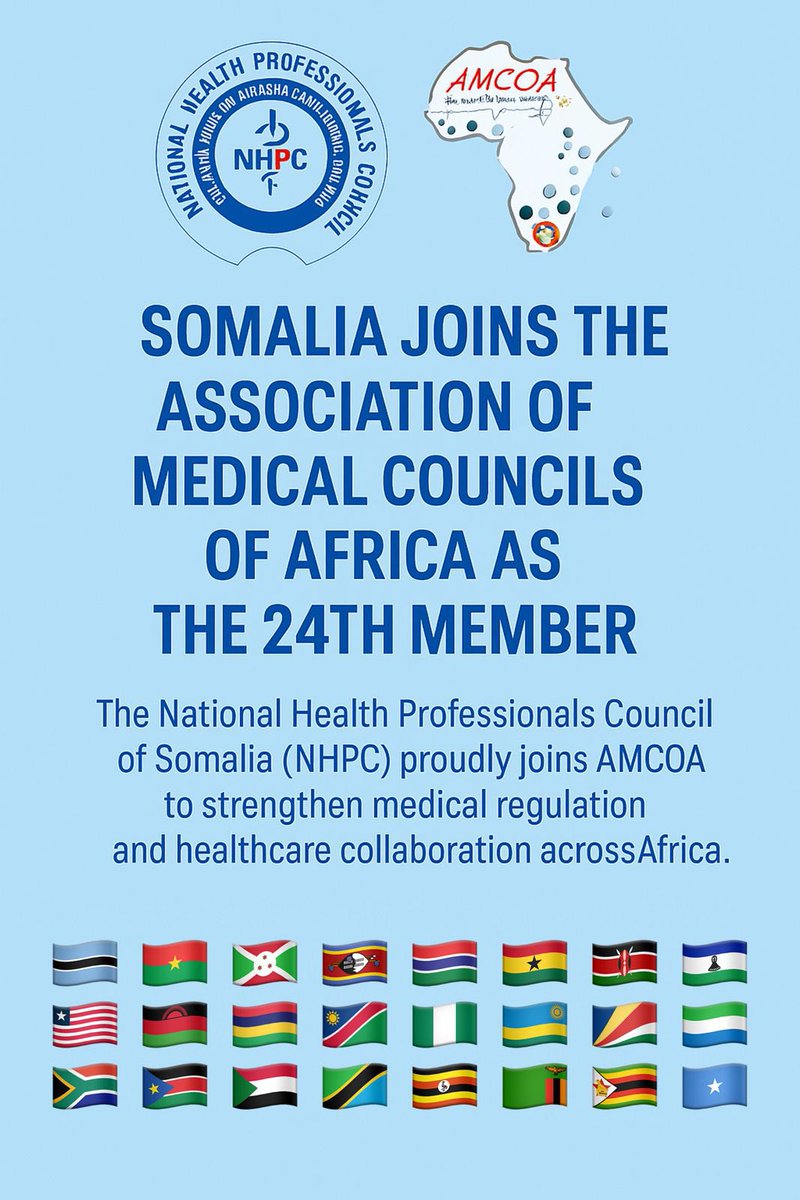
Very proud to officially join AMCOA — the Association of Medical Councils of Africa.
We remain committed to developing and improving health regulation and standards in Somalia through collaboration and regional partnership. 🇸🇴
#HealthRegulation#AfricaHealth.
Waxay ii tahay muunad iyo sharaf inaan halkaan idinkula wadaago WARBIXINTA QIIMAYNTA DARYEELKA ISBITAALKA BIXIYAY 2023-2024 iyo kharash ahaan waxa ku kici lahaa !
𝗕𝘂𝘂𝗴𝗴𝗮𝗻 𝘄𝘂𝘅𝘂𝘂 𝗸𝗮 𝘄𝗮𝗿 𝗯𝗶𝘅𝗶𝗻𝗮𝘆𝗮 𝗞𝗵𝗮𝗿𝗮𝘀𝗵𝗸𝗮 𝗶𝘆𝗼 𝗾𝗶𝗶𝗺𝗶𝗴𝗮 𝗺𝗮𝗮𝗹𝗶𝘆𝗮𝗱𝗲𝗲𝗱 𝗲𝗲 𝗱𝗮𝗿𝘆𝗲𝗲𝗹 𝗯𝗶𝘅𝗶𝗻𝘁𝗮 𝗖𝗮𝗮𝗳𝗶𝗺𝗮𝗮𝗱 ee isbitaalka Demartino ee sanadaha 2023-2024 , qiimeen dhaqaalaha ku kaca marka loo eego daryeelka iyo nooca adeeg ee la bixiyay
Dukumentigan waxa uu soo bandhigayaa falanqayn dhammaystiran oo ku saabsan kharashaadka howlgallada iyo isticmaalka adeegyada ee Isbitaalka Dadweynaha ee De Martino intii u dhaxaysay 2023–2024.
Ujeedka ugu wayn ee buugaan loo soo saaray ayaa in si cilmiyaysan loo soo saaro isku dheellitirka tirada adeegyada la qabtay, kadibna lagu saleeyo dhisida qaab-dhismeed dhaqaale oo adkeysi leh oo ka tarjumaya qiimaha guud ee Ku dhaqaale ahaan ku kacay iyo maaliyada la isticmaalay, iyo xisaabinta qiyaasaha qiimaha ee adeegyada ugu muhiimsan ee ka hirgalayay qaybaha kala duwan ee isbitaalka
Qaab-dhismeedka habraaca warbixintu waxa uu ku tiirsan yahay habab caalami ah oo la asteeyay, waxaa loo raacay wadiiqooyinka iyo tubaha cilmiyaysan ee xog kaydinta iyo war bixinada wax qabadka isbitaalka iyo document ga soo kala baxay 2023 -2024 iyo warbixinno la xaqiijiyey oo ku saabsan shaqaalaha, sahayda, iyo kharashaadka soo galay
"Bandhiga xaqiiqada ah ee warbixinta ayaa ka dgalatay in kaliya la tififitiray waliba si hufan ee xogta aasaasiga ah ee isbitaalka iyo kan wasaarafa caafimaadka taas oo la kaydiyo kadibna waxaa la raacay nidaamka qiimeenta hannaan kharashka adeegyada ku baxa ee isku-dhafan oo ay dajisay Hay'adda Caafimaadka Adduunka (WHO).
warbixintu waa mid cilmiyeeysan oo diirada saaray kharashka ku kaca adeegyada caafimaad iyo dadaalka uu bixiyay isbitaalka demartino oo u baajiyay dadwaynaha , dowlada iyo bulshada dhaqaalo badan oo lagu qabtay si mutadawacnimo ah
Waxaan u mahadcelinayaaa , Maamulka isbitaalka demartino gaar ahaan waaxda maamulka iyo saanada , khubarada iyo aqoonyahanka dhaqaale , la taliyayaasha iyo tififitatayaasha buugaan oo isugu jiray Khubaro soomaliyeed iyo asxaab caalami ah
Ka la dag buugga link gaab hoose
https://t.co/7UCGffL9gg
It is with great pleasure that I announce the publication of my recent article, "Building Resilient One Health Systems: Lessons from the COVID-19 Pandemic and Implications for Somalia," in the Science Journal of Public Health.
This study offers a comprehensive analysis of the critical lessons learned from the COVID-19 pandemic and their direct implications for strengthening healthcare in Somalia.
The main themes of the article revolve around:
The One Health Approach: The paper strongly advocates for the adoption of a "One Health" framework, which recognizes the deep interconnection between human, animal, and environmental health. This integrated approach is presented as essential for preventing, detecting, and effectively responding to future health crises, many of which originate at the human-animal interface.
Lessons from COVID-19: It synthesizes key takeaways from the pandemic's impact on health leadership, finance, and livelihoods globally and in Somalia. The study highlights how the pandemic exposed significant vulnerabilities in global health equity and the specific, compounded challenges faced by fragile, conflict-affected nations like ours.
Somalia-Specific Analysis: The article provides a detailed situation analysis of the COVID-19 experience in Somalia, noting the profound challenges posed by a healthcare system weakened by decades of conflict, political fragmentation, and pre-existing humanitarian crises. However, it also identifies strategic opportunities that emerged, such as renewed engagement with international financial institutions and the potential for greater national cooperation in aid distribution.
Post-Pandemic Improvements and Future Resilience: The study documents tangible improvements made to Somalia’s health system in the wake of the pandemic, including strengthening disease surveillance through the establishment of the National Institute of Health (NIH), upgrading healthcare infrastructure like ICUs and oxygen plants at major hospitals, and investing in the healthcare workforce.
Impact on Somalia's Healthcare System:
The findings and recommendations of this study are intended to have a direct and lasting impact on Somalia's healthcare system. By embracing the One Health model, we can move from a reactive to a proactive stance on public health.
The key impacts include:
Enhanced Disease Surveillance: The paper calls for investing in integrated surveillance systems that monitor health threats across human and animal populations, enabling earlier detection and response to potential outbreaks like Rift Valley Fever or other zoonotic diseases relevant to Somalia.
Strengthened Infrastructure and Capacity: The study underscores the critical need for continued investment in our foundational healthcare infrastructure—from well-equipped hospitals in Mogadishu to primary care in rural areas—and in our invaluable healthcare professionals. This is the backbone of any resilient system.
Improved Collaboration and Governance: It provides a roadmap for establishing formal platforms for inter-sectoral collaboration between health, agriculture, and environmental sectors, breaking down silos to foster joint planning and response.
Greater Community Engagement: A central theme is the importance of building trust and empowering communities through transparent communication and meaningful engagement in health decision-making.
This is vital for the success and sustainability of any public health initiative in our unique context.
This paper concludes with prioritized, actionable recommendations tailored for Somalia.
My hope is that this research will serve as a valuable resource for policymakers, healthcare professionals, international partners, and all stakeholders committed to building a more resilient, equitable, and secure health future for our nation. I invite you all to read the full article and join the dialogue on this crucial endeavor.
Please read the full article here
https://t.co/3TrmrPCfZ0
Bahdaaya Qooyska Aan ku abtirsado Ehelkaan wax ku ahaayoow Tolkayga dhabta ahoow, Guulaysta oo Dhabar adaygiinaa ku taaganahayee ha iga liicina 🙏 @DemartinoPublic
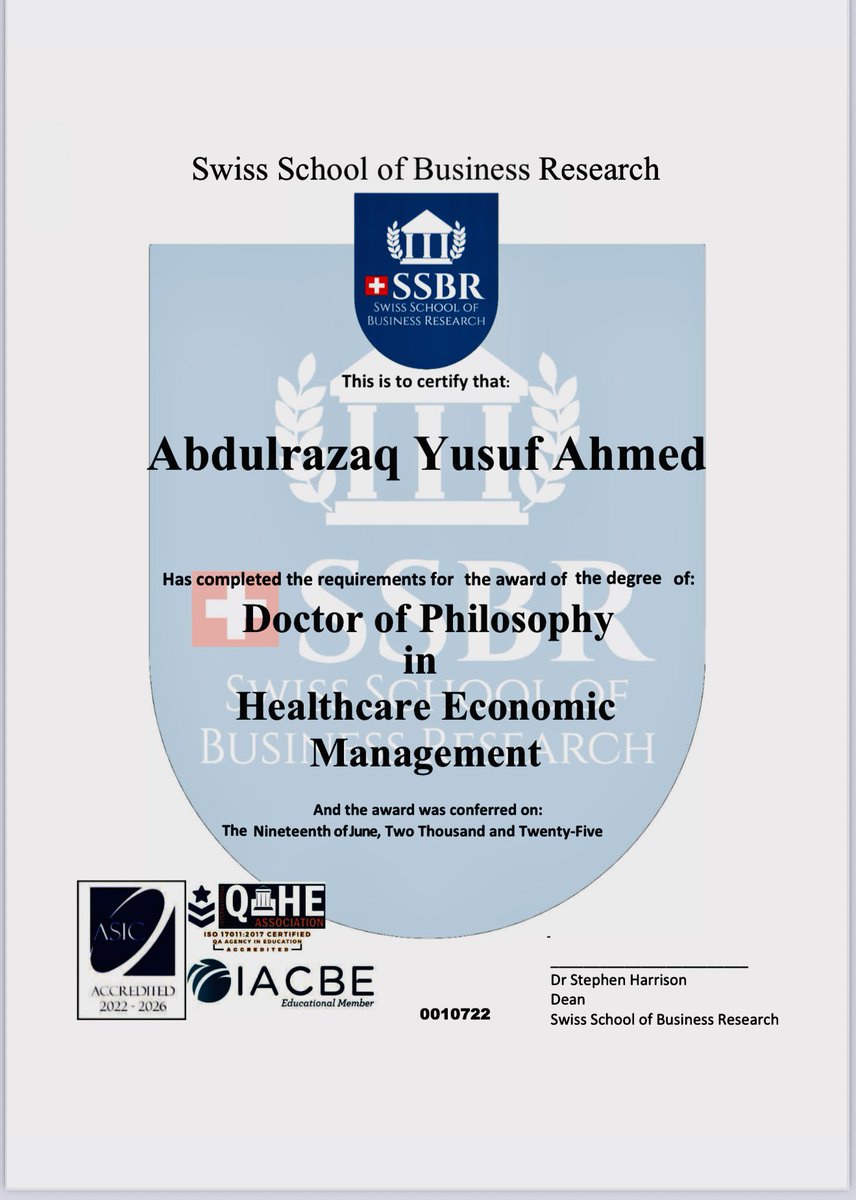
A momentous journey has reached a remarkable summit! I am pleased to announce to the SSBR LinkedIn Group that I have successfully fulfilled the requirements for the award of the degree of Doctor of Philosophy in Healthcare Management from the Swiss School of Business Research (SSBR).
This distinguished opportunity provided by SSBR has been profoundly transformative for my professional trajectory and accomplishments. Through the rigorous PhD program, I have acquired invaluable advanced skills, comprehensive knowledge, and practical experience, particularly within the critical domain of healthcare economics management.
My doctoral research, culminating in the capstone project titled "Disruptive Innovation in Healthcare Delivery: A Proposal for Demartino Public Hospital," enabled me to conduct in-depth analysis and propose tangible solutions for contemporary healthcare challenges.
I extend my sincere appreciation for the exceptional academic rigor and steadfast support provided by SSBR. The successful completion of modules such as Leadership/Strategic Management and Problem Solving/Decision Making, alongside the comprehensive Capstone Project, has equipped me with a robust understanding of disruptive innovation and strategic
leadership within the healthcare sector.
I am especially grateful for the insightful guidance and unwavering support provided by my supervisor, instructors, and professors throughout this demanding academic endeavor. Their expertise and dedication were instrumental in my success. My profound gratitude is extended to:
Dr. Stephen Harrison, Chairman & Dean, whose visionary leadership and extensive academic and professional background provided invaluable mentorship.
Professor Helgard Terblanche, for his profound legal and business acumen, which significantly enriched my understanding of complex organizational and economic principles.
Dr. Steve Mallon, Director of Research, for his fervent commitment to fostering educational excellence and his belief in the transformative power of academic inquiry.
Thank you, SSBR, for empowering me to achieve this significant academic milestone and for substantially contributing to my professional development. I am eager to leverage this advanced knowledge to further contribute to the evolution and enhancement of healthcare systems.
🐦 Twitter/X (≤280 characters)
New in @EJPrevMed: Examining how patient engagement, care quality & healthcare worker conviction shape protocol implementation in Somali public hospitals. Insights on #mHealth, #Telemedicine & community networks → https://t.co/DR3yEgEMkq
#GlobalHealth #Somalia
https://t.co/vvFBCT7Fm4
Reviving De Martino Public Hospital: A Roadmap to Sustainable, High-Quality Care in Times of Crisis
“Sustaining Essential Healthcare in the Face of Compounding Crises”
After five years of steadfast leadership at De Martino Public Hospital—a national institution entrusted to me during a time of significant uncertainty—I find myself reflecting not only on the journey of this hospital, but on the resilience of a vision tested by adversity and refined through necessity.
When I assumed leadership, De Martino operated with just 20 beds, constrained by limited infrastructure, skeletal staff, and financial fragility. Today, through deliberate expansion and collective sacrifice, we have grown into a 300-bed facility, nationally recognized as the primary referral and emergency response hospital in Somalia. This transformation, however, did not occur in ideal conditions—it emerged through a crucible of persistent hardship, interrupted funding, a workforce often without contracts or formal protections, and the painful proximity of project failure.
Today, De Martino stands as a cornerstone of the Somali healthcare system. It has transcended its role as a mere hospital to become a national sanctuary. It is the nation's primary tertiary referral center for the most complex medical cases, a refuge for the vulnerable, and the sole public-sector pandemic response center, which managed over 32,000 COVID-19 cases during the recent global health crisis. It is here that we provide critical care for the national army, treat the devastating injuries of war and conflict, and fulfill our national obligation to respond to the gravest health emergencies.
This unfunded mandate has placed an extraordinary strain on our resources, creating a persistent disconnect between our critical responsibilities and the financial support allocated to us.
This volume chronicles the rich history of De Martino Public Hospital—Somalia’s oldest and largest public medical center—and the unforgettable partnership with the Ministry of Health that has enabled its transformation into a true national referral hub. Here you will read how our hospital has stood as a sanctuary for the gravely ill, a frontline responder to every infectious outbreak, and a lifesaving resource for our national army and civilians wounded by conflict. Beyond clinical care, we have hosted ministry programs, trained future generations of nurses and clinical officers, and upheld our solemn obligation to deliver equitable, high-quality services to every Somali citizen.
Within these pages, you will find not only an honest appraisal of the crises we have faced—but also practical recommendations drawn from hard-won experience. My hope is that this book serves as both a blueprint for sustainable hospital management in fragile settings and a lasting legacy for those who follow. May our story inspire others to confront challenges with courage, to innovate under pressure, and to recommit to the enduring mission of safeguarding health, even in the most trying times.
Read the full article on the below LinkedIn link
https://t.co/wWLMPqRpEm