✨ Building with care and from stories ✨ data self-sovereignty, data equity, data models, inclusive experience design @LWYLStudio 💕 Creating @BelleArtStudios 💕
Happy to share! I’m attending the 5th annual @Ethereum_Women in #Toronto in July - a global gathering of women leading and building a better Internet (world).
Looking forward to hanging out and sharing all things #inclusiveusability#onboarding#consentmodels #dataselfsovereignty
#credentialing 💕
Let me know if you will be attending. Love to connect and conspire 💕
Do you know most DAO governance models DON’T protect the interests of members, contributors, and builders across Web3?
Myself, and leading organizational science researchers are working on a series of case studies about DAO governance and when DAO’s do and don’t work for their members, and how we can build better governance to truly protect DAO member interests and equity from bad actors.
The stories are scary real with people across the #Web3 ecosystem deeply impacted.
If you have a story to share? A DAO that really wasn’t? Members or builders who got left out when the treasury was paid out? A DAO that disappeared?
Get in touch! My DM’s are open and the research team are busy collecting stories.
#DAOGovernance #DAOFraud #Web3 #CaseStudies #Research #TheDAOThatDidnt
#TheDAOThatWasnt
#HowNotToDAO
We all share the responsibility for questioning concentrated power, harmful behavior, exclusionary systems, and decisions being made without community voice.
A truly decentralized ecosystem is not built through silence.
It is built by people willing to speak, listen, challenge, and protect the integrity of the space together.
If we see something, we should say something.
Because truly decentralized systems require participation, accountability, and courage from all of us.
8/💕
Honesty in tech is not just about whether the code works.
It is about whether we are willing to tell the truth about harm, exclusion, failure, power, incentives, and who benefits.
Too often in crypto, AI and emerging tech, optimism is rewarded more than honesty.
1/💕
Honesty. Integrity. Accountability. Care.
✨ These are not barriers to innovation.
💕 They are what make innovation worthy of trust.
If an ecosystem and it's founding leadership cannot tolerate truth, it is not decentralized.
It is simply another concentration of power wearing a different aesthetic.
7/💕
Jess you are inspiring to so many builders, CEO’s and founders, especially the women identifying ones.
Keep going, and know for every negative or misogynistic comment, we who love and admire you would share 10 to counteract it.
Reach out anytime for some love and support. We got you!
💕✨💕
Women in crypto has always been a thing! 🩷 Because we women make it so!
Hat tip to the amazing OG’s who led the charge for years with @metagammadelta and @AWICglobal laying a beautiful foundation for @shefiorg to build!
And before them the OGs of women in tech — @MsTechGroup@WTFounders@AnitaB_org@AdaLovelaceInst
We all stand on the shoulders of giants!
#Love #Peace #BeMoreUnicorn
🩷🦄🩷
Love this! 🩷 Congrats and deep respect for the decade of work you’ve both put into supporting public goods. Truly. 🙏 And using the funds to advance security. Thanks @griffgreen 🩷
So. As two OGs in this space who have helped steward millions in funding toward “public goods,” I have a sincere and curious question.
How do you both define/determine that a grantee is a “public good?”
I’m seeing the term used more and more in crypto-for-social-good and EdTech spaces. Many of these projects are absolutely doing good things, yet “doing good” isn’t always the same as being a public good in the economic sense (non-rivalrous and non-excludable). Some may function more like community/club goods, coalition goods, or mission-driven products with positive externalities.
Given that significant grant funding can follow the public-goods label, clarity really matters, economically and from a governance perspective.
How do @Gitcoin and @Giveth determine what qualifies as a true public good when allocating funds? Or for projects working on security around public goods?
#SuperCurious and would genuinely love to understand your frameworks for some #edtech work my team is navigating.
Doing good is awesome, yet is not always a public good!
I’m always mindful when we use the term “public good” especially in the context of technological solutions and/or data systems.
In economics, a public good has a very specific meaning:
💗 Non-rivalrous - my use doesn’t reduce your access.
💗 Non-excludable – no one can be locked out.
Clean air is a public good. Open internet protocols are public goods.
[1]
So lets be mindful not to mislead, folx.
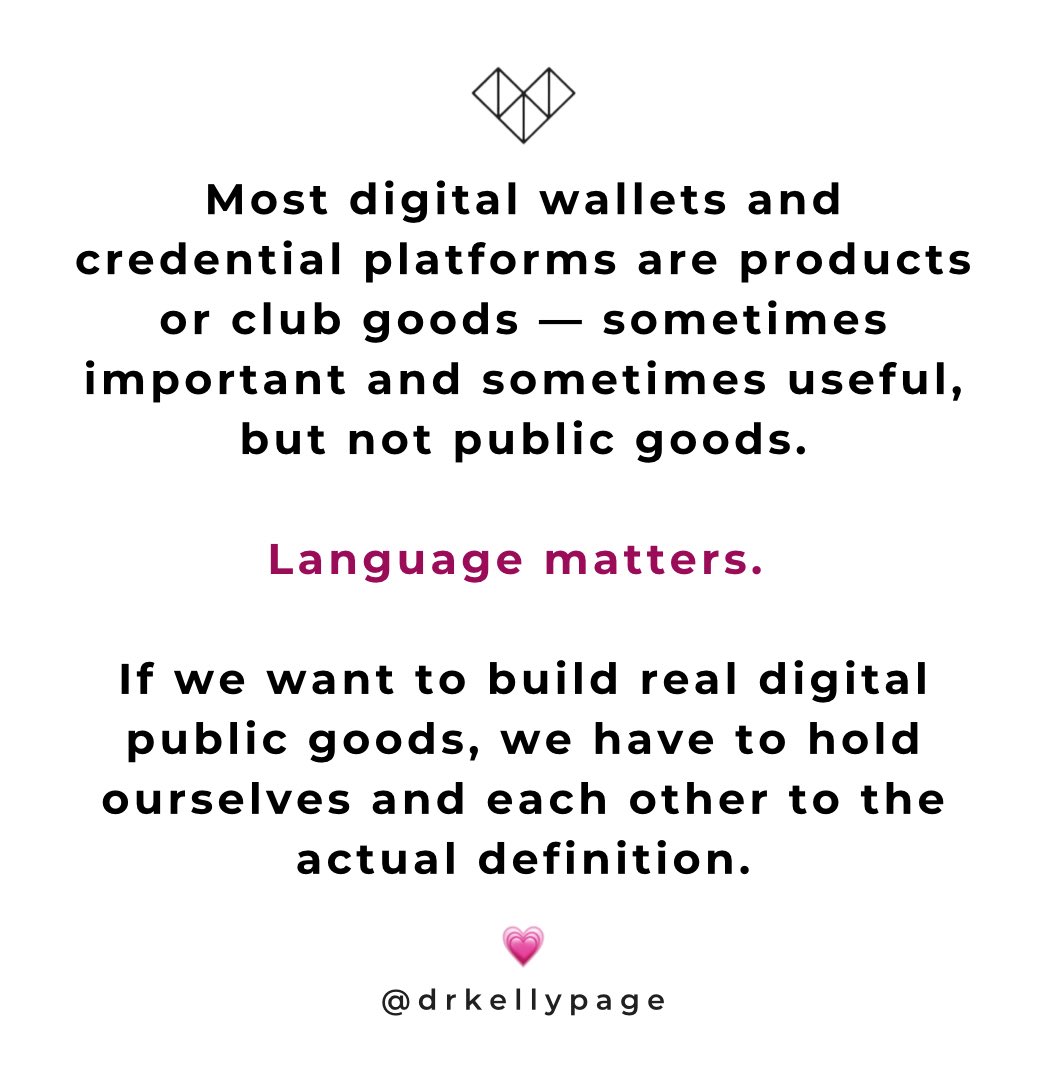
Most digital wallets, credential or grant platforms, and the data coalitions who power them are “products” or “club goods” — sometimes useful, helpful and sometimes important — but they are not public goods.
😎 Rule of thumb: If you need to pay, sign a contract such as terms and conditions, or get permission — it’s not a public good.
Language matters.
Clarity matters.
And if we want to build real digital public goods, we have to hold ourselves, and each other, to the definition in order to truly serve, be accessible, and be free for ALL people, so most importantly — we do not cause harm.
#PublicGoods #DigitalPublicGoods #Credentials #DigitalCredentials #DigitalWallet #DigitalPassport #EdTech #FutureOfWork #FutureOfLearning #Open #Accessible #Permissionless #Free
I’m always mindful when we use the term “public good” especially in the context of technological solutions and/or data systems.
In economics, a public good has a very specific meaning:
💗 Non-rivalrous - my use doesn’t reduce your access.
💗 Non-excludable – no one can be locked out.
Clean air is a public good. Open internet protocols are public goods.
[1]
To be a true digital public good, a wallet or platform would need:
✅ Open-source infrastructure – anyone can use, adapt, build on or extend it. An example: Linux powers the internet and anyone can build on it.
✅Universal access – no exclusion based on ability to pay. An example: Wikipedia is free for all, no paywalls.
✅Interoperability – works across systems, not just one silo. An example: Email protocols (SMTP/IMAP) let messages move freely between providers.
✅Democratic governance – people using it + communities shape the rules. An example: Internet governance bodies (like W3C) are multi-stakeholder, not controlled by one vendor or project.
✅ Sustainability without rent-seeking – no dependency on gatekeeping for revenue. An Example: Public libraries funded by taxes serve everyone without charging at the door.
[4]





![drkellypage's tweet photo. I’m always mindful when we use the term “public good” especially in the context of technological solutions and/or data systems.
In economics, a public good has a very specific meaning:
💗 Non-rivalrous - my use doesn’t reduce your access.
💗 Non-excludable – no one can be locked out.
Clean air is a public good. Open internet protocols are public goods.
[1]](https://pbs.twimg.com/media/G1iTaUVakAA60V_.jpg)