Global South. An Invention of the North? Edited by my friend and colleague @stefanomanservi
My contribution to this edition focus on Africa's Action in a Global Interregnum, explores Africa's agency and strategic positioning at a time of profound global transition.
Highly recommended reading for anyone following the shifting dynamics of global governance and North-South relations.
📖 The English edition is now available!
#GlobalSouth #Africa #CeSPI #GlobalGovernance #InternationalRelations #AfricanAgency #NorthSouthRelations
https://t.co/7r2PqvMNwp
News: Rights groups urge #UN Human Rights Council special session as #Ethiopia fighting raises atrocity fears
A coalition of human rights organizations has called on the United Nations Human Rights Council (HRC) to convene a special session on Ethiopia, warning that renewed large-scale hostilities could lead to a repeat of atrocities committed during the country’s 2020–2022 war.
“The significant escalation means that the 2022 Cessation of Hostilities Agreement has collapsed,” the organizations said, while warning of mounting risks to civilians.
They said Ethiopia’s transitional justice process has largely stalled, while the HRC’s decision to end the mandate of the International Commission of Human Rights Experts on Ethiopia (#ICHREE) removed an international mechanism that had been investigating violations and supporting accountability.
“The resulting impunity,” the organizations warned, creates “grave risks for civilians, including of new atrocities.”
https://t.co/EXCVUaGlQu
The fifth anniversary of the war on Tigray and the third anniversary of the Pretoria Agreement call not only for remembrance but also for renewed commitment to mobilize all peace-loving peoples to prevent any return to war and atrocities in Tigray and across the Greater Horn of Africa.
Yet, the implementation of the Pretoria Agreement is being overtaken by rapidly evolving events on the ground—most notably, the increasingly likely, if not inevitable, prospect of war between Ethiopia and Eritrea. Five indicators signal the escalating risk.
1. both states have initiated extensive military mobilization, including massive training and conscription.
2. significant arms procurement has taken place, including drones and air defense platforms.
3. sustained "war propaganda" aimed at societal mobilization.
4. “war diplomacy” has accelerated, with flurry of delegations and letters sent from both sides.
5. leaders on both sides appear to calculate that international intervention will be minimal and that military victory is assured.
Renewed fighting in Tigray, particularly as part of a looming Ethiopia–Eritrea war, would render the Pretoria Agreement obsolete.
Preventing war between Ethiopia and Eritrea must therefore begin with a revitalised implementation mechanism of the Pretoria agreement.
Whether the lessons of implementation failure are heeded will be measured not in the number of communiqués issued and their signatories, but in human lives—in the return, to status quo ante of constitutional boundaries, and of the displaced families to their homes, in the provision of justice to victims, in the reconstruction of shattered communities, and ultimately in whether one of Africa's oldest political communities can transition from the trauma of war to the promise of sustainable peace.
Ethiopia: The U.S. Embassy in Addis Ababa is aware of reports of possible long-range attacks directed at Ethiopian military installations on several instances in October of this year. U.S. citizens should accordingly exercise caution and follow the advice of local authorities. U.S. citizens are advised not to travel to the Amhara Region (including Lalibela), the Tigray Region, or the Afar Region for any reason. U.S. citizens in those areas are advised to leave if it is safe to do so or shelter in place until conditions improve, monitor local media for updates, and stay in touch with their airline for notifications on operations. More at: https://t.co/OHZTnYmUWb
Abiy and Isaias have found ways to fight it out in Tigray through Tigrayan bodies. The real culprits are the Tigrayan leaders, who had all the time in the world to prevent Tigray from becoming a battleground, but chose power over people, and survival over the welfare of millions.
When the prize was awarded, Ethiopia and Eritrea were, in the words of the Committee, at a "no peace, no war" stalemate. Now, they are inching toward full-blown war.
"The profound irony, however, is that even now, Ethiopia and Eritrea are neither at peace with each other nor within themselves—certainly not enough to merit talk of a breakthrough. For a brief time, their mutual borders remained closed, and tensions in the border areas led to the militarization of the Ethiopian regional state bordering Eritrea."
Having failed to prevent despite every warning, can the international and Pan-African community at least de-escalate, protect civilians, and deliver aid?
The sad prospect of a direct military confrontation between Ethiopia and Eritrea grows more likely by the day.
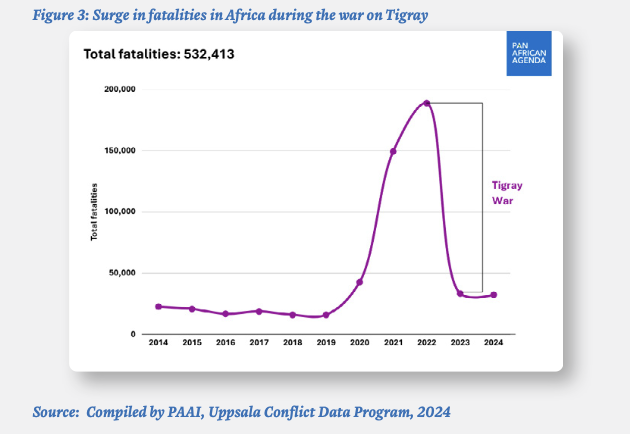
The consequences would be devastating for communities that have already borne the highest human and economic costs of any conflict in a generation: record fatalities, mass displacement, and sweeping economic destruction, all thoroughly documented.
The Horn of Africa, and the world, cannot afford another war in the region. The window for prevention is fast narrowing. The cost of inaction could end up measured in hundreds of thousands of lives.
If the Pretoria Agreement teaches us any lesson as a contrasting message of hope, a rarity thesedays, it is that diplomacy, when applied with determination, can still produce a sharp decline in direct fatalities from fighting. The 2022 agreement demonstrates precisely that: mediation, when conducted with resolve and backed by states with leverage, can halt even the most devastating conflicts.
The Pretoria Agreement thus stands as a significant humanitarian accomplishment, preventing further catastrophic loss of life and proving the value of diplomatic engagement in resolving complex internationalised wars.
Yet despite being an internationalised conflict that unfolded in a country hosting the AU headquarters, the war was deliberately ignored - as is now in the mounting mobilization for war by both states, no impactful intervention was made by these very institutions or their leadership.
The AU's just-concluded summit repeated this failure: a missed opportunity for preventive diplomacy between the host state and Eritrea, having failed to meaningfully deliberate or deploy whatever remains of its leverage on an impending war that could still be prevented in collaboration with those holding the necessary levers, the United States, the EU, and others.
Today, only US President Trump appears to hold the leverage to compel de-escalation. Simply because the confrontation between Ethiopia and Eritrea is deeply embedded in the geopolitical competition of the principal Middle Eastern powers: leaders facing few constraints on their highly personalised state power and economy, driven by struggles for regional supremacy.
Their proxy wars and the multiple actors they sustain in the Horn intersect with the rivalries of African leaders contesting 'water security', 'sovereign access to the sea', 'territorial sovereignty', 'independence', and the 'Abraham Accords', collectively steering the region toward catastrophe.
In this context, the protection of civilians remains the overriding priority.
@Amnesty continues to receive reports that civilian infrastructure, including several schools, has been damaged or targeted during aerial attacks in Tigray, Ethiopia.
The African Union Peace and Security Council cannot wait for mass atrocities to unfold or for a surge in civilian casualties before placing Ethiopia on the agenda.
They must urgently convene an emergency session on Ethiopia!
https://t.co/Y3OeTYONXu
'The sound keeps coming back': children maimed in #Ethiopia's #Tigray clashes
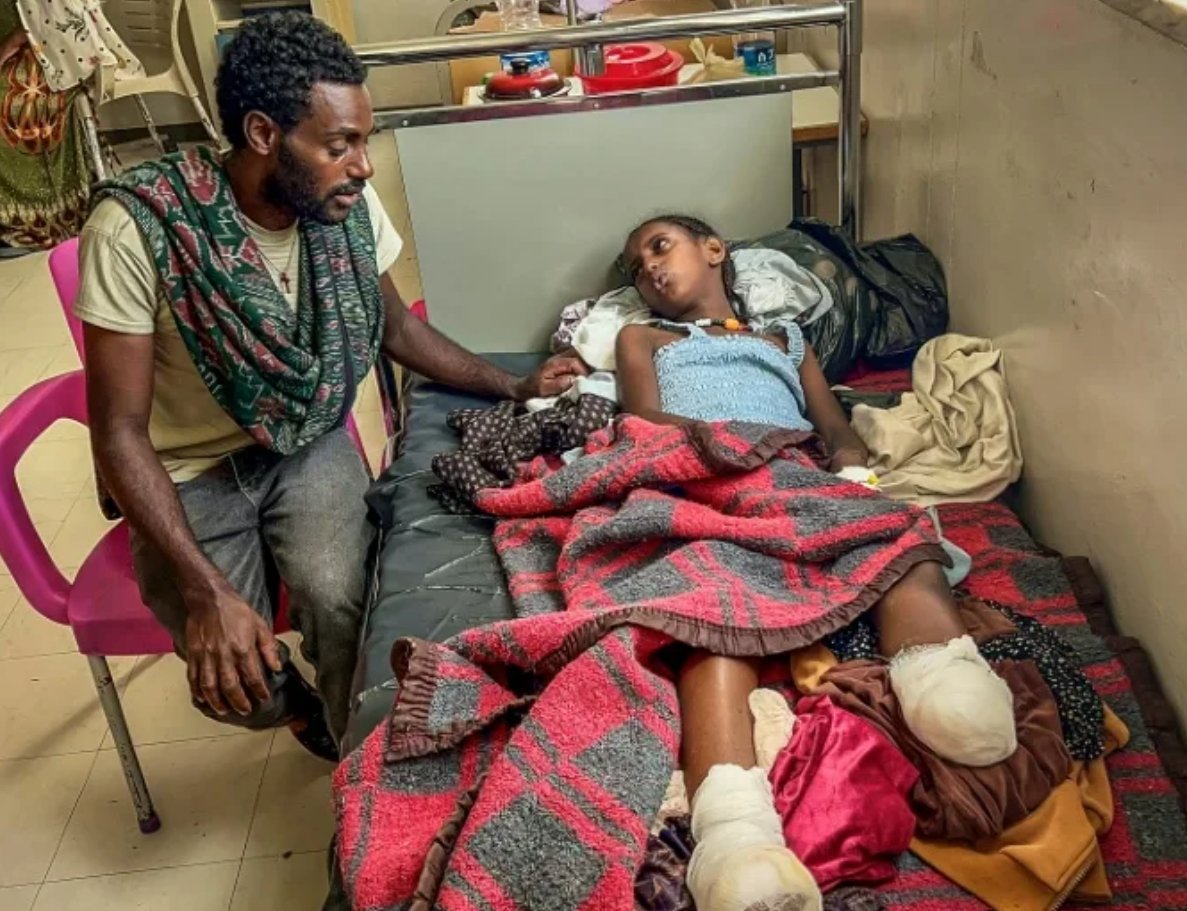
Lying on a hospital bed, rolled-up blankets propping up the remains of her legs, 10-year-old double-amputee Iyerusalem is among scores of civilians wounded in northern Ethiopia after fighting erupted last month.
***
"I was in our compound with my older brother and our horse when we were hit. My brother and the horse died," she told AFP from Ayder Comprehensive Specialized Hospital in #Mekelle, capital of the northern Tigray state.
Many of the wounded live in remote villages hours from the hospital along difficult roads where there has been fighting and shelling.
"Right now, my amputated legs hurt badly," said Iyerusalem, who comes from Qarsole village in Alamata district, south of Mekelle.
"If I get medical treatment and can walk again, I want to go back to school," she said, as her father Hiluf watched anxiously.
https://t.co/7FT93OYs3O
According to residents who spoke to BBC Tigrinya, four rounds of strikes late Sunday night targeted the Segen Hotel and its surroundings, killing 11 people.
#Ethiopia#Tigray#Adwa
https://t.co/oW0mQ2pbOK
Airstrikes and artillery hit north Ethiopia as government and rebels clash, sources say
Air attacks killed at least 17 people northwest of Tigray's capital Mekelle - which federal government forces took over the weekend - according to a bulletin circulated among humanitarian groups.
https://t.co/3NYh8NGOvk
The continued escalation of violence in Ethiopia and heightened regional tensions are alarming.
This risks triggering a broader regional conflict, with severe consequences for peace and stability across the Horn of Africa.
The EU calls for immediate de-escalation on all fronts. External actors should refrain from interference.
Respect for international humanitarian law is imperative. Civilians need to be protected at all times, and unhindered humanitarian access must be ensured.
My statement on behalf of the EU ↓
https://t.co/dk6u2zPhtY
Flawed as it was, the Pretoria Agreement offers a lesson, and a rare note of hope in this era of praetorian rule; determined diplomacy can still sharply reduce death, displacement and destruction.
The 2022 agreement showed that impartial, resolute mediation, backed by states with leverage, can halt even the most devastating wars.
Any chance of de-escalation depends on levers being pulled in concert, yet such coordination is lacking globally just when it is most needed.
A coalition of African and Middle Eastern leaders willing and able to stake their diplomatic capital on ending the atrocious wars in the Horn of Africa, with support from the highest level of the United States government with the support of the UN, AU, EU and RECs, could muster the leverage needed to compel it.
This is because the recent military escalation in Ethiopia is deeply entwined with the long-running war mobilisation between Ethiopia and Eritrea.
The wars in Ethiopia, Eritrea, Sudan and Yemen are now ever more deeply embedded in a geopolitical competition marked by an acute security dilemma.
All parties and their external backers see these wars as existential for their leaderships and integral to their national security, and they are being played out among Middle Eastern powers, chiefly Saudi Arabia, Egypt, the UAE and Iran.
Insisting on former President Obasanjo as AU mediator, despite serious questions about his impartiality, dooms the process before it begins: no mediation can succeed when any of the warring parties distrusts the mediator.
Nor can the AU resolve these wars alone, given the involvement of powerful extra-continental actors.
“The Pretoria Agreement is a significant humanitarian accomplishment, preventing further catastrophic loss of life and proving the value of diplomatic engagement in resolving complex internationalized conflicts.
Yet, the resulting peace agreement remains fundamentally fragile, reversible, and vulnerable to collapse. The root causes of the conflict are unresolved, and the agreement has been abandoned by the signatories, the AU, and other international observers.”
Excerpt from Pan African Agenda's recently launched Pretoria Agreement Implementation report.
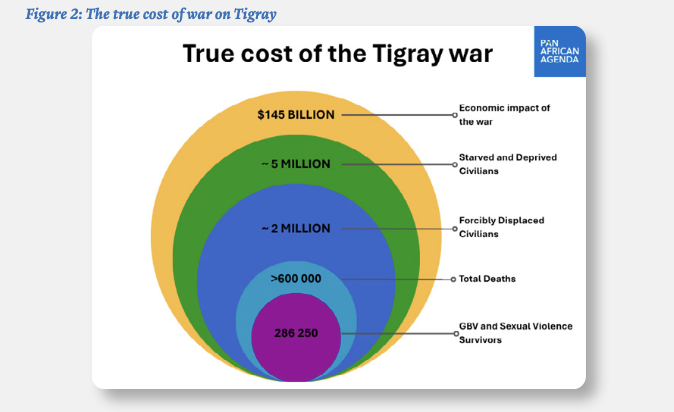
"The fatalities and humanitarian toll of the war were catastrophic. According to the Uppsala University Conflict Data (2022), Africa experienced an estimated 368,756 battle-related deaths between 2020 and 2022.14 Over 300,000 of these deaths, representing over 80% of the continent’s conflict mortality during this period, occurred in the Ethiopia–Eritrea’s war on Tigray. However, these figures only account for direct battle-related deaths and exclude indirect mortality from disease, starvation, and lack of medical care in the siege of Tigray. During the conflict, over 5 million people were besieged and deliberately subjected to starvation as a weapon of war. According to the commission of Inquiry on Tigray Genocide, 286,250 survivors were victims of sexual and gender-based violence, and more than 2 million people were forcibly displaced from their homes. The siege of Tigray deprived more than 5 million civilians of essential supplies, including food, medicine, and fuel. When indirect deaths are included in estimates, the total death toll from the war on Tigray exceeds 600,000, rendering the conflict the deadliest on the African continent since the 1994 Rwandan genocide, and one of the deadliest internationalized intrastate wars in recent history."
You can download it here: https://t.co/AjoCjlIZIR
Pretoria stopped a war. It did not settle the politics.
That is the central premise of this new assessment, and an increasingly important one as unresolved questions of territory, security, justice, and implementation again shape the trajectory of northern Ethiopia.
A point many of us on Capitol Hill made when Pretoria was signed…and repeatedly in the years that followed.
Rettberg and Dupont's literature review finds that peace agreements are most often undermined by insufficient political will and inadequate capacity, with parties frequently failing to honour their commitments, especially in the critical early phase of implementation, when trust is fragile and setbacks can quickly unravel the deal.
An empirical study of the implementation analysis of 80 peace agreements by Cil and Huth indicates, as shown below, the link between an increase in aid and the implementation of power-sharing and reform.
Governments are significantly more likely to make progress on implementation each year if direct aid is reduced to penalize any failure to implement power-sharing provisions the previous year.
Conversely, governments are more likely to institute reforms when project aid is increased in response to implementation failures that are the result of inadequate capacity. Such a phased approach could address capacity constraints effectively.
Read more from our PAIR Study here: https://t.co/AjoCjlIZIR
I am alarmed and deeply concerned by reports of the possible transfer of Lt. Gen. Tadesse Werede, Colonel Gebregziabher Alemseged, Colonel Tewelde Gebretensay, Mr. Isaias Tadesse, and others detained in Mekelle without charge or appearance before a court of law.
Their safety, whereabouts, and humane treatment must be guaranteed by those who detained.
Any transfer that conceals their whereabouts or places them at risk could amount to enforced disappearance, a practice the TPLF is well known to have used before, including against members of my own immediate family.
Those responsible must understand that they bear individual responsibility for any harm that comes to the detainees.
I call on the TPLF, Tigray army leaders and police commissioners to disclose where the detainees are being held, grant immediate access to the ICRC and their families, and either bring them before a court of law or release anyone held solely for their dissenting political views.
I am alarmed and deeply concerned by reports of the possible transfer of Lt. Gen. Tadesse Werede, Colonel Gebregziabher Alemseged, Colonel Tewelde Gebretensay, Mr. Isaias Tadesse, and others detained in Mekelle without charge or appearance before a court of law.
Their safety, whereabouts, and humane treatment must be guaranteed by those who detained them.
Any transfer that conceals their whereabouts or places them at risk could amount to enforced disappearance, a practice the TPLF is well known to have used before, including against members of my own immediate family.
Those responsible must understand that they bear individual responsibility for any harm that comes to the detainees.
I call on the TPLF, Tigray army leaders and police commissioners to disclose where the detainees are being held, grant immediate access to the ICRC and their families, and either bring them before a court of law or release anyone held solely for their dissenting political views.
Getting v credible reports that the TPLF is trying to remove the 4 senior generals it has detained in Mekelle - Tadesse Worede, Colonel Gebre, Tewolde Gebretensae, Isayas Tadesse - ostensibly for “somewhere safe” as they evacuate the city. Detainees refusing to open their doors