🚨¿El futuro del tratamiento de la obesidad está en la microbiota intestinal?
Revisión de 217 ensayos clínicos muestra que la investigación sobre moduladores de la microbiota está creciendo rápidamente.
🦠Los probióticos lideran la evidencia clínica.
📈Los postbióticos emergen.
Nearly 41 million #Indian#children are already #overweight or obese. Hoping to halt the trend before it worsens, the Indian Council of Medical Research (#ICMR) on Wednesday unveiled a roadmap proposing front-of-pack nutrition labels, healthier school food and tighter curbs on marketing of unhealthy foods to children. Key proposals include #front-of-pack #nutrition labelling, restrictions on the marketing of #unhealthyfoods to children, healthier school food environments, #lower #saltintake, healthier dietary fats and low-sodium salt substitutes, improved #nutritionliteracy, and fiscal measures such as taxes on foods high in fat, salt and sugar (#HFSS). @timesofindia@ICMRNIN@MoHFW_INDIA@JPNadda
Muscle loss is hitting Indians in the 40s
✅Optimum protein intake as part of a balanced diet and strength training play a vital role in maintaining muscle mass and strength.
An important and timely article published in the Times of India.
@TOIIndiaNews@TOIHyderabad
🚨 Pharma companies cannot patent a plant extract, so they will never fund the trial that buries their blockbuster drugs. Berberine lowers blood sugar, and the data is real. But calling it "nature's Ozempic" is the fastest way to get people hurt.
Here is what the science actually says.
🔬 What berberine actually does:
✅ Activates AMPK, the same energy-sensing enzyme metformin activates
✅ Reduces hepatic glucose production
✅ Improves insulin sensitivity at the cellular level
✅ Slows intestinal glucose absorption
💓 The clinical data:
✅ A 2008 meta-analysis pooling 14 randomized controlled trials showed berberine reduced fasting blood glucose by 19.83 mg/dL compared to placebo.
✅ Head-to-head trials against metformin showed comparable HbA1c reductions in patients with type 2 diabetes, with berberine dropping HbA1c by roughly 0.9% over 3 months.
✅ LDL dropped. Triglycerides dropped. It did real metabolic work.
⚠️ Here is where the "nature's Ozempic" label breaks down completely.
GLP-1 receptor agonists like semaglutide reduce major adverse cardiovascular events. SUSTAIN-6 (semaglutide) cut cardiovascular death and nonfatal stroke. LEADER (liraglutide) reduced cardiovascular death by 22%. SELECT (semaglutide) cut major adverse cardiovascular events by 20% in people without diabetes.
Berberine has no cardiovascular outcomes trial of that scale.
Zero.
The glucose numbers move. Whether that translates into fewer heart attacks and fewer deaths the way GLP-1 drugs do, we do not have that answer yet.
🩺 I am a cardiologist. I have patients who take berberine as an adjunct to lifestyle changes. The metabolic signals improve. But I do not prescribe berberine instead of guideline-directed therapy. I prescribe it alongside it.
That distinction saves lives.
🔸 The bioavailability problem no one talks about:
Berberine absorbs poorly. Oral bioavailability sits around 5%. This is why dosing in the trials runs 1500 mg per day split across 3 doses. People buying a 500 mg once-daily capsule from a wellness influencer are not replicating the clinical protocol.
❌ Berberine will not replace semaglutide for high-risk diabetic patients.
❌ Berberine will not give you 15% body weight loss.
❌ Berberine will not clear your arteries.
The tools with the strongest data are unsexy, free, and require your participation.
A patient who combines berberine 500 mg three times daily with a low-processed-food diet and consistent walking can meaningfully lower fasting glucose in 12 weeks. That is real. That matters.
That patient is also not skipping metformin, not skipping their statin, and not treating a supplement as a substitute for proven medicine.
That is the real story.
❤️ Bottom line:
Berberine is not snake oil. It is also not Ozempic. It is a plant-derived compound with real mechanistic data and real clinical signal on glucose and lipids. The trials are smaller, shorter, and lack the cardiovascular outcomes evidence that defines modern diabetes pharmacology. Use it as a tool in the toolbox. Never use it as the whole toolbox.
The question is no longer whether berberine does something. The question is whether you are using it correctly, at the right dose, with the right expectations, alongside the therapies that actually have outcomes data behind them.
This is why patients need to stop getting their medication advice from supplement brands.
#Cardiology #HeartDisease #HeartHealth #CardiovascularHealth #Berberine #BloodSugar #MetabolicHealth #Diabetes #PreventiveCardiology #LifestyleMedicine
In his latest Voices blog post, @PaulSaxMD shares part 2 of his "Syphilis Testing Is Terrible" series: reverse algorithms, serofast results, prozone effects, and why there is no such thing as a quick syphilis question. Read more: https://t.co/nAQpQ9axnr
Coffee may help you live longer
Research suggests that 2–4 cups of coffee/day (≈200–400 mg caffeine) is the sweet spot for most healthy adults.
✅ Regular coffee consumption is associated with a lower risk of:
🔸Heart disease & stroke
🔸Type 2 diabetes
🔸Parkinson's disease
🔸Liver disease
🔸Some cancers
🔸Premature death
▶️Too much coffee (>5–6 cups/day or >400 mg caffeine), especially late in the day, may increase:
🔸Anxiety & tremors
🔸Insomnia
🔸Palpitations in susceptible people
🔸Acid reflux
🔸Blood pressure (temporary rise)
🟠Pregnant women should limit caffeine to <200 mg/day.
✅The healthiest coffee is often plain or with minimal sugar/cream (not a dessert in a cup).
Scientific Evidence:
✅The 2025 Circulation study adds to a large body of evidence suggesting that moderate coffee intake is associated with lower all-cause and cardiovascular mortality, whereas the health effects depend partly on what is added to the coffee.
✅Studies consistently show a U-shaped association, with the greatest benefits around 2–4 cups/day.
Ref: https://t.co/VdM5q0vWsr
Dr Sudhir Kumar @hyderabaddoctor
❌ Waistline > 40 (men), > 35 (women)
❌ BP above 130/80 (or on BP meds)
❌ Triglyceride >150 mg/dl
❌ Fasting Glucose > 100 mg/dl
❌ HDL levels < 50 mg/dl (men),
< 40 mg/dl (women)
If you fit 3 or more of these criteria, then you have Metabolic Syndrome.
Basically a fancy way to say that your Metabolism is a mess.
& If you have Metabolic syndrome, you are at risk for Diabetes, Heart attacks, Stroke, Cancer etc.
At the root of Metabolic Syndrome is Insulin Resistance. (Hence also called Insulin Resistance Syndrome)
🚨 Your blood pressure jumping 20 points after your morning coffee is not a heart attack waiting to happen.
Most people panic over spikes that their cardiovascular system handles without breaking a sweat.
But the spike that should scare you is the one that never comes back down.
🫀 Here is what the science actually says.
Your cardiovascular system is designed to handle acute pressure surges. That is not a flaw. That is physiology working exactly as intended.
💓 Coffee raises systolic blood pressure by roughly 10 to 20 mmHg in most adults. That peak arrives within 30 to 60 minutes and resolves within 3 to 4 hours. Your heart does not even register it as a threat.
🩺 Exercise is more dramatic. A hard cardio session can push your systolic pressure above 200 mmHg. That is not dangerous. That is your heart and vasculature doing their job. Blood pressure returns to baseline within 60 minutes in a healthy cardiovascular system. In fact, regular exercisers see a post-exercise dip that runs 5 to 10 mmHg below their resting baseline. That is called post-exercise hypotension and it is one of the most underrated cardiovascular benefits of physical activity.
🔬 Acute psychological stress hits differently.
The sympathetic nervous system floods your body with catecholamines.
Heart rate climbs. Vessels constrict. Systolic pressure can surge 30 to 40 mmHg in minutes.
In a healthy person, parasympathetic recovery pulls it back down within 30 to 90 minutes.
In someone with underlying hypertension or endothelial dysfunction, it does not come back down cleanly.
That is the problem.
⚠️ The number that actually matters is not the peak. It is the recovery.
A person whose blood pressure spikes to 175 mmHg during a stressful meeting and returns to 118 mmHg within an hour is in a fundamentally different category than the person who spikes to 155 mmHg and sits at 145 mmHg four hours later. One is a normal stress response. The other is sustained hypertension with a trigger attached.
🔸 Repeated spikes without full recovery cause cumulative endothelial damage.
🔸 That damage accelerates atherosclerosis.
🔸 That atherosclerosis raises your lifetime risk of myocardial infarction and stroke.
🩺 I am a cardiologist. I have seen patients convinced their morning espresso was going to kill them while their resting blood pressure sat at 158 over 96 mmHg untreated for three years. The coffee was not the problem. The baseline that never normalized was the problem.
"A patient who monitors their blood pressure 30 minutes after coffee, exercise, and a stressful event and sees consistent return to below 130 over 80 mmHg within 90 minutes is watching a healthy stress-response system at work. That is the difference between a cardiovascular system that recovers and one that does not."
❌ Panicking about a 15-point coffee spike will not protect your heart.
❌ Avoiding exercise because your pressure climbs during it will not protect your heart.
❌ Treating the spike instead of the sustained elevation will not protect your heart.
❤️ Bottom line:
Transient blood pressure spikes after coffee, exercise, and stress are normal physiology. They are not the enemy.
Sustained elevation that never fully resolves is hypertension. That is the enemy.
Check your blood pressure at rest. Check it again 90 minutes after the trigger. Watch the recovery, not the peak.
If your pressure is still above 130 over 80 mmHg ninety minutes after the stressor resolved, that is the conversation to have with your cardiologist.
The question is no longer what caused the spike. The question is why it is not coming back down.
#Cardiology #HeartHealth #HeartDisease #CardiovascularHealth #BloodPressure #Hypertension #BloodPressureSpikes #PreventiveCardiology #MetabolicHealth #LifestyleMedicine
Underrated Blood Markers people rarely Test
🩸 Fasting Insulin
Can detect insulin resistance years before blood sugar or HbA1c become abnormal.
🩸 Ferritin
Reflects iron stores. Low levels can contribute to fatigue, hair loss, poor exercise performance & restless legs, while very high levels may indicate inflammation or iron overload.
🩸 Homocysteine
An important marker of methylation. High levels may suggest deficiencies of vitamin B12, folate (B9) or vitamin B6 & increased cardiovascular risk.
🩸 Vitamin B9 (Folate)
Essential for DNA synthesis, red blood cell production & methylation. Low levels can contribute to anemia, elevated homocysteine & neurological symptoms.
🩸 Methylmalonic Acid (MMA)
One of the most sensitive markers of functional vitamin B12 deficiency, even when serum B12 appears normal.
🩸 Cystatin C
A more sensitive marker of kidney function than creatinine, especially in older adults & people with high or low muscle mass.
🩸 Lipoprotein(a)
A genetically determined cardiovascular risk factor that is largely unaffected by diet or lifestyle. Most people only need to test it once in their lifetime.
🩸 Apolipoprotein B (ApoB)
Measures the total number of atherogenic lipoprotein particles & is often a better predictor of cardiovascular risk than LDL cholesterol alone.
🩸 hs-CRP (High-Sensitivity C-Reactive Protein)
A marker of low grade chronic inflammation associated with cardiovascular disease & overall metabolic health.
⚠️ These tests are not necessary for everyone, but in the right clinical context, they can provide valuable information that routine blood work often misses.
Approach to Management of Hypertension, summarizing guidelines derived from the 2025–26 AHA/ACC/ASH Guidelines for the Management of High Blood Pressure.
https://t.co/S1uwA29miS
Waist-To-Height Ratio (WHtR) is superior to Body Mass Index (BMI) and Waist Hip Ratio *WHR) in its ability to predict future risk of cardiovascular diseases (such as heart attack and stroke) and premature mortality.
✅WHtR of <0.5 is considered normal.
🔸Pitfalls of BMI: BMI does not differentiate between weight due to fat, muscle, bone or body fluids.
A person with good muscle bulk could have a higher BMI, as compared to a skinny person with excess abdominal & visceral fat.
🔸LDL-C levels are often measured to assess the future risk of CVDs. Calculating triglyceride:HDL-C ratio can add more value.
✅TG:HDL ratio of below 2 is considered ideal.
🔴A ratio above 3 is considered high.
(Source: @TOIIndiaNews@TOIHyderabad)
LDL-C Distance to Target: A Practical Tool for Guiding Treatment
• A new review proposes using “LDL-C Distance to Target (DtT)" to guide lipid-lowering therapy.
• Treatment should match the % LDL-C reduction needed, rather than using stepwise escalation.
• The review reinforces early and sustained LDL-C lowering to reduce cumulative LDL exposure.
• Patients farther from LDL-C targets should receive more intensive combination therapy.
• Conclusion: A DtT-based approach may help overcome therapeutic inertia and improve LDL-C target achievement.
https://t.co/reDGMoAQmM
@DrNadolsky@DrKarlNadolsky@NutritionMadeS3@drmatthewnagra
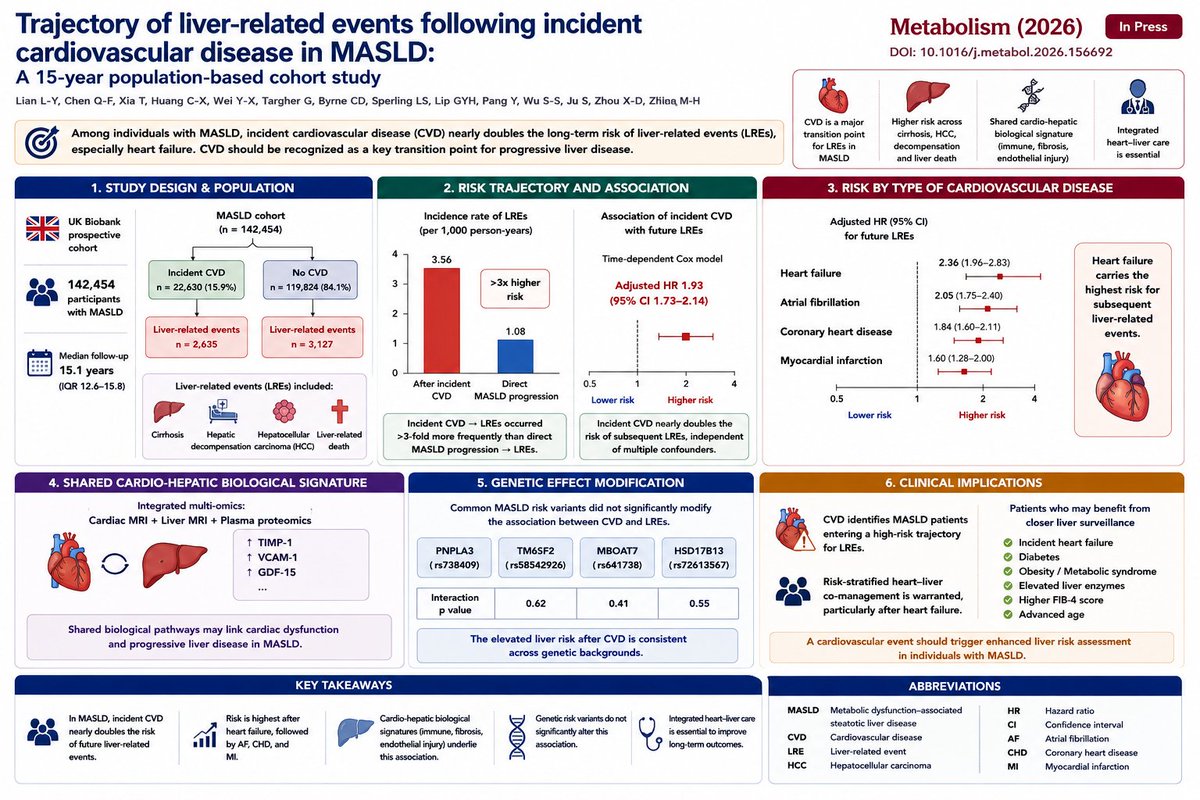
Trajectory of liver-related events following incident cardiovascular disease in MASLD: A 15-year population-based cohort study
Metabolism (2026, in press)
DOI: 10.1016/j.metabol.2026.156692
> ❤️🫀🩺 In MASLD, a cardiovascular event is more than a cardiac complication—it marks a major escalation in future liver risk. Individuals who develop incident cardiovascular disease (CVD) experience nearly double the subsequent risk of liver-related events, highlighting the need for integrated heart–liver care.
Although MASLD is widely recognized as a risk factor for cardiovascular disease, the reverse clinical trajectory has received far less attention. Using 142,454 UK Biobank participants with MASLD followed for a median of 15.1 years, investigators demonstrate that developing CVD identifies a subgroup at substantially greater risk for cirrhosis, hepatic decompensation, hepatocellular carcinoma, and liver-related death.
Key findings
❤️ Among 142,454 individuals with MASLD, 22,630 (15.9%) developed incident cardiovascular disease and 2,635 subsequently experienced liver-related events during long-term follow-up.
📈 The transition from CVD → liver-related events occurred at 3.56 per 1,000 person-years, more than threefold higher than direct progression from MASLD → liver-related events (1.08 per 1,000 person-years).
⚠️ Time-dependent Cox analysis showed that incident CVD nearly doubled future liver-related event risk (adjusted HR 1.93, 95% CI 1.73–2.14), independent of demographic, metabolic, hepatic, and lifestyle risk factors.
🫀 Risk differed across cardiovascular phenotypes, with heart failure showing the strongest association, followed by atrial fibrillation, coronary heart disease, and myocardial infarction.
🧬 Integrated cardiac MRI, liver MRI, and plasma proteomics identified a shared biological signature linking cardiac dysfunction with hepatic injury, enriched for immune activation, extracellular matrix remodeling, fibrosis, and endothelial inflammation, including proteins such as TIMP-1, VCAM-1, and GDF-15.
🧬 Common MASLD susceptibility variants (PNPLA3, TM6SF2, MBOAT7, HSD17B13) did not significantly modify the association, suggesting that the elevated liver risk after CVD extends across genetic backgrounds.
Why it matters
This study reframes cardiovascular disease in MASLD as a clinical transition point rather than simply a competing complication. After a cardiovascular event—particularly heart failure—patients enter a substantially higher-risk trajectory for progressive liver disease. While the study does not establish causality, it provides strong evidence that incident CVD identifies patients who warrant closer hepatic evaluation.
Rather than recommending universal liver surveillance, the authors advocate risk-stratified heart–liver co-management, prioritizing patients with heart failure, diabetes, obesity, elevated liver enzymes, higher FIB-4, or other markers of advanced metabolic risk. The work strengthens the concept that MASLD should be managed as a multisystem cardiometabolic disease, where coordinated hepatology and cardiology care may improve long-term outcomes beyond either specialty alone.
🚨 Hypertension treatment is changing fast
✅ New target: <130/80, <120 systolic encouraged.
✅ New tools: Endothelin antagonism, RNA interference, RDN
The era of precision hypertension management has arrived
https://t.co/SY9HSZZRJe
#JACC#Hypertension#HeartHealth#Cardiology
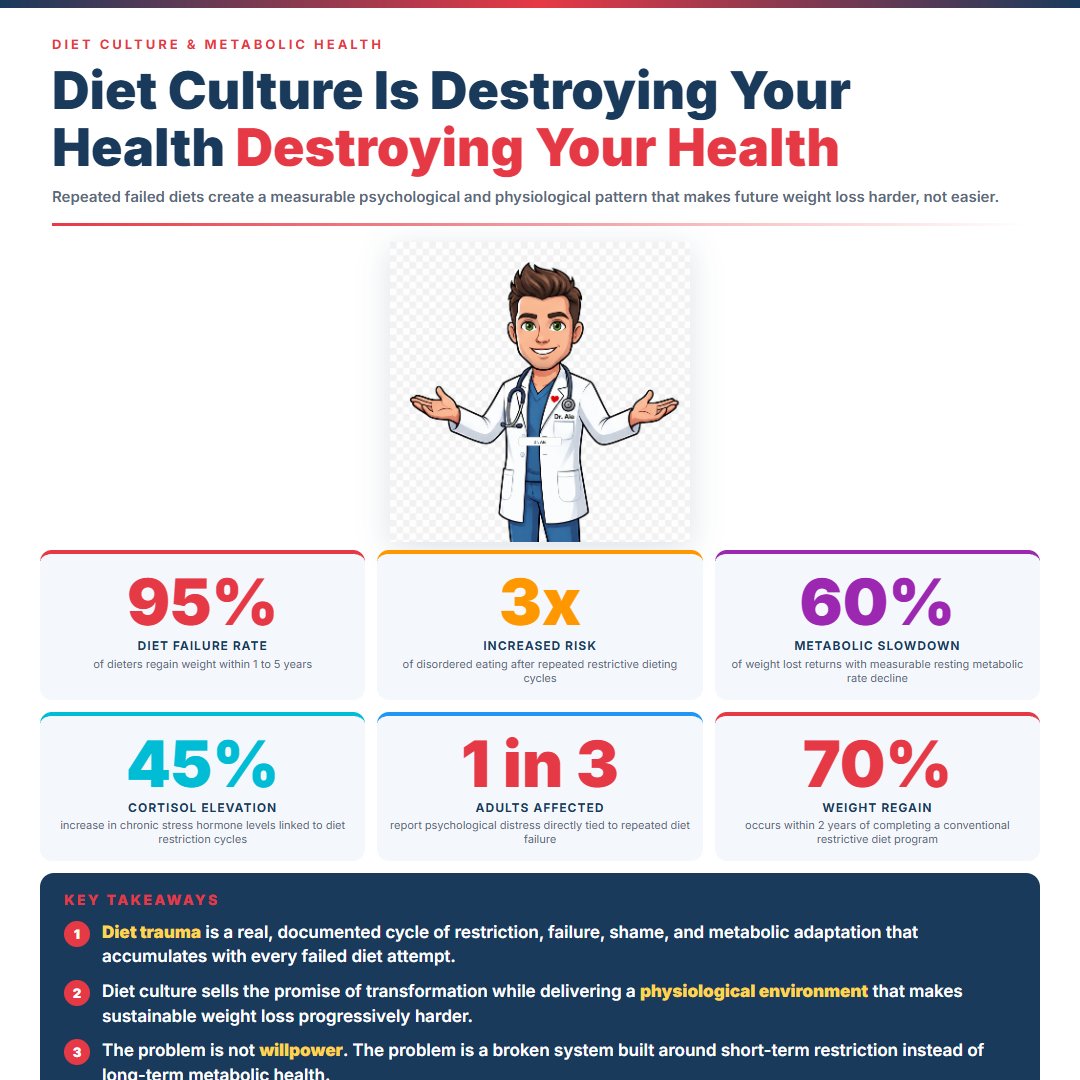
🚨 Diet culture does not make you healthy. It makes you sick, and the research proves it.
45 million Americans go on a diet every year. The vast majority end up heavier, more anxious, and more metabolically broken than when they started.
But we keep selling the same lie.
🔬 Here is what the science actually says.
Chronic restrictive dieting triggers cortisol elevation, disrupts the hypothalamic-pituitary-adrenal axis, and drives insulin resistance. The biological stress response to repeated caloric deprivation is nearly identical to the stress response from psychological trauma. Your body does not know the difference between a famine and a juice cleanse. It just knows it is starving.
💓 The data on yo-yo dieting is not a footnote. It is a warning.
Weight cycling. repeated cycles of loss and regain. increases cardiovascular mortality risk by 41% in some cohort analyses. It raises LDL. It lowers HDL. It increases visceral adiposity with every cycle. The person who has dieted 10 times is not 10 times healthier. They are metabolically worse off than the person who never dieted at all.
🩺 I am a cardiologist. I see the downstream damage of diet culture in my clinic every week.
Patients who have restricted calories for decades and developed orthorexia, disordered eating, and cortisol-driven hypertension. Patients whose A1C went up, not down, after years of elimination diets. Patients who were told to eat less and move more, followed that advice faithfully, and ended up with a slower metabolism, higher inflammatory markers, and a broken relationship with food.
That is diet trauma. And it is real.
⚠️ The worst offenders in the diet culture space.
❌ Extreme caloric restriction below 1200 calories per day does not preserve lean muscle mass. It destroys it.
❌ Detox cleanses do not remove toxins. Your liver and kidneys do that. A $90 juice does not help them.
❌ Elimination diets pursued without clinical indication do not reduce cardiovascular risk. They increase nutritional deficiency risk.
❌ The number on the scale is not a surrogate for metabolic health. A patient can be thin and metabolically devastated.
🔬 What actually works.
✅ Sustainable caloric moderation, not restriction. Eating in a modest deficit of 300 to 500 calories per day preserves muscle, reduces fat, and avoids the cortisol spike of aggressive cutting.
✅ Protein adequacy. 1.2 to 1.6 grams per kilogram of body weight per day protects lean mass and satiety simultaneously.
✅ Resistance training. The single most underutilized metabolic intervention in preventive cardiology. It improves insulin sensitivity, lowers resting heart rate, and increases resting metabolic rate.
✅ Addressing the psychological relationship with food. Cognitive behavioral interventions for disordered eating reduce binge eating episodes by 60% in randomized trials. The mind-body connection in metabolic health is not optional science.
🫀 A patient who stops chasing the next diet, builds consistent protein intake, trains with weights three times per week, and works with a behavioral health provider can reverse metabolic syndrome markers in 6 to 12 months.
That is the difference between diet trauma and genuine cardiovascular health.
❤️ Bottom line:
Diet culture is not a wellness movement. It is a $78 billion industry that profits from your failure and recycles you back for the next product.
The research on weight cycling, cortisol disruption, and disordered eating spans decades and hundreds of thousands of patients. This is not fringe science.
Stop restricting. Start building. Prioritize protein, resistance training, sleep, and stress management over the next cleanse.
The question is no longer what diet should you follow. The question is whether diet culture has already done damage you need to repair.
Have you ever felt worse after a diet than before you started it?
#Cardiology #HeartHealth #HeartDisease #CardiovascularHealth #DietCulture #DietTrauma #MetabolicHealth #WeightCycling #PreventiveCardiology #LifestyleMedicine
📱 هذه أكثر التطبيقات اللي أعتمد عليها بشكل يومي كطبيب، ولكل واحد منها دور مختلف:
🦠 Sanford Guide: مرجع سريع للمضادات الحيوية وعلاج الأمراض المعدية.
📚 UpToDate: أفضل مرجع لاتخاذ القرار السريري، من التشخيص إلى العلاج.
🩺 Medscape: موسوعة طبية مجانية تضم الأمراض، الأدوية، وآخر الأخبار الطبية.
🎓 AMBOSS: يجمع بين التعليم الطبي والممارسة السريرية مع شرح مبسط ومراجعة للاختبارات.
🫁 Osmosis: فيديوهات ورسومات ممتازة لفهم الأمراض والمفاهيم الطبية.
🧮 MDCalc: جميع الحاسبات الطبية المهمة في مكان واحد (CHA₂DS₂-VASc، CURB-65، Wells وغيرها).
📖 DynaMed: مرجع طبي مبني على الأدلة، سريع ومناسب أثناء المناوبات.
إذا كنت طبيب امتياز أو مقيم، وجود هذه التطبيقات في جوالك يوفر عليك وقتًا كبيرًا ويساعدك في اتخاذ قرارات مبنية على الأدلة. 🩺