Ever watched a clinician
make a complex case look easy?
That is not talent alone.
That is preparation.
The best cases are rehearsed mentally, planned meticulously and then executed clinically.
Thats what I believe in, practice and preach.
Improvisation
usually ends in adjustment, compromise,
or remake.
Prosthodontics is less about reacting,
and more about anticipating.
Take-home message:
Most failures are planned unknowingly long before they happen.
This is the last Prosthobite of this series.... Coming up next is "The MIK REPLY"... Watch this space for more
Prostho is a game of millimetres? No—microns.
“Small gap.”
“Minor discrepancy.”
“Almost fitting.”
Interesting terminology.
Patients may not see precision—
but biology certainly does.
At the margin,
microns decide:
• Seal
• Fit
• Longevity
• Tissue response
A rough finish line.
Slight overcontour.
Tiny occlusal discrepancy.
Individually small.
Collectively destructive.
Take-home message:
Fixed prosthodontics is defined in microns—
respect the tiny details, or manage big problems later.
Reputation is built slowly—
and damaged quickly.
Early in practice,
we say yes to everything.
Experience changes that.
Sometimes the best treatment plan
is restraint.
Not every patient is treatable—
at least not safely, ethically, or predictably.
Dentistry is not just about skill—
it is also about judgement.
And wisdom is knowing
which battles are worth fighting.
Take-home message:
Your reputation is built not only by the cases you do—
but also by the ones you wisely refuse.
Every case you accept
carries your name.
Provisionals are not temporary crowns.
They are prototypes.
A chance to test:
• Vertical dimension
• Anterior guidance
• Phonetics
• Aesthetics
• Comfort
Especially in smile design and FMR cases,
the provisional becomes your rehearsal.
And when the rehearsal works—
why improvise the final?
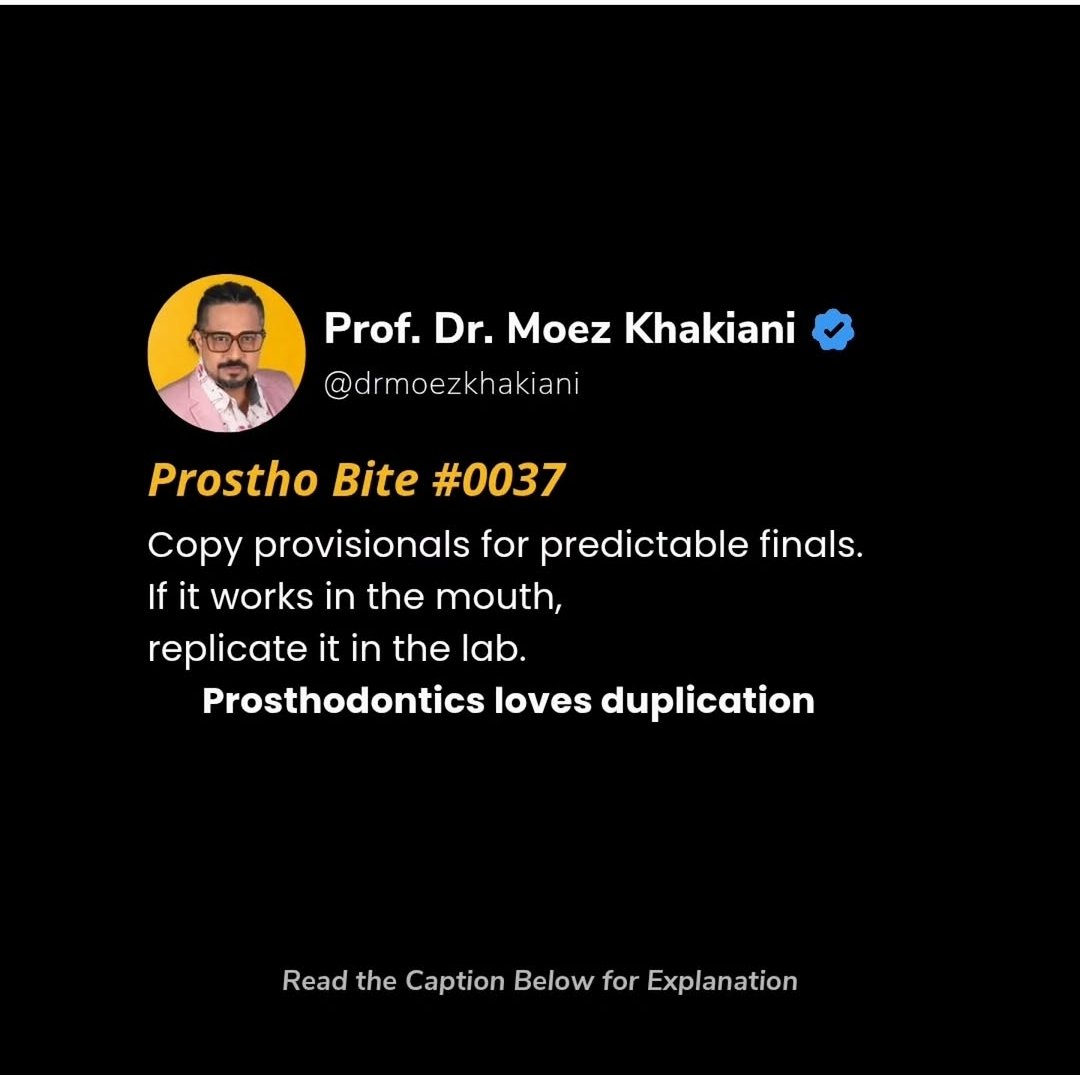
If the patient has adjusted and approved the provisionals, then why do we redesign everything for the final... Baffles me!
Take-home message:
Validate in the mouth.
Replicate in the lab.
One of the biggest mistakes in implant prosthodontics?
Planning only for delivery day.
Will it need maintenance?
Probably.
Will it need repair?
Possibly.
Will you wish it was retrievable?
Almost certainly.
Screw-retained restorations allow access.
Cement-retained restorations often limit it.
Funny how one tiny screw
can save so many headaches.
Loose component? Retrieve it.
Fractured ceramic? Retrieve it.
Occlusal correction? Retrieve it.
Simple.
But with cement-retained restorations?
Things get… interesting.
Residual cement.
Tissue irritation.
Difficult access.
Compromised maintenance.
Because implant dentistry is not just about restoring—
it is about maintaining.
Take-home message:
Don’t plan just for placement—plan for retrieval- It is intelligent planning.
From pain and discomfort to a symptom-free life! ✨
No more clicking, locking, or shifting—just smooth jaw movement and a happy smile. Seeing our patients regain comfort is the biggest reward. 🙌🦷
#TMJ#JawPainRelief#PatientSuccess
If your zirconia crown keeps coming out-
The culprit may be sitting right in front of you.
Saliva.
That innocent try-in,
quietly contaminates zirconia.
And zirconia does not forgive contamination.
Unlike other restorations,
you cannot simply “cement and forget” with zirconia.
Bonding zirconia requires chemistry.
The protocol is simple:
APC
• A → Air abrasion (50 µm aluminium oxide)
• P → Primer (10-MDP)
• C → Composite resin cement
Miss one step—
and strength becomes weakness.
Take-home message:
Most zirconia failures are protocol failures.
Follow APC—because chemistry remembers shortcuts.
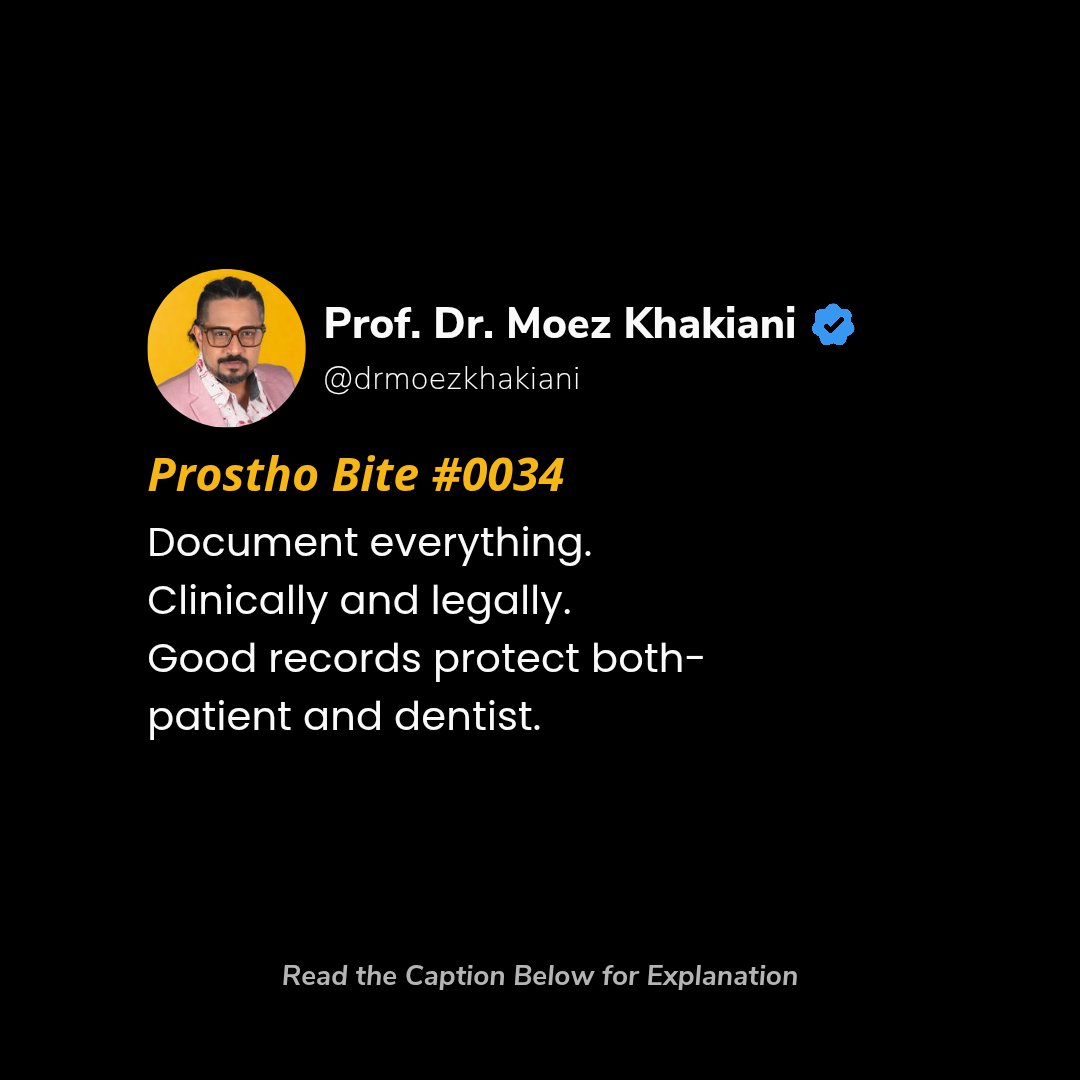
We often separate clinical work and legal work.
But in reality, they are connected.
Photographs.
Notes.
Radiographs.
Consent.
These are not administrative tasks—
they are part of treatment.
Because good dentistry
must also be defensible dentistry.
Documentation often feels unnecessary…
until the day it isn’t.
A dissatisfied patient.
A complication.
A question of consent.
That’s when your records become
your strongest defence.
Not your memory.
Not your intention.
Your documentation.
Take-home message
Do great dentistry—
but document it even better.
Every dentist has a “go-to” material.
But no material can handle
all combinations of:
• Load
• Aesthetics
• Bonding
• Thickness
• Space
Pick any two.
Because every material is a compromise:
Zirconia → strength, lower translucency
Lithium disilicate → aesthetics, moderate strength
PFM → forgiving, but less aesthetic and prone to chipping
Composite → repairable, but less durable
Acrylic → temporary, not definitive
Each has a role.
Each has limitations.
Good prosthodontics is not about choosing the best—
it’s about choosing the most appropriate.
Take-home message
Every material solves one problem
while creating another—choose wisely.
Once an implant is restored,
it enters a force system.
One of the biggest mistakes?
Treating implants like natural teeth.
Same contacts.
Same loading.
Natural teeth have:
• Periodontal ligament
• Shock absorption
• Sensory feedback
Implants have none of that.
So what feels normal for teeth
may actually be overload for an implant.
Without a ligament,
there is no buffer.
No shock absorption.
No proprioceptive feedback.
So every force is transmitted directly.
Clinically, this means:
Load implants lighter than adjacent natural teeth—
use ≤20 µm articulating paper and confirm with shimstock.
Take-home message
Load implants like implants—not like teeth.
Respect the difference—lighter, controlled occlusion is essential.
Cementation is not the end of treatment.
It’s the beginning of maintenance.
Restorations live in a dynamic environment—
force, saliva, bacteria, time.
And over time, things change:
• Contacts shift
• Materials wear
• Tissues respond
Without follow-up,
small issues become big failures.
Regular recalls catch them early.
Follow-ups are often treated like a formality.
But without them,
you’re not completing treatment—
you’re abandoning it early.
The real test of your work
doesn’t happen on the day you finish.
It happens months,
years,
decades later.
Take-home message
If you don’t review your work, biology will.
Longevity is not delivered—it’s maintained.
Natural teeth adapt.
Implants don’t— they respond.
They lack a periodontal ligament.
No cushioning.
No forgiveness.
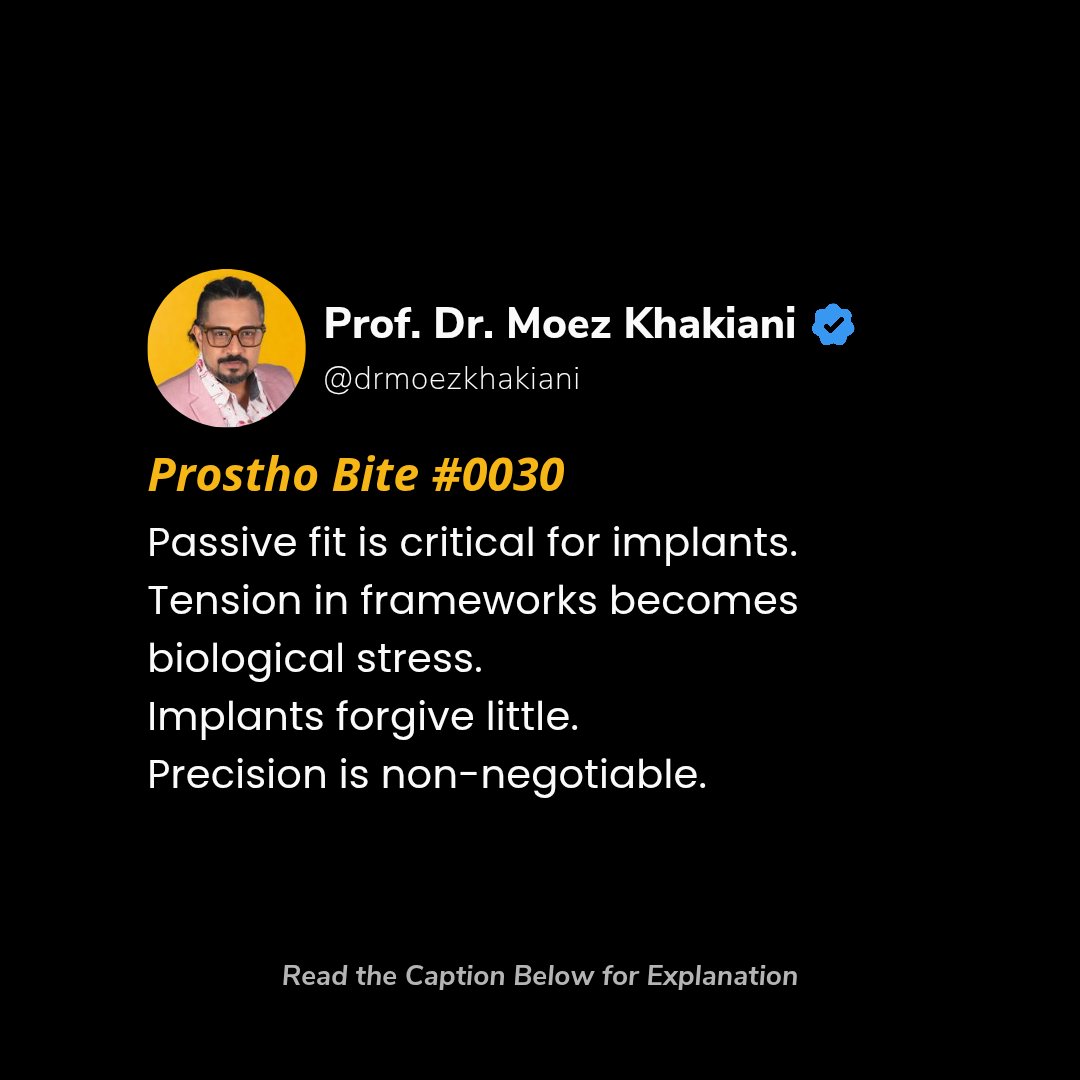
So when a framework doesn’t fit passively,
that tension has nowhere to go.
It transfers directly to bone and components—
as biological stress.
Even minimal misfit
creates strain.
And that strain is amplified
under function.
Almost passive… is not passive.
A framework should seat
without force,
without tension,
without persuasion.
If you have to “help it sit”,
you’ve already introduced stress.
And implants will carry that stress
every single day.
Over time, this leads to:
• Screw loosening
• Component fatigue
• Bone loss
• Prosthetic complications
Take-home message
If it’s not passive, it’s already a problem—
biology will reveal it later.
Sorry to disappoint—
that’s not communication.
That’s guesswork.
Shade is visual.
Not verbal.
And interpretation = variation.
The technician wasn’t there.
They didn’t see the patient.
They only see what you send.
They work with your data.
And data is only as good as:
• Your photographs
• Your lighting
• Your angulation
Photographs capture what words cannot—
texture, translucency, character.
Take-home message
If the lab can’t see what you saw,
they can’t replicate it.
Images don’t just help—
they define the outcome.
Perfect symmetry is impressive.
But rarely natural.
Nature doesn’t follow grids.
It doesn’t measure midlines with calipers.
And yet-
it looks right.
Because slight asymmetry creates character,
depth, and realism.
Perfect symmetry, on the other hand,
often looks manufactured.
Subtle variations in:
• Tooth length
• Line angles
• Gingival levels
These are not mistakes.
They are what make a smile feel beautiful.
Smiles move.
They express.
They live.
And in motion,
slight asymmetry feels more real.
Take-home message
Don’t plan smiles to perfection—
design believability.
Implants are easy to place.
Placing them in the right position is not.
Far too often, implants are placed
where bone is available—
instead of where the tooth needs to be.
That’s where the problems begin.
Because implants don’t decide the prosthesis—
the prosthesis decides the implant.
Start with the final crown.
Then plan the position, angulation, and depth.
Otherwise, you’re not planning—
you’re adapting later.
Angled abutments.
Compromised emergence.
Cement nightmares.
All because planning started with bone—
not with the final restoration.
Implants are not the end goal.
They are the support system.
And once placed,
they don’t give you freedom—
they lock you in.
Here’s a simple rule:
Start with the end.
Final tooth position →
Implant position →
Surgical execution.
Not the other way around.
Take-home message
Think prosthetically. Act surgically.
Implants should serve the prosthesis—never limit it.
Veneers look simple.
Thin. Conservative. Elegant.
Which is exactly why they are dangerous.
In many restorations,
you have some room for error.
In veneers—you don’t.
Because the entire restoration
depends on a thin adhesive interface.
Small mistakes don’t stay small.
And when a veneer fails,
we blame the lab.
Or the material.
Or the cement.
Rarely the bonding.
Bonding doesn’t fail suddenly.
It weakens—
micron by micron,
cycle by cycle,
function by function…
Until one day—
it lets go.
With veneers, there is no fallback.
No retention form.
No mechanical safety net.
Just adhesion.
And adhesion is unforgiving.
Moisture.
Improper etching.
Inadequate isolation.
Rushed protocol.
Each one silently reduces longevity.
So while veneers look simple—
they demand the highest level of discipline.
Take-home message
Bonding is not a step—it is a discipline.
And discipline is what determines longevity.
There is no doubt—zirconia is strong.
But strength is not bonding.
Without proper surface treatment,
that “strong” crown can debond surprisingly easily.
Zirconia is chemically inert.
Which means surface treatment is not optional—
it is essential.
You cannot rely on friction and cement alone.
Zirconia requires:
• Proper surface cleaning (e.g., sodium hypochlorite / dedicated cleaners)
• Air abrasion (≈50 µm aluminium oxide)
• An MDP-based primer
10-MDP changes the game—
it creates a chemical bond, not just mechanical hope.
The difference?
Retention vs regret.
Take-home message
Zirconia doesn’t forgive poor chemistry—
prime it, or expect decementation.