ASHRAE approves groundbreaking Standard to safeguard indoor spaces from disease transmission. The new ASHRAE Standard 241- Control of Infectious Aerosols is a major step forward in reducing the risk of infectious disease spread in buildings. https://t.co/Jkd918vOF6.
#MyASHRAE
We’ve known how to prevent dust and sand storms for nearly a century, but these storms will likely grow in intensity as farming expands and climate change intensifies
https://t.co/fULk6iJXGg
Our study on sources and concentrations of diverse air pollutants in homes and optimal sensor positioning. See the open-access publication to learn more: https://t.co/7gketibjJB
Kudos to Viviana González and Yale colleagues Krystal Pollitt and Elizabeth Lin for pulling this off.
Older adults emit at least twice as many aerosol respiratory particles per minute than young adults, whether at rest or while exercising, according to a study with implications for viral transmission dynamics. In PNAS: https://t.co/M6IUkZ8nRL
The ASHRAE project committee that is developing Standard 241P Control of Infectious Aerosols approved a public review draft today. It will be posted soon for a two-week public review.
Scaling risk models for infectious aerosols with DNA-based aerosol tracers can inform building operation strategies. Read the full story in ES&T: https://t.co/8qIZQbTrt5
@Safetraces @DrNickClements@ProfKAHamilton@StanDeresinski
This week we welcomed Jie Zhao, PhD VP at Delos Labs for a show on how modern buildings are integrating IEQ controls, lighting, acoustics and more to make work environments healthy and high performing.
https://t.co/p6v0qneFxF
How do we design buildings to reduce infectious aerosol transmission risk? In collaboration with @SafeTraces @ProfKAHamilton@StanDeresinski and Peter Cook we demonstrate a method of scaling a QMRA model with aerosolized synthetic DNA measurements, https://t.co/HXtlL56QW9
Very nice new study “proving” viable sars2 virus in bioaerosols
Of course, this was obvious as soon as the 1st superspreader events happened
Many scientists were yelling it
Took far too long to be accepted by public health agencies & impact policy
https://t.co/s8cwqZHb0W
Meet Shelby Buckley, an environmental engineering student in @CUEngineering that recently studied the impacts of climate change up close during a five-week trip to the Arctic aboard an icebreaking ship.
https://t.co/VlkkBoqKS4
I ❤️ low-cost sensors for PM air pollution (eg PMS5003, SPS30). But they have serious limitations. They cannot see particles > 1 micron.
PM1 👍🏻 😀
PM2.5 🧐
PM2.5-10 👎🏻😬
PM10 👎🏻 ☹️
Networks like #PurpleAir should stop reporting PM10 and coarse PM. https://t.co/11J3LkQxks
Indoor air pollution made visible! Five days of filtering particulate matter = noticeably dirty filter. Better on the filter than in our lungs! Now that its ASHRAE volunteer service is done, this #CorsiRosenthalBox is off to a new home. Many more particles to catch!
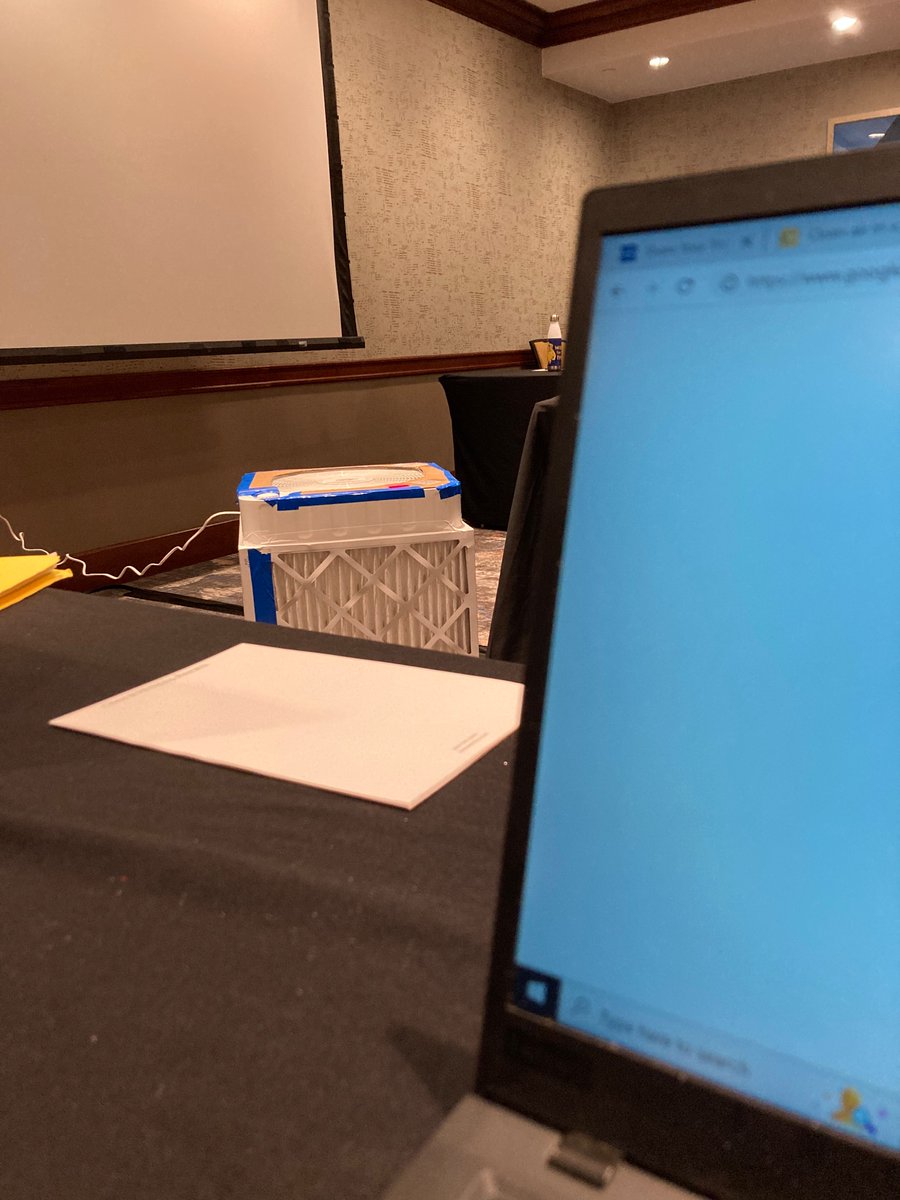
#CorsiRosenthalBox in the wild at the @ashraenews conference. Getting enhanced IAQ in the committee meeting of the Guideline for Enhanced IAQ! ASHRAE friends, join us in International Ballroom B to keep the construction going. 7 am onward each day. DM me!
@CathNoakes @healthyheating Still much work to do as well, e.g. for designing a ventilation standard for infectious aerosols, what level of risk reduction is acceptable to target? How does one calculate risk given variability in pathogens, viral load, emission modes, exposure events, building types, etc?
I am hiring a Postdoctoral Associate-Aerosol Scientist for my research group! Research experience in aerosol measurements and community-based field studies needed. Job includes conducting aerosol measurements of respiratory aerosols, indoor aerosols and…https://t.co/nVDHBjh2x0
@Embarnesey@Poppendieck@ShellyMBoulder@OwenAFC1 Thanks! We tested with and without, didn’t see that it helped with this fan. There aren’t voids in the corners of the fan like the lasko. Without good evidence of it helping we chose not to use it since it adds so much build time. We plan more testing to figure that out though.
@Poppendieck@ShellyMBoulder@OwenAFC1 Yes, fan was selected for noise (Laskos are too loud for residential settings), full cubes tend to be too large for many home spaces, and ability to build 100+ for the participants were all considered.