"If you had the hypothesis that the government was seeking to destroy the National Health Service...all the data that we're seeing are consistent with that hypothesis," said Professor Sir Michael Marmot (UCL Institute of Epidemiology & Health)
#NHS
https://t.co/RM3KzjhN5t
"Have last year’s cuts put the system back into some form of balance? Obviously, the answer to that is ‘No,’ because almost twice as many trusts and ICBs (64%) now say they are expecting to make more, similar cuts this year. So more cuts are coming."
#NHS
https://t.co/L3WNHVVULy
Shocking 👇 the government's decision to say no to public ownership of water MUST be revisited
Mandelson co-founded Global Counsel which lobbied for privatised water
Both Environment Secretaries Steve Reed and Emma Reynolds were clearly close to him
https://t.co/ivPGBO9gSH
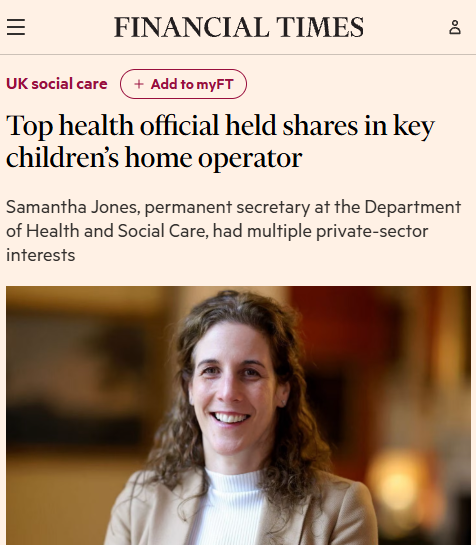
🚨 @wesstreeting appointed a health dept secretary who held stakes in 12 firms with public health contracts, including a children's care firm that hiked council fees by 10% to £128K per child.
When private interests run the NHS, patients pay the price.
https://t.co/VQo784O1nR
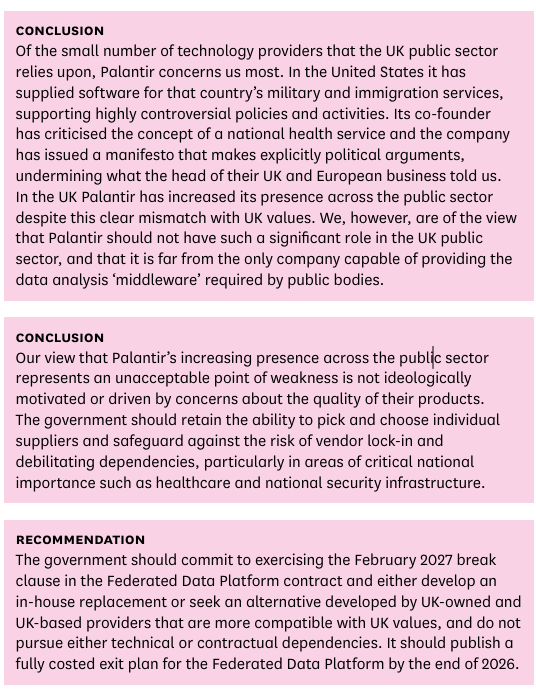
The Commons Science & Technology Committee has just said what many of us have been warning.
Britain’s public data infrastructure should not be handed over to Palantir.
Not our NHS data.
Not our national security infrastructure.
Not the digital spine of the public sector.
Surgeons and anaesthetists are experiencing record levels of burnout, and many are planning to leave the NHS.
@scarlettmcnally offers advice for reducing burnout in surgical staff
https://t.co/oDrmLWAaTT
The Starmer–Mandelson–Palantir story raises serious questions about how power is being used.
A private meeting, a £240m contract without competition - the public deserves answers and full transparency now.
@GreenJennyJones asserts that Palantir's contracts should be cancelled.
Working hard? Nigel Farage registered ‘absent’ from the last 77 votes in Parliament.
UK MP basic salary is £98,599 plus expenses, including second home.
Since becoming MP Farage has collected £2m from other jobs.
Questions about his undeclared gifts.
https://t.co/u2pYkxFB6D
A British biologist looked at 200,000 years of human history and found that the entire reason humans broke out of poverty was not intelligence, not language, not even agriculture, but one mechanism so simple a 6-year-old could explain it.
His name is Matt Ridley.
He is a zoologist by training, an evolutionary biologist by career, and in 2010 he wrote a book called The Rational Optimist that quietly argued the most important fact about human progress had been hiding in plain sight for the entire history of economics.
Naval Ravikant has been telling people to read everything Ridley has ever written for the last 15 years. The reason is the argument inside this one book.
For 200,000 years, anatomically modern humans walked around with the same brain you have right now. Same skull size. Same neural architecture. Same raw capacity for language, planning, and abstract thought.
For roughly 190,000 of those years, almost nothing happened. Generation after generation lived and died inside the same Stone Age toolkit their great-great-grandparents had used. Then somewhere around 50,000 years ago, the line on the chart of human progress started to tick upward. Then it bent. Then it exploded.
The question Ridley spent years on was the only question that mattered. What changed.
It was not the brain. The brain had been the same for 190,000 years. It was not language, which had existed long before the takeoff. It was not even agriculture, which arrived only 10,000 years ago and was actually preceded by the upward bend, not the cause of it.
What changed was that humans started trading with strangers.
This sounds too small to be the answer. Ridley argues that it is the answer to almost everything. The moment one human exchanged a useful object with another human from a different group, something happened that no other species on earth had ever done.
Two ideas that had developed in isolation came into contact. The flint knapper learned what the spear maker had figured out. The fisherman from the coast learned what the hunter from the forest had figured out. The two pieces of knowledge fused into something neither side could have produced alone.
Ridley calls this ideas having sex. The phrase sounds frivolous and it is meant to. The point is that ideas, like genes, get better when they combine with other ideas from different lineages.
An idea sitting inside one head, no matter how brilliant the head, eventually hits a ceiling. The same idea exposed to ten thousand other ideas does something genes do under sexual reproduction. It mixes. It recombines. It produces offspring nobody planned.
The cleanest proof of this argument is the most uncomfortable case study in the book. Tasmania.
Around 10,000 years ago, rising sea levels cut Tasmania off from mainland Australia. A population of roughly 4,000 humans was now isolated on an island, with no possibility of contact with the rest of humanity. They had the same brains. The same language. The same starting toolkit as their cousins 150 kilometers north. The natural experiment was now running.
What happened next is something no economist or geneticist had ever predicted.
The mainland Australians kept inventing. Boomerangs. Spear-throwers. Fishing nets. Bone needles for sewing fitted clothes. Watercraft with paddles. Their technology compounded slowly across the centuries.
The Tasmanians went the other way. They did not just fail to invent the new tools their cousins were developing. They started losing the tools they already had. Fishing was abandoned within a few thousand years. Bone tools disappeared. Fitted clothing disappeared. They forgot how to make fire from scratch and started carrying lit firebrands from camp to camp instead, relighting their fires from a neighbor's whenever their own went out.
By the time European explorers arrived in the 17th century, the Tasmanians had the simplest toolkit of any human society ever recorded. Their material culture had gone backward for 8,000 years.
The archaeologist Rhys Jones called it a slow strangulation of the mind.
Joseph Henrich at Harvard later proved with formal mathematical models that there was nothing wrong with Tasmanian brains. There was something wrong with their network. A toolkit requires a critical mass of people exchanging skills to maintain itself.
The act of teaching a skill is imperfect. Every generation loses a small percentage of what the last generation knew. If your population is large enough and trading widely enough, those losses get caught and corrected by someone else who still remembers.
If your population shrinks below a certain threshold and stops mixing with outsiders, the small losses compound until entire technologies disappear.
This is the part that should haunt anyone reading this in 2026.
Intelligence is not a property of the individual brain. Intelligence is a property of the network the brain is connected to. A genius in isolation will produce less than a mediocre thinker inside a dense exchange of other mediocre thinkers.
The thing your ancestors needed in order to break out of 190,000 years of stagnation was not better brains. It was better connections between brains they already had.
The implication for any individual is direct and uncomfortable. If you are smart and isolated, you will be outproduced by people half as smart who are connected.
The most successful people in any field are almost never the smartest people in it. They are the ones positioned at the intersection of the most idea flows. They are reading more authors than their competitors. They are talking to more people from more disciplines. They are in the rooms where ideas from different lineages bump into each other.
Ridley ends the book on the line that sounds optimistic but is actually a warning its this "The future will be invented by people who connect ideas, not by people who guard them."
My home country Scotland 🏴
NO cervical cancer cases detected in vaccinated women following HPV immunisation!
None! Zero!
What a stunning achievement !
The HPV vaccine ie a modern medical miracle!
“I want to kill someone today & it might be you"
"They wrenched my trousers & underwear down & I was raped by one of the soldiers"
"Other people had guns inserted inside them"
"My daughter was syringed with an unknown substance"
Juliet Lamont's Gaza Flotilla testimony:
Per NHS England there are 27 MILLION ED presentations a year
That’s 74,000 every day
Can anyone explain to me the difference between news and corporate propaganda anymore?
@We_OwnIt This is literally rampant corruption & cronyism, not just Jones but her husband as well. @wesstreeting should be investigated over this appointment!
The top civil servant at the Health Department "worked for or held shares in 12 companies that benefited from public contracts with DHSC or related health organisations"
She was elevated to the top role by Wes Streeting
She should resign. And we must end NHS privatisation.
Two economists just published the maths on where AI job cuts are heading. Not a prediction. Not an opinion. A proof. Every company is acting rationally. Every company is following the incentives correctly. And every company is collectively building a trap it cannot escape.
Full story at the link below 👇
This is Rebecca Goodwin
She was raped. She reported it. She even handed in a 7 minute recording of her sexual assault. Police said it was insufficient evidence.
Fearing he would target others, she exposed the man publicly. Out of fear, he handed himself in and was remanded.
But on appeal, he was released. He is now bailed until a court date in 2027.
Rebecca has been failed. Women across this country are failed daily. We ask why women don’t report? This is why.
Violence against women is a pandemic, nationally and locally. #EndDomesticAbuse
This is extremely shameful.
🇦🇺Australian filmmaker Juliet said:
"I was raped by an Israeli soldier inside a darkened shipping container while handcuffed and shackled on a Gaza aid flotilla.
They also used water torture and beatings."
The matter is even more shameful when the whole world is silent and toothless on this 😭
@jackcoder0 This is one of the clearest explanations of the long-term AI demand paradox I’ve seen. Productivity without purchasing power is not a sustainable economy.
Two economists just published a mathematical proof that AI will destroy the economy.
Not might. Not could. Will — if nothing changes.
The paper is called "The AI Layoff Trap." Published March 2, 2026. Wharton School, University of Pennsylvania. Boston University. Peer reviewed. Mathematically modeled.
The conclusion is one sentence.
"At the limit, firms automate their way to boundless productivity and zero demand."
An economy that produces everything. And sells it to nobody.
Here is how you get there.
A company fires 500 workers and replaces them with AI. A competitor fires 700 to keep up. Another fires 1,000. Every company is behaving rationally. Every company is following the incentives correctly. And every company is building a trap for itself.
Because the workers who were fired were also customers.
When they lose their jobs faster than the economy can absorb them, they stop spending. Consumer demand falls. Companies respond by cutting costs — which means automating more workers — which means less spending — which means more falling demand — which means more automation.
The loop has no natural exit.
The researchers tested every proposed solution. Universal basic income. Capital income taxes. Worker equity participation. Upskilling programs. Corporate coordination agreements.
Every single one failed in the model.
The only intervention that worked: a Pigouvian automation tax — a per-task levy charged every time a company replaces a human with AI, forcing them to price in the demand they are destroying before they pull the trigger.
No government has implemented this. No major economy is seriously discussing it.
Meanwhile the numbers are already tracking the curve. 100,000 tech workers laid off in 2025. 92,000 more in the first months of 2026. Jack Dorsey fired half of Block's workforce and said publicly: "Within the next year, the majority of companies will reach the same conclusion."
Nobody is doing anything wrong. Companies are following their incentives perfectly. That is exactly the problem.
Rational behavior. At scale. Simultaneously. With no mechanism to stop it.
Two economists built the math. The math leads to one place.
Source: Falk & Tsoukalas · Wharton School + Boston University ·