I stutter. In school, I’d raise my hand to ask a question and teachers ignored me, afraid I’d stutter. My questions went unanswered. Starting today, everyone gets their questions answered—by the best in the world.
Introducing: MasterClass On Call.
My CEO AI stack has completely changed in the last 3 weeks. It used to be Claude, ChatGPT Notebook LM and some Make flows. No longer. It is now all custom built apps in Lovable and Claude Code. With my hardest problems going to ChatGPT Pro. My stack:
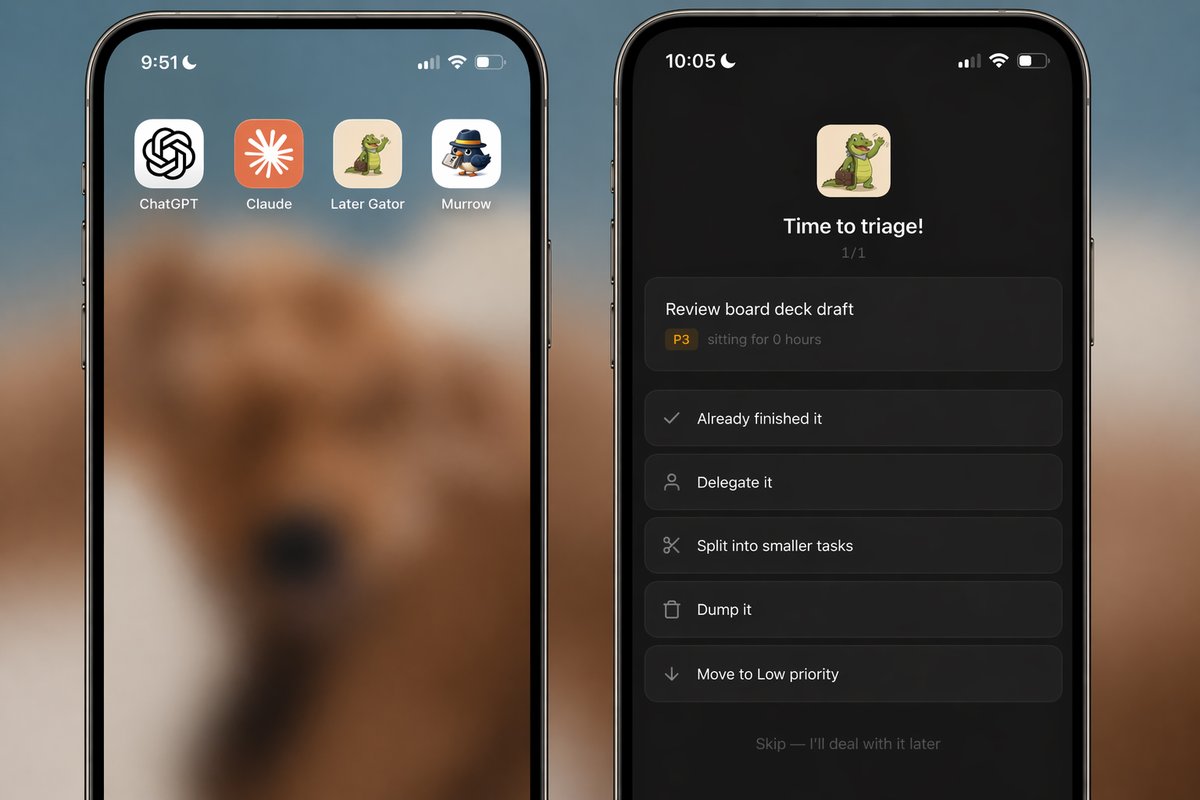
1. Later Gator. Named after my daughter's favorite book (See you Later Alligator). It's my custom to do list app. It's like any other to do list, but a) after 48 hours if I don't do a task it forces me to make a decision to dump it or delegate it; b) it easily connects to Seldon (see below). First built in Lovable, then Claude code. All graphics in ChatGPT.
2. Seldon. My virtual second brain. It prioritizes my todos, updates them in my Later Gator, briefs me on my day, drafts my emails and slacks, even checks updates in my important google docs. Claude co-work.
3. Murrow. My custom news app based on education, business and AI. It pulls from sources I don't often check (e.g. substacks, blogs, X, academic articles). Built in Lovable. Loved so much -- built it out in Claude code and ChatGPT.
4. Chat GPT Pro. I think simply the best at reasoning and thinking. Just takes a while, so I only use for the super hard problems.
5. Lovable and Claude Code - helps me build all the above.
If building your own apps sounds daunting. It’s not. That’s why we added a Lovable AI lab to MasterClass Executive.
He got a cheque for half a million dollars 🤯
and he used it to start @masterclass 😮
@drogier chatted about what young founders are getting wrong about success and how to kept going when no one believes in your idea!
This is a real masterclass from the founder of MasterClass!
He got a cheque for half a million dollars 🤯
and he used it to start @masterclass 😮
@drogier chatted about what young founders are getting wrong about success and how to kept going when no one believes in your idea!
This is a real masterclass from the founder of MasterClass!
I’m so freakin excited! Today, MasterClass is launching the first ever AI native business school experience in collaboration with OpenAI and Chicago Booth.
I’ve been working on this for almost a year and I believe this is the most important thing we've ever built. The old rules don’t apply anymore. This is the only business education built to keep up.
Who’s teaching? @RayDalio. @paulkrugman. @mcuban. Indra Nooyi. @TonyRobbins. @garyvee. Along with 2 Turing Award winners, billionaire operators, world-class professors and even a Nobel prize winner.
You’re gonna get the new business playbook by the people writing it. From how to lead an AI team to applied AI labs with @Lovable and @elevenlabs.
But here's the part I'm most excited about: the entire multi-modal experience is personalized by AI so there is no wasted time and no filler content. This is how you thrive in this new world.
We're accepting 10% of applicants. More selective than the elite. Apply below.
Big thank you to everyone at MasterClass, Madav, @StarrMarcello, @leahbel, @matiii, @antonosika, Van, Julie and Lukas.
You did everything right. But the world changed anyway.
Meet the AI-native business school experience built for today.
Introducing: MasterClass Executive.
Developed with @ChicagoBooth and with collaboration from @OpenAI.
Learn more and be the first to apply: https://t.co/qKWC9FDFVY
I looked at what happened with past mass job displacements. I feel like someone needs to share this.
If the layoffs due to AI are as bad as everyone says, it’ll be even worse. Decades of research from economists at the Fed, Yale, and Columbia show that displaced workers earn ~25% less money for the rest of their lives. And worse: in that first year, their mortality rate increases by 50-100%!
But this is the cruelest part: every single month of unemployment permanently decreases your long-term salary more and more. It’s a trap. It’s what makes going back to grad school so difficult. It’s time lost. So what do you do?
First, whether you currently have a job or were laid off, become the AI expert of that craft. For example, if you are an analyst, spend 3-4 weeks mastering using AI to build financial models, tying together new data sources, creating new work flows. Take classes, build things.
Then spend the next 6 months, still working, becoming a generalist. You need to be able to do 2-3 totally separate job functions. If you make spreadsheets, learn how to create visual designs, or code.
These changes will hurt millions, so part of the future of MasterClass is going to be to try to help. If you want to be included, get on the waitlist here: https://t.co/isrWACCajW
Also, if you were recently let go because of AI, reply or DM and the first 25 will get free access to our AI classes.
This is personal. I don’t know if it’s because I stutter or because of a few bad bosses, but I always felt there were rules to the career game that were never told to me.
My dad (an immigrant) tried to teach them to me. Those rules were always work hard, build relationships, kiss ass if you need to, think about your personal brand. Those rules are changing.
The next phase of MasterClass is to help you figure out how to thrive in the new rules. We are launching probably our biggest most ambitious new project in the next few weeks. If we do it right, it’ll change your life and education.
The best mathematician in the world. Off-the-charts scores. If that's their only skill? They become a professional test-taker.
Now start stacking:
Math + curiosity = decent professor.
Math + curiosity + perseverance = great professor.
Math + curiosity + perseverance + the ability to connect unrelated ideas = Nobel Prize.
The prize doesn’t go to the person who’s best at math. It goes to the person with the right combination. In fact, the Nobel winner might be worse at pure math than the others.
If intelligence is combinatorial and success comes from stacking the right skills then the real question isn’t:
“What skill should I develop?”
It’s:
“What combination should I build?”
Career advice that will get you fired: specialize. Pick a lane. Get good at one thing. Build a moat. I got this advice so many times, but now, it’ll get you fired.
Unless you become the best in the world, a smart generalist with AI can do your job. Think about it. A good generalist with AI can now:
- Write copy that's 80% as good as a good copywriter
- Design wireframes that are 80% as good as a good designer
- Run analysis that's 80% as good as a good analyst
So what’s the better career advice?
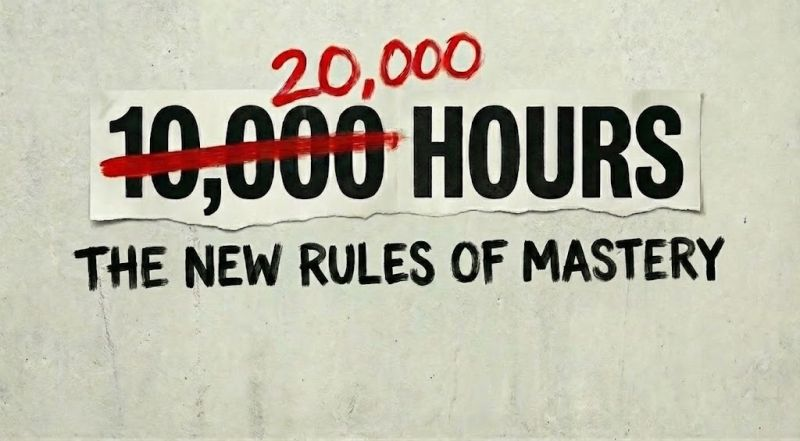
If you're a specialist, good is no longer enough. You have to be great. Masterful. Not 10,000, but 20,000 hours at the craft.
If you're a generalist, double down. Learn every aspect of business. Finance, marketing, product, engineering. And of course, learn to use AI to increase your productivity by 30%. You need to know what and how to drive.
And if you’re early in your career, resist the pressure to specialize too fast. Learn how businesses actually work. Get reps making decisions, not just executing them.
What do you think? Right? Wrong?
You’ve seen the empire. Now learn how she built it. @KimKardashian shares how to trust your instincts, create opportunities, and build influence that lasts.
The New Rules of Business: The Ten Kimmandments
Streaming now: https://t.co/UUVasOoMMo
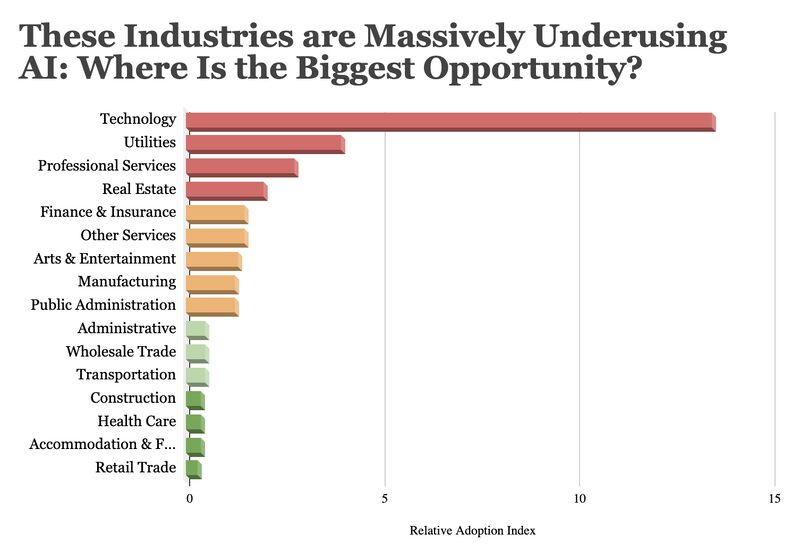
These industries are massively underusing AI.
I analyzed ChatGPT weekly usage. The biggest industries in America have the LOWEST AI adoption rates. Here's what I discovered have the lowest usage:
1. Retail trade: Only 0.30 adoption index (10% of workforce, 3% of ChatGPT users)
2. Healthcare: 0.38 adoption index
3. Food service: 0.38 adoption index
4. Construction: 0.40 adoption index
Meanwhile, tech workers are 13.5x more likely to use AI than the average worker.
What this means for YOU:
Founders: These green bars = massive market opportunities. Build AI tools for these underserved industries and you'll have less competition but huge demand.
Current employees: If you're in retail, healthcare, food service, or construction and you learn AI skills NOW, you'll be way ahead of your peers. Most of your colleagues aren't even trying yet.
New grads: Skip the oversaturated tech companies. Go into these traditional industries and show them what AI can do. You'll be the expert in a room full of beginners. The biggest opportunities are in the industries that haven't caught up yet.
Which industry surprises you most? And what AI use case do you see there?