Georg Cantor introduced the concept of different "sizes" of infinity, which is counter-intuitive when you first encounter it. For many people, the idea of infinity means something without end, unlimited and universally same-sized. But Cantor, through his work on set theory, demonstrated that there are hierarchies of infinity—some infinities are indeed "larger" than others.
There are two possible outcomes: if the result confirms the hypothesis, then you've made a measurement. If the result is contrary to the hypothesis, then you've made a discovery.
-- Enrico Fermi
Ettore Majorana, an Italian physicist renowned for his groundbreaking contributions to quantum mechanics, experienced a mysterious and perplexing disappearance that has baffled the scientific community for decades. In March 1938, at the age of 32, Majorana boarded a steamship named from Palermo to Naples, Italy. However, he never arrived at his intended destination, and his subsequent fate remains unknown.
Majorana's scientific contributions include:
• He applied Fermi’s statistical model of atomic structure (now known as the Thomas–Fermi model) to calculate the core electron energies and the fine structure splitting of atomic spectra.
• Discovered the phenomenon of autoionization in atomic spectra, which occurs when an electron in an excited state decays to a lower state by emitting another electron instead of a photon.
• Developed the Majorana equation, a relativistic wave equation for particles with arbitrary spin that is invariant under charge conjugation.
• Introduced the concept of Majorana fermions, which are particles that are their own antiparticles, such as neutrinos.
• Proposed a symmetric theory of electrons and positrons, in which both particles are described by the same field and can be created or annihilated in pairs.
• Contributed to nuclear theory by deriving the exchange force between two nucleons from a generalisation of the Heisenberg model of ferromagnetism.
• Devised a method to represent the symmetric group and its representations using diagrams, now known as Young tableaux.
On March 25, 1938, Majorana sent a telegram to the director of the Physics Institute in Naples, Antonio Carrelli, announcing his resignation and his intention to leave for an unknown destination. On the same day, he bought a ticket for a boat trip from Palermo to Naples. He boarded the boat at 7 pm and was seen by some passengers during the voyage. On March 26, he arrived in Naples at 10 am and checked into the Hotel Bologna.
He wrote another telegram to Carrelli, saying that he had changed his mind and that he would resume his work as usual. On March 27, he left the hotel without paying the bill and without taking his luggage. He was never seen again.
His family and colleagues reported his disappearance to the police and started a search for him. Several clues and testimonies emerged, but none of them led to a definitive answer about his fate. One prevalent theory suggests that Majorana, plagued by personal and existential struggles, may have chosen to end his own life. This hypothesis is supported by a letter he wrote to a friend prior to his disappearance, expressing a desire to leave the world of academia behind. On the other hand, some propose that Majorana orchestrated his disappearance deliberately, seeking a life of solitude away from the scientific community. This hypothesis is bolstered by reports of sightings of Majorana in subsequent years, although these accounts have been largely unverified and remain inconclusive.
Despite extensive investigations and ongoing searches by authorities, including efforts conducted by Majorana's family and dedicated researchers, no definitive answers have emerged so far.
The fact that an opinion has been widely held is no evidence whatever that it is not utterly absurd; indeed in view of the silliness of the majority of mankind, a widely spread belief is more likely to be foolish than sensible.
-- Bertrand Russell
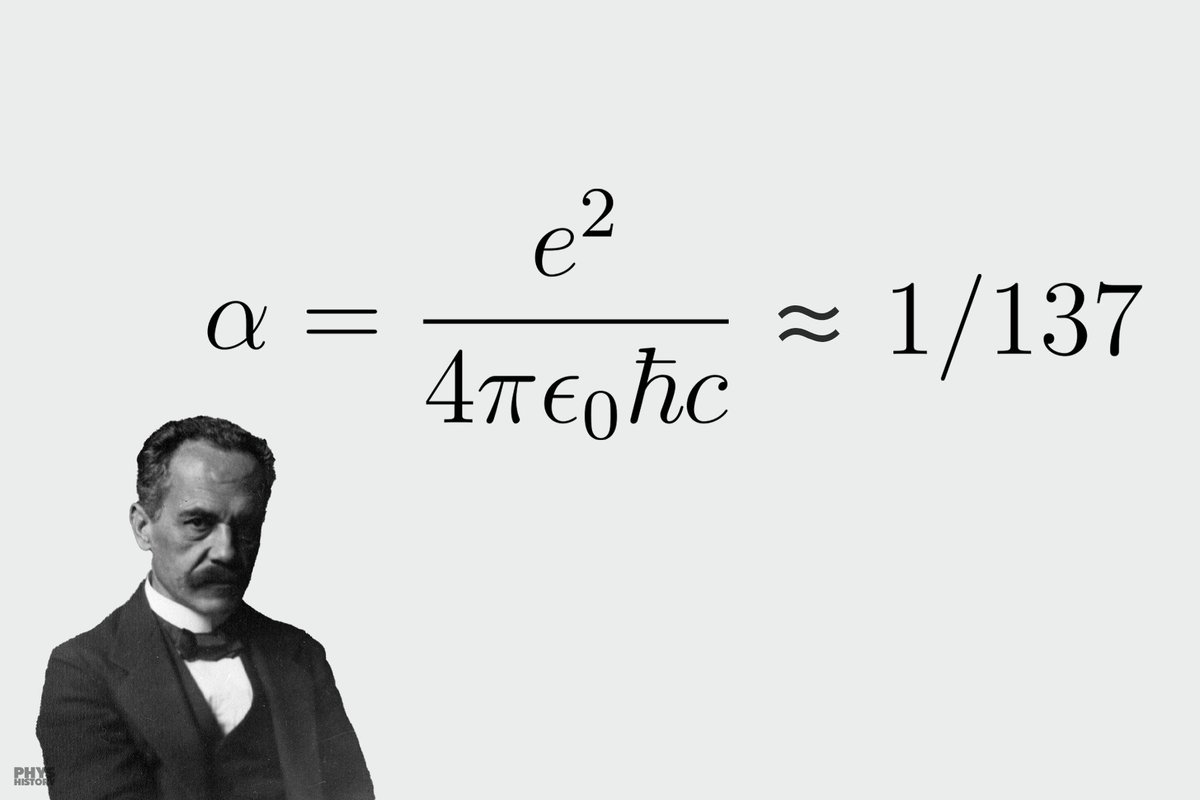
Fine-Structure Constant (approx. 1/137) is a dimensionless constant that characterizes the strength of the electromagnetic interaction between elementary charged particles. Its value is approximately 1/137, and it's one of the fundamental constants of nature whose origin remains a mystery.
It was first introduced into physics by Arnold Sommerfeld in the 1920s to account for the relativistic splitting of atomic spectral lines.
@ProfFeynman John von Neumann gave me an interesting idea:
That you don't have to be responsible for the world that you're in.
So I developed a powerful sense of social irresponsibility because of Neumann's advice.
Made me a very happy man ever since.
[Richard Feynman] via @Robot_Feynman