> almost failed out of PT school
> was flipping Jordans on eBay at 15 before that
> learned to barber for friends and professors
> got rejected by 9 of 10 PT schools
> failed my board exam the first time
> lasted 2 months at my first PT job
> started my own practice in a rented small gym
> made $135 my first month
> the gym shut down
> moved into another gym
> also got shut down 4 months later
> signed my own lease way before I felt ready
> paid agencies that delivered nothing
> burned $40K teaching myself to run ads
> bought a second clinic
> lost 3 staff to a competitor 4 doors down
> hit my first $1M year anyway
> opened a third location in North Carolina
> now pacing $2.6M a year
All of this from a guy who almost failed out of PT school.
I still use everything school taught me about fixing people.
Everything else on this list, I had to learn the hard way.
Alex Hormozi tried to get rid of a broke gym owner by quoting him $6,000.
The guy said yes. That ridiculous conversation eventually led to a $46M company.
The offer playbook behind it (save this):
My life going from flipping Jordans at 15 to building a $2.4M physical therapy business:
> Was flipping Jordans on eBay at 15
> Clearing $500 a month by senior year
> Learned to cut hair for my friends and professors in undergrad and PT school
> Rejected by 9 of 10 PT schools
> Got in off the waitlist and almost failed out
> Failed my board exam the first time
> Quit my first PT job after 2 months
> Started in a room I rented inside a gym
> Made $135 my first month
> That gym shut down, then the next one did too
> Paid agencies that delivered nothing
> Burned $40K learning to run ads myself
> Bought a second clinic and lost 3 staff to a competitor 4 doors down
> Hit my first $1M year
> Opened a third location in North Carolina
> Now pacing $2.4M a year
> Ran a marathon in 2:59:50
> Got married
> Got an orange cat named Momo who doesn't care about any of it
If you're somewhere in the middle of your own list right now, keep going. It gets better.
You've got less than 60 days to make $10K.
That's 5 clients at $2,000.
If you run a service business, you don't need to spend another dollar on ads.
They're already sitting in your phone.
Here's exactly what I'd do starting this week:
1. GO HARASS YOUR ENTIRE LEAD GRAVEYARD
Everyone who filled out a form, DM'd you or called and never bought.
Pull them all into one list. Say it's 200 people.
Send this:
"Hey [name], it's [you] from [business]. You reached out a while back about [problem]. Is that still something you're dealing with?"
No offer or link yet. Just the question.
If 10% reply, that's 20 conversations. Close 1 in 4 and that's your 5 clients.
2. ASK YOUR HAPPIEST CLIENTS FOR ONE REFERRAL
Don't wait until the end. Ask the day they tell you something's working.
Say this:
"Who do you know that's dealing with something like what you came in with? Many of our best clients come from people like you sending someone they care about."
Referrals already trust you before the first call. They close faster and usually pay in full.
3. MOVE PAST CLIENTS ONTO A MONTHLY PLAN
Every client you've finished with is a client you can keep.
"You came to us to fix [problem]. Now let's make sure it never comes back."
Bill it every 4 weeks instead of monthly. That's an extra billing cycle and 13 payments a year instead of 12.
10 clients at $300 is $3,000 coming in every 4 weeks without a single new lead.
4. RAISE YOUR PRICE FOR NEW CLIENTS ONLY
One of our clients didn't close a single person from his ads in January.
He fixed his sales process, raised his prices, and closed 78% of the people he spoke to by March.
Charging more didn't scare people off. Charging like he believed it brought them in.
5. ASK FOR THE REVIEW AT THEIR HAPPIEST MOMENT
The day they say "this is the best I've felt in years," have a QR code ready and ask them right there.
"Would you mind doing us a huge favor and leaving a quick review? It helps other people find us."
Every review makes steps 1 to 4 close easier.
The math:
5 new clients at $2,000 = $10,000
Plus a monthly plan that keeps paying in January
Less than 60 days, your phone and zero new ad spend.
Start with the list tonight.
3. "If we could make the numbers work, would you be down to move forward with this today so we can get you back to xyz goal?"
Tie it down again. You get the yes first, then you figure out the payment together.
If someone says “I need to check my budget, it’s really expensive and a lot more than what I thought it would be”.
Never say:
"No problem, give me a call after you check."
"What did you think it was going to be?"
"I can probably give you a discount."
Instead say:
Nobody warns you about your first employees:
> some will leave and go work for your competitor
> some will be better at the job than you
> you'll repeat yourself 50 times before you write anything down
> you'll pay them before you pay yourself
> you'll hire too late, then fire too late
Still the best decision I ever made.
- You spend on what makes money first
- You hire for your lowest ROI task first
- You know exactly how much it costs you to acquire one customer
- You document SOPs so your team can do it
- You take a week off to see what breaks
- You make decisions off data not from emotions
Signs you still think like an employee:
- You wait to "feel ready"
- You won't pay for help
- You feel weird saying your price
- You do every job yourself
- You blame the market
- You only earn when you work
Signs you think like a business owner:
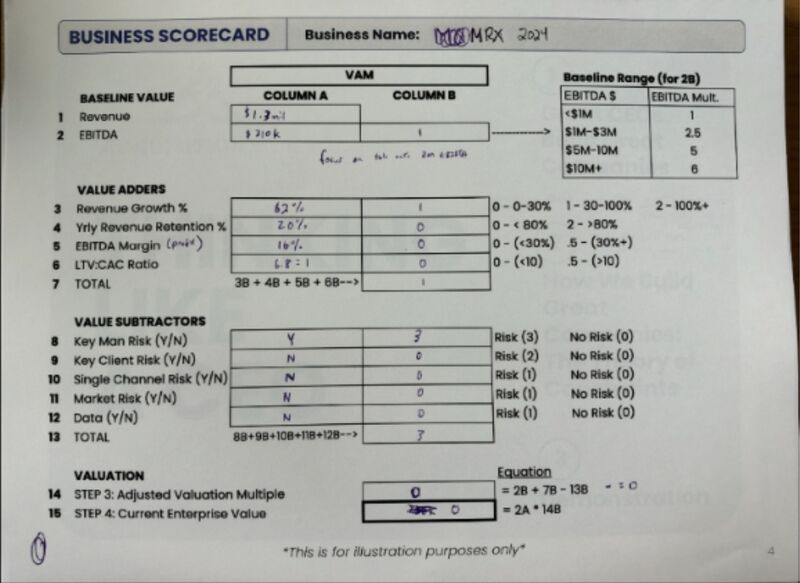
2 years ago my business did $1.3M in revenue, but it was worth $0.
I had no idea until I sat in Alex Hormozi's workshop and ran it through his valuation scorecard.
I walked in expecting a 2-3x multiple.
By the last line of the sheet, I was looking at a zero.
Here's exactly how it happened:
1. The starting multiple
Buyers value a business on profit (EBITDA), and we had $210K.
Anything under $1M in EBITDA starts at a 1x multiple.
2. What added value
Revenue growth: 62%. That earned +1.
Revenue retention: 20%. It needed 80%+. 0.
Profit margin: 16%. It needed 30%+. 0.
Lifetime value to customer cost: 6.8 to 1. It needed 10 to 1. 0.
3. The one line that wiped it all out
Key man risk.
If I disappeared, the business went with me. -3.
1 + 1 - 3 = -1.
A multiple can't go below zero.
0 x $210K = $0.
Every dollar of that $1.3M depended on me showing up.
Here's what actually makes a business worth something:
> It runs without the owner
That one line cost me 3 points on its own.
> Recurring revenue
It's why software companies sell for 10x. Predictable money is worth more than big months.
> Leads growing every year
Buyers pay for growth they can project forward. Flat lead flow kills your multiple.
> A bigger top line
Private equity won't even look at you until around $10M in revenue. At 20 to 30% margins, that's $2 to 3M in profit a year.
Since that workshop, I've built the business like I'm going to sell it, even though I don't plan to.
Today we're pacing $2.6M, and the goal is still $10M.
traits of people who end up building a $1M business:
> started selling something before 18
> bad students, great hustlers
> get bored on vacation by day 3
> would rather overpay than wait
> say "let's just try it" way too often
> can't watch a movie without thinking about work
> spend on courses before furniture
> drive the same car for 10 years
> slightly allergic to being told no
> hate the word "someday"
> treat rejection like a numbers game
> wake up before anyone needs them to
> get weirdly excited about spreadsheets
> have quit at least one thing everyone said was safe
> lose sleep over a bad month, then fix it by Monday