@EJFisch Sorry to hear you're struggling with this EJ. Please forgive me talking my own book to an author, but what you're dealing with is my daily work. Take a look at this site I put together to share how we address this condition in clinic. Hope it helps. https://t.co/8AADRgjPxr
WORK IN PROGRESS
You know those compulsory CE hours like Pain Management, we all have to take? I'm putting together a 6 hr course to cover this topic, suitable for chiropractors. PACE accredited. Available only to NCA Online Academy members. https://t.co/MwuLbbRNKm
GOT "NOCISTAT"? "Fink & Raffa (2025): ascending and descending pathways are a coupled feedback loop with a "nocistat" set point. This explains why brief interventions fail to produce durable change and why multi-modal, sustained approaches are required to shift the set point.
🇯🇵A Japanese developer built an app that puts a fat cat on your screen and forces you to take a break
Silicon Valley spent billions on wellness platforms, mindfulness subscriptions, and digital detox retreats
A guy in Japan said: fat cat, problem solved
What we can or cannot do, what we consider possible or impossible, is rarely a function of our true capability. It is more likely a function of our beliefs about who we are.
New essay on the economics of structural change and the post-commodity future of work.
1. Almost any question about the impact of advanced AI on the economy needs to start at the same place: what is still scarce? Answer that, and the analysis becomes pretty straightforward. This essay explores what becomes scarce if AI really can replicate most of what humans do in production, and what this mean for the future of jobs.
2. My conjecture, working through the economics: labor reallocates across sectors, and the sector it reallocates to has properties that keep labor a meaningful share of the economy. Ultimately this is about the structure of demand itself. For this, we have to go back to Girard, Augustine and Rousseau: once people's base needs are met, their preferences shift to comparative motives (e.g., status, exclusivity, social desirability). This motive is inherently non-satiated.
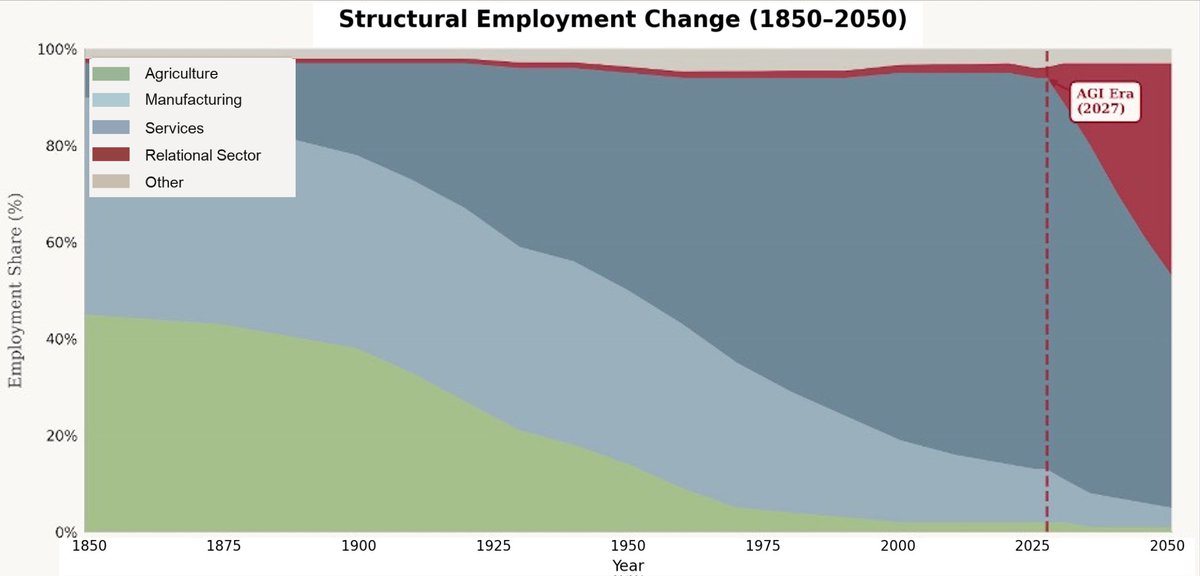
4. The key paper is Comin, Lashkari, and Mestieri (Econometrica 2021). As people get richer, they don't buy proportionally more of everything. They shift spending toward sectors with higher income elasticity. They estimate income effects account for 75%+ of observed structural change.
5. The ironic consequence: the sector that gets automated becomes a smaller share of the economy, not a larger one. Agriculture got massively more productive and its share of employment collapsed. Manufacturing too. The "stagnant" sectors absorb the spending and the jobs.
6. So the question is: which sectors have high income elasticity in a post-AGI world? I argue it's what I call the relational sector. Categories where the human isn't just an input into production, it is part of the value.
7. Why does the relational sector have high income elasticity? Because human desire has a mimetic, relational dimension. We don't just want things for their intrinsic properties. We want what others want, and we want it more when others can't have it. Girard, Rousseau, Augustine, and Hobbes all saw this.
8. In work with Kristóf Madarász, we showed this experimentally: WTP roughly doubles when a random subset of others is excluded from the good. And in new work with Graelin Mandel, AI involvement kills the premium. Human-made art gains 44% from exclusivity; AI-made art only 21%.
9. This all comes together for the core argument. The sector that absorbs spending as AI makes commodity production cheap is one where human provenance is part of the value, and demand for it grows faster than income. Exactly the profile that keeps labor meaningful.
10. To be clear about the claim: I'm NOT saying aggregate labor share must rise. It may fall. The claim is about sectoral composition, i.e., where expenditure and employment go once commodities get cheap, and the fact that the sector that will absorb reallocated labor maps to a substantial component of human preferences and desire.
11. If you're interested in the formal model, a linked companion technical note works out all the economics.
Read the essay here: https://t.co/NcjVgn2o8g
He was told he needed L5-S1 fusion.
He's an orthopedic surgeon who has done spine surgery himself.
He chose something else instead.
Here's what changed in a year.
I built a free program that walks you through finding your pain-off direction.
It is the first thing I do with every patient who comes in with these signs.
Start here: https://t.co/xhSGkFAQcQ
5. Morning is the hardest part of the day.
Discs absorb fluid overnight. By morning they are at maximum pressure.
The first 30 minutes are brutal. Then it slowly improves as you move around and the pressure redistributes.
If 3 or more of these match your situation, you are probably dealing with a disc problem, not a muscle strain or a bad back.
The good news: discs respond to mechanical input. The right movement in the right direction can change your symptoms within minutes.