FREE skin health for everyone, everywhere. 🌍
Meet DermAIde — FREE AI dermatology help in minutes.
Check it. Share it. Pass it on. ❤️
https://t.co/z4XLTe8gBW
#DermAIde#FreeSkinCheck
The Seller's Finance Playbook shows you how to sell and buy real estate without a bank: become the lender, collect monthly income, and sell on your own terms.
✅How to structure a deal — price, rate, and terms
✅How to run the numbers in 2 minutes (no spreadsheet needed)
✅How to qualify a buyer the way real lenders do
✅Exactly what to do if a payment is missed or a deal goes sideways
✅The legal basics
Free, Grab your copy here 👇 https://t.co/cOdSLb0jV3
A lot of people have asked me why I started IGR.
Short answer: because, why not? Long answer: at 12 PM today.
Join me live as we talk about IGR, journalism, India’s voice in the world, and what possesses someone to start a media company in 2026.
(Also, I’ve done approximately one YouTube Live in my life. So this could be mildly chaotic.)
Most people misunderstand Elon's ultimate goal
He is trying to make our entire civilization win. To view it as anything less is just shortsighted
Elon winning means humanity winning
While most people are stuck in a zero-sum mentality, he operates with a "grow-the-pie" mindset
You can see all the things he built till now and also his future plans
He started working on things long before it was popular or considered possible:
• Zip2 & payment systems
• Electric vehicles & batteries
• Pure vision self-driving
• Humanoid robots
• Starlink Internet
• AI (OpenAI)
• Neuralink
• The Boring Company
And the future is even bigger: 1TW compute clusters, space datacenters, lunar bases, mass drivers on the Moon, and making life multi-planetary... basically driving humanity toward becoming a star-faring civilization
He consistently takes on the world’s hardest problems to push our civilization forward... He freakin makes sci-fi real
Across the United States, millions of older adults are living alone—without consistent support, structure, or daily connection.
More than 14 million seniors live alone, and nearly 1 in 4 adults over 65 are considered socially isolated. Loneliness is not just emotional—it has measurable health consequences. Studies show that prolonged isolation increases the risk of dementia, depression, and even premature death at levels comparable to smoking or obesity.
At the same time, most housing environments offer no built-in support system. Residents are left to manage appointments, medications, transportation, and daily routines on their own. Small changes—missed meals, forgotten medications, reduced activity—often go unnoticed until they become serious problems.
Care systems exist, but they are designed for later stages, typically introduced only after decline has already occurred—and often at a cost of $3,000 to $6,000 per month, making them inaccessible for many middle-income individuals .
This creates a growing population that is:
Too independent for assisted living
But lacking the structure and support needed to stay stable
The result is a silent gap—where millions live alone, gradually declining without intervention, coordination, or connection.
The system is not failing because support does not exist—it is failing because support arrives too late.
⸻
👉 The question is:
How do we create a system that supports people earlier—before isolation becomes decline?
https://t.co/nMjQcILxG5 every model, half off.
Original APIs, on our dime.
No wrappers. No dumbed-down models. No throttling.
Anthropic, OpenAI, Gemini
Official APIs, zero markup, plus 1-for-1 top-up bonus.
Why so cheap? Because we're paying for it.
For the past few years, I’ve been studying something that most people overlook:
Where real estate stops… and where care begins.
And more importantly—
what happens in between.
The U.S. has two massive systems:
Apartments — scalable, stable, but limited to rent-driven growth
Assisted living — high revenue, but expensive, institutional, and entered too late
Between them, there is a large gap.
Not a niche.
A gap.
Millions of people are still independent—but not fully supported.
They don’t need assisted living.
But they also don’t thrive in traditional housing.
From a resident perspective:
They slowly decline without structure or support.
From an investor perspective:
Multifamily has capped NOI growth.
Assisted living is operationally heavy and hard to scale.
So the question becomes:
👉 What if housing itself could evolve?
Not by building new facilities—
but by transforming what already exists.
I’ve been working on a model that:
• Adds a structured support layer inside apartments
• Increases revenue per unit beyond rent
• Improves retention and resident experience
• Scales without requiring new development
And most importantly—
👉 Controls the full economic flow, not just a portion of it.
This is not assisted living.
This is not traditional multifamily.
It’s something in between—
built for scale.
Still early.
Still refining.
But the fundamentals are strong.
If you are an investor interested in:
• Platform-driven real estate
• Recurring revenue models
• Large, underserved markets
I’m opening a few conversations for an initial round.
Feel free to reach out privately.
3 Ways to Buy a Home (With & Without the Bank)
Most people think there’s only ONE way to buy a home:
👉 Go to the bank
👉 Get approved
👉 Pay for 30 years
But in reality, there are 3 powerful ways to buy a house:
⸻
🏦 1. Traditional Bank Loan (The Most Common Way)
How it works:
You go to a bank, they check:
Your credit score
Your income
Your job history
If approved, they lend you money to buy the home.
⸻
📊 Example:
Let’s say you buy a home in Phoenix for $400,000
Down payment (5%) = $20,000
Loan = $380,000
Interest rate ≈ 7%
Monthly payment ≈ $2,500–$2,800
⸻
👍 Pros:
✔ Safe and predictable
✔ Lower interest (compared to creative deals sometimes)
✔ Widely accepted
👎 Cons:
❌ Hard to qualify
❌ Requires good credit + income
❌ Takes time (30–45 days)
❌ High upfront costs
⸻
🤝 2. Seller Financing (Seller Becomes the Bank)
How it works:
Instead of going to a bank…
👉 The seller says: “Just pay me monthly.”
👉 You agree on:
Price
Down payment
Monthly payment
Interest
⸻
📊 Example:
Home price: $400,000
Down payment: $20,000
Seller finances: $380,000
Interest: 6% (negotiable)
Monthly payment ≈ $2,200–$2,500
⸻
💡 What’s different?
No bank approval
Terms are flexible
Faster closing (can be 7–14 days)
⸻
👍 Pros:
✔ Easier to qualify
✔ Flexible terms
✔ No bank needed
✔ Great for self-employed buyers
👎 Cons:
❌ Not every seller agrees
❌ May need a bigger down payment
❌ Shorter terms (balloon payments sometimes)
⸻
🔑 3. Subject-To (Take Over the Existing Loan)
This is where things get powerful.
How it works:
The seller already has a mortgage
You take over the payments
The loan stays in their name
You get control of the house
⸻
📊 Example:
Seller bought the home in 2021 with a 3% interest rate
Remaining loan balance = $320,000
Monthly payment = $1,700
Today, that SAME house is worth $400,000
👉 Instead of getting a new loan at 7%…
👉 You take over the $1,700 payment
⸻
💥 Why this is powerful:
If you bought the same house with a new loan today:
Payment would be ≈ $2,600+
But Subject-To:
👉 You only pay $1,700
That’s a $900/month difference
⸻
👍 Pros:
✔ No new loan
✔ Keep LOW interest rates
✔ Lower monthly payments
✔ Can buy with little money down
👎 Cons:
❌ Loan stays in seller’s name
❌ Needs trust + proper paperwork
❌ Must structure correctly to protect both sides
⸻
🧠 SIMPLE WAY TO UNDERSTAND
Think of it like this:
🏦 Bank Loan = Borrow from the bank
🤝 Seller Financing = Borrow from the seller
🔑 Subject-To = Step into seller’s loan
🔬Indexer Electrs in Neurai
Along with the large-scale updates we are making to Neurai, we also need better blockchain indexing support. For the past few weeks, we have been working on integrating KAWPOW and the new Neurai OP_codes and PQ addresses into electrs.
🔍 Who is Electrs?
Electrs is a high-performance Electrum server implementation written in Rust. It provides fast and efficient blockchain indexing with low resource usage, enabling lightweight clients to query the blockchain quickly without needing to run a full node with heavy indexing.
🛠️ Features
✅ Supports Electrum protocol v1.4
✅ Works with PQ addresses
✅ Maintains an index over transaction inputs and outputs
✅ Fast synchronization of the Neurai blockchain
✅ Low index storage overhead (~10%)
✅ Efficient mempool tracking (allowing better fee estimation)
✅ Low CPU & memory usage (after initial indexing)
txindex is not required for the Bitcoin node
✅ Uses a single RocksDB database for better consistency and crash recovery
A new service that works with post-quantum addresses and new tools for advanced scripting.
#Neurai #XNA $XNA #PQ
🏡 What is Seller Financing (Seller Carry)? And Why It Matters Today
In real estate, most people think you must go through a bank to buy a property.
That’s not always true.
With Seller Financing (Seller Carry):
👉 The buyer does NOT need a bank at all.
Instead, the seller acts as the lender and finances the deal directly.
🔍 So how does this actually work?
Let’s break it down simply:
Buyer and seller agree on the price and terms
Buyer gives a down payment (if required)
No loan application, no bank approval, no traditional underwriting
The seller creates the financing terms (interest rate, payment, timeline)
Buyer makes monthly payments directly to the seller
It’s essentially a private agreement between buyer and seller.
💡 Example:
Purchase price: $300,000
Buyer puts down $30,000
Seller finances the remaining $270,000
Buyer pays the seller monthly (just like a mortgage)
👉 The key difference:
There is no bank involved in the transaction.
🚀 Why this is powerful:
For Buyers:
No dealing with banks, loan officers, or strict approval processes
Faster and more flexible closings
Opportunity to acquire deals that may not qualify traditionally
For Sellers:
Earn consistent monthly income
Potential to earn interest (like a bank would)
More flexibility to structure a deal that works
⚠️ Important:
This is a negotiated structure. Everything—terms, payments, timeline—is agreed upon between both parties, so it must be done carefully and documented properly.
📌 Bottom line:
Seller financing removes the bank from the equation and replaces it with flexibility.
In today’s market, that flexibility can be the difference between a deal happening—or not.
#RealEstateInvesting #SellerFinancing #CreativeFinance #NoBank #Multifamily
🌎 Neurai: The Next Step
The Neurai Testnet extends Neurai's scripting engine with a set of specialized opcodes.
The goal is concrete:
✅Scripts that inspect their own transaction and enforce spending rules at the consensus layer.
✅Native asset introspection: covenants that read asset names, amounts, and metadata directly.
✅External state via reference inputs: read on-chain oracle data without consuming it.
✅Implemented and running on testnet today.
🌍New Opcodes add more power
1⃣ Covenant Primitives: OP_CHECKTEMPLATEVERIFY locks a UTXO to an exact transaction template: outputs, amounts, and destinations are fixed at creation time. OP_CHECKSIGFROMSTACK verifies a signature against any arbitrary message on the stack, enabling scripts to consume oracle-signed data. Both support classical ECDSA and post-quantum ML-DSA-44 keys.
2⃣ Transaction Introspection:
Opcodes that push raw transaction data onto the stack: output amounts (OP_OUTPUTVALUE), output scripts (OP_OUTPUTSCRIPT), the spent UTXO's own script or value (OP_TXFIELD), locktime (OP_TXLOCKTIME), input/output counts, and configurable field hashes (OP_TXHASH). The building blocks for covenants that enforce transaction structure.
3⃣ Asset Introspection:
Neurai-native. OP_OUTPUTASSETFIELD and OP_INPUTASSETFIELD read asset fields directly from transaction inputs and outputs: name, amount, decimal units, reissuable flag, IPFS hash, type. Scripts can verify asset properties without parsing serialized data.
4⃣ Reference Input Introspection:
A new vrefin vector carries UTXOs that are read but not spent. OP_REFINPUTFIELD and OP_REFINPUTASSETFIELD expose their value, script, and asset fields to the script engine. Shared onchain state price feeds, device registries, rate limits readable by many transactions simultaneously without being consumed.
5⃣ Byte Manipulation:
OP_CAT (re-enabled) concatenates two stack elements. OP_SPLIT splits a byte array at a given position. OP_REVERSEBYTES reverses byte order. These are the primitives for constructing and parsing data structures on the stack.
6⃣64-Bit Arithmetic:
OP_MUL, OP_DIV, and OP_MOD are re-enabled and operate on 64-bit signed integers with overflow protection. Existing arithmetic opcodes (OP_ADD, OP_SUB, comparisons) are upgraded to the same domain. Required for any covenant that computes amounts, rates, or fees in script.
🌏Use Cases
1) Trustless Limit Order (DEX)
A seller locks ASSET_A in a covenant. Anyone can spend it, but only if the transaction sends the required ASSET_B back to the seller. Atomic swap enforced by consensus — no escrow, no platform.
2) Vault with Spending Cap
Withdrawals are capped at 1 XNA per transaction. The remainder must return to the same covenant. A stolen key can only drain 1 XNA per block. Cold recovery after a 144-block timelock.
3) Recurring Payment Stream
A UTXO funds a scheduled payout. Each settlement is only valid after the next time period, pays the exact defined amount, and returns the remainder to the same covenant. Anyone can trigger it. No operator needed.
4) Asset Reissuance Gate
An oracle signs off-chain approval data. The covenant verifies the signature, caps the reissue amount, and keeps the owner token locked. Supply increases require provable approval enforced by the script.
5) CTV Payout Tree
A single UTXO commits to a tree of future payouts. Each recipient claims their branch independently. Only claimed branches consume block space. No coordination required.
6) OracleFed Covenant via Ref Inputs
An oracle UTXO holds a price or state value. Contracts read it via vrefin without consuming it. The oracle persists and can be referenced by hundreds of transactions simultaneously.
7) IoT Sensor with Conditional Payment
A sensor signs its readings. The covenant verifies the signature, checks the device is registered against a reference input, computes payment from units × rate, and enforces the output. Bad data or unregistered devices, transaction fails.
8) Asset-Gated Encrypted Messaging (DePIN)
Only holders of a specific Neurai asset can query the message pool. Messages are encrypted per-recipient via hybrid ECIES. The access gate is a covenant, OP_INPUTASSETFIELD verifies asset ownership at the consensus layer. No server-side database decides who can read. Supports paginated retrieval for embedded hardware (ESP32 example included in the codebase).
⚛️PostQuantum Addresses
AuthScript supports ML-DSA-44 (FIPS 204) natively. Covenants using AuthType 0x01 require a post-quantum signature before executing. Any vault, order, or governance contract can be quantum-resistant today. Hash-based covenant logic is inherently quantum-resistant by design. When CSFS is active, the stack element cap extends to 3072 bytes to fit PQ keys in standard relay.
We are adding all of this and more to Neurai to make it more powerful and durable for years and decades to come.
Soon we will begin testing on Testnet to unlock the full potential of what we are deploying.
Spoiler:
The new upgrade is called: Positronic
#Neurai #XNA $XNA #PQ #IoT #DePIN #AI
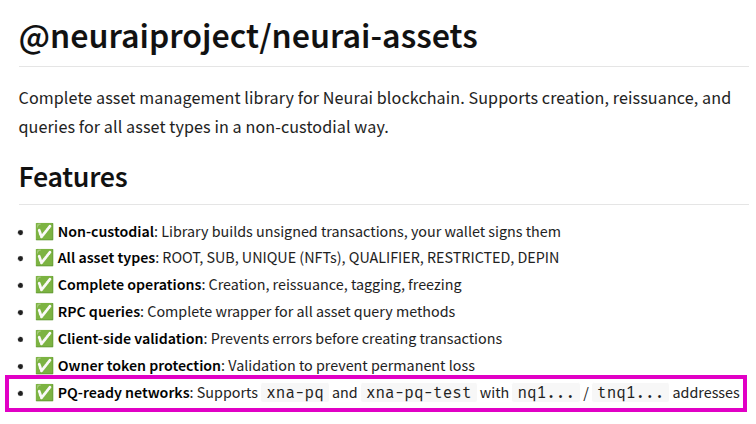
Adding support for post-quantum cryptography addresses isn't the most critical part of the upcoming network update, but it is one of the most important steps toward ensuring the network's future functionality.
A lot of people ask me why I like buying homes “subject-to” instead of the normal way—especially for a primary home. Let me break it down super simple.
When you buy a house the traditional way, you usually have to go through a bank. That means a big down payment, strict credit checks, and higher interest rates. It can feel slow, expensive, and sometimes stressful.
With subject-to, it’s different.
You’re buying the house, but instead of getting a new loan, you take over the seller’s existing mortgage. That one shift can make a big difference.
First, you don’t always need a huge amount of cash upfront. In many cases, the entry cost is much lower compared to a traditional purchase.
Second, you can benefit from the seller’s old interest rate. Many homeowners locked in rates years ago that are much lower than today’s rates. That means your monthly payment can be more affordable.
Third, the process is usually faster and more flexible. You’re not dealing with the bank the same way, so there’s less red tape and more room to structure a win-win deal.
Another big advantage is that credit isn’t always the main factor. This opens the door for people who might not qualify the traditional way.
And honestly, one of the best parts is that you’re often helping the seller solve a problem—maybe they need to move quickly or can’t sell the traditional way. So both sides can benefit.
That said, it’s not perfect. The loan stays in the seller’s name, and you have to be responsible and make every payment on time. This strategy works best when you understand what you’re doing.
For me, subject-to is just a smarter, more creative way to approach real estate—especially in today’s market.
If you know how to use it right, it can open doors that the traditional path can’t.
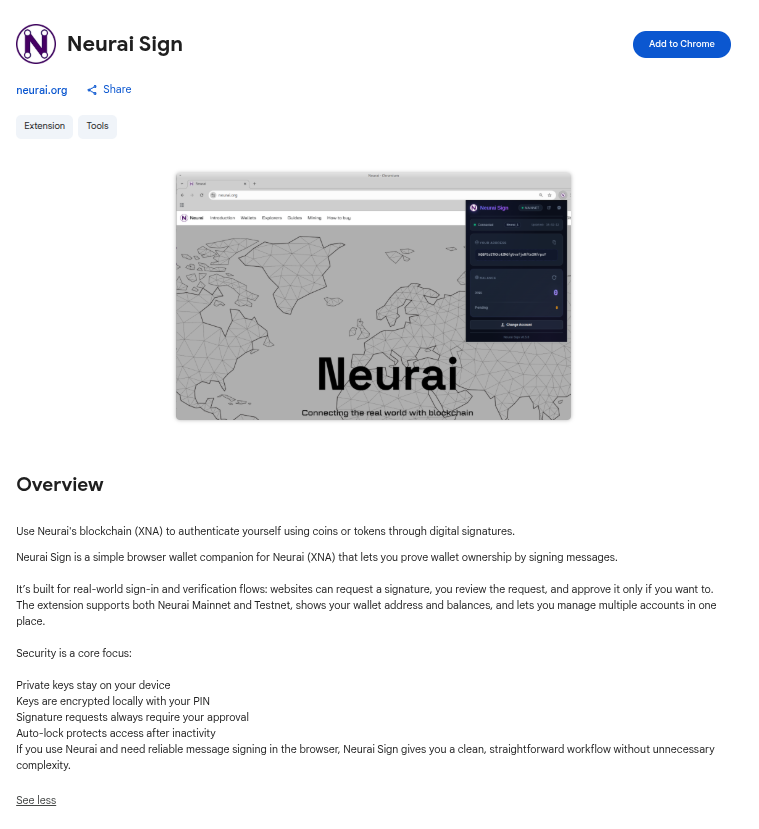
🔏 Chrome Store: Neurai Sign
The Chrome Store has approved our addon for validation via the Neurai blockchain. This is a test version, and we have a superior version on our Github that will be uploaded this week, which includes more options.
Remember, for now it is only for testing and trialing, and should not be used with a wallet containing funds.
🔬 To test:
We have created this small website to test the addon:
https://t.co/Jr6XKgadet
🎯Addon Chrome Store url:
https://t.co/hMxZs9gfE3
#Neurai #XNA $XNA #Sign #NFT #IoT
🔐 Neurai: MLDSA for ESP32
We present the first NIST post-quantum library exclusively for ESP32 microcontrollers, hosted in the Arduino library with easy integration into the software developed for these small devices.
This is one of several libraries that we will be creating for ESP32 devices to optimize the use of the Neurai network in the interconnection of IoT devices through the DePIN system that we have developed.
✨Features about this library
✅ FIPS 204 compliant
✅ML-DSA security levels (44, 65, 87)
✅Hardware RNG
✅Memory optimized
✅Constant-time
✅NVS key storage
✅Simple C++ wrapper classes (MLDSA44, MLDSA65, MLDSA87)
✅NIST test vectors
Today we have updated to MLDSA65 and MLDSA87, ensuring more powerful models for devices with greater resources, such as advanced ARM processors.
🎯Benefits of this library
1⃣ On-Device Transaction Signing The library enables ESP32 microcontrollers to process ML-DSA key generation and signature algorithms locally.
2⃣ Message Payload Authentication For Neurai's token-based messaging system, the library provides the necessary cryptographic functions to append ML-DSA signatures to data payloads.
3⃣ Elimination of Centralized Signing Proxies By supporting heavy cryptographic operations on the edge, the system architecture can be simplified.
4⃣ FIPS 204 Cryptographic Compliance for Extended Lifecycles Embedded devices often have operational lifecycles spanning several years.
5⃣ Implementation of Token-Based Access Protocols The library allows the ESP32 to act as a verifier for incoming commands.
🛰️ Conclusion
We are currently creating a series of devices with software for ESP32 that we will be presenting in the coming days. Although the problem of quantum computers is still years away, it is good to start thinking about having everything adapted for when the time comes.
With the DePIN communication encryption we currently have, we can be certain that it will not be possible to decrypt it for many years to come.
#Neurai #XNA $XNA #MLDSA #ESP32
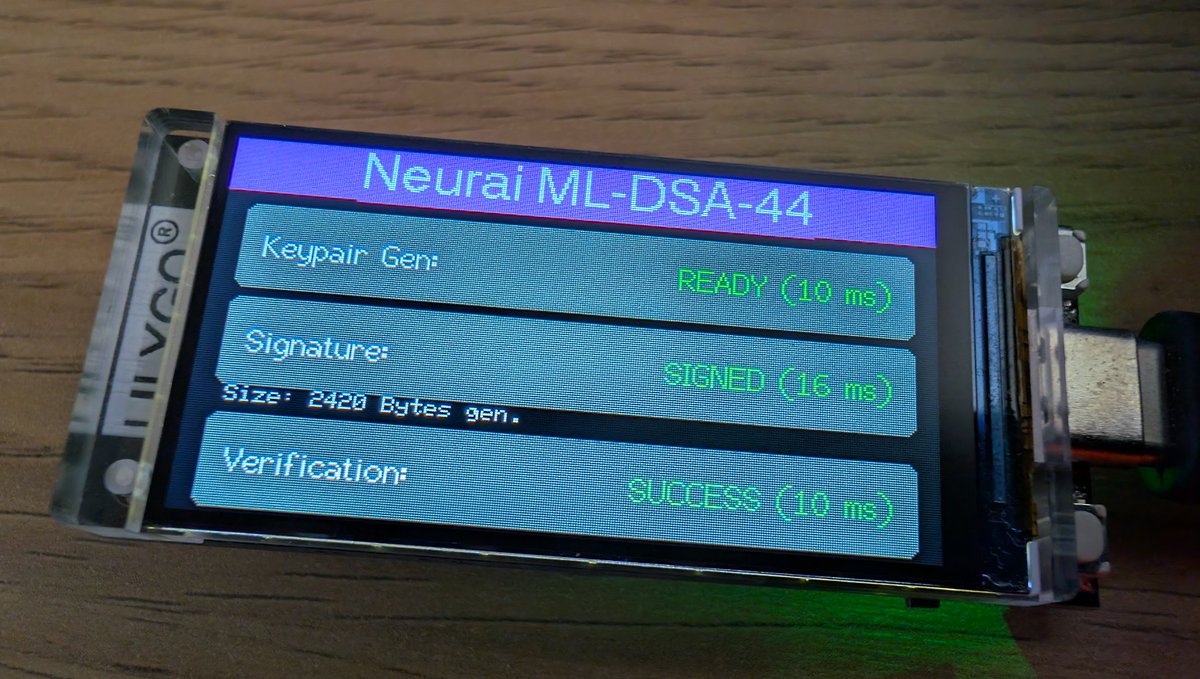
🔐 Neurai: MLDSA44 for ESP32
Here's a sneak peek at what we've been working on these past few weeks.
The first MLDSA44 library for post-quantum signatures for ESP32, created by our developers.
More coming soon.
#Neurai#XNA $XNA #MLDSA44#ESP32