This is a video from All India Institute of Ayurveda. This person is the head of department of Ayurvedic surgery.
The person who is interviewing him is a so-called Ayurvedic surgeon and a vile troll on Instagram.
Can anyone tell me what is Ayurvedic in what they are doing?
Can you see how insulting this is, to the tens of thousands of students who clear real medical entrance post graduate exams to become surgeons, spending time, money and their whole lives dedicated to the work...
...and these pseudoscience frauds with a side degree are allowed to sit at the same table as those hardworking surgeons across the country.
No other country dehumanizes and degrades it's doctor community like India does. So congratulations if you are a doctor in India. You are basically on the same page as quacks and frauds with a degree in ancient bullshittery, allowed to be glorified by the pseudoscience sympathizing government.
https://t.co/JRibMnnELl
🤔 Thinking about PRP?
Before you decide, ask these 7 questions. An informed patient makes better treatment decisions. 🧵
**1️⃣ Am I a good candidate for PRP?**
Ask if your diagnosis and stage of arthritis are likely to benefit from PRP.
2️⃣ What type of PRP will be used?
Leukocyte-rich or leukocyte-poor? How is it prepared, and why is that protocol chosen?
3️⃣ How will the injection be performed?
Will it be ultrasound-guided to improve placement accuracy?
4️⃣ Why do you recommend this number of injections?
Is the plan based on evidence and my specific condition?
5️⃣ What results should I realistically expect?
How much improvement is possible, and how long might it take?
6️⃣ What happens after the injection?
What activities should I avoid, and what rehabilitation plan should I follow?
7️⃣ What are the risks and limitations?
When is PRP not the right choice? What alternatives should I consider?
Remember: PRP is not just about the injection.
Patient selection, diagnosis and rehabilitation often influence outcomes just as much.
A good doctor welcomes questions.
Shared decision-making leads to realistic expectations and better treatment choices.
#PRP #KneeArthritis #Orthopedics #EvidenceBasedMedicine
If you were considering PRP, which of these seven questions would you ask first?
Like follow and share for more useful content.
DM for personal consultations.
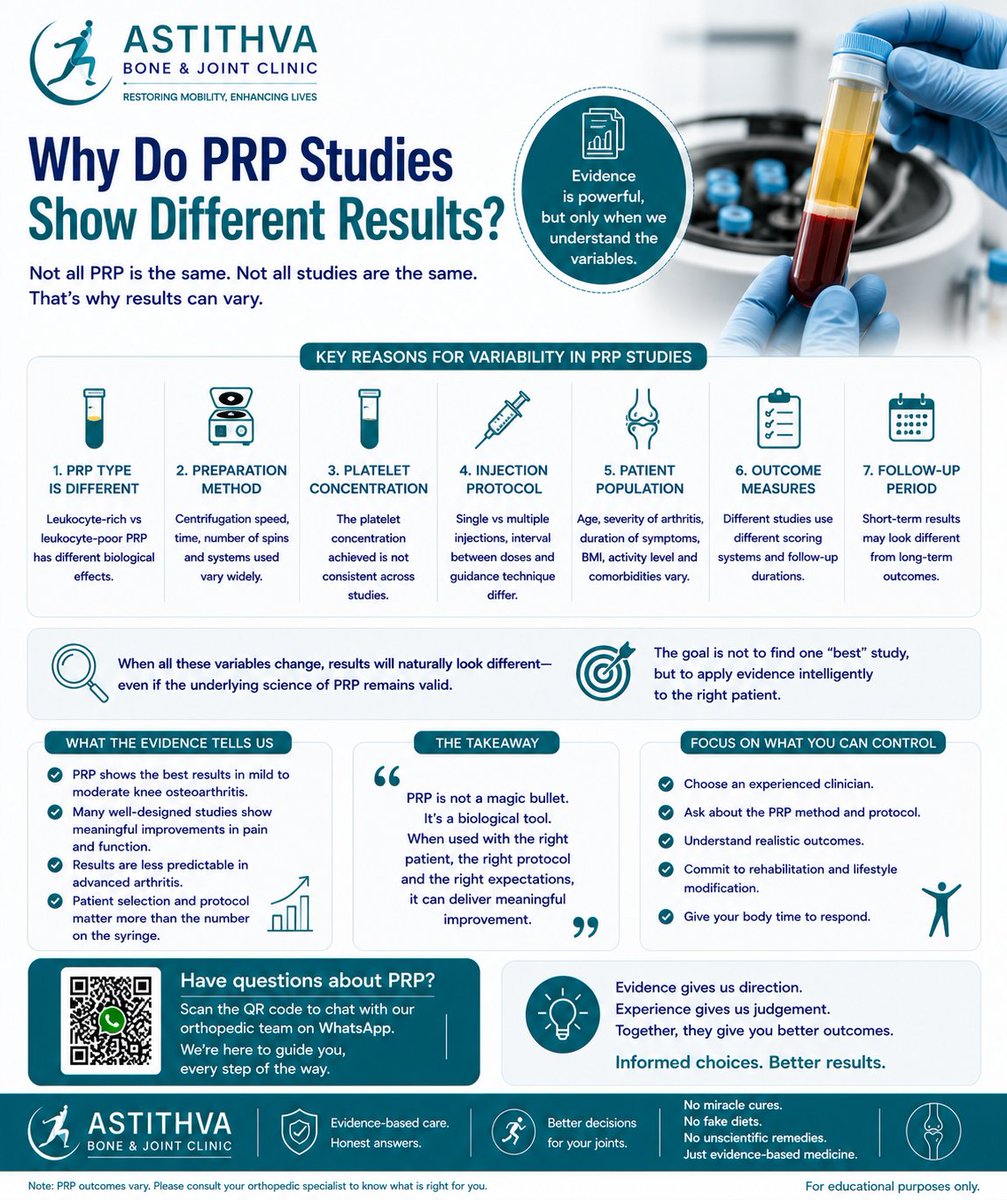
Why Do PRP Studies Show Different Results?
📚 Ever wondered why one PRP study looks promising while another seems less impressive?
Here's why. 🧵
PRP isn't one standardized treatment.
Different studies often evaluate different products and techniques.
🩸 PRP preparation varies.
Platelet concentration, white blood cells and processing methods differ between systems.
💉 Injection protocols vary.
Some studies use one injection.
Others use two or three.
Some use ultrasound guidance, others don't.
👤 Patients differ too.
Age, arthritis severity, body weight, activity level and overall health all influence outcomes.
📅 Follow-up matters.
A study measuring results at 3 months may reach different conclusions than one measuring outcomes at 12 months.
Researchers also use different scoring systems for pain and function.
Comparisons aren't always straightforward.
That doesn't mean PRP doesn't work.
It means biological treatments are complex and results depend on many variables.
The strongest evidence generally supports PRP in carefully selected patients with mild to moderate knee osteoarthritis.
The question isn't:
"Which study is best?"
It's:
"What does the total body of evidence tell us?"
#PRP #EvidenceBasedMedicine #Orthopedics #KneeArthritis
When you hear conflicting medical studies, what helps you trust a treatment—scientific evidence, your doctor's experience, or both?
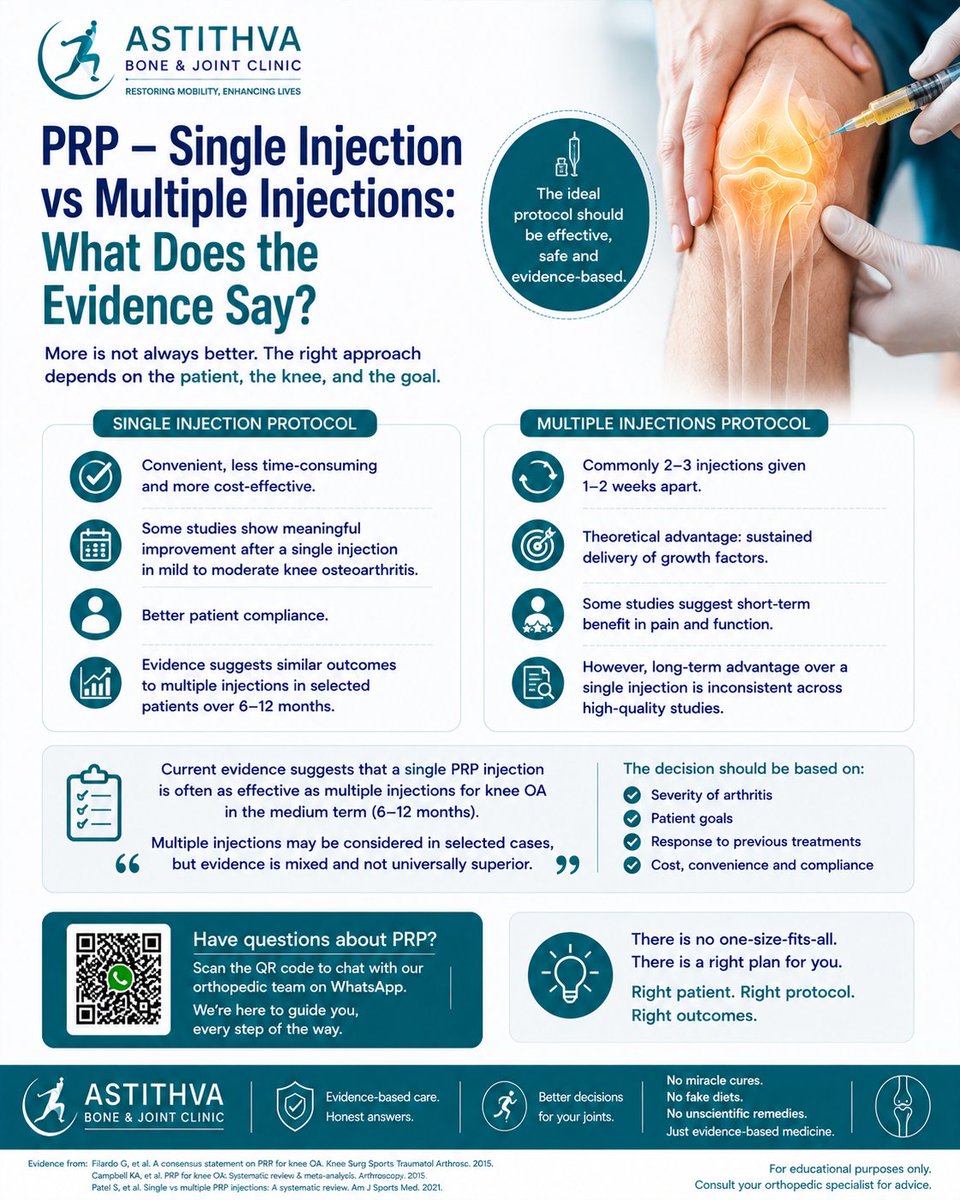
💉 One PRP injection or a series of injections?
Is more always better? Here's what current evidence suggests. 🧵
Many clinics offer 1, 2 or 3 PRP injections.
But there isn't one protocol that's proven best for every patient.
✅ A single PRP injection has shown meaningful improvements in pain and function in many patients with mild–moderate knee OA.
Some clinicians recommend 2–3 injections given weeks apart.
The idea is to provide repeated biological stimulation.
But does adding more injections always produce better results?
Current evidence says: **not necessarily.**
Several studies have found similar outcomes between single and multiple injections over medium-term follow-up.
That doesn't mean multiple injections never help.
Selected patients may benefit, depending on symptoms, response and treatment goals.
The decision shouldn't be based on a package.
It should be based on your arthritis stage, clinical findings and shared decision-making.
More treatment isn't always better treatment.
The right treatment is the one supported by evidence for your situation.
PRP should be individualized.
✔️ Right patient
✔️ Right protocol
✔️ Right expectations
✔️ Right rehabilitation
#PRP #KneeArthritis #Orthobiologics #EvidenceBasedMedicine
If you were offered PRP, would you prefer the fewest injections needed or a treatment plan tailored to your condition, even if it meant additional sessions?
Leukocyte-Rich PRP vs Leukocyte-Poor PRP – Does It Matter?
🩸 Not all PRP is the same.
You may hear terms like Leukocyte-Rich (LR-PRP) and Leukocyte-Poor (LP-PRP). What do they mean? 🧵
PRP contains platelets.
Some preparations also contain different amounts of white blood cells (leukocytes).
That's where the names come from.
🧪 LR-PRP contains more white blood cells.
This may create a stronger inflammatory response after injection.
🧪 LP-PRP contains fewer white blood cells.
It may produce less post-injection pain in some patients.
Does one work better for knee arthritis?
Current research hasn't shown a clear winner for every patient.
Some studies suggest LP-PRP may be better tolerated in knee OA.
Others show little difference in long-term outcomes.
The preparation method is only one piece of the puzzle.
Patient selection often has a greater impact on results.
Your arthritis stage, activity level, health and rehabilitation may influence outcomes more than PRP type alone.
The best PRP isn't simply "rich" or "poor."
It's the right preparation for the right patient.
Evidence continues to evolve.
Treatment decisions should be individualized—not based on marketing labels.
#PRP #KneeArthritis #Orthobiologics #EvidenceBasedMedicine
Before today, had you ever heard of Leukocyte-Rich and Leukocyte-Poor PRP?
Let me know in the comments below.
Like follow for more such content.
@drprashanthhk Hi Dr Prashanth.. I feel that anyone who follows some quack influencer and faces some health problems as a result, richly deserves what he gets
🩸 Is PRP safe?
Because PRP comes from your own blood, many patients ask whether it's safer than other injections. Here's what we know. 🧵
PRP is an autologous treatment.
That means the injected material comes from your own blood.
Since it uses your own blood, allergic reactions to the PRP itself are uncommon.
Like any injection, PRP can cause temporary pain, swelling or stiffness for a few days.
Bruising at the blood draw or injection site can also occur.
These effects are usually short-lived.
Serious complications are uncommon when PRP is prepared properly and injected using sterile technique by trained clinicians.
Safety depends on more than the PRP.
Patient selection, sterility and correct injection technique all matter.
PRP is not suitable for everyone.
Certain medical conditions or medications may influence whether it's appropriate.
Always discuss your medical history, medications and expectations before deciding on treatment.
A safe procedure begins with the right diagnosis—not simply choosing an injection.
#PRP #Orthopedics #EvidenceBasedMedicine
💬 Question: What safety concern about PRP would you like answered first???
Pain, infection risk, side effects, or recovery.
Let me know in the comments.
Like follow and share for more such content.
DM for personal consultations.
Somewhere along the way, we normalized taking medical advice from people whose biggest qualification is a ring light and an algorithm.
Today, anyone can call themselves a "Health & Wellness Coach," "Biohacker," "Longevity Expert," or "Functional Guru" and confidently tell millions what medicines to take, what tests to ignore, and which doctors are "wrong."
Where is the accountability?
If a qualified doctor makes an error, they answer to medical councils, hospitals, courts, ethics committees, and public scrutiny.
If an influencer's advice harms someone?
They upload another reel.
To make matters worse, pharmaceutical advertisements increasingly encourage symptom-based self-medication. Yet when something goes wrong, the first question is often:
**"Who prescribed it?"**
Doctors are expected to justify every prescription, every investigation, every decision. As they should.
But why isn't the same standard applied to those dispensing medical advice to millions without training, regulation, or accountability?
Patient safety cannot depend on follower count.
Healthcare isn't entertainment.
Virality isn't evidence.
Confidence isn't competence.
Regulate medical misinformation with the same seriousness that we regulate medical practice.
Patients deserve evidence-based advice.
Qualified healthcare professionals deserve respect.
And the public deserves a system where accountability applies to everyone - not just doctors.
Until then, we're not empowering patients.
We're normalizing misinformation.
@NMC_BHARAT@MoHFW_INDIA
#Healthcare #PatientSafety #MedicalEthics #EvidenceBasedMedicine #Doctors #MedicalMisinformation #India
The eyes have their own cleaning system. Everyone one blinks, the dust and germs and foreign bodies are washed away. The composition of the normal tears is completely different from tap water.
You do not need to wash your eyes using an eye cup.
Do not do your eyes a disservice.
Ever wondered what happens after you take that PRP shot into your knee???
Read to find out ⬇️
How PRP Works Inside Your Knee
🦵 PRP doesn't replace damaged tissue overnight.
It works by influencing your body's natural healing response. Here's how. 🧵
PRP is prepared from your own blood.
It contains a higher concentration of platelets than normal blood.
Platelets contain growth factors and signalling proteins that help regulate healing after tissue injury.
These signalling molecules can help reduce excessive inflammation within the joint environment.
PRP may encourage repair processes in surrounding tissues and support a healthier healing response.
Some studies suggest PRP may improve the biological environment inside an arthritic knee rather than simply masking pain.
PRP is not a lubricant.
It is not a steroid.
It works differently from both.
Improvement is usually gradual.
Many patients notice changes over several weeks—not overnight.
Exercise and rehabilitation remain essential.
PRP complements movement; it doesn't replace it.
Think of PRP as improving the environment for healing—not creating a brand-new knee.
#PRP #KneeArthritis #Orthobiologics
Before today, did you think PRP worked like a painkiller or as a biological treatment?
Let me know in the comments below.
Like follow and share for more such content.
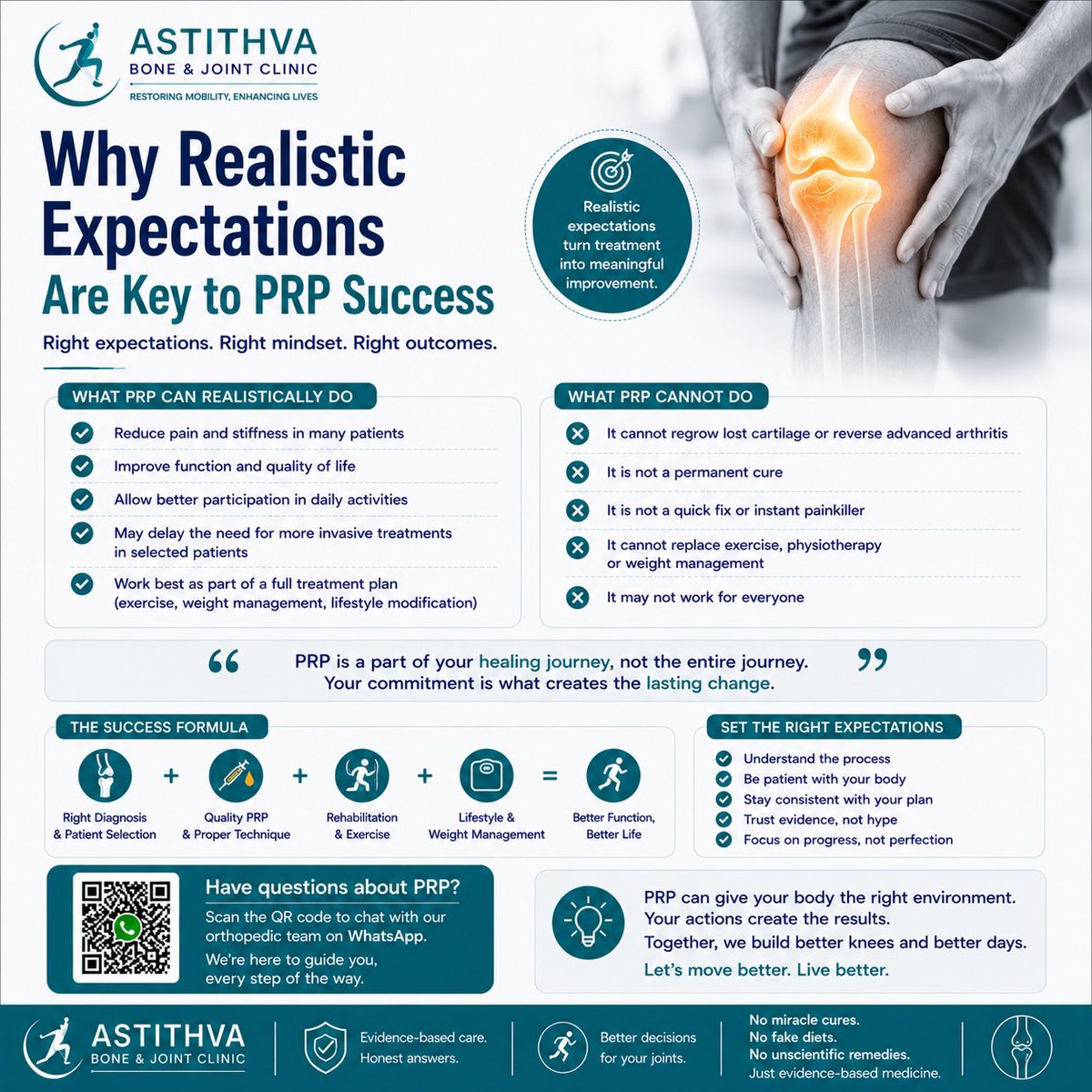
🎯 The biggest predictor of PRP success isn't just the injection.
It's having realistic expectations. Here's why. 🧵
✅ What PRP *may* do:
• Reduce pain
• Improve knee function
• Improve quality of life
In appropriately selected patients.
PRP may also help some patients stay active longer and, in selected cases, delay more invasive treatments.
❌ What PRP cannot do:
It does not reliably regrow lost cartilage or reverse advanced osteoarthritis.
PRP is not a permanent cure.
If it works, symptom improvement can last months, but arthritis still requires long-term management.
PRP is not an instant painkiller.
Improvement, when it occurs, usually develops gradually over several weeks.
An injection alone is rarely enough.
Exercise, rehabilitation, weight management and healthy habits remain essential.
The best outcomes usually come from:
✔️ Right diagnosis
✔️ Right patient
✔️ Good technique
✔️ Rehabilitation
Don't compare your results with someone else's.
Every knee, every patient and every stage of arthritis is different.
Our promise remains simple:
🦴 No miracle cures.
🥗 No fake diets.
🚫 No unscientific remedies.
✅ Just evidence-based medicine.
#PRP #KneeArthritis #Orthopedics #EvidenceBasedMedicine
Before starting PRP, what expectation do you think is most important to have???
Realistic timeline, realistic results, or the need for rehabilitation?
Let me know in the comments below.
Like follow and share for more such content.
DM for personal consultations.
🩸 Is PRP right for your knee arthritis?
The answer should never come from an ad, a package or a promise. It starts with a proper evaluation. 🧵
PRP is not for every painful knee.
Before discussing an injection, the first question should be: What is actually causing your pain?
📋 1. Your history matters.
Where is the pain? How long has it been present? What triggers it? How much does it affect daily life?
🩺 2. The examination matters.
Swelling, tenderness, movement, alignment, stability and muscle strength can change the treatment plan.
🩻 3. Imaging may matter.
X-rays can help assess arthritis severity. MRI may be useful in selected cases—but not every patient needs one.
❤️ 4. Your overall health matters.
Medical conditions, medications and other health factors may affect whether PRP is appropriate.
🎯 5. Your goals matter.
Are you trying to walk comfortably, return to sport, reduce medication use or delay surgery? Treatment should match the goal.
PRP may be considered in selected patients with knee OA whose symptoms persist despite appropriate basic treatment.
PRP may be a poor fit when arthritis is very advanced, expectations are unrealistic or another treatment is more appropriate.
The best PRP decision is not:
“Can I get the injection?”
It is:
“Is this the right treatment for my knee, at this stage, for my goals?”
#PRP #KneeArthritis #Orthobiologics #EvidenceBasedMedicine
Before choosing PRP, what would you want assessed first???
Your symptoms, X-ray, arthritis stage, health, or treatment goals?
Follow like and share for more.
DM for personal consultations.
🩸 Why do some patients respond better to PRP than others?
Same treatment. Different outcomes. The answer is often more complex than the injection itself. 🧵
PRP is not one-size-fits-all.
Some patients improve significantly. Some improve partially. Others may have little or no meaningful benefit.
🦵 1. Stage of arthritis matters.
Patients with mild to moderate knee OA generally have more predictable outcomes than those with advanced disease.
🧬 2. Age and biology may matter.
Age alone does not decide the outcome, but biological health and tissue condition can influence the response.
❤️ 3. Overall health matters.
General health, metabolic factors, smoking and uncontrolled medical conditions may influence recovery and outcomes.
🏃 4. Activity and fitness matter.
PRP works within the body you bring to treatment. Strength, mobility and physical conditioning can influence function.
⚖️ 5. Body weight matters.
Excess load on an arthritic knee continues after the injection. Weight management can reduce stress on the joint.
💪 6. Rehabilitation matters.
PRP cannot replace exercise. Strengthening and physiotherapy may help turn symptom relief into better long-term function.
The PRP itself can vary too.
Preparation method, cellular composition, injection protocol and technique may influence outcomes.
PRP may help create a better environment for improvement.
But the right patient + right plan + rehabilitation + consistency matter.
#PRP #KneeArthritis #Orthobiologics #EvidenceBasedMedicine
Which factor do you think patients underestimate most???
Arthritis stage, weight, fitness, overall health, or rehabilitation?
Let me know in the comments below.
Follow for more.
DM for a personalised consultation.
🩸 PRP myths, debunked.
PRP is surrounded by miracle claims, marketing hype and confusion. Here’s what patients should actually know. 🧵
❌ MYTH: PRP regrows lost cartilage.
✅ FACT: There is no convincing evidence that PRP reliably regrows cartilage or reverses advanced arthritis.
❌ MYTH: PRP gives instant pain relief.
✅ FACT: PRP is not a painkiller. When improvement occurs, it usually develops gradually over weeks.
❌ MYTH: One PRP injection is enough for everyone.
✅ FACT: There is no universal protocol. The number of injections varies by condition and treatment plan.
❌ MYTH: PRP is a permanent cure.
✅ FACT: PRP may improve pain and function, but it does not cure osteoarthritis or stop ageing of the joint.
❌ MYTH: All PRP is the same.
✅ FACT: Preparation methods, platelet concentration and cellular composition can differ significantly.
❌ MYTH: PRP has no side effects because it comes from your own blood.
✅ FACT: Temporary pain, swelling or stiffness can occur after injection.
❌ MYTH: PRP works without exercise.
✅ FACT: An injection cannot replace strength, mobility, weight management and rehabilitation.
PRP is a tool—not magic.
The right patient + right diagnosis + right technique + realistic expectations matter more than marketing claims.
Our promise:
No miracle cures.
No fake diets.
No unscientific remedies.
Just evidence-based medicine.
#PRP #KneeArthritis #Orthobiologics #EvidenceBasedMedicine
Which PRP claim have you heard most often :-
cartilage regrowth, instant relief, permanent cure, or “zero side effects”?
Let me know in the comments below.
DM for personal consultations
🩸 What does the research really say about PRP for knee arthritis?
Not marketing. Not miracle claims. Here’s what the evidence actually shows. 🧵
📚 Multiple systematic reviews and meta-analyses have studied PRP for knee osteoarthritis.
The overall signal? PRP can help selected patients.
📉 PAIN RELIEF
Many studies report meaningful reductions in pain after PRP, particularly over short- to medium-term follow-up.
Have personally seen anecdotal evidences of patients being free from pain over 5-7 years.
🚶 FUNCTION
Research also reports improvements in knee function and daily activity.
But not every patient responds equally.
��� Does PRP regrow cartilage?
There is no convincing evidence that PRP reliably regrows lost cartilage or reverses structural damage.
❌ PRP is not a cure for arthritis.
The realistic goal is symptom improvement: less pain, better function and easier daily activity.
🎯 Who tends to respond better?
Evidence generally supports better outcomes in selected patients with mild to moderate knee osteoarthritis.
Why do studies sometimes disagree?
PRP is not one standard product. Preparation, dose, injection protocols and patient selection vary widely.
Other factors matter too:
• Arthritis severity
• Age and health
• Number of injections
• Follow-up duration
• Rehabilitation
The evidence supports cautious optimism—not hype.
PRP can be a useful option for selected patients, but it is not a magic injection.
#PRP #KneeArthritis #Orthobiologics #EvidenceBasedMedicine
What evidence would you want to see before considering PRP???
Success rates, duration of relief, safety, or comparison with other treatments?
🩸 Is PRP right for you?
PRP is not for everyone. The best results depend on the right patient, the right stage and realistic expectations. 🧵
🟢 Who may benefit most?
Patients with mild to moderate knee osteoarthritis may have a better chance of meaningful improvement.
🏃 Active individuals may be good candidates.
Especially those who want to reduce pain, improve function and continue an active lifestyle.
📅 Age matters—but it is not the only factor.
Younger, biologically active patients may respond better, but the condition of the joint matters greatly.
🦵 Symptoms matter too.
PRP may be considered when persistent knee pain and stiffness affect daily life despite appropriate basic treatment.
💪 Commitment to rehabilitation matters.
PRP works best as part of a plan that may include exercise, strengthening and weight management.
🔴 Who may benefit less?
Patients with severe bone-on-bone arthritis or major deformity may have less predictable results from PRP.
Your overall health matters.
Uncontrolled illness, infection, bleeding problems or certain medications may affect whether PRP is appropriate.
🚫 PRP is a poor match for unrealistic expectations.
It cannot guarantee a cure, rebuild a severely damaged joint or work equally well for everyone.
The formula is simple:
Right diagnosis + right patient + right technique + rehabilitation + realistic expectations.
That’s how PRP is used responsibly.
#PRP #PRPTherapy #KneeArthritis #Orthopedics
If you were considering PRP, what would you want assessed first???
your X-ray, arthritis stage, age, health, or chances of success?
After due consideration you have finally got your PRP injection. Read on to know what happens next⬇️
🩸 What happens inside your knee after PRP?
The injection takes minutes. The biological response that follows may unfold over weeks. Here’s the process. 🧵
🎯 Step 1: PRP reaches the target area.
A concentrated portion of your own platelets is injected into the affected knee joint.
📡 Step 2: Platelets release signals.
Activated platelets release proteins that interact with cells involved in inflammation, repair and tissue responses.
🔥 PRP is not simply a painkiller.
Its aim is to influence the joint environment. That is why improvement, when it occurs, is usually gradual.
⏳ What happens in the first few days?
Some patients notice temporary soreness. Biological signalling begins, but meaningful pain relief is not expected instantly.
📅 Over the following weeks, some patients may notice less pain, easier movement and better function.
The timing and degree of improvement vary.
🦵 Does PRP regrow cartilage?
Current evidence does not support promising patients a brand-new joint or reliable regrowth of lost cartilage.
So what is the realistic goal?
Less pain. Better function. Improved activity. A better quality of life in appropriately selected patients.
Why do results differ?
Diagnosis, arthritis severity, age, body weight, activity, PRP preparation and rehabilitation can all influence outcomes.
PRP is one part of a bigger plan.
The right diagnosis + good patient selection + exercise + rehabilitation often matter as much as the injection.
#PRP #PRPTherapy #KneeArthritis #Orthobiologics
What would you most like to know about what happens after PRP? Pain, recovery time, results, or how long benefits may last?
Let me know in the comments below.
Like follow and retweet if you like the content.
DM for personalised consultation.