Sam Altman reveals a legal problem with ChatGPT that nobody thought about even a year ago
"People talk about the most personal things in their lives to ChatGPT. Young people especially use it as a therapist, a life coach"
"If you talk to a therapist or a lawyer or a doctor about those problems, there's legal privilege for it. We haven't figured that out yet for when you talk to ChatGPT"
"If you go talk to ChatGPT about your most sensitive stuff and then there's a lawsuit, we could be required to produce that. I think that's very screwed up"
"We should have the same concept of privacy for your conversations with AI that we do with a therapist or a doctor"
"No one had to think about that even a year ago. Now I think it's this huge issue"
This is a great outcome, but there's nothing different about you
If you are stressed, not sleeping enough, and surrounded by calorie dense (often processed) foods, it's near impossible to resist
It's the environment causing the need for GLP1s, not your biology
GLP-1 is insane. I don't understand how people live without it.
I've been on Mounjaro for some time, and I can finally look at food and not want to eat it, or order a meal and leave half of it. That has never happened in my entire life without a serious internal battle.
Some people have a high natural resistance to food. I'm not one of those people. Now I understand what that feels like, and I genuinely cannot believe how some people live with food noise ringing in their brains.
Experts are able to level up faster with AI because they know where to focus, while non-experts waste a lot of time asking questions that are irrelevant
Two weeks ago I shared that I got Classic Hodgkin Lymphoma ("cHL")...
For those who may be unfortunate to end up in a similar place I wanted to share lessons from the wild rollercoaster of the past two weeks.
Perhaps it might be a little bit cathartic as well ⬇️
Reta will likely become the #1 selling drug in the world.
Good news:
People will lose weight while they are on it. It may even help with addictions.
Bad news:
That weight will be regained when reta is stopped. Many may also lose interest in things they previously enjoyed due to GLP-1's role in pleasure pathways in the brain.
It surely helps people, but at what cost?
Social media health communications will start to move away from click baity headlines because people don't want to be tricked into giving up their attention
Not when it comes to health
I look forward to this evolution
Take too much Ozempic, and your brain stops wanting things: food, sex, even the urge to get out of bed. People end up in hospital beds for days, staring at the ceiling, feeling nothing. The medical name for that state is anhedonia, and it tells you how the drug actually works.
Ozempic, Wegovy, and Mounjaro all belong to the same drug family, called GLP-1s. They kill hunger. They also quiet almost every other craving your brain produces.
Inside your brain there is a small region that makes a chemical called dopamine. Dopamine is your brain’s “this is worth wanting” chemical, the reason you reach for one more bite of pasta, refresh your inbox one more time, or pick up your phone every few minutes. GLP-1 drugs reach that region and turn the dopamine down. The right dose dampens the loudest craving first: food. Take too much, and the volume drops on everything else, sex, exercise, work, even the urge to get out of bed in the morning.
Anhedonia is the medical name for not feeling pleasure from anything at all. It looks identical to deep depression. The good news is that anhedonia from GLP-1s has an off switch: once the drug clears your system, the wanting comes back.
The FDA has logged over 1,150 reports of bad reactions tied to compounded GLP-1s through July 2025. These are custom-mixed versions made by smaller pharmacies. In many of those cases, patients accidentally took five to twenty times their prescribed dose. The cause is usually confusion between milliliters and units when measuring out a dose with an insulin syringe, since compounded versions come in plain vials instead of the pre-filled pens that brand-name Ozempic uses.
About 15 million Americans currently use a GLP-1, roughly one in eight adults. Around 75% of them eventually quit. Cost and side effects are the top reasons. A growing number describe a third reason that patients call “the lights dimming,” a flat, gray feeling across the whole day that doctors now recognize as anhedonia caused by the drug itself.
This same mechanism has caught pharma’s attention. Eli Lilly is now running two large clinical trials with a combined 2,200 patients to see if a GLP-1 drug can treat alcohol addiction. The bet is that the same brain switch that turns off cravings for food can also turn off cravings for alcohol, cocaine, nicotine, and gambling. A 2026 psychiatry review put it bluntly: doctors should be treating these as psychiatric drugs, because that is what they have turned out to be.
The drug works by quieting your brain’s signal that something is worth wanting. A normal dose turns the volume down on food cravings. Push the dose too high, and everything else goes quiet too.
Dr. Paul Saladino: “One of the first issues I have with these GLPs is you’re probably on them FOR LIFE.”
“So if Charles [Barkley] stops the GLP-1, the research is pretty clear that he’s going to regain the weight within one to two years…”
PBD: “Why is that?”
Dr. Saladino: “When you stop it, the eating habits that you never fixed will outpace the metabolism that’s been changed by the GLPs.”
“These GLPs will slow down your metabolism because you’re eating less food. And so you’ve lost fat. You’ve also lost muscle mass. Muscle mass is positive for our metabolism. Muscle mass burns calories.”
“There’s a study that came out saying that when you stop a GLP-1, you regain the weight four times faster than if you stopped exercise. Four times faster!”
@Zeneca Yeah 100%. I think in a few years we'll not distinguish human from human + AI - I think everyone will be using AI and it will be assumed so (one would be foolish not to leverage the help)
The nuance is key. Sometimes SSRIs are the best option. All of this has to be in the context of the situation and the alternatives.
They definitely aren't perfect though.
SSRIs are dangerous and their efficacy is questionable
Exercise, diet, sleep, meditation and socialization/community are well established solutions for depression or the blues.
Mock @joerogan, @TomCruise or me for pointing this out, but this is the established truth
Go research it.
Be very careful with these drugs, as joe points out, they are known to make people suicidal and their efficacy is unknown.
And they are brutally hard to get off of
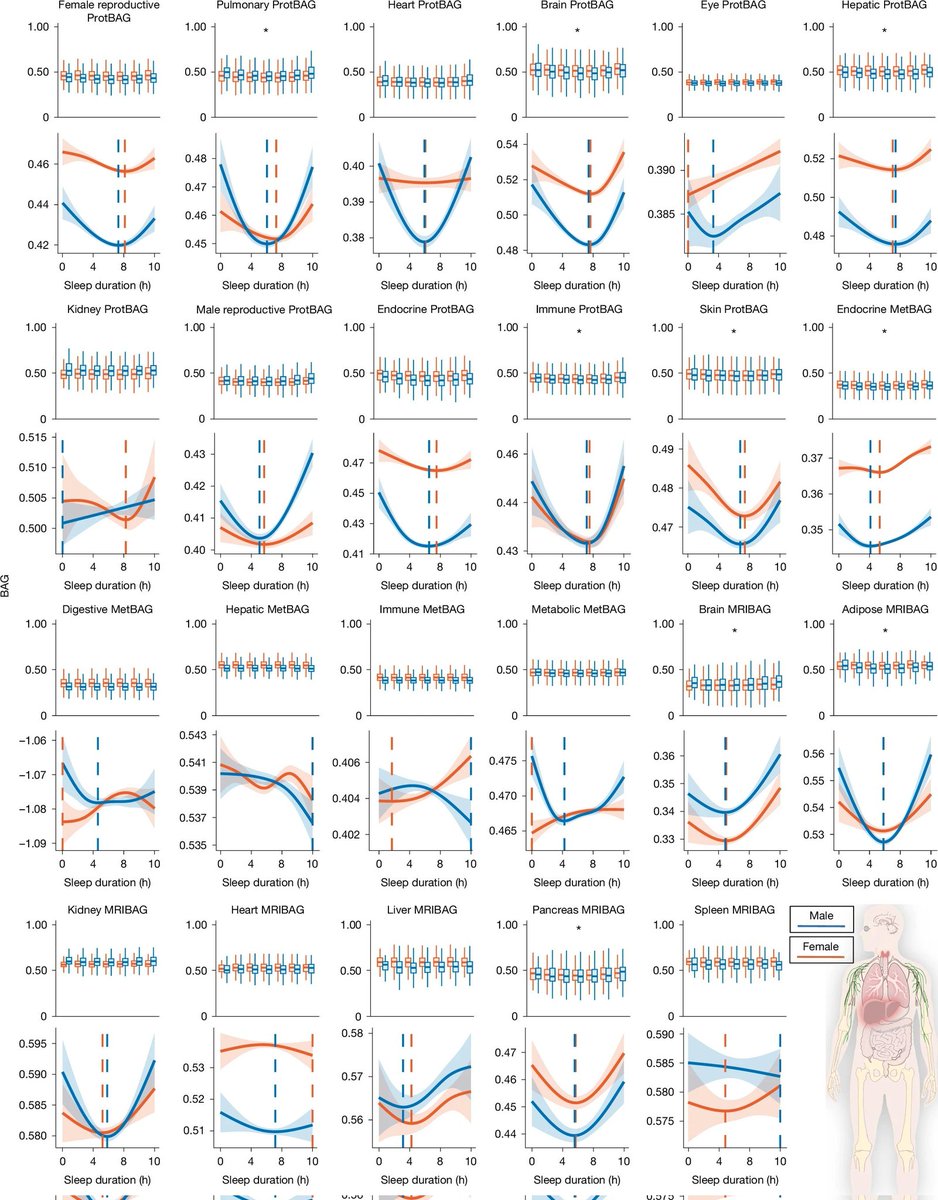
A new study found that different aging clocks produce quite different estimates of optimal sleep duration for men and women and across clocks.
It's a good reminder of how gimmicky they are.
@nntaleb@EricTopol@otrasenda_AC This is key - how much of the GLP1 effect is unique vs. reversing metabolic dz (which comes w/ weight loss)?
Based on principles, only the addiction / compulsion benefits are unique
ALL other benefits are via lower metabolic dz
GLP1s are just one way to get there
This is key - how much of the GLP1 effect is unique vs. reversing metabolic dz (which comes w/ weight loss)?
Based on principles, only the addiction / compulsion benefits are unique
ALL other benefits are via lower metabolic dz
GLP1s are just one way to get there
@EricTopol@otrasenda_AC Yes, but I was wondering if there was a way to see if energy deficit prior to weight loss does it (that is, the stressor not the result).
This is a common finding with dietary interventions where something is added.
Basically, if you give people food, they eat more food. They don't cut other food to make room.
This is what regulatory capture looks like
It's a lot more obscured in healthcare, but it's the same thing that has defense contracts ballooning
This is exactly why consumer health is coming, with an emphasis on prevention (it's a lot cheaper)