🔴 BAVENO VIII – Portal Hypertension: What Changes Clinical Practice?
📌 Baveno VIII – Advancing Consensus in Portal Hypertension
The Baveno VIII consensus, developed across 9 expert panels, achieved strong consensus on 272 statements/recommendations and proposes 153 research priorities. The central message continues the paradigm shift from simply preventing variceal bleeding to identifying clinically significant portal hypertension (CSPH) early and preventing first and further hepatic decompensation.
🔑 1. CSPH remains the pivotal therapeutic threshold
CSPH = HVPG ≥10 mmHg, but invasive HVPG is no longer necessary for routine risk stratification in many compensated patients.
👉 Liver stiffness measurement (LSM), platelet count and increasingly spleen stiffness form the backbone of non-invasive assessment.
Clinical pearl: Do not wait for varices to appear before thinking about portal-hypertension-directed treatment.
🔑 2. The “Rule of Five” remains clinically powerful
Think progressively:
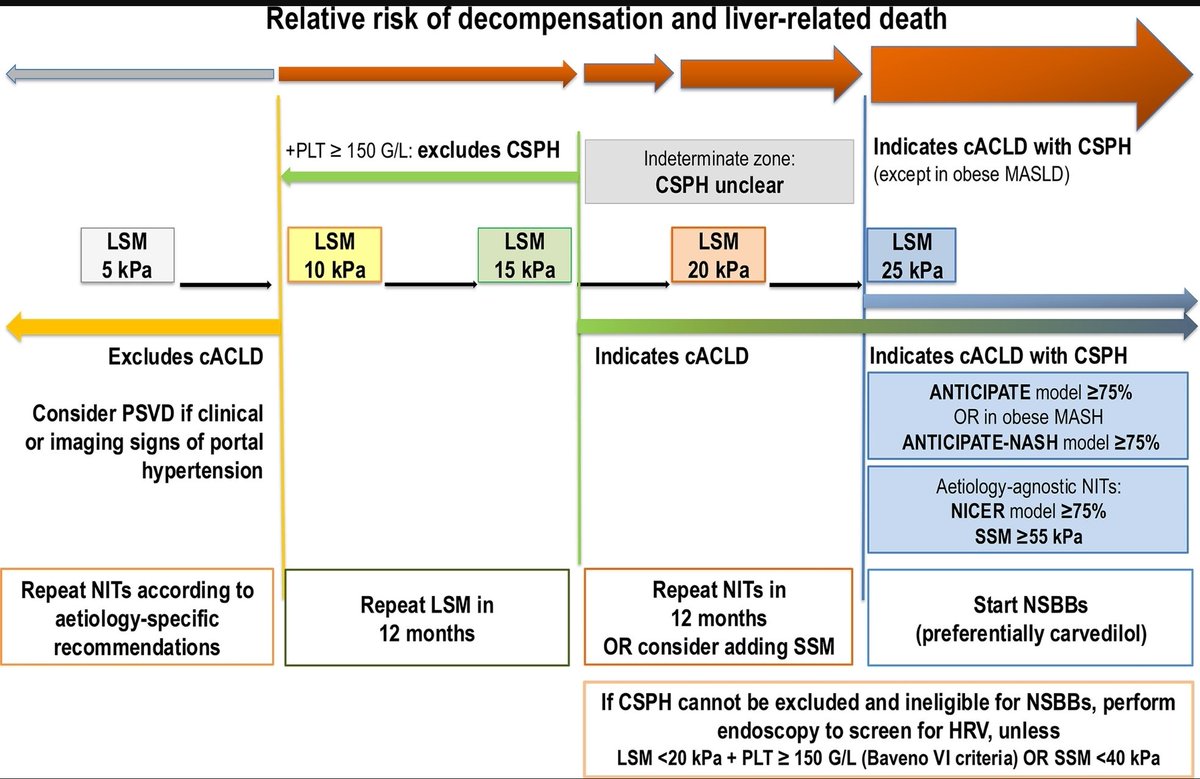
LSM 5 → 10 → 15 → 20 → 25 kPa
Increasing liver stiffness reflects progressively increasing probability of advanced liver disease, CSPH and clinical events.
The well-validated Baveno framework remains:
✅ LSM ≤15 kPa + platelets ≥150 ×10⁹/L → CSPH can generally be ruled out.
✅ LSM ≥25 kPa → strongly supports CSPH in appropriate populations.
But an important caveat is MASLD with obesity: an isolated LSM ≥25 kPa is less reliable for ruling in CSPH. Recent individual-patient meta-analysis showed that obesity materially reduces the reliability of this simple rule-in threshold.
🔑 3. The old 15–25 kPa “grey zone” is becoming smaller
Patients falling between the classical rule-out and rule-in thresholds should not automatically undergo invasive testing.
Additional tools such as:
➡️ platelet count
➡️ spleen stiffness measurement (SSM)
➡️ ANTICIPATE/ANTICIPATE-NASH probability models
➡️ selected biochemical algorithms
can further refine CSPH probability.
This is particularly relevant in steatotic liver disease and obesity, where a one-size-fits-all LSM threshold performs less well.
🔑 4. Carvedilol is not merely an “anti-variceal” drug
This is one of the most important conceptual messages for physicians.
In a compensated patient with CSPH, a non-selective β-blocker is used not only to prevent bleeding but to prevent hepatic decompensation, particularly ascites.
Carvedilol remains particularly important because of its additional α1-blocking action and greater portal-pressure reduction.
Thus the clinical thinking becomes:
CSPH identified → ask whether NSBB/carvedilol is appropriate, rather than waiting for large varices.
Baveno VII established this paradigm, and subsequent evidence has strengthened non-invasive identification of the patients most likely to benefit.
🔑 5. Endoscopy becomes more selective
A major evolution of Baveno guidance is:
Not every compensated patient with cirrhosis needs screening endoscopy solely to decide whether to start an NSBB.
If CSPH is established and the patient is an appropriate candidate for an NSBB, treatment may be initiated on the basis of the portal-hypertension risk assessment.
Endoscopy assumes greater importance when:
➡️ NSBBs are contraindicated/intolerable
➡️ the non-invasive assessment is uncertain
➡️ endoscopic therapy would alter management.
This represents a move from “find varices and treat them” toward “identify portal hypertension and prevent decompensation.”
🔑 6. MASLD changes the portal-hypertension equation
Baveno VIII gives increased importance to steatotic liver disease and its modifiers.
⚠️ Obesity can alter the diagnostic performance of VCTE.
Therefore:
LSM ≥25 kPa should not be interpreted mechanically in an obese MASLD patient.
BMI, platelets and other NITs may need to be integrated.
📖Next
.....https://t.co/eUHAxZLFku
Treatment of Hepatitis B is never an easy job. I tried my best to make the Hepatitis B algorithm very simple. Here are the main points you have to follow 👇
First question I ask:
Is this ACUTE or CHRONIC Hepatitis B?
NEET PG 2025 Round 1 Update
Among the top 100 rankers, a massive 46 chose MD Medicine ,nearly half!
Internal Medicine continues to stand tall as the most trusted, most impactful and most intellectually fulfilling specialty.
From critical care to chronic diseases, from diagnosis to direction Medicine shapes the entire hospital ecosystem.
Acc to AASLD
Cut off HBV DNA for
HbeAg +ve : 20000
HbeAg -ve : 2000
Then look for ALT
If > 2* UNL - treat
If between 1-2 time
Treat if any one present
1. If it persists for 6 month
2. Fibroscan F2
3. Liver biopsy A3
🧵 Paradoxes in Medicine — where physiology laughs at logic
Life saving oxygen kills
Anticoagulant induces clots !
A fat patient who lives longer !
Here are 12 such paradoxes you scratch your head at, with underlying physiology
1/12
#MedTwitter#Medicine#FOAMed
@DrAkhilX
One good mentor can change your entire career.
In medicine, the best lessons don’t come from textbooks.
They come from people.
From that senior who taught you to listen to the patient before ordering tests.
From that consultant who stayed back after rounds to show you how to break bad news with grace.
From that professor who reminded you that the patient is not the disease, the disease lives in a person.
Every doctor has that one mentor who shaped their thinking without even trying.
Not through lectures, but through example.
Through patience, humility and kindness.
We remember their calm during chaos.
Their compassion during exhaustion.
The quiet gestures that said,
“This is how you heal people, not just treat them.”
In the end, mentorship in medicine is not about seniority or hierarchy.
It is the passing on of humanity from one generation to the next.
Who was that person for you?
The one who made you see medicine differently?
Tag them below or share what they taught you.
Let’s give them the credit they never asked for, but truly deserve.
#MedTwitter #MedEd #ResidencyLife
My young alcohol-associated fatty liver disease (not even cirrhosis) patient who is a weekend drinker was diagnosed with an aggressive form of blood and bone marrow cancer called myelodysplastic syndrome which has the potential to transform into life-threatening leukaemia.
This is exactly why the WHO said:
"No level of alcohol consumption is safe for our health".
It is not only about the liver anymore.
Please drill this into your brains.