Your access to care is at risk. Dr. Sergio Viroslav speaks on proposed 2027 Medicare cuts that could mean more visits, more trips, and less access to care.
Learn more: https://t.co/UQJJaPWyyC
Comment by Sep 14: https://t.co/XjOA4dFZLT
Contact your rep: https://t.co/le4AoFxANL
📣 Silence results in Medicare cuts — here's your chance to speak up.
Medicare's proposed rule cuts 50% for a second service and up to 20% for hips, knees and shoulders.
‼️ If patients and physicians don't speak up, it gives Medicare the green light to move forward.
Visit TOA's Action Center to reach both Medicare and your members of Congress ➡️ https://t.co/oK7noGShb3
Three different congressional committees have now advanced three different price transparency bills, and there is significant disagreement between the bills. Depending on the outcome, transparency can be a tool that helps patients and independent physicians or just gives large payers and health systems more negotiating power.
The Senate HELP Committee approved the Patients Deserve Price Tags Act 21 to 1. The House Energy and Commerce Committee advanced the Lower Costs, More Transparency Act of 2026, H.R. 9393, 45 to 0. The House Ways and Means Committee approved a competing measure, the Health Care Price Certainty for All Americans Act, on a party line 25 to 15 vote. A fourth bill out of Energy and Commerce, the Prices on the Wall Act, would require hospitals and surgery centers to physically post cash prices inside their facilities, and cleared committee 24 to 21.
The difference in the bills is whether a hospital can satisfy its transparency obligation with an online price estimator tool instead of posting actual dollar figures. Under current federal rule, a hospital can technically comply with shoppable service pricing requirements by offering a calculator that generates an estimate rather than listing what a service actually costs. Patient advocacy groups, including Families USA, have pushed against that loophole, arguing an estimator is not a price and does not let a patient compare costs before choosing where to be treated. The stronger House and Senate versions require standardized dollar figures. The Ways and Means version preserves more flexibility for estimator tools.
Why does this matter? Independent physicians already operate under full fee schedule transparency. Medicare publishes every physician's payment rates. Commercial payer contracts, once negotiated, become visible through claims data and machine readable files. A hospital system negotiating the same service can obscure its actual price behind an estimator tool, a bundled facility fee, or a consolidated system wide rate that never isolates what any single service costs. That asymmetry means transparency mandates, as currently structured, do more to expose independent practice pricing to payer scrutiny than they do to expose the much larger price variation inside hospital owned care. A payer negotiating against a small independent group already knows exactly what that group charges. The same payer negotiating against a hospital system with an estimator tool and bundled billing does not have the same clarity, and neither does the patient.
The question the lame duck session has to answer is which version of transparency Congress adopts: one that requires actual prices from every site of care, or one that lets the largest, most consolidated systems continue to shield their pricing behind a compliance satisfying tool that never functions as a real price comparator.
@DrRobHartzler is right: all orthopaedic surgeons and their patients need to engage both Congress and CMS on the proposed Medicare cuts and other payment policies.
TOA made it easy to submit your comments to CMS:
https://t.co/BwSQD3yRvV
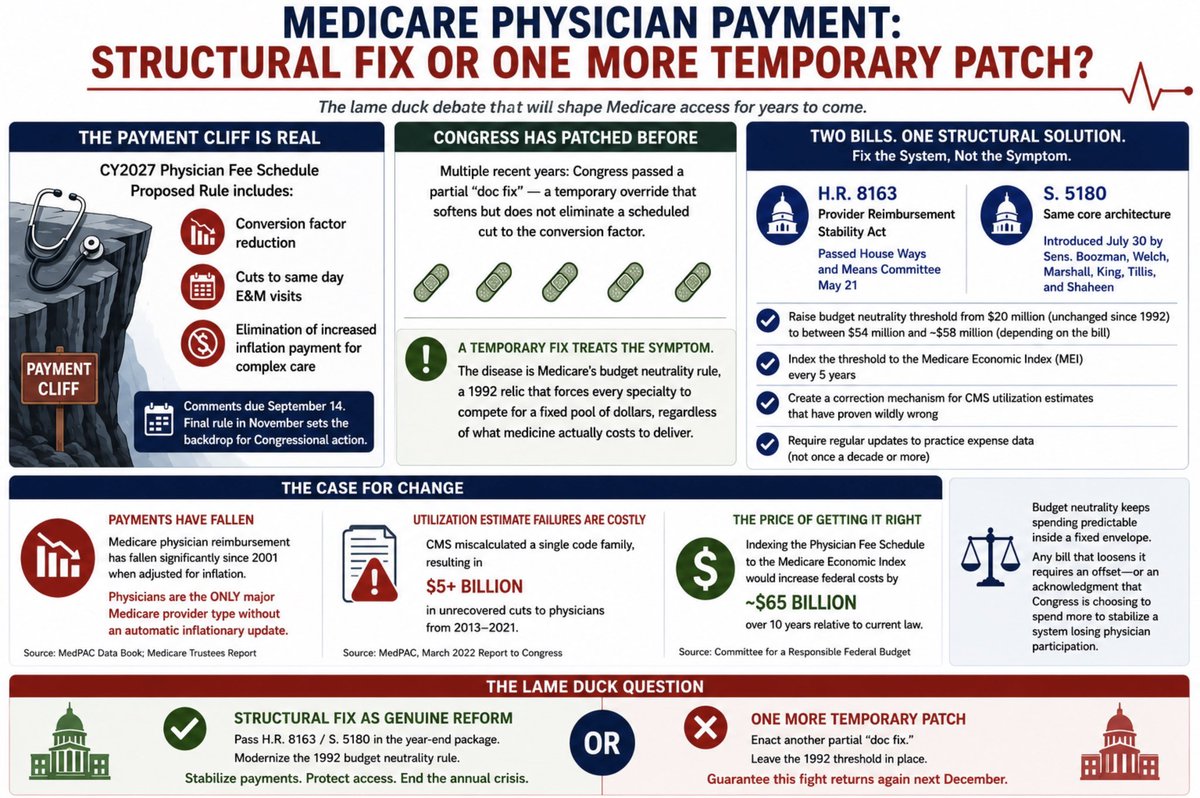
Medicare physician payment sits at the center of any lame duck healthcare package, because a payment cliff is already built into current law. The CY2027 Physician Fee Schedule proposed rule carries a conversion factor reduction on top of cuts to same day E&M visits and the elimination of the increased inflation payment for complex care, changes I have covered in earlier weeks. Comments on that rule are due September 14, and whatever CMS finalizes in November becomes the backdrop against which Congress decides whether to intervene again.
Congress has intervened before. In multiple recent years, lawmakers have passed a partial doc fix, a temporary override that softens but does not eliminate a scheduled cut to the conversion factor. That pattern makes a repeat plausible this December. But a temporary fix treats the symptom. The disease is Medicare's budget neutrality rule, a mechanism that has not been meaningfully updated since 1992 and forces every specialty into competition with every other specialty for a fixed pool of dollars, regardless of what medicine actually costs to deliver.
Two bills now sit in position to fix the structure rather than paper over the symptom. H.R. 8163, the Provider Reimbursement Stability Act, passed House Ways and Means Committee on May 21. Its Senate companion, S. 5180, introduced July 30 by Senators Boozman, Welch, Marshall, King, Tillis, and Shaheen, carries the same core architecture: raise the budget neutrality threshold from 20 million dollars, a figure untouched since 1992, to somewhere between 54 million and roughly 58 million depending on the bill, and index that threshold to the Medicare Economic Index every five years going forward. Both bills also create a correction mechanism for CMS utilization estimates that have proven wildly wrong in the past, and require practice expense data to be updated on a regular schedule rather than left stale for a decade or more.
The case for this is not theoretical. Medicare physician reimbursement has fallen significantly since 2001 when adjusted for inflation, as physicians remain the only major Medicare provider type without an automatic inflationary update. The utilization estimate problem alone cost physicians more than 5 billion dollars in unrecovered cuts between 2013 and 2021 from a single miscalculated code family, a documented failure I walked through in detail during the H.R. 8163 series previously.
The Committee for a Responsible Federal Budget estimated that indexing the physician fee schedule to the Medicare Economic Index would raise federal costs by roughly 65 billion dollars over ten years relative to current law. Budget neutrality exists precisely to keep Medicare physician spending predictable inside a fixed envelope, and any bill that loosens it needs an offset or an acknowledgment that Congress is choosing to spend more to stabilize a payment system that is losing physicians from Medicare participation.
The lame duck question is whether this structural fix rides on the year end funding package as genuine reform, or whether Congress settles for one more temporary patch that leaves the 1992 threshold in place and guarantees this fight returns again every December.
🎉 Congratulations to Dr. Verma, recipient of a 2026 AANA Research Grant!
Through the AANA Research Grant Program, AANA invests in research that helps shape the future of arthroscopy and orthopaedic care.
Dr. Verma's multi-center study fills a major knowledge gap as the first longitudinal MRI evaluation linking biologic healing to clinical outcomes in UCL repair versus reconstruction. By tracking graft maturation over 24 months, this research will give surgeons evidence-based benchmarks for return-to-play decisions and long-term durability.
Learn more: https://t.co/5pT5nLuijP
We at AAAHKS are taking this incredibly seriously. It’s important for us to be a part of a solution. Let’s make our voices heard together to reverse these cuts so we can provide the care our patients need.
CMS just gave physician-owned hospitals their most serious lift in fifteen years.
In today’s FY2027 IPPS Final Rule, CMS confirmed it intends to propose, in future rulemaking, a policy allowing physician-owned hospitals to voluntarily opt into the TEAM bundled payment model, including outside mandatory CBSAs. In CMS’s own words:
“After consideration of the public comments we received, we intend to propose in future rulemaking a policy to allow POHs not located in mandatory CBSAs to participate in TEAM.”
This is not final policy, but read the language closely. CMS credited specialty-focused POHs directly:
“We agree that physician-led specialty hospitals may have experience in orthopedic, spine, cardiac, and other surgical service lines that are relevant to TEAM’s episode-based design.”
CMS addressed the “cherry-picking” and patient-selection arguments raised by hospital associations and declined to accept them as grounds for exclusion, stating plainly:
“We do not agree that these concerns require rejecting POH participation through a voluntary opt-in altogether.”
And CMS confirmed it holds statutory authority under Section 1115A to waive Stark Law provisions specifically for testing this model. It didn’t use that authority today but it didn’t close the door on it either.
Section 6001 of the ACA has frozen physician hospital ownership for fifteen years. This is the first real administrative crack in that wall.
There is still a fight ahead, through the FY2028 rulemaking cycle and whatever waiver documentation CMS issues next, but physicians who want to own and lead the facilities where we treat patients, not just staff them, just got heard.
Quick thank you to @physicianhosp for their leadership on this issue! If you aren’t a member, you should be!
https://t.co/tww3yvhhoe
Pp 1494-1506
The Budgetary Redistribution That Destroys Access
While we are talking physician fee schedule, let’s talk about how bad things have gotten for surgeons.
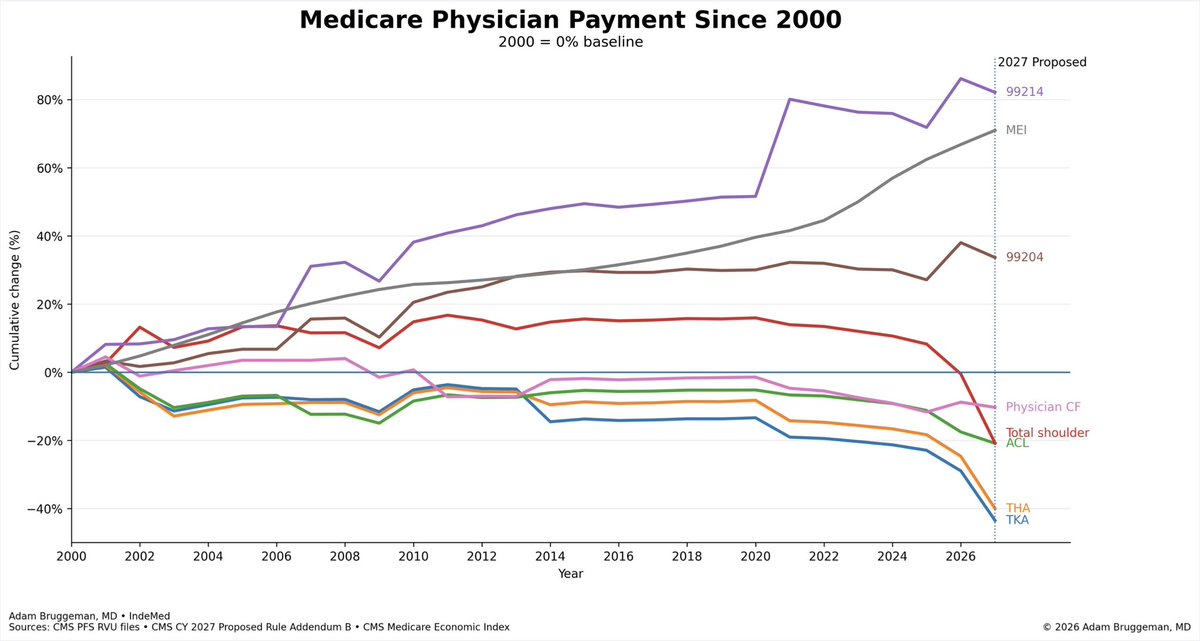
I wrote earlier today that budget neutrality has created a major problem in healthcare and that we will need to find a way out of this. It creates a sort of medical hunger games that pits one type of physician against another to fight for payment, and it’s why looking at just the conversion factor doesn’t tell the entire story.
Here is the orthopedic story. While the physician conversion factor has fallen 81 percentage points behind practice-cost inflation since 2000, Total Shoulders and ACLs have fallen even further to 91 points behind. Total Knees and Total Hips are worse, more than 110 percentage points behind inflation-adjusted payment, and roughly 30 points worse off than the conversion factor overall.
And where did that money go? It went to office visits. 99214, a return office visit, has actually outpaced practice-cost inflation, running about 12 percentage points ahead of the cost of running a practice. 99204, a new patient visit, has fallen behind inflation too, but only by about 37 points, which is less than a third as far behind as total knee and total hip replacement.
This needs to end. We don’t just have a shortage of primary care doctors. Decisions like this will create real shortages for various specialties, which means access problems for Medicare patients for some of the most commonly performed surgeries.
We can’t have winners and losers in the payment world of physicians. We all need to win, and it can’t be at the cost of our own colleagues. Policies that continue to favor one aspect of medicine over others have significant long-term consequences that cannot continue to be ignored. Just asking for the CF to be tied to inflation doesn’t fix this problem. We need a better ask.
@IndeMedAction
Make your voice heard on physician-led hospitals! This is straightforward to do, please consider taking a few minutes to engage. @DrBruggeman@TSAOG_Ortho@TXOrthoAssn https://t.co/SzEF2iLu6T https://t.co/5gIoK9U6ct
A promising alternative bearing surface, pyrocarbon hemiarthroplasty in young, active patients may improve pain, range of motion and patient-reported outcomes, @DrRobHartzler and colleagues said.
Read more about this technique here.
https://t.co/gNLkjwka96
At Precision Shoulder Surgery: Training for Today’s Surgeon, you’ll hear technical pearls talks – then take those insights straight into the lab.
📍 June 13 | Rosemont, IL
👉 https://t.co/W31yExT34d
AANA26 may be over – but this is where you put it into practice.
On June 13, take what you’ve learned and bring it into the lab with AANA’s E.L.I.T.E. Skills Training:
• Precision Shoulder Surgery: Training for Today’s Surgeon
• Pick Your Joint (customize your focus)
📍 Rosemont, IL
👉 https://t.co/FvHZSHF64q