The cooling-off period is our next stop because the final rule made real progress on it and also left the most important questions unanswered.
First, the progress. The Departments shortened the cooling-off period for batched disputes from 90 to 30 business days, which is a meaningful reduction. They also committed to publishing clarifying guidance on how the cooling-off period applies under the finalized batching provisions, and they acknowledged directly in the rule that stacking could lock physicians out of arbitration for years.
Congress designed the cooling-off period as a contracting incentive. After an IDR determination establishes what a fair payment looks like, the parties should use that information to negotiate an in-network contract rather than return to arbitration for the same service. While that is a very reasonable idea, in practice, no meaningful in-network contracting is happening during the cooling-off period. What is happening instead is that insurers are using ambiguity in the statute as a prospective payment denial tool.
The mechanism is straightforward. An insurer receives a claim. It decides on its own that the claim falls within a cooling-off period from a prior IDR determination. It refuses to pay. The physician disagrees. The IDRE disagrees. Two of the three parties agree the cooling-off period does not apply. The insurer still does not pay. The physician cannot challenge that through IDR, because the claim is already adjudicated. After the Fifth Circuit's June 2025 decision in Guardian Flight (and multiple others), the physician cannot sue to collect. Their only option is a CMS complaint with no guaranteed timeline and no penalty on the insurer. The insurer's unilateral assertion, even when wrong, is self-executing.
The reason this works as a trap is that the statute never defined who constitutes the same parties for purposes of triggering the cooling-off period. Is it the insurer, meaning a determination against UnitedHealthcare triggers cooling-off for every employer plan UHC administers as TPA? Or is it the specific employer plan, meaning a determination against Employer A's self-insured United plan does not affect Employer B's self-insured United plan, even though they share the same TPA? Insurers read same parties as broadly as possible while physicians and IDREs read it narrowly. There is no mechanism to resolve the disagreement because the insurer holds the money and refuses to pay while the physician is prevented from resubmitting the same claim. It is a circular trap that the insurer wins by default.
As I stated clearly at the Ways and Means panel on May 18, the cooling-off period is being used as a weapon to not pay.
So, for review, a physician submits a claim. The IDRE reviews it and determines it is eligible. Arbitration proceeds. The physician wins. The payer then looks at the award and decides, based on its own interpretation of the cooling-off period, that the claim was actually ineligible because it was filed a day or several days early. Not that the patient was wrong. Not that the physician was wrong. Not that the IDRE made an error on the merits. Just that in the payer's unilateral view, the timing fell inside a cooling-off window the payer defined for itself. So the payer does not pay. That award, won on the merits through the process Congress created, is gone. There is no mechanism to resubmit. There is no mechanism to appeal. The payer holds all the money and has appointed itself judge and jury.
The final rule removed the option to resubmit inappropriately batched disputes. That provision was intended to reduce gamesmanship, but in the context I just described, it eliminates the only potential corrective pathway for a physician whose claim was handled correctly in every material respect and then declared ineligible retroactively by the party that owes the money.
I was at a panel on May 18 where a representative from Elevance Health said, with apparent conviction, that everyone must follow the law. That is the right standard. I agree with it completely. But the same industry is currently running significant advertising in Washington describing IDREs as the fox in the henhouse, arguing that the arbitrator and the attorney representing the physician are corrupt actors tilting the process unfairly. What that framing obscures is that the insurer is simultaneously acting as judge and jury on its own payment obligations, with no oversight, no appeal mechanism, and no penalty for getting it wrong or acting in bad faith. If the IDRE is the fox, what do we call a party that unilaterally decides which of its own legal obligations it intends to honor?
The NSA imposed automatic civil monetary penalties of up to $10,000 per occurrence on physicians for balance billing violations, enforceable without a complaint being filed. That same exposure applies to failing to provide a Good Faith Estimate, violating the notice and consent process, or failing to display required patient notices. For insurers, the penalty for failing to pay a binding IDR award is zero. The penalty for miscalculating the QPA is zero. The penalty for bad faith conduct during open negotiation is zero. Senator Marshall's legislation, S.2420, describes H.R. 4710 explicitly as providing parity between penalties imposed against parties who are not compliant with the law. That language is an acknowledgment from Congress itself that no such parity currently exists.
A physician in a cooling-off dispute has no private right of action. After Guardian Flight, there is no lawsuit to file. There is no appeal process. There is no mechanism to compel payment short of a CMS complaint with no guaranteed timeline and no penalty on the other side. The physician is structurally a claimant and nothing more, while the insurer holds the money, interprets the rules, asserts its own compliance, and faces no consequence for getting any of it wrong.
Physicians lack the plan-level data to make accurate eligibility determinations at the point of submission. They lack any appeal mechanism when an insurer asserts cooling-off after the fact. They lack enforcement tools when an arbitration award goes unpaid. And they face unilateral civil monetary penalties for procedural violations while the counterparty faces none. The real insurer win rate across all NSA-eligible claims is over 95%, documented using the insurance industry's own survey data. And yet the narrative being advanced in Washington is that physicians are the bad actors ruining the system.
Tomorrow I will talk about where we go from here, including where I think genuine consensus with insurers is possible and what Congress needs to do where it is not.
@IndeMedAction
In every serious policy conversation about the NSA, insurers and insurer supported think tanks claim that IDR volume proves the process is being abused. That argument is built on a foundation of bad data.
The federal government projected 17,000 annual IDR disputes. The system is now processing over 2.6 million. That gap is routinely cited as evidence that physicians are gaming the system. I said at a Ways and Means Committee panel on May 18 that the 17,000 number is not a number we can anchor on, and @PatrickVelliky has done a great job explaining this in Health Affairs Forefront and his Substack.
The Departments based their estimate entirely on New York's IDR experience, scaling New York's roughly 1,000 annual disputes to the national insured population to arrive at 17,000. The problem is that New York's law structurally eliminated emergency medicine disputes by tying out-of-network emergency payments to usual and customary rates rather than sending them to arbitration. Emergency medicine accounts for more than half of all federal IDR disputes. Using New York as the baseline created the system around a model that excluded the largest category of claims from the beginning.
Texas was the right baseline and the data was publicly available. Texas had an analogous arbitration structure with no emergency medicine carve-out. In its first year, the Texas Department of Insurance received nearly 49,000 disputes from approximately 5.8 million Texans in state-regulated plans. Apply that rate to the 183 million nationally insured and you get roughly 1.55 million estimated annual federal disputes, not 17,000. The volume crisis was baked in before the law took effect and doesn’t reflect gaming.
Let’s look at what the volume actually represents. The October 2025 AHIP/BCBSA survey, the insurance industry's own data, found approximately 19.7 million commercial claims were NSA-eligible in 2025. Of those, only 1.23 million were submitted to IDR, a rate of 6.2%. After removing ineligible disputes and cases where the insurer prevailed, additional IDR payments were required in just 4.4% of NSA-eligible claims. The real insurer win rate across all NSA-eligible claims is over 95%. The insurance industry is telling Congress it is losing a process it wins 95% of the time.
The 85% provider win rate in IDR applies only to the 6% of claims that actually reach arbitration. These are cases providers specifically chose to dispute because they were confident the underpayment was real and documentable. Patrick provided a great example. A district attorney with a 50% conviction rate would be investigated for wrongful prosecution. A high win rate in a self-selected pool of documented underpayments is exactly what a functioning backstop looks like.
One more piece of context on the awards themselves. An independent December 2025 analysis of Q4 2024 CMS data across Aetna, BCBS, Cigna, and UHC found that in 60.6% of dispute cases, the actual median in-network contracted rate exceeded the reported QPA, and where it did, the actual in-network rate was 290.5% higher than the QPA. When providers win at what gets called three or four times QPA, they are frequently winning at or below what the same insurer pays its own contracted network physicians for the same service. The QPA is the benchmark, but the QPA is not the market rate.
The final rule does not address QPA methodology but does continue to ensure that eligible cases get through
@IndeMedAction
Last week the tri-Departments of HHS, Labor, and Treasury published the final IDR Operations rule, CMS-9897-F. We have been waiting on this rule for a long time, and I want to spend this week walking through what they got right, what still needs work, and where the upcoming guidance and congressional action need to go.
Any discussion needs to start with the fact that The No Surprises Act is the patient shield. It was designed to take patients out of the middle of a dispute between a physician and an insurance company over what constitutes fair payment, and it is doing exactly that. While it was not designed to as a system cost savings, a 2025 BMJ study found that patients in NSA-protected states saw an 18% reduction in out-of-pocket costs, averaging $567 in annual savings per patient, with no statistically significant increase in premiums. More than 10 million surprise bills were prevented in the first nine months of 2023 alone. Any serious conversation about reforming the dispute resolution administration has to start there, because the shield must be protected.
The machinery underneath that protection is a different matter. CMS projected roughly 17,000 IDR disputes per year based on flawed data. The system received 489,000 in its first 14 months and is now processing over 2.6 million annually. The backlog reached 590,000 unresolved cases. Median decision time stretched to 80 business days against a 33-day statutory target. In 2024, 59.6% of IDR awards were not paid within the required 30-day window, up from 24% the year before.
The Departments addressed several of those failures directly in this rule and deserve credit for doing so. The administrative fee drops from $115 to $15 per party, effective within days of Federal Register publication. A mandatory payer registry gets established. Payers must now formally respond during open negotiation. The batching cap rises to 50 line items. Extensions are available for extenuating circumstances. The cooling-off period for batched disputes is shortened from 90 to 30 business days. These are real wins that reflect years of advocacy by independent physicians and patient advocates.
This week I will go through each of those in detail, and then identify what the rule left open. The Departments have committed to issuing clarifying guidance on several key questions, and hopefully this series will help to guide advocates and the Departments as to how the guidance should be shaped.
@IndeMedAction
New IDR rule strengthens one of healthcare's most important patient protections, the No Surprises Act.
“We appreciate the Administration’s efforts to improve the dispute resolution process, and now Congress has an opportunity to build on that progress. The No Surprises Enforcement Act would provide important accountability measures to ensure physicians are paid promptly after disputes are resolved. IndeMed stands ready to partner with Congress and the Administration to help deliver a system that works fairly and efficiently for physicians and patients alike.” - @DrBruggeman
"Inside the NSA Roundtable: Insurers Concede the Win, Then Move the Goalposts"
If you're an IndeMed member, check today's email newsletter to learn more about where the insurers and physicians representing patients stand on the IDR.
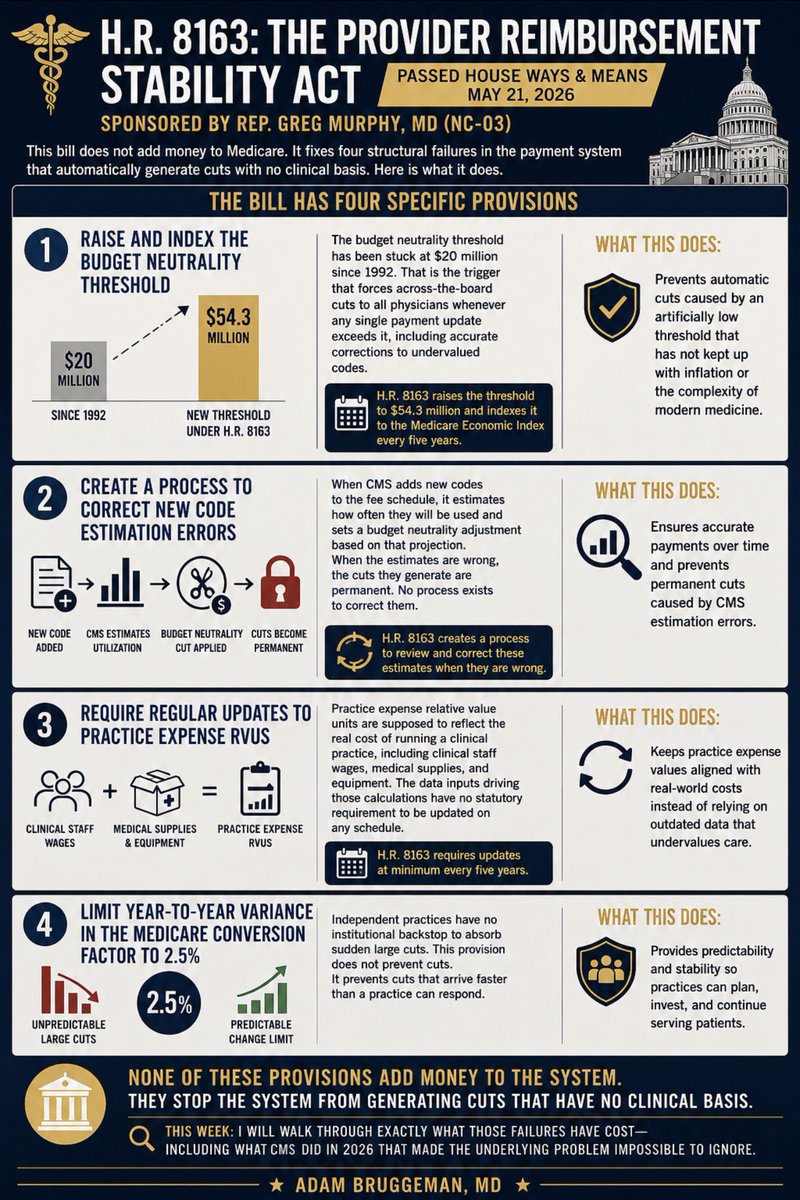
On May 21, 2026, the House Ways and Means Committee passed H.R. 8163, the Provider Reimbursement Stability Act, sponsored by @RepGregMurphy (NC-03), co-chair of the @gopdoccaucus. Before I walk through the documented failures this bill addresses, I want to explain what it actually does. It has four specific provisions, and the mechanics behind each one matter.
The budget neutrality threshold has sat at $20 million since the Medicare Physician Fee Schedule was created in 1992. That number is the trigger that forces across-the-board cuts to all physicians whenever any single payment update exceeds it, including accurate corrections to undervalued codes. H.R. 8163 raises the threshold to $54.3 million and indexes it to the Medicare Economic Index every five years so it never falls this far behind again.
When CMS adds new codes to the fee schedule, it estimates how often they will be used and sets a budget neutrality adjustment based on that projection. When the estimates are wrong, the cuts they generate are permanent. No process exists to correct them. H.R. 8163 creates one.
Practice expense relative value units are supposed to reflect the real cost of running a clinical practice, including clinical staff wages, medical supplies, and equipment. The data inputs driving those calculations have no statutory requirement to be updated on any schedule. H.R. 8163 requires updates at minimum every five years.
The fourth provision limits year-to-year variance in the Medicare conversion factor to 2.5 percent. Independent practices have no institutional backstop to absorb sudden large cuts. This provision does not prevent cuts. It prevents cuts that arrive faster than a practice can respond.
None of these provisions add money to the system. They stop the system from generating cuts that have no clinical basis. This week I will walk through exactly what those failures have cost, including what CMS did in 2026 that made the underlying problem impossible to ignore.
H.R.8163 - Provider Reimbursement Stability Act of 2026 advanced through the House Ways & Means Committee today, Thursday, May 21st!
This legislation reforms the flawed budget neutrality requirement in Medicare physician fee schedule!
Specifically it would:
--Increase the $20 million budget neutrality threshold to $54.3 million starting next year. The $54.3 million threshold would then be updated by the Medicare Economic Index every fifth year starting in 2032.
--Require CMS to compare estimated utilization to actual utilization for RVU adjustments in certain circumstances. If CMS determined that it overestimated or underestimated utilization by over a threshold amount of 0.1 percent of total estimated PFS expenditures, it would be required to adjust its estimated PFS expenditures for services for the following year to reconcile the difference, and the adjustment would not be subject to the budget neutrality requirements.
--Require CMS to update the prices and rates for each of the direct cost inputs that contribute to the practice expense RVUs every five years.
--Beginning in 2027, limit any increase or decrease to the PFS CF to 2.5%, effectively capping the impact that the budget neutrality requirement could have on the conversion factor.
Rep Frank spot on here.
The answer is that no one wants to take on insurers or hospitals, who are the true drivers of costs.
Think about it… nearly every value based care model runs through hospitals but the ones who can actually make decisions that reduce the costs are doctors. We incentivize the wrong people who then scrape the profits out and leave doctors empty handed.
Doctors are easy to blame because they lack organization and a singular voice. Hospitals, insurers, and the government have done a great job pitting physician against physician through a hunger games-like process where we scrap and fight each other for payments due to budget neutrality. Hospitals exploit the budget neutrality gap to consolidate physician practices and capture referral sources. Insurers encourage the same behavior by lowering payment to smaller independent groups compared to consolidated groups. It’s a vicious cycle that has dramatically accelerated the costs that employers pay.
It takes courage to stand up against powerful and wealthy lobbyists while having the tenacity to see the truth.
It was an honor to be asked to come to a consensus on ways we can fix the IDR system. I will be posting some thoughts shortly on where we can find some wins and consensus
Thanks to @RepAaronBean and @GregMurphyMD for leading an important discussion about the No Surprises Act.
Thanks to IndeMed's chair, @DrBruggeman, for representing physicians and patients.
You can tune in live right now:
https://t.co/FBMpqJncqY
Texas orthopaedic surgeons can be found in their clinics, hospitals and ASCs in Texas ... and also in the halls of Congress ensuring that patients and orthopaedic surgeons have a voice in Congress.
Thanks to San Antonio orthopaedic surgeon @DrBruggeman for representing patients and surgeons in Congress today.
Iowa just put patients first.
HF 2635 passed the Iowa Legislature, and it will prohibit health plans from punishing physicians who refer patients to the physicians and facilities of their choice, create certificate of need reforms and institute prior auth reforms.
Thanks to @IAGovernor for her expected bill signing tomorrow. Following Indiana's SEA 189, the laboratories of democracy are open for business.
More from IndeMed:
https://t.co/eLL2BC1Moj
Interesting graphic from Brookings. But it’s important to look at what happened to insurance premiums during that same time. One would expect that if premiums were related to how much insurers pay doctors or hospitals, then the premiums would show the same changes. My first impressions:
1) The time period being demonstrated post-COVID indicates that any influence from IDR and no surprises act implementation is not meaningfully impacting spending.
2) Insurers are simply extracting profits at this point, not passing savings on to their customers.
“Bending the cost curve” as a % of GDP is a macroeconomic abstraction that masks what actually happened. Costs have shifted, not reduced. Vertical integration and insurer consolidation extracted the same or more dollars from employers and workers while GDP grew. The $977B “savings” gap in the Brookings chart is largely illusory from the consumer’s standpoint. Any changes to the healthcare system need to focus on putting money directly in the pockets of those providing care and reducing intermediary funding to insurers.