A second member of the care team had already said it was terminal and recommended hospice.
The oncologist overruled that. He told a woman with stage four cancer in both lungs, with her daughters in the room, that a miracle drug would have her feeling like her old self again in six to eight weeks.
This is not a story about a bad doctor. It is a story about what happens when medicine treats death as a failure to be avoided rather than a fact to be told.
She trusted him completely. So she spent her last weeks sick, hospitalized to drain lungs that could not breathe, chasing a recovery that was never coming. A grandchild had been born ten days before her diagnosis. She wanted to meet that baby. She wanted to see the beach one last time. She got neither.
Two months after diagnosis, a rural ER doctor in New Hampshire took one look at her and said her death was imminent. She died a day and a half later, on hospice.
Patient advocate Althea Halchuck, EJD, wrote about it. The article was shared four thousand times in two weeks, far past her usual reach, and nurses and oncology staff wrote to her describing the same thing on their own units.
Here is the part worth sitting with. The oncologist almost certainly thought he was being kind. But a culture that treats death as a failure to be avoided turns honest prognosis into something that feels like giving up, and the optimistic lie becomes the path of least resistance. The kindness and the harm came from the same instinct.
Her argument is simple and hard to refute: patients are not asking for a crystal ball. They are asking whether they have a month, whether they will see another Christmas. An honest prognosis, a rough timeline, and earlier hospice would have given her the one thing the false hope took: time. Palliative care and hospice are largely free under Medicare and badly underused.
Listen to the full conversation on The Podcast by KevinMD. Link in the replies.
What would it take for honest prognosis to become the default in your field instead of the exception?
#EndOfLife #ThePodcastbyKevinMD
The Department of Transportation just affirmed food allergy as a disability under the Air Carrier Access Act. Then it restricted pre-board protection to peanut and tree-nut allergies only.
That is a structural error.
The ruling extrapolated from the specific characteristics of prior plaintiffs (peanut and tree-nut allergies) rather than the legal category they fell under (food allergy as disability). It creates a hierarchy within a single disability category that no other disability category faces.
Then the airlines started disregarding even the narrow scope.
Southwest has been denying pre-board to passengers with peanut and tree-nut allergies despite the ruling explicitly protecting them. Frontier still serves peanuts. A Southwest captain threw a passenger off a flight for asking to pre-board with a pistachio allergy, which is a tree-nut allergy and protected under the ruling. JetBlue's published policy is to notify the row in front and the row behind the allergic passenger. The execution is left to whichever crew is working that day.
The numbers: a Northwestern survey of 4,704 passengers flying with food allergies. 98 percent report anxiety. 70 percent were promised accommodations that never came through. Roughly 32 million Americans live with food allergies.
The marginal cost of letting all food-allergic passengers pre-board to wipe down their seat is roughly zero. The marginal cost of NOT letting them is one episode like this, multiplied by every flight, every day.
The medical-equipment argument is the one airlines have not answered. Oxygen tanks and defibrillators are on every commercial aircraft for foreseeable in-flight emergencies. Epinephrine auto-injectors are not standard. The FAA reauthorization decision is the next pressure point.
Leanne Mandelbaum, who brought the original 2019 complaint that first established food allergy as a disability under federal law, lays out the cinematic scene that drove her advocacy: her son Josh on a JetBlue flight, a passenger in the next row saying out loud to his own child that the whole plane was suffering because of "one fricking jerk of a child with a peanut allergy," and a different flight attendant quietly offering to wait until landing to eat her own peanut butter sandwich.
Her closing line about Josh after exposure and an auto-injector: "I have seen my son completely lose the light in his eyes. The light came back."
Listen to the full conversation on The Podcast by KevinMD. Link in the replies.
What is the single change to airline disability-accommodation policy that would move pre-boarding from cabin-crew discretion to documented workflow step?
#FoodAllergy #ThePodcastbyKevinMD
A retired neurologist after forty years at Kaiser thinks the prevailing burnout story is missing half the diagnosis. The half he names is the one most physicians don't want to hear.
He calls it moral injury, and he defines it sharper than the version that's circulating: moral injury is what happens when our actions and feelings don't match our values.
Every clinician walks in carrying two stamped-in values from medical school. One, I do it right. Two, I do it with compassion. The system makes both impossible most days. Every time you can't live up to them, a piece of your moral compass takes a hit. Day after day. Year after year. That's the injury.
The contrarian part: he says we keep diagnosing this as something done to us, and he agrees the external pressure is real. EMR, administrators, in-basket, work-ins, the medical industrial complex. Real. But there's an internal driver too, and we've barely named it.
Scott Abramson, MD calls it the never-appreciated category. He says he lived in it for the first twenty-five years of his career. The doctor who walks out of the room. It's nothing. Next patient please.
Then there was a 38-year-old who came in for an MRI because her mother had died of a brain aneurysm at the same age she was now. Scan was clean. Two ten-year-old daughters at home. She grabbed his hand and wouldn't let him leave. Thank you doctor, thank you doctor, God bless you doctor.
He said it was nothing. He left.
Later it hit him: to her, it was a big something. It was a blessing. It should have been a blessing to him too. He'd been walking past those moments for twenty-five years.
The reframe he leaves you with: we are heroes to so many people, and we're heroes for the ordinary mundane routine stuff we do. The blister-popping. The MRI we called incidental. The dermatologist who looked at the mole we were sure was cancer and called it a blood blister and walked off to his next patient never knowing he'd saved a life.
His phrase for it: don't blame others for the path you're on. It's your own asphalt.
Listen to the full conversation with Scott Abramson, MD on The Podcast by KevinMD. Link in the replies.
#ThePodcastbyKevinMD
A 77-year-old marathon walker developed a headache. Over the next four months, she was seen by a nurse practitioner, a PA twice, a medical assistant, and an emergency room. She was given two Medrol dose packs, NSAIDs, and a prescription for fluoxetine after a PA decided she had anxiety. She had never actually seen her primary care physician. She had giant cell arteritis. A sed rate of 41 confirmed it, the moment her neurologist finally examined her, took her history, palpated her temporal arteries, and asked about jaw claudication.
The patient told her neurologist: "if you think I need fluoxetine I'll be on it, but I don't think I'm anxious and this headache is just crazy."
The structural argument matters more than the cinematic detail. Team-based care is sold as a solution to the physician shortage. The math runs the other way. If a physician is the diagnostic instrument that holds the differential together on a multi-system presentation in a 77-year-old, the marginal cost of putting that physician in the room at visit 1 is zero. The marginal cost of NOT putting that physician in the room across this case was four office visits, an ER visit, two courses of steroids that partially masked the inflammatory signal, a misdiagnosis of anxiety, an SSRI prescription, and a delay in identifying a vision-threatening time-sensitive diagnosis. The team did not save physician time. It spent physician time everywhere except with the patient.
Reeta Achari, MD, a neurologist in solo private practice in Houston for 25 years, makes the operational case in plain terms. There is a physician shortage. The response has been to use physician time for documentation, prior authorizations, peer-to-peer calls, board recertification weeks, and electronic-record data entry. The response should have been the opposite. If there is a shortage of the diagnostic instrument, the workflow has to put the instrument in front of the patient, not behind four other people.
Her own response was structural. She opted out of Medicare. She built a quarterly subscription practice with prices middle-class patients can afford and scholarships for long-relationship patients. New patients get a one to one-and-a-half hour intake. Follow-ups get 30 minutes. The model is not concierge. It is continuity, priced to clear.
The diagnostic line from her conversation: "No physician touched her."
Listen to the full conversation on The Podcast by KevinMD. Link in the replies.
What does the cascade in your practice or your own care look like? Where in the workflow did the physician finally enter the room?
#ThePodcastbyKevinMD
A radiologist with paresthesias, migraines, vertigo, tinnitus, reflux, and bleeding gums saw five specialists. Every lab and every scan came back negative. Every specialist gave her a different medication. None of them were trained to name what was actually wrong.
What was actually wrong is what the literature now says is true for up to 90 percent of the symptoms patients (and physicians) bring into a clinic: the autonomic nervous system stuck in a chronic sympathetic register it cannot get out of on its own. One upstream driver. Five clinical destinations. No specialty trained to own it.
Robin Tiger, MD lived this from the inside. She was reading films and doing breast biopsies with hands that kept going numb at the wrong moment. She would be at the lesion, biopsy gun in hand, her tech saying her name, and she would have to wait for the paresthesias to pass before she could finish the procedure. The tech did not know. Nobody did.
Her father had died when she was seven. By 58, she had lived twice as long as he ever had.
The turning point wasn't a new prescription. It was the night she looked at her own kids and thought: what happened to me cannot happen to you.
What she rebuilt around, after stepping outside the box of her own training:
One. Breath and somatic tools that move the autonomic system back toward balance.
Two. A plate built around whole plants. Mood and food run on the same circuit.
Three. Movement, for the brain before the heart.
Four. Sleep treated as medicine.
Five. Connection, which the longitudinal data keeps landing on as the single most protective factor.
The paresthesias resolved. The migraines resolved. The racing thoughts resolved.
The hardest part of this for clinicians is the asymmetry: we are trained to recognize this pattern in patients and reflexively miss it in ourselves. Five specialists, five prescriptions, five negative workups, and the answer was upstream of all of them.
Listen to the full conversation on The Podcast by KevinMD. Link in the replies.
What is the one chronic-stress symptom you see most often get worked up as something else first? #ThePodcastbyKevinMD
A farm worker with gangrene got the ultrasound, the procedure, and a saved leg in a week.
The hospital system that turned him away told him to wait three weeks just to be seen.
Interventional radiologist Saravanan Kasthuri runs the office-based practice that took him. The same vertebroplasty he billed at $7,800 in 2016 now pays $4,800, a 40 percent cut in 10 years. His staff costs are up 70 percent over the same decade. His Medicaid mix went from 1.2 percent to 27 percent.
There are more than 300 office-based procedures where Medicare reimbursement is now less than the direct cost of the supplies.
Private practice has collapsed from roughly 60 percent of physicians in 2012 to about 18 percent today. The Medicare physician fee schedule was written in 1992, when most procedures happened inside hospital walls. Medical technology moved $4 million linear accelerators and $4,000 stents into the office. The payment did not follow.
The fix is structural. Pull the high-cost supplies and equipment out of the physician fee schedule and reimburse them the way they are reimbursed in hospitals and ASCs, which have their own technical fee schedules. Get the physician fee schedule back to reimbursing for the work physicians actually do. That is the policy argument that finally seems to be landing in D.C. The 2026 fee schedule is the first year in the last five or six where office-based reimbursement has actually gone up overall.
If you want a cardiology consult right now, the wait is seven months. This is rural healthcare in 2026.
Consolidation is not a market outcome. It is a payment-policy outcome. The math at one site of service makes survival impossible. The math at another keeps a building solvent. When practices like this one close down, it is not just the physicians who are affected. It is the patients.
Listen to the full conversation on The Podcast by KevinMD. Link in the replies.
#RuralHealthcare #ThePodcastbyKevinMD
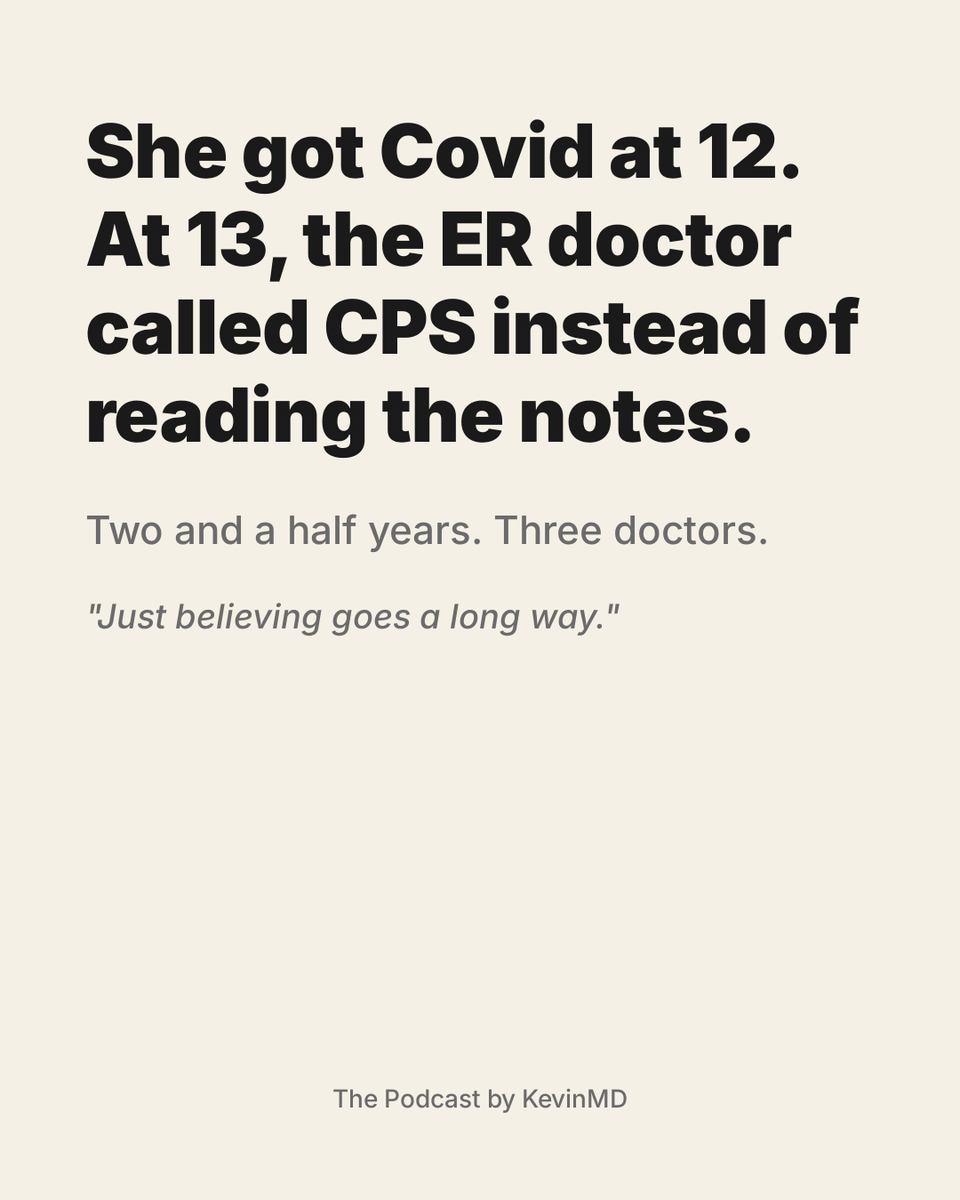
A mother asked an ER attending to check her daughter's chart before judging the dose. The attending didn't read it. She called CPS instead.
The patient was 13 years old. Her name is Lily Fernando.
June 2020: healthy 12-year-old gets Covid with the family. Ten days later the family recovers. Lily does not.
The 30 months that followed: POTS. MCAS. Tick-borne illness treated with doxycycline. A round of PT and OT to learn to walk again. A second Covid infection that reignited everything twice as hard. Anaphylaxis to MRI contrast. A medication trial for chronic pain that produced serotonin syndrome and left her in a tilted-space wheelchair, unable to sit up on her own.
A neurologist documented scheduled diphenhydramine. On it Lily was alert, schoolwork came back, reactions calmed. The treatment plan was in the chart.
In the ER the attending was concerned about the dose. The mother asked her to read the prescribing notes. The attending didn't. She filed a report with Child Protective Services. In Wisconsin a medical-neglect report also triggers a criminal investigation. The family cooperated, the social worker reviewed the entire record, and the family was cleared.
The mother then vetted autonomic specialists across the country and found one in Virginia. At the first appointment, before any history was taken, the new doctor said "I believe you."
Lily, now 14, says it was probably the best moment of her life.
Linda Bluestein, MD, who treats POTS, MCAS, and hypermobility patients, frames the structural lesson: imaging is a snapshot, taken supine, not upright, not dynamic. Labs are point-in-time samples. Normal results don't rule out a diagnosis. They constrain the differential. Listening to the history is not optional. It is the diagnostic instrument.
The marginal cost of reading the prescribing physician's notes in the chart is roughly zero. The marginal cost of not reading them, in this case, was a CPS investigation and a criminal investigation against a family that turned out to be cleared.
Listen to the full conversation on The Podcast by KevinMD. Link in the replies.
What is the single change to an ER workflow that would make "read the prescribing notes before reporting" the default rather than the exception?
#PatientAdvocacy #ThePodcastbyKevinMD
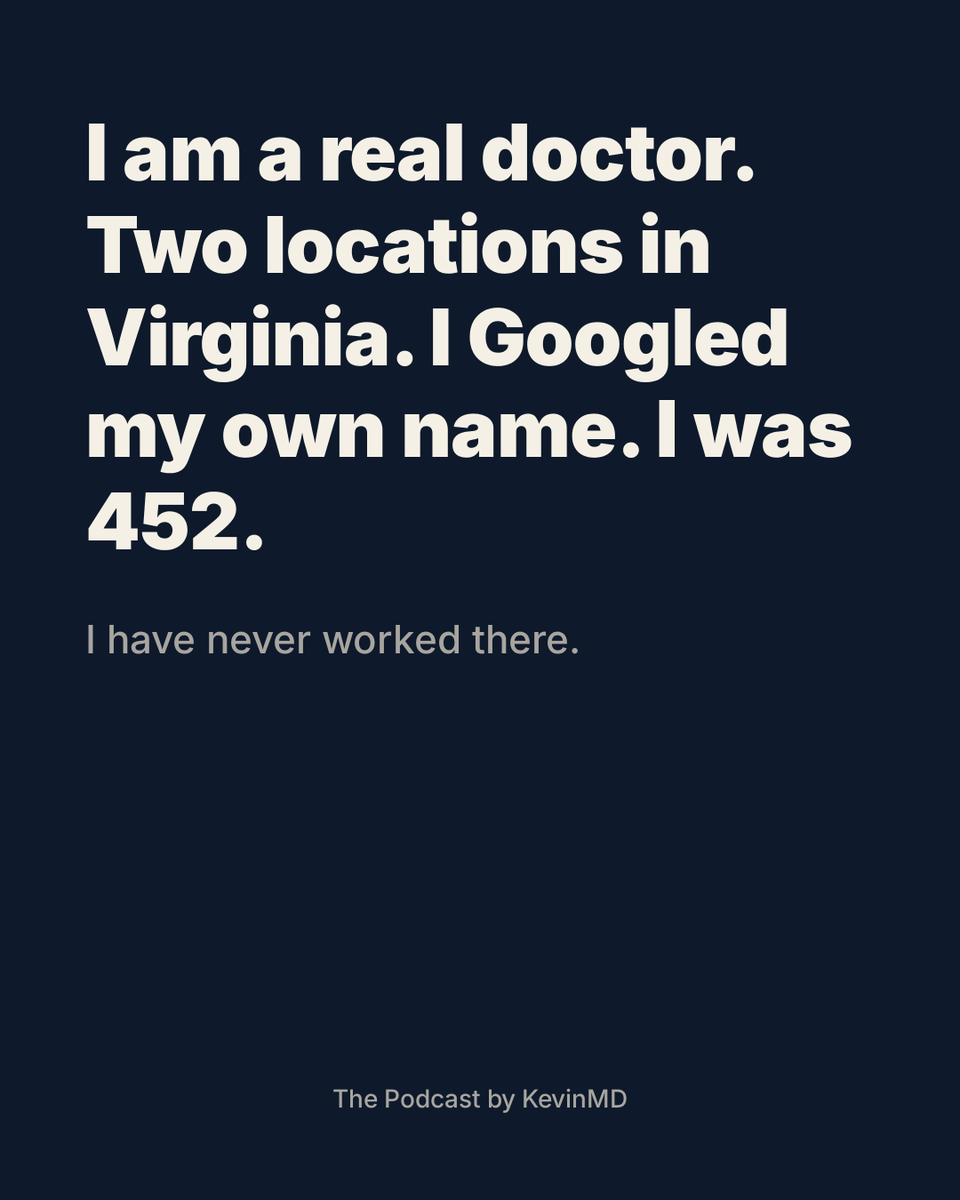
A practicing psychiatrist Googled her own name and was the 452nd result. The first seven clinics that came up were not hers. The clinic ranked first had no clinical staff she had ever met.
This is vertical integration in U.S. health care, observed at the consumer-facing search bar.
Three structural notes.
One. Vertical integration in U.S. health care now stacks payor, pharmacy benefit manager, bulk-purchase group, drug distributor, mail-order pharmacy, retail pharmacy, and clinic ownership inside single corporate structures. One parent company owns every step of the chain that connects a patient to a medication. When a market is vertically integrated end to end, the price-setting power and the patient-routing power both consolidate at the top of the stack.
Two. The consumer-facing consequence is search-result routing. Owned-and-operated clinics rank first not because their clinical reputation is stronger but because the search architecture is shaped by the parent company's commercial relationships, paid placements, and directory contracts. The patient typing a doctor's name into a search engine in 2026 is not finding the best clinical match. The patient is finding the result the largest parent company wants found.
Three. The independent practicing physician, the one with the two-location practice, the established patient panel, the clinical track record built over ten years, is now ranked 452. Not because the clinical care is worse. Because the ownership structure is smaller.
The historical antitrust frame applies cleanly. A "trust" was a group holding assets across an industry, and that asset-holding became illegal when it began to harm consumers on price and access. The vertically integrated structures now operating in U.S. health care satisfy that test. The unresolved question is whether existing authority will be applied to them.
The car-industry version of this structure would be one company that owns the factory, the dealership, the bank that finances the loan, the auto body shop, and the parts supplier. That structure was made illegal in cars a century ago. The same structure is currently legal in U.S. health care because corporate ownership is layered behind shell companies, and tracing who owns which clinic, which pharmacy benefit manager, and which clinic-chain back to a single parent is genuinely hard.
If you are searching for a physician right now, the doctor you find first is the doctor the corporate parent wants you to find first. The doctor with the best clinical match for your condition may be 451 results down the page.
Stephanie Waggel, MD, psychiatrist in Northern Virginia, explains how the search result became an ownership question on The Podcast by KevinMD. Link in the replies.
What is the single antitrust action that would most directly disrupt vertical integration in U.S. health care today?
#VerticalIntegration #ThePodcastbyKevinMD
Femoral hernias kill 5% of the women who get them. Women are 10 times more likely than men to have them. Six randomized trials have enrolled seven women total.
That is the actual research foundation behind how we manage one of the deadliest hernias in surgery.
Shirin Towfigh, MD, the first female editor of the hernia journal, walked through what happens when a young woman shows up with chronic pelvic pain in a system built on that foundation. She gets sent to the gynecologist. She gets treated for endometriosis. Then for ovarian cysts. Then for vulvodynia. The average woman waits two years longer than the average man to get a hernia diagnosis. She is more likely to be on narcotics preoperatively. And at some point she is told the pain is in her head.
Then a surgeon palpates the inguinal canal and finds what was there the whole time.
The clinical lesson is the one every primary care physician already knows but rarely operationalizes. Pelvic pain in a woman is more likely to be an inguinal hernia than endometriosis, ovarian cysts, or vulvodynia combined. The bulge is not required. Younger and thinner women present with pain, not a bulge. Hip pain, inner thigh pain, urinary frequency, pain with intercourse, pain during menses, bloating, nausea, all of these are described in the literature as inguinal hernia presentations and routinely worked up as something else.
The imaging matters. A dynamic hernia ultrasound has 100% sensitivity when positive and roughly 50% when negative, in which case the next step is a soft-tissue MRI of the pelvis with Valsalva, which runs over 90% sensitive and specific. A CT scan was in single digits for occult inguinal hernias in their analysis. If you are ordering CT to rule out an occult inguinal hernia, you are ordering the wrong study.
The systems lesson is uglier. The reason these women are missed is not that the clinicians in front of them are inattentive. It is that the literature behind those clinicians was built on six trials of seven women. The watchful waiting protocol that is considered safe in men has zero female data. We do not know if it is safe in women. We know femoral hernias have the highest mortality of any hernia, and we know women are 10 times more likely to have one. We have not enrolled the women needed to answer the question.
I am writing this for every physician who has sent a woman home with chronic pelvic pain. The diagnosis you missed might kill her.
Listen to the full conversation on The Podcast by KevinMD. Link in the replies.
#WomensHealth #ThePodcastbyKevinMD
An ER physician in Missouri spent three years warning his private-equity employer that the staffing plan was unsafe. A patient died. He got louder. They fired him. He sued for wrongful termination and won. He won again on appeal.
This is the story Wendy Dean, MD told on The Podcast by KevinMD, and it is the story most people who work in healthcare recognize without being able to name. Dean is a psychiatrist who introduced the term "moral injury" to medicine. She is describing what happens when a corporate employer's obligation to its investors collides with a clinician's obligation to a patient, and the clinician is the one who has to absorb the contradiction.
The pattern repeats: a young rheumatologist's dream practice gets bought by private equity. He takes a pay cut. He gets productivity targets that change how he can think during a visit. He gets a non-compete clause that says he can stay in his town and stop practicing rheumatology, or he can keep his specialty and move a hundred miles. He starts worrying about whether he can afford his kid's childcare. He has not done anything wrong. The math just changed underneath him.
Multiply that by every rheumatology practice, every dermatology group, every emergency department, every radiology shop that private equity has acquired in the last decade. Then ask why so many physicians say "burnout" and mean something they cannot quite describe.
Dean's distinction matters here. Burnout is a demand-resource mismatch. You can fix part of it with staffing, paid time off, and protected admin time. Moral injury is something else. It is a relational rupture: the promise the clinician made to the patient, the promise the employer made to its investors, and the clinician standing alone in the gap.
The FTC is currently taking public comment on corporate consolidation in healthcare. Submissions can be anonymous. Anyone can submit: patient, nurse, administrator, physician.
Dean's closing reframe:
"This isn't about you. This is about where and how you're asked to work."
Search "The Podcast by KevinMD" wherever you listen to podcasts. Link in the replies.
What is the single change to your organization's structure that would actually realign clinician obligations with patient care?
#MoralInjury #ThePodcastbyKevinMD