Are government price controls ever good for markets? >Indiana just passed a law that will cap hospital prices starting in 2029.
Sounds great, right? Finally someone taking on greedy nonprofit hospitals.
Here's why this may backfire spectacularly. 🧵
Physicians have been kept at the margins of venture investing. PhyCap was built to change that.
We're hosting our last session before our June 1 final close.
📅 Thursday, May 21 | 2:00 PM ET
🔗 https://t.co/RXYtVj1oDN
@DutchRojas@drslo
Take a peek at SF area home prices over past 6 months....just a small preview of the tsunami of wealth soon to be unleashed by theses IPOs. It won't all be parked in real eatate...
Five percent of US market capitalization is about to enter public markets through three IPOs.
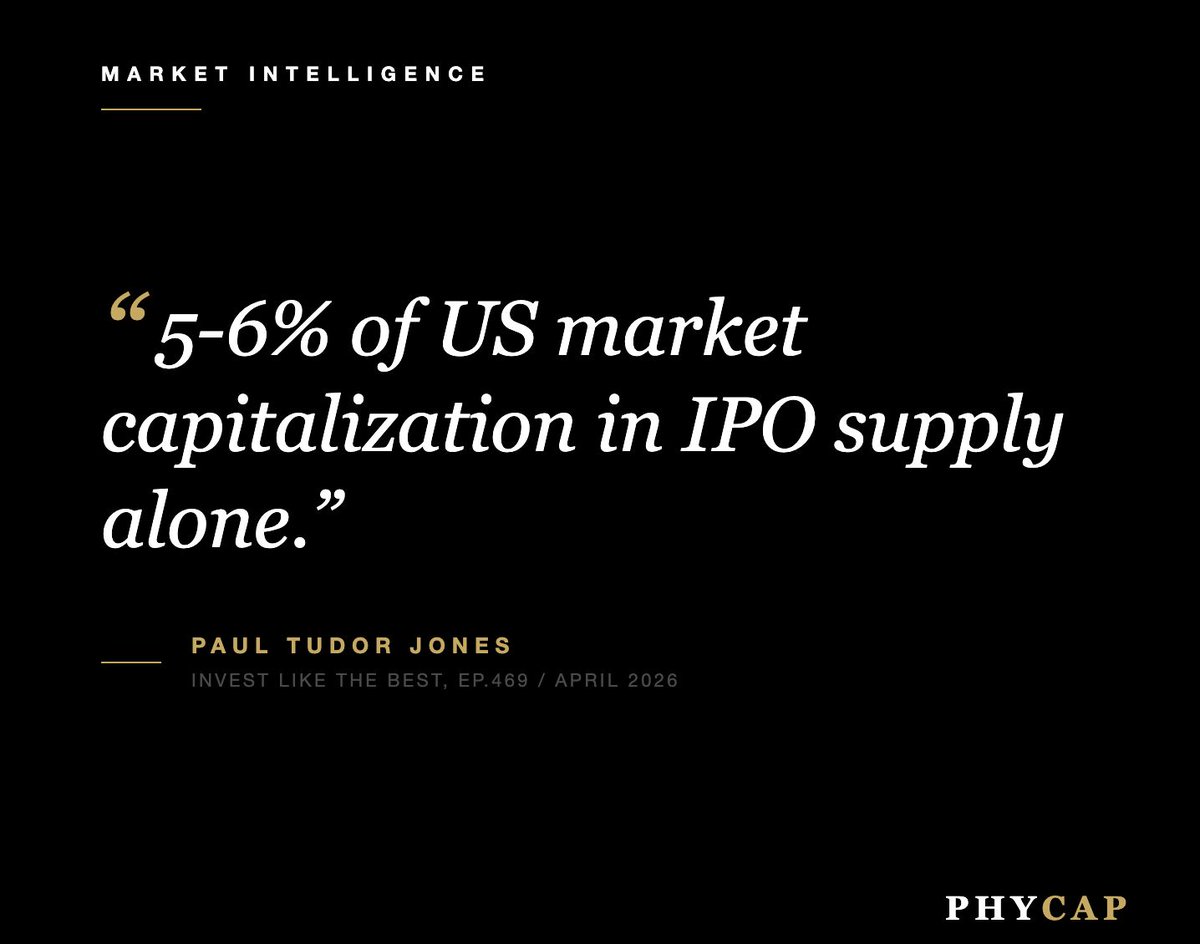
Paul Tudor Jones laid out the structural read on Invest Like the Best. The contemplated IPOs over the next year represent 5-6% of US market cap. Normal IPO issuance runs 0.5 to 1% in active years. The 2026 pipeline runs ten times that ratio.
The mechanism is direct. Buyback capacity has supported equity prices for a decade. The mega-IPO pipeline reverses it. The funding for SpaceX, OpenAI, and Anthropic is already being pulled out of existing technology stocks. Magnificent Seven weakness year to date is the rotation, not a coincidence of earnings cycles.
Standard 180-day lockups place the insider supply wave in Q1 through Q3 of 2027. The 2000 parallel is exact. Supply hit demand at the same moment fundamental concerns began to bite.
For physician allocators, healthcare sits structurally outside this pipeline. That creates the asymmetry worth positioning for.
No wonder he doesn’t understand healthcare!
Abdul El-Sayed told a podcast in 2022 that during his only clinical rotation, his job was “to be the, like, worst doctor on the team” and that he was “cosplaying a doctor.”
That four-week sub-internship at the end of medical school is the entirety of his time at a patient bedside.
He is now running for U.S. Senate in Michigan calling himself a physician.
El-Sayed earned an MD from Columbia in 2014, after two years at the University of Michigan Medical School and a Rhodes Scholarship at Oxford where he completed a DPhil in public health. The academic ladder is real.
Two doctorates. “Dr.” is accurate.
He never entered residency.
He has never held a medical license in Michigan, New York, or any other state.
He has never independently treated a patient.
In March 2026, El-Sayed told a group of Teamsters nurses he had “been in enough codes to watch who really does the work.” On a podcast that same month: “I’ve been a doctor my whole career.”
His campaign objects to the Politico report that surfaced these statements.
The spokesperson’s response was that “he has earned the right to be called ‘doctor’ twice over.”
That is true, and it is beside the point. The contested word is physician.
In American medicine, the MD is the beginning. Residency is the apprenticeship, three to seven years long.
State licensure follows residency. Independent practice follows licensure.
The structure exists because patients pay the price when it is skipped.
Every physician in this country surrendered most of their twenties to those steps.
Eighty-hour weeks.
Overnight call. Boards. Maintenance of certification. Malpractice exposure that follows them for the rest of their careers.
Physician is not a credential of the classroom.
It is a credential of the bedside, the licensing board, and the legal accountability of both.
To borrow it without paying for it is to take something from every doctor who did.
El-Sayed knows the difference.
He named it himself.
Excellent reporting @adamwren
https://t.co/wbe8SklW8e
5-6% of US market capitalization is about to enter public markets through three IPOs.
Normal run rate is 0.5 to 1%.
The 2026 pipeline is ten times that.
SpaceX.
OpenAI.
Anthropic.
$240 billion combined.
Healthcare sits outside the supply wave.
@PhysiciansCap It's already cranking through the SF Bay area.. escalating property values are the canary in the coal mine. Ripples soon to follow outward.
We have our Business Leadership Virtual Summit June 22nd. Please join us no charge.
6 Sessions on The Deal Market-PE, VC, Healthcare, Business Services, Real Esate and more. Also sessions on issues facing CFOs, AI use cases, talent and staffing and more. Maybe an added session on the silver tsunami and esops for transactions.
Great speakers include Jeremy Jacobowitz Tom Mallon Paula M. Avenaim Erris Langer Klapper, M.S., ESQ. Dylan Werner Will Conaway Jeff Freedman Chris Lacy Kat Marie Alvarez, RN,MBA BRENT BERGER Kenny Motew Michael Motew Nader Samii Bart Walker Andrea Marin Paul Slosar, MD, MHCDS and Brian Taylor.
For more information reach Lauren Eskenazi or myself. Thank you. Thank you. Thank you.
Tomorrow: Patterns from 500 Healthtech Deals
Join @drslo and Tracy Poole as they walk through the signals that build conviction quickly and why some of the strongest looking companies fall apart during diligence.
📅 April 29 | 7:00 PM ET
🔗 https://t.co/uQ86xcOYsL
@DutchRojas
Clinical decision support tools(AI-driven) are growing and will be an important solution helping doctors and frontline health care professionals address the caregiver shortage. VC investments in these is complex.... and requires extraordinary clinical insight. @PhysiciansCap
AI clinical decision support: 70% observed venture failure rate. The segment with the heaviest generalist-VC concentration is the segment with the worst return distribution. Workflow blindness has a price, and the return books show it.
@PhysiciansCap@drslo
WOW 🚨 Delta Dental is considered a nonprofit but the CEO skyrocketed her pay from $4.5 million per year all the way to $48 million over 4 years
That’s $1 million dollars per month pay for one employee as a nonprofit
“Delta Dental is considered a non-profit, and as such you can be their taxes online. So I got curious in their 2014 filing, the IRS requests for the organization's top accomplishments.
Delta Dental reported that over 95% of claims electronic, online and paper were processed without any manual intervention. That means when your care is denied, there is less than 1 in 10 chance a human reviewed it
— That same year, Delta dished out up to a 30% pay cut on the care that doctors deliver, and for a decade, they did not raise what they pay for your dental care by a single penny.
Meanwhile, their CEO's salary skyrocketed. She went from 4.5 to $15 million a year. From 2014 to 2018, she made off with almost $48 million before leaving her position. That's a million dollars a month. Must be nice. And she's not even a clinician. She's a CPA.
You don't have to be an accountant to do the math. Dr. Pay cuts stagnant reimbursements. They were never about saving patients money on premiums.”