This tweet is about how I have studied ML and made it my profession. I'll share the resources I've used and the sequence of my study.
Straight to point
ML pre-requisites(maths) : Linear Algebra, Probability Theory, Calculus, Optimization Theory(optional), Information theory(optional)
Linear Algebra: Lecture course by Gilbert Strang
Probability theory: MIT 6.041 (it contains parts of Bayesian inference as well)
Calculus: your high school and college classes are enough
Once basic maths is done then we move to ML.
Classical ML : CS229. Either by Andrew NG or someone else. Follow their lecture notes and solve their problem sets.
Reference books for classical ML that I followed: PRML by Christopher bishop, Pattern Classification by Duda, Hart and Stork
After getting comfortable with classical ML we move to Deep Learning and everything else.
Deep Learning and Computer Vision: CS231n. Very good lecture and assignments
Reference book: Deep Learning by Ian Goodfellow. This is the best book on deep learning. I’ve read some chapters of it many many times. Beautiful maths and intuitions
MLOps: dvc, WandB, MLFlow
NLP: I just read hugging face blogs. I haven’t spent much time with classical NLP though.
Alignment/AI safety/AI explainability: Anthropic Blogs(I’m a noob in this, just started learning couple months ago)
Additionally:
Blogs: Lilian Weng(OpenAI)’s blogs, colah’s blogs
Additionally: arxiv. I read many papers from arxiv
Karas and Tensorflow blogs: for introductory code about modern deep learning frameworks
Competitions: Kaggle
Cloud compute. GCP/collab/Kaggle notebooks
PS: this is not a roadmap. Just what I followed till now and I find it quite structured. Even after 5 years I still find myself learning new stuff everyday.
I just tried GPT Astra 6.2 on a pretty huge video editing task, and I'd say it performs at least at par with Opus 5.5, with almost half the tokens consumed.
It's also much faster and follows instructions much more clearly than Opus.
Because Opus takes a lot of time, it consumes a lot of tokens as well.
For a similar kind of infographics and animation, ChatGPT Astra 6.2 wins.
>your lack of urgency is what's stopping you from reaching your full potential
read it somewhere and it has stuck with me ever since
I am at the stage of life right now where the only thing that's stopping me from moving fast as fuck is my sense of urgency.
When I am in the zone and the urgency kicks in I am able to do weeks work in hours but then at other times it goes into the flat line again.
change of envirionment helps every now and then but I gotta find a more stable solution.
Introducing Claude Meetings: add Claude to your team’s video call and it builds docs, whiteboards, and other artifacts with you while you’re still talking.
Starting to roll out in beta on Team and Enterprise plans.
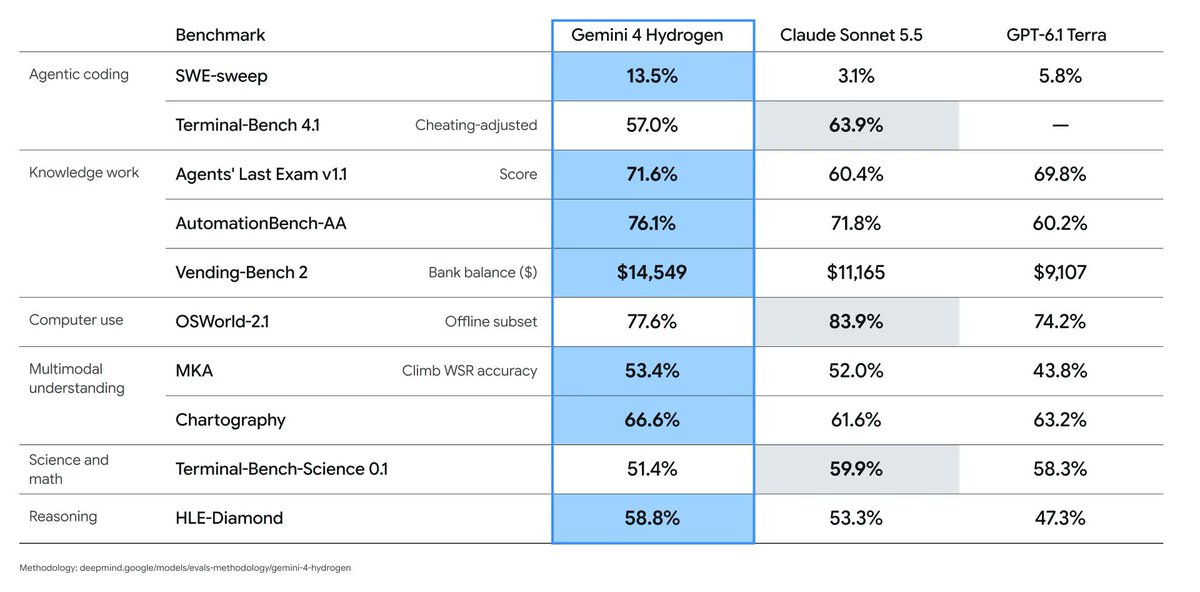
Introducing Gemini 4 Hydrogen, an extremely capable and fast model built to bring Gemini 4 to everyone!
Available to all tiers of Google AI Studio, Gemini API, Gemini for business, the Gemini app, Google Search, and paid Google AI Pro + Ultra subscribers in Google Antigravity.
Even the simplest weight edit, a deletion, can teach an LLM new skills!
Meet Deletion Tuning (#NeurIPS2026): just zeroing <0.1% of weights matches full fine-tuning's accuracy at scale. It's thousands of times smaller and avoids forgetting, a step toward continual learning. 🧵👇
Attention was not born in 2017.
In 2014 Bahdanau, Cho and Bengio taught a translator to look back at its source sentence, weigh every word with a softmax, and take what it needed.
Graves was addressing memory by content that same year. Luong reduced it to a dot product in 2015.
By 2016 Cheng and Lapata had sentences attending to themselves.
Wasn't that attention? Of course it was! It was there, working, waiting.
And yet I must be fair, because fairness is harder than criticism. The Transformer threw out recurrence, which everyone clung to like an old habit, and trusted attention alone. That was the real courage.
But why does the field remember who scaled an idea and forget who first had it? Is it the title, so confident it was almost arrogant? Or do we simply worship whoever arrives last and loudest? I don't know.