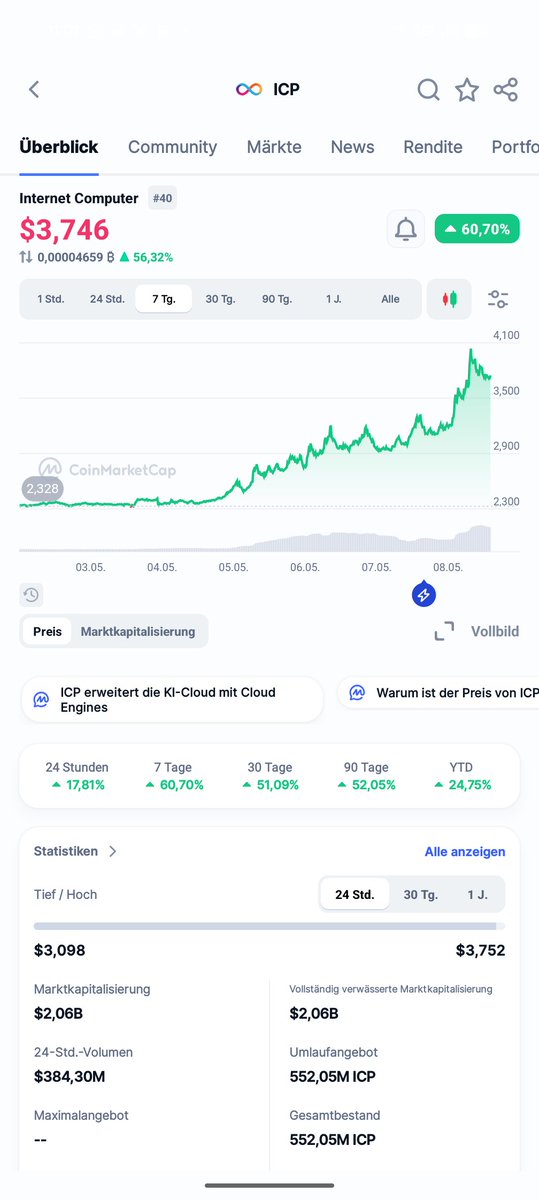
WHY will $ICP end up with way more developers than EVERY other chain combined? 🫵🏻
i genuinely believe it’s because the whole idea of what a “developer” even is isn’t set in stone.
it changes with the times, just like every job or role throughout history.
right now people using #caffeineAI for vibe coding on ICP aren’t officially counted as real devs, but that doesn’t mean it’ll stay that way forever.
we’re already at the point where AI is writing 41% of all code worldwide.
that’s hundreds of billions of lines, including 256 billion lines just in 2024.
a huge and growing number of new apps in the app store are being built with heavy AI help.
developers everywhere are already leaning on AI like crazy, so it makes total sense that this will shift to basically 100% AI-driven creation in the coming years.
once that definition updates and these caffeine builders get fully recognized as legitimate developers, ICP is gonna have more active devs than ethereum, solana and the rest of web3 put together.
that’s exactly why i’m so convinced about this whole thing.
if you feel the same way, let me know.
cheers
What does a Bible app absolutely need before V1.0 launch? ✝️ #jesus#christianity
I’m in the final stage of building one with #CaffeineAI and want honest community feedback.
My current must-haves:
• Full offline access (multiple translations)
• Powerful search
• Bookmarks, highlights & notes
• Daily verse + reading plans
• Bible verse learning mode
• Verses tailored to specific topics/themes
• Streaks for daily usage
• Clean distraction-free mode + dark mode
• Easy verse sharing
• Audio Bible
What would you add or remove? What is non-negotiable for you? #vibecoding
Drop your thoughts below 👇
Especially from heavy Bible app users!
Introducing pump fun GO: Pay ANYONE to do ANYTHING
Create & complete bounties for ANY task and leverage the power of humans & money across the globe
The world is at your fingertips. It’s time to GO 👇
Dear @ElectricCapital,
The current debate around “vibe coders” vs. “craft coders” is, at its core, a symptom of a much larger misunderstanding: the industry is in the middle of a fundamental shift toward AI-assisted development, and parts of the old guard simply don’t know how to measure it.
The claim that only “traditional” developers—those with individual repositories or purely manual workflows—should count is not just reductive, it’s wrong. It ignores how modern software is actually built. Code is no longer the point. Output, iteration speed, and problem-solving are what matter—not how many lines someone typed by hand.
“Vibe coding” is often used as a dismissive label, as if it represents something less real or less valuable. In reality, it describes a new mode of interaction with technology: developers orchestrate systems, leverage AI as a force multiplier, and shift their focus from raw implementation to architecture, logic, and product thinking. If that’s not “real engineering,” then the definition itself is outdated.
Saying AI-assisted developers don’t count is about as logical as saying a musician isn’t real because they use digital instruments. Tools evolve. That doesn’t invalidate the work—it amplifies it. No one seriously argues that films using CGI aren’t “real films.” Yet somehow, that flawed standard gets applied to software.
There’s also a structural issue here: when metrics are designed in a way that systematically excludes entire categories of developers—those working with abstraction layers, AI tooling, or alternative workflows—you don’t get an objective view of reality. You get a narrative. And that narrative can conveniently downplay ecosystems, platforms, or technologies that don’t fit a legacy mold.
In fast-moving domains like Web3, where infrastructure and development models are still evolving, this becomes even more problematic. Measuring the future with outdated criteria doesn’t just produce bad data—it leads to fundamentally wrong conclusions. The next generation of developers won’t use less AI—they’ll use more. And they’ll be exponentially more productive because of it.
Another key point: the divide between “vibe” and “craft” is artificial. Great developers have always been defined by how effectively they use tools. The difference today is that the tools have become exponentially more powerful. A developer who integrates AI intelligently isn’t less skilled—they’re expanding their capabilities, increasing efficiency, and solving more complex problems in less time.
The idea that this shift can be ignored or minimized feels almost nostalgic—like trying to evaluate the industrial revolution with pre-industrial standards. The outcome is predictable: you end up measuring the wrong thing.
At the end of the day, the truth is simple: code is code. Whether it’s written with or without AI is secondary. What matters is what gets built, how well it works, and the value it creates. Everything else is gatekeeping—and in the context of a global technological shift, it simply doesn’t hold up.
If someone argues today that AI-assisted developers “don’t count,” what they’re really saying is that they haven’t understood where the industry is heading.
👀🐍 internet-computer:native
Caffeine v3.0 ☕️, Tuesday, April 7th
https://t.co/IfQrVovF3L
A new era begins on ICP in a few days. A huge Caffeine upgrade will take place. This is about more than the new features it packs: what can be built on the Internet Computer through chat alone shall advance by a quantum leap.
It will blow your mind, because you can go so much further: those wanting to build apps and services on self-writing cloud, where every technical task is automated and directed by natural language interaction, may rationally decide that the Internet Computer is the place to be thanks to the work of Caffeine Labs.
But, stunning as the v3.0 advance is, this only marks the beginning of a new beginning for ICP. Caffeine is just getting started, and will be joined by other major advances unfolding in the ICP ecosystem. Several things are coming together:
1) The architecture that powers Caffeine v3.0 will ensure it continues to grow more powerful as time goes on. We expect that it will be possible for non-technical people to build almost anything on the Internet Computer in the future. Eventually special features like "Caffeine Snorkel" will also make it possible to auto-migrate legacy apps and services to the Internet Computer.
2) For the first time, Caffeine will allow all users to publish the App Market, so that other users can install copies of their apps, and if they want, remix them, since apps from the market are mutable and can be changed as needed. This is important change will be followed by the activation of monetization features, which will kickstart a new open source onchain economy based around the AI-driven development of re-usable apps and services.
3) Caffeine apps use ICP Blob Storage (which is currently exclusively available to Caffeine owing to its ongoing development) to maintain copies of files and binary large objects. Coming advances will enable Caffeine apps to store data at the world's best $/GB — making the Caffeine the perfect plartform to use to build apps that must store and share large amounts of data (for example, for a photo sharing app, or a team communications platform where video meetings are routinely recorded and archived).
4) Caffeine will soon be joined by new ICP "cloud engine" functionality, and then, the Internet Intelligence Network (IIN) — two new parts of the Internet Computer. Cloud engines will provide enterprise users with much more control over how the Internet Computer hosts their apps and services. IIN will provide everyone with access to inference on open weights models at lower cost than is possible today (for example allowing a business to create an e-commerce website on the Internet Computer where every customer can be helped through product exploration by AI, without worrying about the cost).
5) Cloud engines, which are essentially private subnets that can be controlled via a control panel, enable the Internet Computer to provide a cloud experience that feels more familiar to prosumers and enterprises used to centralized clouds. Users will be able to select the nodes combined to power their cloud engines, and nodes can include cloud-on-cloud nodes, such as AWS instances, as well as traditional sovereign node hardware. These nodes can be chosen to match precise throughput needs, or regulatory requirements (e.g. GDPR). The Internet Computer is thus transforming into a mass market cloud solution.
6) Powerful additional advantages of cloud engines include a) since they are essentally Internet Computer subnets, as usual hosted apps and services are tamperproof and unstoppable, and don't require support by security and systems administration personnel, b) hosted apps can have their query throughput auto-scaled horizontally by adding nodes, which can be located in proximity to demand, and can have ther update throughput auto-scaled by splitting the engines — enabling auto-scaling where software does not have to be updated — and c) owners can traverse underlying compute vendors and geographies and jurisdictions, simply by adding and deleting nodes, which can be done without interrupting hosted apps.
7) The Internet Intelligence Network is an extension to the Internet Computer that we plan to propose to the NNS soon (which I have mentioned before). This will be powered by community-operated hardware devices, which crucially, in combination with new technology we are developing, shall shall facilitate provision of lower per-token inference costs than AI clouds can currently achieve within targeted market segments (low costs that are derived from the technology involved, in contrast to certain contemporary decentralized GPU networks that use token appreciation to drive unsustainable subsidization flywheels).
8) A key unique additional aspect of IIN is that inference is verifiable, just like onchain compute — that is, those supplying prompts and context will know that their results are correct, and shall not have to trust that the IIN nodes powering inference haven't changed their results (for example, by inserting advertising, or malicious content). The strength of the verification is configurable. In the default mode, there will be no discernible difference in cost or performance/time thanks to the techniques developed. In higher security modes, useful for special high-security purposes, verification cost will scale linearly with every node checking the inference, while the hit to performance/time remains very small. (Note that because inference is non-deterministic, inference verification is technically challenging and novel, and will advance the state-of-the-art).
In all, v3.0 is part of the Internet Computer's march towards the mainstream cloud market, which is predicted to generate $1 trillion in revenue in 2026, and $2 trillion in 2030.
While we see the Internet Computer as a revolutionary decentralized cloud platform, rather than a network beloning to the web3 industry per se, we note that after tokens (Bitcoin), and DeFi (Ethereum), onchain cloud is the first new decentralized network functionality to unlock mass market potential — and it's happeing exclusively on the Internet Computer, which is by far the most technologically advanced network the world has ever seen.
ICP is advancing to define an important new cloud sector, where the network is the cloud, and the cloud is self-writing.
🚨JUST IN: ICP PAYMENTS GO LIVE IN 137+ SWISS SUPERMARKETS
Dfinity Foundation (@dfinity) confirms rollout of $ICP payments across SPAR Switzerland. Per reports, integration is powered by OpenCryptoPay and @DFX_Swiss.
Over 1.4 million customers can now pay with ICP. ckBTC is also supported for Bitcoin-based payments. No banks or card networks involved.
Onchain Internet Computer canisters used in hack of Iranian machines/interesting! To clarify, we had nothing to do with this, and as I understand, the network's boundary nodes brought it down.
https://t.co/25H8UxsOGn