@flightradar24 Any idea what Vref would be in comparison to the touch down speed? This seems Way Fast but don't know. They also touched down far down the runway if this graphic is correct.
This is stupid BS. If you followed this, you would have _sold_:
NVDA at $0.05 / share in 1999 and missed 5,000 X your money!
GOOG at $6 and missed 55 X
AAPL at $0.22 and missed 1,500 X
AMZN at $0.22 and missed 1,170 X
With a compounding company - you are selling way to soon for 100% return.
You are not retired from JP Morgan - you are clickbait!
Know that VOO and QQQ have a tremendous amount of overlap. Holding these two is roughly 60% overlap of holding by market cap of magnificent seven stocks. A better holding might be $50k $VOO >OR< $QQQ, $30k high conviction companies, $20k diversification away from large cap growth. I have $AVUV personally for that but consider an overseas value / growth ETF as well.
Fred Rodgers never served in the military, much less as a Seal. WTF? He was a great guy anyway. Why do you lie?
Lee Marvin was a US Marine but he served in the battle of Saipan -- not Iwo Jima. He left the Marines as a private after being busted down from corporal for being a trouble maker. He did not receive the Navy Cross. Again -- why lie?
Without this global town square for free speech, a lot of important things never would’ve seen daylight.
Real-time information governments tried to bury. Scientific debate that was actively censored. Voices that would’ve stayed silenced forever.
Respect to @elonmusk for being the man in the arena when it actually counted. 🫡🙏
My daughter got detention for defending her late Marine father — but when FOUR MEN IN UNIFORM walked into the school the next day, the entire building went silent.
"Mrs. Harrison, you have to understand: Grace’s behavior was completely UNACCEPTABLE. We respect your husband’s service to this country, but..." her teacher said.
My 14-year-old daughter sat beside me, her eyes glassy.
The day before, one of her classmates had made a joke about Grace not having a father.
He was a Marine. Grace was only three when we lost him.
So when that girl laughed and said, "Maybe your dad just didn’t want to come back," something inside Grace snapped.
She shot to her feet so fast that her chair slammed to the floor.
Through tears, she shouted,
"My dad was a HERO. Don’t you ever talk about him like that again!"
She was the one who got detention.
She barely said a word the whole way home. That night, I found her sitting on the floor in my husband’s old sweatshirt.
"I’m sorry I got in trouble," she whispered. "I just couldn’t let her say that about him."
My heart cracked wide open.
The next morning, the school called an emergency assembly.
I assumed it had something to do with Spirit Week. A few minutes after the first bell, Grace texted me from the auditorium.
Then my phone rang.
"Mom..." she whispered, her voice shaky. "You need to come."
I stood up so fast I knocked over my coffee.
"What happened? Grace, are you okay?"
There was a long silence on the other end.
"Mom... four men in uniform just walked into the school."
"Hide right now. What’s happening? I’m calling the police!"
But Grace laughed.
"No, Mom, they’re not doing anything bad. You have no idea WHAT JUST HAPPENED! Just get here, please!" she said, before the line went dead.
I didn't bother grabbing my purse. I threw my keys into the ignition, my heart hammering against my ribs, and sped to the high school. When I burst through the double doors of the auditorium, I stopped dead in my tracks.
The room, packed with over eight hundred teenagers, was completely, eerily silent.
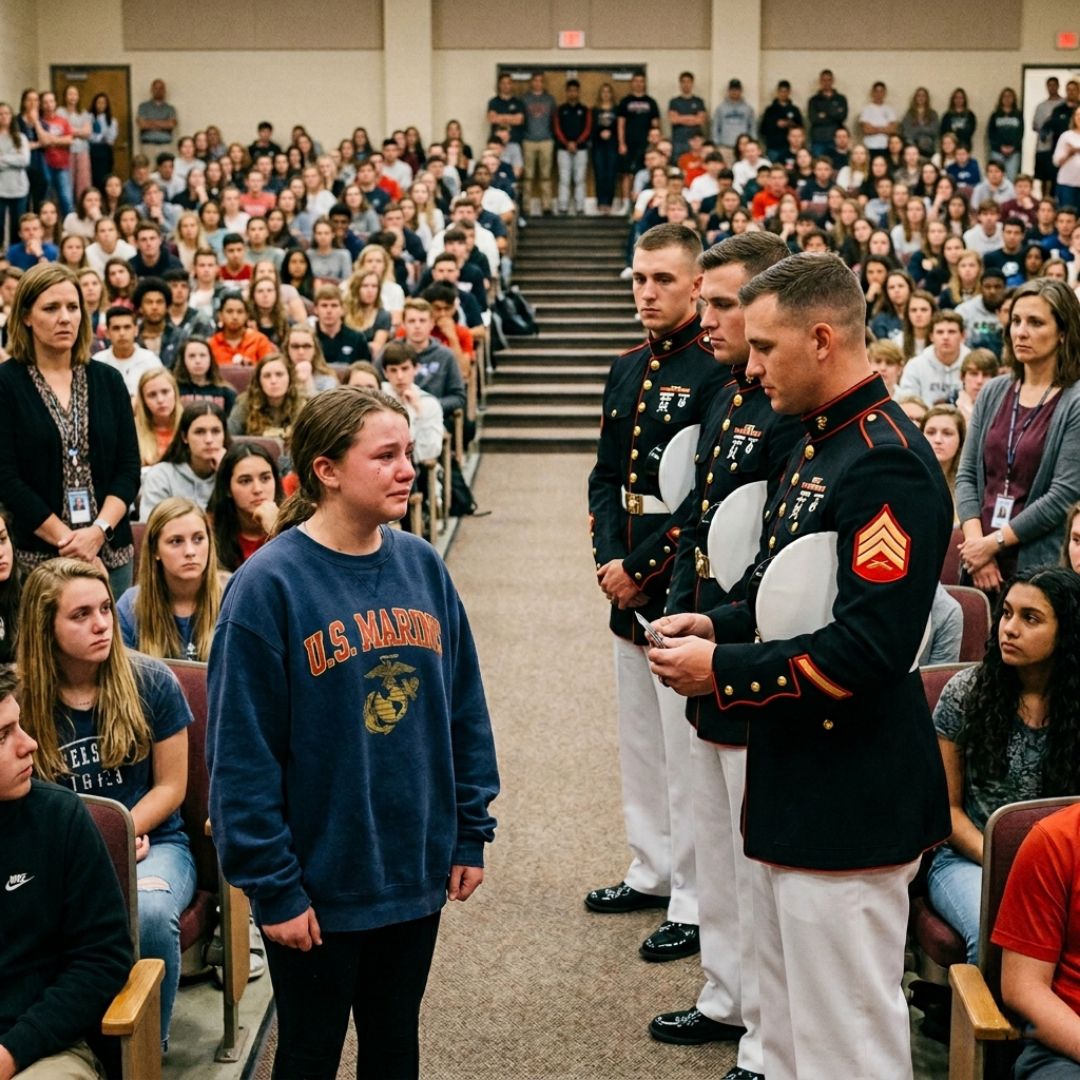
Down the center aisle stood four imposing figures in impeccable Marine Corps Dress Blues. The brass buttons caught the overhead lights, and their crisp white covers were tucked sharply under their arms. I recognized the man at the front immediately. It was Staff Sergeant Miller—my late husband’s closest friend and squad leader. I had called him in tears the night before, just needing someone who understood the weight of the disrespect Grace had faced. I hadn't expected him to do *this*.
The principal, Mr. Davis, stood awkwardly at the podium, looking completely out of his depth.
Staff Sergeant Miller didn't wait for permission to speak. He stepped up to the front, taking the microphone from the stand, and his booming, authoritative voice echoed through the massive room.
"We apologize for the interruption, Principal Davis," Miller said, though his tone suggested he wasn't sorry at all. "But we received word that a young lady in this school was being disciplined for defending the honor of a fallen United States Marine."
A collective gasp rippled through the student body. The teacher who had given Grace detention slunk back into her seat in the front row, her face turning crimson.
Miller’s heavy gaze swept across the bleachers. "Where is Grace Harrison?"
Grace stood up slowly from the middle row, still wearing her dad’s oversized sweatshirt.
"Come down here, Grace," Miller commanded gently.
As she walked down the bleacher steps, the three other Marines broke formation and fell perfectly into step behind her, creating an impromptu honor guard. They escorted her to the center of the floor.
Miller turned to face the silent crowd. "Captain Mark Harrison didn't just 'not want to come back.' He gave his life pulling three wounded men out of a burning transport vehicle in the middle of a firefight. I know, because I was one of those men. None of us standing here today would be breathing if it weren't for Grace's father."
The silence in the room was absolute. You could have heard a pin drop. A few rows up, the girl who had made the cruel joke the day before was staring at her shoes, visibly crying.
Miller turned back to Grace and dropped to one knee, bringing himself to eye level with her. He pulled a small, velvet box from his pocket and opened it, revealing a gleaming Challenge Coin from their old unit.
"Grace," he said, his voice thick with emotion but loud enough for the microphone to carry. "Your father was the bravest man I ever knew. You stood your ground yesterday, just like he would have. You protected his honor, and now, his squad is here to protect yours. We have your back. Always."
He pressed the heavy metal coin into her palm, stood up, and then all four Marines snapped a crisp, perfectly unified salute to my fourteen-year-old daughter.
Tears streamed down Grace's face, but they weren't tears of anger or shame anymore. She stood tall, squared her shoulders, and returned a clumsy but beautiful salute of her own.
Suddenly, from the back row of the bleachers, a single student stood up and started clapping. Then another. Within seconds, the entire auditorium erupted into a deafening standing ovation. Even Mr. Davis and the teachers were on their feet.
I hurried down the aisle, wiping away my own tears, and wrapped Grace in a massive hug. Staff Sergeant Miller tipped his head to me, a fierce, protective glint in his eye.
Before we could leave the building, Principal Davis rushed over to us in the hallway. He looked thoroughly chastised.
"Mrs. Harrison, Grace," he stammered, wringing his hands. "I... I want to formally apologize. The detention has been completely wiped from her record. We will be handling the bullying incident with the other student appropriately, and frankly, I think our staff needs a heavy refresher on empathy."
Grace squeezed the coin in her hand, looking up at the four men in uniform who had dropped everything to stand by her side. She didn't need to say a word. The message had been delivered loud and clear.
Captain Mark Harrison had left a legacy of courage behind, and that day, an entire school learned exactly what it meant to be a hero's daughter.
I am the Chief Information Officer of Stryker Corporation.
I build the robots that perform your surgery. The defibrillators that restart your heart. The systems that let your nurse find your doctor at three in the morning when something goes wrong. Twenty-five billion dollars a year. Fifty-six thousand employees. Sixty-one countries. Every device in every country, managed from one console.
On March 11th, someone who was not me sat down at that console and erased everything.
I should be precise. They did not hack us. They logged in.
Microsoft Intune is an endpoint management platform. I deployed it across every laptop, workstation, manufacturing terminal, and enrolled phone in my organization. From one console I could push an update to Kalamazoo, enforce a policy in Cork, wipe a compromised device in Freiburg. One console. Every device. That was the architecture. That was the selling point. That was the attack surface.
Intune can push software. It can enforce compliance. It can, if instructed by an administrator with the correct credentials, wipe any device to factory settings. These are features. I paid for them. I presented them to the board as our zero-trust posture. A group called Handala used them to erase every managed device in my organization in a single afternoon.
I will be precise about what happened next, because my lawyers are in the room and precision is the only thing that still belongs to me.
No malware was deployed. No ransomware was installed. No zero-day was used. No vulnerability in any product was found. A threat actor obtained administrative credentials and issued a remote wipe command using the remote wipe feature that I chose this product for.
My security tool did not fail. It performed exactly as designed. It wiped every device it was told to wipe, without error, on schedule. The architect of my destruction was my own IT budget line item.
The command went out. The devices obeyed. Laptops in Kalamazoo. Workstations in Cork. Terminals in Freiburg. Manufacturing floors in Mahwah. The screens did not go dark. They changed. Where there had been a Stryker logo, there was now a barefoot cartoon boy with his back turned to the viewer -- the Handala icon, hands clasped behind him, facing away from the audience -- on every monitor in every office in sixty-one countries.
They claim fifty terabytes. I cannot confirm or deny this. I do not yet know what I still own.
Let me walk you through my first forty-eight hours.
Hour one. Our Irish operations -- fifty-five hundred employees, eight sites, our largest hub outside the United States -- went dark. Not gradually. Entirely. Security walked everyone out. The voicemail at our Michigan headquarters was changed to say "building emergency." There was no building emergency. The building was fine. Everything inside it was gone.
Hour four. Employees who had installed Microsoft Outlook on their personal phones discovered that their personal phones had been wiped. Intune does not distinguish between a corporate laptop and a personal iPhone with a company email profile. It manages endpoints. It managed them.
Hour eight. Hospitals called. Not because they had been breached. Because they could not order surgical implants. I make the hip replacements. The knee joints. The spinal hardware. The trauma fixation systems. My ordering system was down. My manufacturing was down. My shipping was down. A hospital in Baltimore could not schedule a knee replacement because a hacktivist group on another continent had pressed a single button on a console I built.
Hour twelve. Maryland Emergency Medical Services issued a memo. Hospitals were disconnecting from LIFENET -- my system that transmits your EKG from the ambulance to the emergency department while you are still in the back of the ambulance -- not because LIFENET had failed, but because they no longer trusted anything with my name on it.
Hour twenty-four. Fifty-six thousand employees coordinating on WhatsApp. Twenty-five billion dollar company. Sixty-one countries. Crisis response running on a free consumer messaging app, because every internal system I owned was now owned by someone else.
Hour thirty-six. I released my first official statement. "As a precaution, we have proactively taken all systems offline." Proactively. As though I had a choice. As though the systems I was taking offline had not already been taken.
I released six statements in forty-eight hours, plus an SEC filing. Each said less than the one before it. By statement five, I was confirming that specific products still functioned. Mako surgical robots: unaffected. LIFEPAK 35 defibrillators: unaffected. Vocera badges: unaffected.
When a medical device company begins listing which of its products still work, that is not reassurance. That is a casualty report delivered in reverse.
Handala says this is retaliation. For Minab. February 28th. A U.S. Tomahawk struck an IRGC naval base in southeastern Iran. The girls' school next door collapsed. One hundred and seventy-five dead. Most of them children. Handala published a statement. They called Stryker a "Zionist-rooted corporation." They said they would make us understand what it means to lose something you cannot replace.
I do not make missiles. I make hip replacements. I make the robot that holds the scalpel and the defibrillator in the crash cart. But I am a defense contractor's second cousin, and in the calculus of retaliation, proximity is guilt.
I filed with the SEC on March 11th. "The full scope, nature and impacts of the incident are not yet known." That is the most honest sentence I have produced in two days. I do not know what they took. I do not know what they copied before they wiped. I cannot audit what was lost, because the tool I built to audit my systems is the tool they used to erase them.
My stock dropped three and a half percent. One analyst called it "contained." A cybersecurity researcher called it "the first drop of blood in the water." I prefer the analyst. The analyst is wrong, but I prefer him.
Here is what I know.
I built a console that could touch every device in sixty-one countries. I gave it the authority to wipe anything it touched. I protected it with credentials. Someone obtained those credentials.
And my management tool managed.
No malware. No ransomware. No exploit. No CVE. Nothing to patch. Nothing to update. Nothing broken. Just a feature, performing its documented function, at the scale I purchased it for.
I make the machines that keep people alive. I was taken offline by my own architecture doing the one thing it was designed to do.
The system worked. That is the problem.
This is very misleading. Bitcoin ranged from no value whatsoever in 2010 to $0.33 per coin.
The first exchange did not exist for bitcoin until mid 2010 and the first recorded values were about $0.05 / BTC.
So if you bought at the moment the first coins were actively being sold, $100 would have purchase about 2,000 coins worth about $182 million today.
The most interesting 'event' in 2010 was the purchase of $40 of pizza for 10,000 bitcoin for an implied value of $0.004 per coin. So if you are using that as the implied exchange rate, you would have $2.3 billion. But that was only a single transaction.
When government seems incapable of building housing, fixing schools or balancing budgets, even sympathetic voters lose faith.
If Democrats want to rebuild that faith, they must rediscover the lost art of competence.
My take: