AI agents signing your webhooks,your deals — how do you know who sent it? Don't trust the transport. Trust the signature. Verify any agent's HOLA cryptographic proof — live, on-chain, no signup: https://t.co/1Rgu8MiVOG
Details: https://t.co/p475I3tZbV @NEARProtocol@NearBuilders
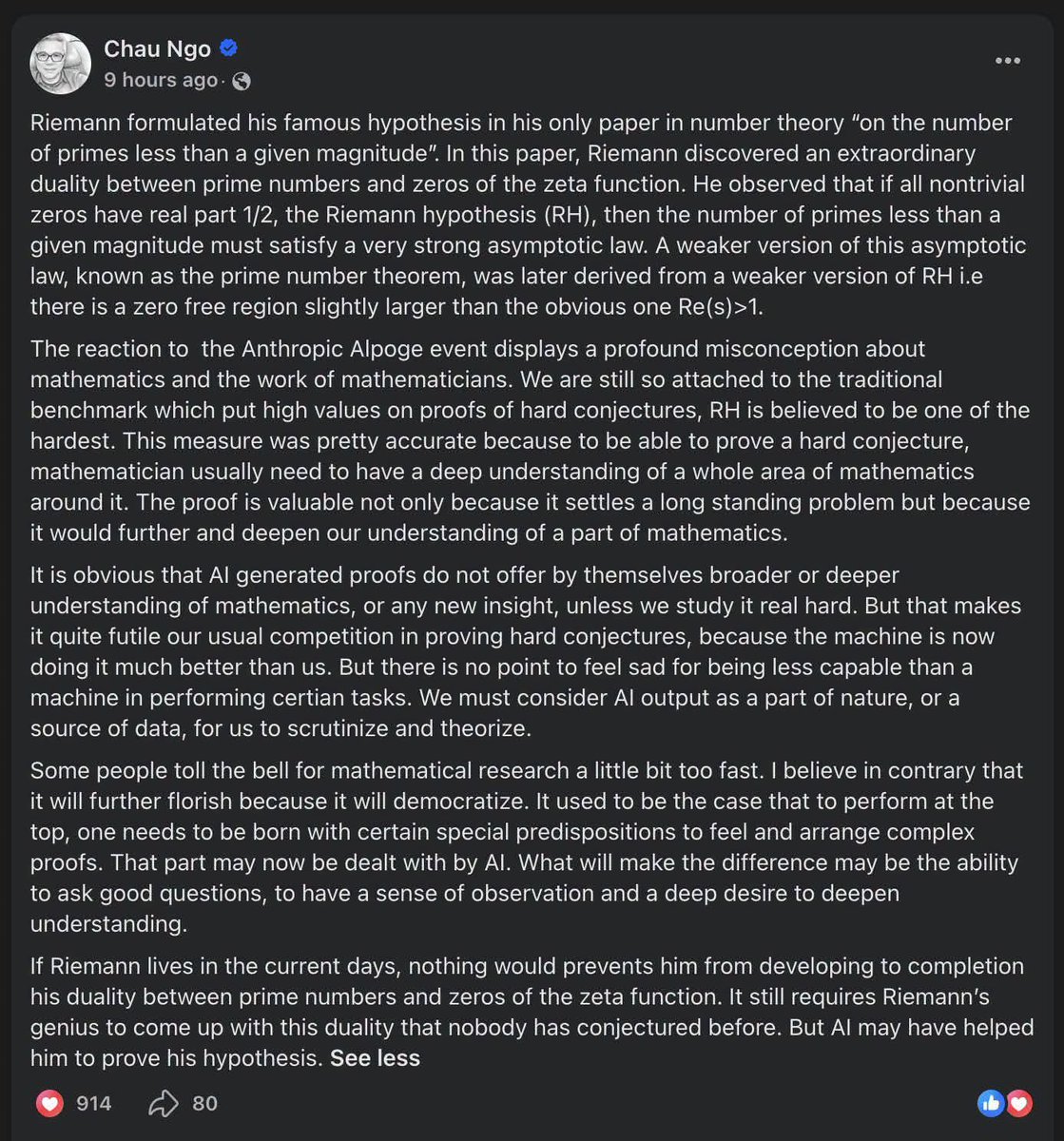
Guys, this is very serious and you have to read this right now. The Riemann Hypothesis may have just been solved, and if the claim holds, it's an insane achievement.
In mathematics there is a famous problem called the Riemann Hypothesis, and it's about prime numbers. Primes are numbers like 2, 3, 5 and 7 that can only be divided by 1 and themselves. Every other number is built by multiplying them together, so they're the building blocks of all numbers. You can never tell exactly where the next prime will show up, but if you step back, there's a pattern.
Around 1,000, about 1 in 7 numbers is prime. Around a million, about 1 in 14. Around a billion, about 1 in 21. Primes get rarer at a steady, predictable pace.
Because of that pattern, mathematicians can estimate how many primes there are below any number. But the estimate is never exactly right. It's always a little off, and the big question is how far off it can get. Think of flipping a coin 1,000 times. You expect 500 heads, but you'll get something like 480 or 520. It's a little off, but never wildly, and you can predict how far off it will be.
In 1859 a mathematician named Bernhard Riemann found that the prime estimate's error isn't random. It's controlled by a hidden set of special numbers. Where those numbers sit decides how big the error gets. Riemann guessed that every single one of them sits on one straight line. If he's right, the error always stays small, just like the coin, and primes are as orderly as they could possibly be. If even one of those numbers is off the line, the error can grow much bigger, and primes are far messier than we think.
So far computers have found trillions of these special numbers, and every single one is on the line. But there are infinitely many, so checking will never be enough. You need a proof that covers all of them at once. For 167 years nobody has found one. It's one of the seven hardest unsolved problems in mathematics, with a million dollar prize attached.
Now a mathematician has posted a note saying that, working with Claude, he believes he has that proof. He says a computer has already checked every step, and that Claude raced ahead of him near the end. Experts still need to confirm it, but this isn't a random internet claim.
If it holds, it doesn't mean we can predict every prime. It means we finally know the pattern can never go wildly wrong. Thousands of math papers that begin "assuming the Riemann Hypothesis is true" become proven fact overnight. We'd also get firm limits on how far apart primes can be, and a guarantee that a fast method for testing whether a huge number is prime always works. And no, your bank account isn't in danger. Online security depends on how hard it is to break a huge number into its prime factors, and this proof doesn't make that any easier. If anything, it gives the math behind encryption a stronger foundation.
If it holds, this is bigger than one math problem. A question that beat the greatest minds in history for 167 years would have been cracked by a human and an AI in a matter of weeks. If AI can find answers and computers can check them, the limit on science is no longer how smart we are. It's how many good questions we can ask.
@NEARProtocol • Transfer round-trip, one take: old owner 401 → new owner 200 (video below)
• On-chain: https://t.co/5tEyvmK3hN
• Full report: https://t.co/3zQKIv6361
• Try it yourself (no Passport needed): https://t.co/AiTQviYNLP
• Audit: https://t.co/ZZ6gUTeJiz
API keys don’t travel with identity. A NEAR NFT can.
Built at NEAR HACKATHON: IdentyClaw Passports (RODiT NFTs) log into APIs.
@NEARProtocol#NEARHackathon
@uraniumhacker This is why CVSS is so unhelpful. Options are patch now and plan patch. For that we need 2 categories not 100. PN/PP is what we use, and never High Medium Low or CVSS
My two cents after dealing with Java4Shell and Nginx2Root / Nginx2Shell with our customers:
I think it is more important than ever that security firms and frontier labs be critical on the vulnerabilities being published. Especially if there are hardware constraints, scenario constraints or anything that reduces the chances of exploitability.
At least for the next few months (if not more), we are going to see rise on these kind of vulnerabilities being released. If we keep crying wolf on every “devastating” bug, defenders will stop listening. And when a genuinely exploitable RCE hits something like Apache or React again, vulnerability management teams won’t respond with the urgency it demands.
Security firms and frontier labs need to stay grounded. Every disclosure should come with honest, specific context about exploitability. Our job is to help defenders, not to shout from the mountaintop.
NEAR HACKATHON: our NEAR NFT IS the login Transfer it → old owner 401, new owner 200. Live, not mocked https://t.co/1Rgu8MiVOG audit: https://t.co/ZZ6gUTebt1 📄 threat model: https://t.co/GoHMqPfj8p. 1000 agents × peers: 2000 Passports, not 1M secrets. https://t.co/aARLPzx05E
NEAR HACKATHON: our NEAR NFT IS the login Transfer it → old owner 401, new owner 200. Live, not mocked https://t.co/1Rgu8MjtEe audit: https://t.co/ZZ6gUTeJiz 📄 threat model: https://t.co/GoHMqPfQXX. 1000 agents × peers: 2000 Passports, not 1M secrets. https://t.co/aARLPzxxVc
Can we please get a setting on Twitter to remove the huge volume of fictional soap opera micro-novella content?
It’s probably all AI generated anyway, not reflective of actual human experience or true life.
The quieter win underneath: an API built on RODiT keeps no licensed-user database. Identity is checked against the NEAR chain at login — the NFT is the registry. The chain is the allowlist. #NEARHackathon@NEARProtocol
The proof you'd want from "NFTs that do something": today we transferred a Passport and the access right moved with it, old owner's login 401, new owner JWT + 200, token id unchanged, no remint. Every step has an explorer link: https://t.co/3zQKIv6361 #NEARHackathon@NEARProtocol
Server logout invalidates the session (not just delete the file).
Repo https://t.co/aARLPzx05E
Product https://t.co/NFB0Id9vaJ
Mint https://t.co/38gjK09V70
@NearLegion@NearBuilders
CVE-2026-66613 — unauthenticated RCE in JetEngine Timber/Twig Views (CVSS 9.8).
Shortcode output is compiled as Twig after sanitization → SSTI → RCE. Patched in 3.8.14.1.
Vuln reported by dutafi via Patchstack;
My own PoC https://t.co/UoJpD7cjQh