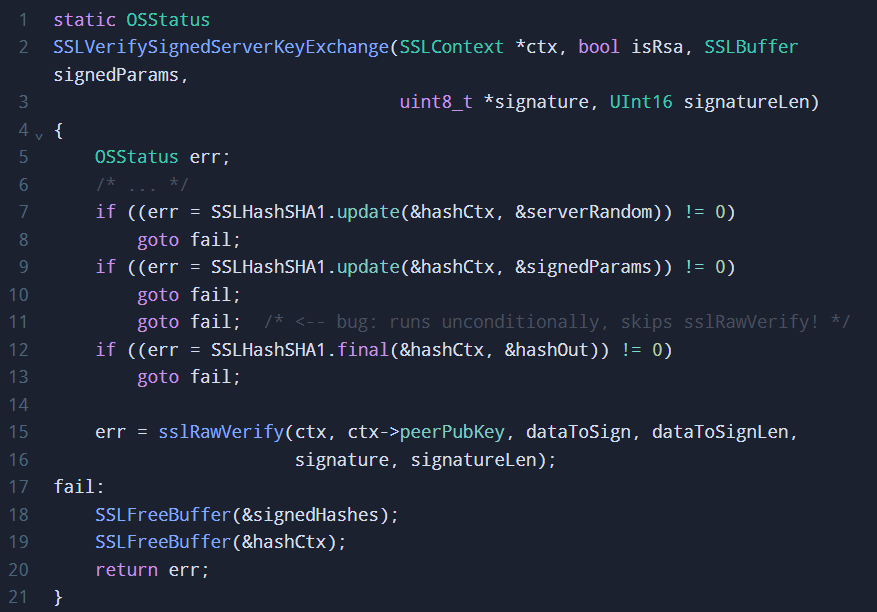
In 2014, researchers discovered that a single duplicated line in Apple's C source code (sslKeyExchange.c) allowed affected iPhones and Macs to accept forged SSL/TLS server key exchanges.
Because the second goto fail; was outside the if, it executed unconditionally whenever execution reached it skipping the cryptographic signature check entirely.
If the preceding hash operation succeeded, err was already 0. The function returned success without ever calling sslRawVerify().
One extra line had bypassed a critical authentication check.
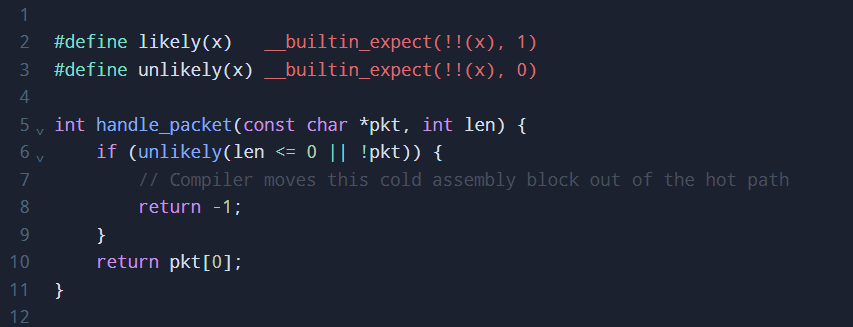
If you look at the Linux kernel source code, you'll see likely() and unlikely() wrapped around error checks everywhere.
They use __builtin_expect to tell the compiler to move cold error-handling instructions to the far end of the function so the CPU's L1 instruction cache stays packed with the fast path.
You can lock a Linux C process inside a security sandbox so strict that even if an attacker gets Remote Code Execution, they cannot open a file, spawn a shell, or touch the network.
One call to prctl with SECCOMP_MODE_STRICT tells the kernel: if this process attempts any syscall other than read, write, or _exit, kill it immediately with SIGKILL.
In C, if you need a macro to generate a guaranteed unique variable or struct name every time it is expanded across a file, GCC and Clang provide a secret built-in macro called __COUNTER__ that automatically increments 0, 1, 2, 3... every time the preprocessor touches it:
In C, if you need a macro to generate a guaranteed unique variable or struct name every time it is expanded across a file, GCC and Clang provide a secret built-in macro called __COUNTER__ that automatically increments 0, 1, 2, 3... every time the preprocessor touches it:
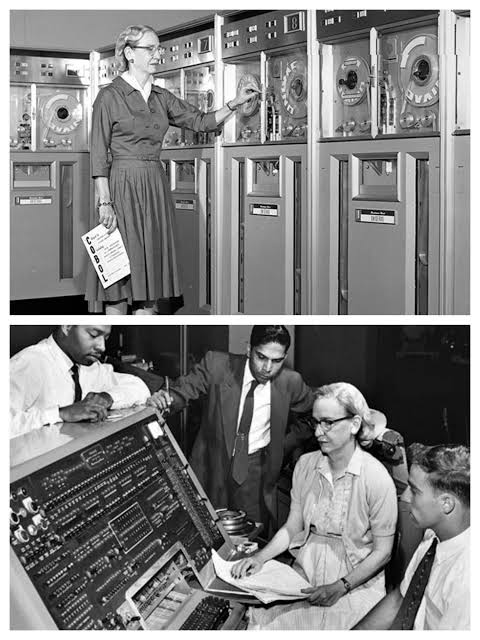
Every time a developer says using AI isn't real programming, remember what happened to Grace Hopper in 1952.
When she built the first operational compiler so programmers could write in English words instead of symbols, fellow engineers refused to touch it insisting that computers could only do arithmetic, not write programs.
Every generation mistakes its current abstraction layer for the only real way to work.
Motherboard manufacturers spent years turning BIOS menus into flashy, mouse-driven gamer interfaces with animated dashboards and overclocking widgets.
Meanwhile, half the people who actually change BIOS settings just hit F7 to get into Advanced Mode and navigate the same old menus with arrow keys.
We somehow managed to give the BIOS a gaming UI.
If your notes, photos, or projects live inside a proprietary cloud database and become inaccessible the day you stop paying a $15/month subscription, you aren't using a software tool.
You are paying rent to a digital landlord to look at your own files.
Look at how code reviews work in almost every company:
> A 10-line Pull Request: receives 28 comments debating variable names and formatting.
> A 2,400-line Pull Request rewriting the core memory allocator: receives "LGTM! ��" in 4 minutes because nobody knows how to read it.
Why did playing the original Quake (1996) over the internet feel like swimming in glue until QuakeWorld arrived?
Because Quake sent your movement inputs to the server and waited for the response before showing your character move. On dial-up, that could mean hundreds of milliseconds of delay.
John Carmack rewrote the netcode so your client could simulate your movement immediately (Client-Side Prediction) and correct it when authoritative updates arrived from the server.
That basic architecture still powers many modern multiplayer shooters, nearly 30 years later.
imagine building a CPU where 95% of the silicon is dedicated to generating single use states just to run a basic non Clifford gate.
that’s been quantum computing since 2004. Google just cut the error rate on magic state cultivation by 40x on real hardware.
huge step toward chips that actually run code instead of just babysitting qubits.
Published in Science today: Magic state cultivation works in practice on our Willow processor. We achieved a 40x error reduction, compared to without cultivation, and 99.99% fidelity. Learn how this addresses a critical resource bottleneck: https://t.co/XojsYpQhDE