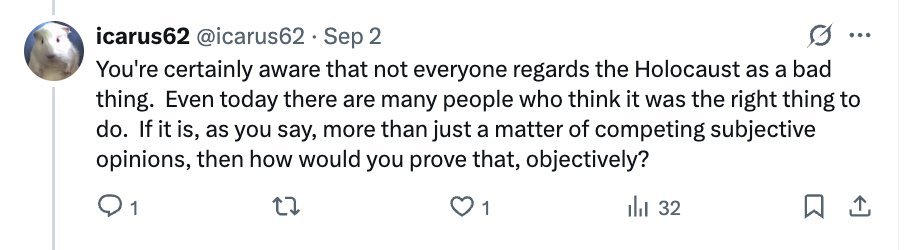
@icarus62 You keep conflating moral disagreement with moral subjectivity.
Disagreement tells us nothing by itself about whether there is an objective fact of the matter. People have disagreed about the shape of the Earth. Their disagreement doesn't make the underlying reality subjective, nor does it make both positions equally valid. One side can simply be wrong. It's that simple.
The same applies to morality. The fact that people disagree about what is morally right or wrong does not, by itself, establish that morality is subjective. It establishes only that people disagree about morality. Again one side can be wrong.
You're now asking for moral objectivity to be positively demonstrated while treating disagreement as enough to infer subjectivity, as if that settles it. Yet, I have highlighted why your position is weak numerous times.
So forgive me for not wanting to repeat myself. I think it's fair for you to now demonstrate how moral disagreement entails subjectivity?
You've gone on quite a tangent.
None of what you said actually addresses any of my pointd. Claiming religious beliefs have been imposed by force tells us nothing about whether those beliefs are true or false. That's a genetic fallacy.
Most kids are forced to eat vegetables. They don't particularly like the taste, but their parents know they're good for them. Does the fact that they are forced to eat them somehow make vegetables being healthy, a lie? Of course not.
How someone comes to believe something tells you nothing, by itself, about whether that belief is true.
And the age of religious belief versus modern science is completely irrelevant. Dawkins' theological arguments are poor, Thus my point remains... expertise in evolutionary biology doesn't make him an authority on theology, philosophy of religion, metaphysics or Christian history.
My second point was about consequences. If you deliberately hollow out the religious foundations of a civilisation, you shouldn't simply assume everything built upon those foundations will remain unchanged forever. And you shouldn't then be surprised when things start falling apart around you, morals, mental health and meaning, to name three.
You reap what you sow.
There’s a problem with remaining permanently unconvinced or uncertain. At some point, the fence you’re sitting on becomes uncomfortable for you, and unproductive for everyone else. In other words, what exactly do you bring to the table?
It’s not healthy scepticism if everyone else has to put their cards on the table while you keep yours in your pocket. Personally, I’d find it exhausting to spend most of my adult life looking left and right at the arguments, forever saying, “I’m not convinced.”
We don't establish everything about reality with mathematical certainty. We have to reason from inference, probability and plausibility while accepting that some things will remain mysterious. Some questions may remain unanswered, but that shouldn't become an excuse for epistemic paralysis
We make judgements about what is most reasonable without having absolute certainty.
By taking a position, it'll force you to understand it better. Commitment makes you follow them through, confront objections and discover where your own reasoning leads.
For example, if you commit yourself to theism, you have to work out what kind of theism (classical theism, deism, pantheism etc) then work out what follows from that philosophically, morally, existentially and practically (for you and for society). The same goes for atheism. Only then can you actually start to make sense of reality.
Remaining stuck in metaphysical limbo avoids much of that work.
Now... at the end of the day, of course it always boils down to what evidence is being presented for you to evaluate.
Where you get your understanding of Christianity, theology and the arguments for God matters. Is it grounded in serious academic philosophy, theology and historical scholarship, or in pub-level debates on social media?
God, in classical theism, as you know, isn't an empirical object sitting somewhere inside the universe waiting to be detected by a laboratory instrument. So when people insist that a metaphysical claim must be established using only the tools of empirical science and then conclude that nothing has been found, this is a category error.
Now, sure... sometimes individual pieces of evidence aren't convincing when evaluated in isolation, even when we're using the right methods of enquiry. That's precisely why we have to step back and look at the whole picture.
Just as in a court of law, it requires a degree of holistic thinking rather than examining every piece of evidence in isolation and demanding that each one prove the entire case by itself.
If someone is unable or unwilling to reason this way because of cognitive myopia or a pre-existing disdain for religion, then that may tell us more about the limitations of their method of enquiry (empirical etc) and their own preconceptions (prejudice etc) than it does about what is true.
And the threat of prison and a life sentence without parole is more effective? The deterrent is psychological either way.
It doesn’t cease to be a deterrent simply because the punishment is believed to be divine rather than imposed by the state. If someone genuinely believes that their actions have eternal consequences, that belief can obviously influence how they behave.
You’re assuming that removing religious belief leaves us with some superior system of secular morality. But where Christianity declines, the vacuum doesn’t automatically get filled by enlightened, rational humanism. In the West, we’re seeing it filled by other religions, competing ideologies (Marxism/Anarchism) and/or other radical forms of secular liberalism.
Christianity at least gave the West a deeply rooted moral framework in which human beings possess inherent dignity, moral obligations, and accountability beyond the state.
You can reject its theology, but simply removing it doesn’t remove the human need for a moral framework. It just means something else gets to fill the space. If that ends up being Islam, or another ideology riddled with relativism and nihilism, then the West is in big trouble.
What happens to a civilisation when the foundation of its moral framework is discarded? You need to genuinely think about that.
No, that's not what I'm saying at all. You're arguing against a position I didn't make.
Dawkins is an evolutionary biologist. His expertise in evolutionary biology. That doesn't make him an authority on theology, philosophy of religion, Christian history, metaphysics or ethics. Yet he's spent decades making extremely confident claims about those subjects, often attacking simplified versions of Christianity.
Tell me... would you take your landscape gardener's opinions on structural engineering simply because he's an excellent landscape gardener? Of course not. You'd listen to him on landscaping and a structural engineer on structural engineering.
So you can absolutely reject Christianity... that's your choice. But if you're going to call it “bullshit”, perhaps you should at least consider what replaces it. The dominant worldview of a civilisation matters: its underlying beliefs shape its institutions, moral assumptions and, over generations, the minds and values of its people. And that has consequences.
The decline of Christianity hasn't produced some “neo-Enlightenment”. Other worldviews, including Islam, have continued to grow and contribute to demographic change across parts of Europe through migration. And for those left without a religious framework for meaning and purpose, secularism hasn't necessarily filled the gap; we've instead seen the persistence of nihilism, relativism and hedonism alongside serious social and mental health problems.
Dawkins and his ilk, Hitchens, Harris, Dennett... thought they were doing the West a service by “saving” us from the Bible and “bringing us to our senses”. What they failed to consider was what would replace Christianity, and the consequences of hollowing out the religious foundations of the culture that ironically, allowed them the freedom critique.
I sometimes wonder what the intellectual atheists of Europe will be criticising in twenty years' time, and whether they'll still have the same freedom to criticise it.
Will the next generation of outspoken atheists be standing in places like Tower Hamlets in London, or Barbès in Paris, criticising Islam with the same confidence with which Dawkins criticised Christianity? Or will they discover that some beliefs and ideologies have very different attitudes towards criticism, blasphemy and dissent?
If Christianity is pushed out while being replaced by increasingly ideological forms (islam/anarchism/marxism) what happens when atheists eventually decides to criticise those instead?
You reap what you sow.
@stephen_housman ...“the universe isn’t…” isn’t what? If you’re responding to my point about the universe having order, regularity, and intelligible laws, you’ll need to clarify what exactly you’re rejecting there.
There’s nothing outlandish about what I said. These are basic, observable features of the universe that science itself depends upon.
Creationism and evolution aren’t necessarily competing explanations. Evolution can describe a biological mechanism by which populations change over time; it doesn’t, by itself, answer deeper metaphysical questions.
Granted, that’s not what evolution sets out to do. But it nevertheless assumes an enormous amount of reality that it doesn’t itself explain.
Evolution is a low-tier discussion. It’s why they teach it in elementary school. Evolution is a downstream explanation that already presupposes a universe with laws, order, intelligible patterns, information, life, and rational minds.
It operates within an existing framework; it doesn’t explain the foundation of that framework. So before we get lost arguing over what happens further up this ladder of life, I’m interested in what that ladder is actually standing on.
Why is the universe intelligible? As in, why should we expect our faculties to reliably disclose highly abstract, mathematically sophisticated truths about the universe, truths far removed from the environmental problems that shaped said faculties, especially if the universe itself is indifferent to whether we understand it?
It's time to move on from the evolution debate and go deeper, onto more important questions.
It only “makes no sense” if you ignore the Old Testament and its scriptural context.
In Matthew 27:46 and Mark 15:34, Christ deliberately quotes the opening of Psalm 22: “My God, my God, why have you forsaken me?” The Psalm begins with apparent abandonment but ends in vindication and deliverance: “Nor has He hidden His face from Him; but when He cried to Him, He heard” (Psalm 22:24).
Christ is invoking the Psalm and identifying His Passion with its messianic pattern: suffering > apparent abandonment > vindication and deliverance.
These words aren't spoken in a vacuum. They were the opening of a Psalm familiar to His hearers, and Christ speaks them in His humanity, taking upon Himself our experience of suffering, death, and God-forsakenness.
This is theology Anthony, exegesis is required. You can't isolate an English translation, strip away its Jewish and scriptural context, and then use one verse to dismiss 2,000 years of Christian interpretation. Please read it in the context Christ Himself gives us: Psalm 22, the Passion, and ultimately the Resurrection.
So let me ask you a simple question, @icarus62: how do we determine whether something is objectively wrong? You believe we can't?
Take a high school mass shooting, for example. If the perpetrator says, “I don't think what I did was bad,” while the judge and jury say, “But it is bad,” whose judgment is correct, the perpetrator's, the judge's, or nobody's?
Because if the perpetrator's moral judgment is just as valid as everyone else's, as you claim under moral subjectivism, then on what basis can anyone condemn his actions in a court of law?
We've been through this before, @icarus62. You keep rehashing the same debate with different Christians.
This time last year, I pointed out to you that if you treat the minds of people who believe the Holocaust and the systematic murder of millions of innocent people are acceptable, people who clearly aren't reasoning rationally, as evidence that morality is subjective... then the argument becomes absurd.
Regardless of such people's mental state, you use their opinion as evidence for moral subjectivity.
Following that same logic, we should conclude that child murder is subjective simply because child serial killers believe it's acceptable.
Even from an atheistic perspective, moral subjectivism is clearly problematic. It contradicts both reason and our fundamental moral intuitions.
The problem for moral subjectivists is that their own position can unravel into absurdity when it relies on the moral judgments of the least competent moral reasoners to prop it up....