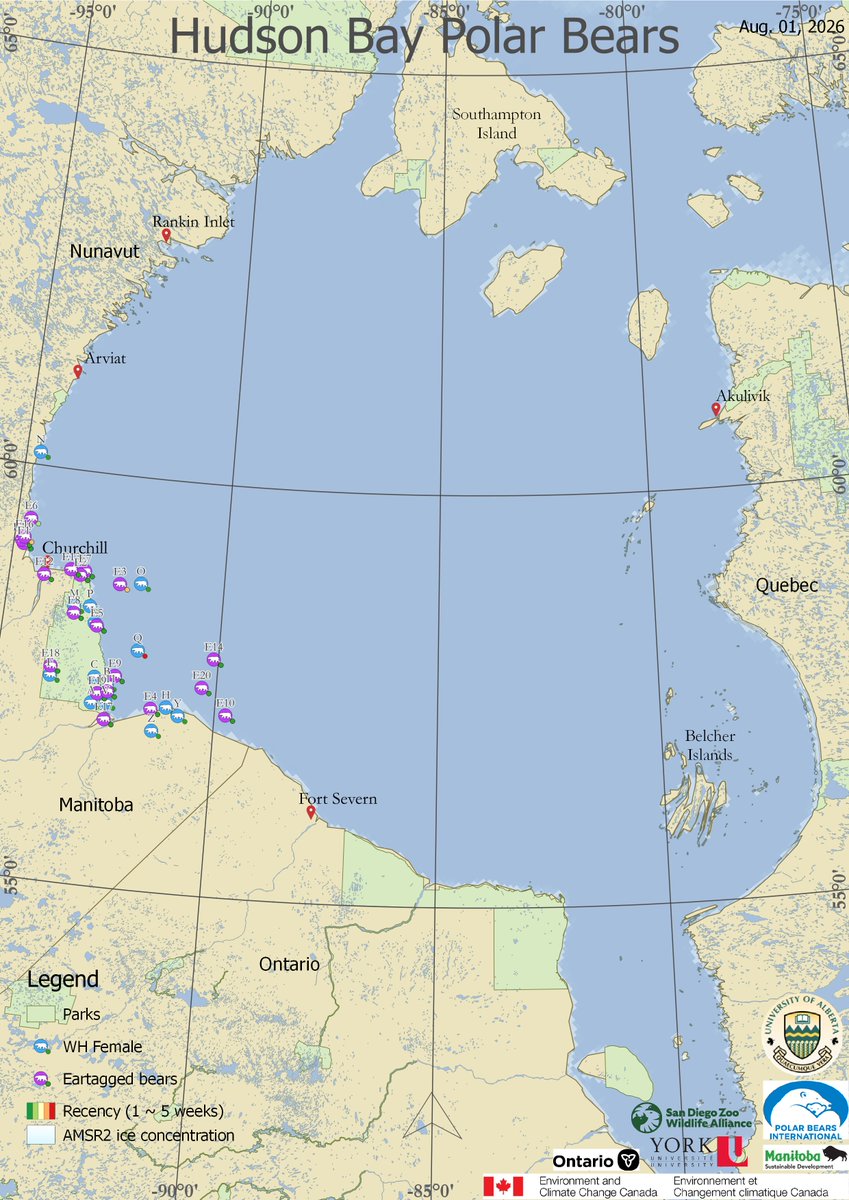
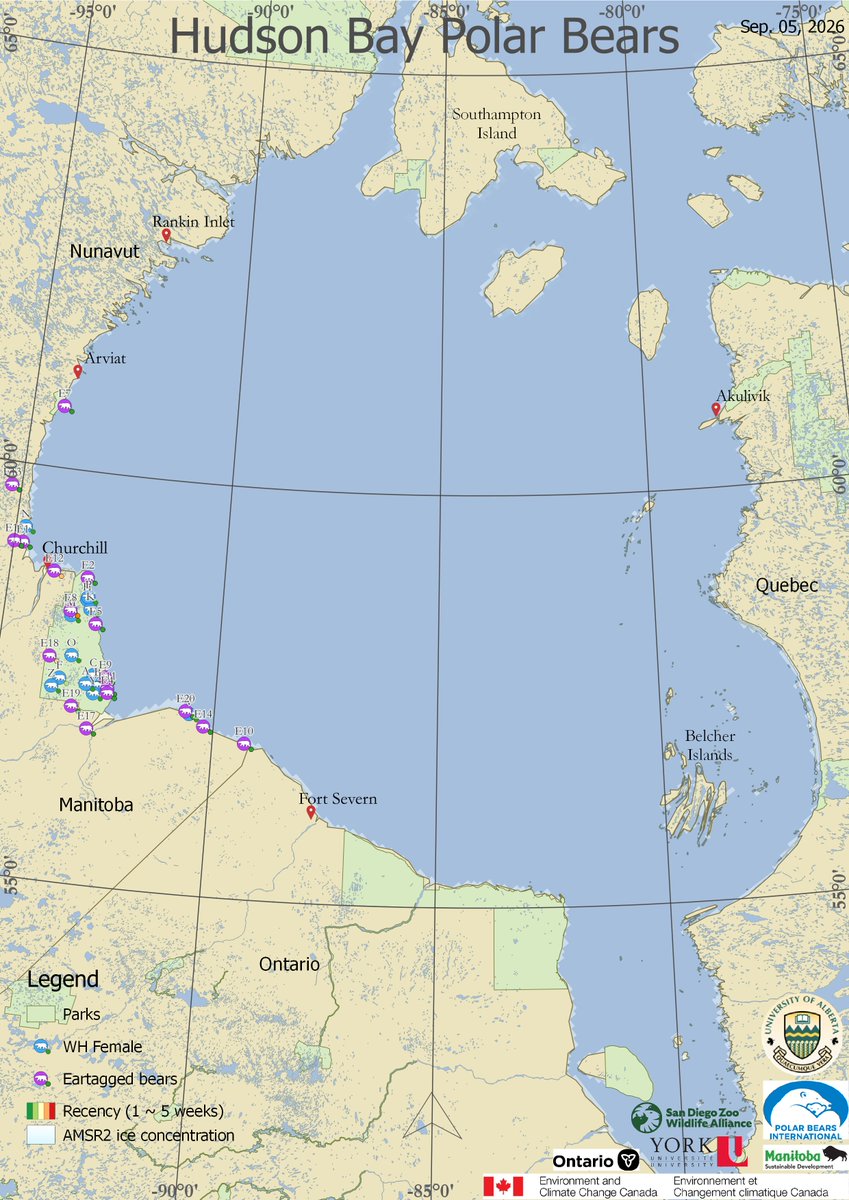
Hudson Bay polar bears tracked by satellite telemetry are patiently waiting for sea ice to reform. It's 2 C in Churchill & -1 C in Arviat today so the Bay won't be cooling very fast but the temperatures are about average so with luck freeze-up will come in November this year.
Hudson Bay polar bears doing what they always do in October: waiting for freeze-up. The Bay will be slowly cooling now & the weather will determine how soon the ice comes. Earlier is always better for the bears.
Western Hudson Bay polar bears are relaxing away the ice-free slimming season. At 1 kg of mass loss per day, the sooner freeze up comes the better. No problems for now but the bears would welcome a November freeze up.
W. Hudson Bay polar bears are idling away the ice-free period. Everyone came "home" this year. The few bears to the south is typical & the mixing area between W. Hudson & S. Hudson bears. Bears appear to be in good shape this year: many stayed on the ice late into break-up.
All western Hudson Bay polar bears are ashore. Lots of variation in their dates on land. Now they wait & use about 1 kg (2.2 lb) of body mass to survive until they hunt again. Break up date & freeze up are critical to persistence of polar bears & climate change is affecting both.
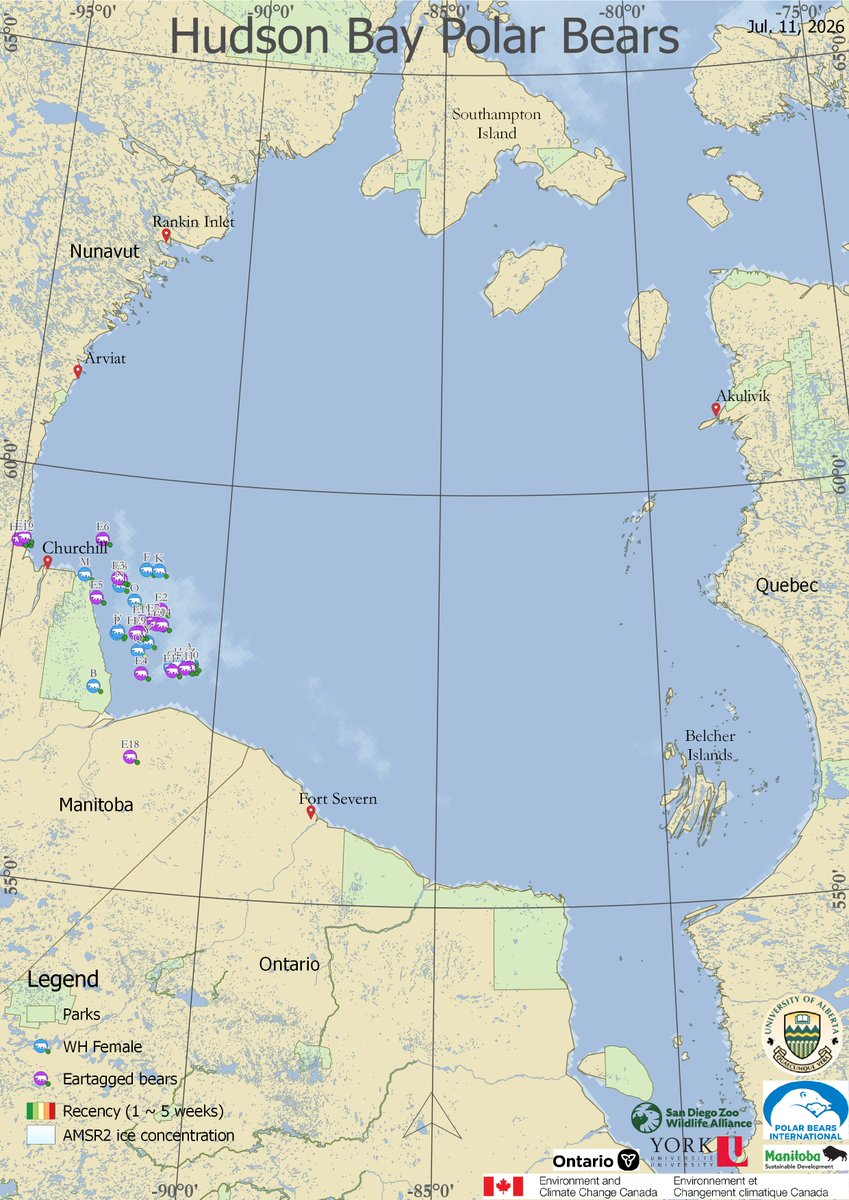
Almost all western Hudson Bay polar bears are ashore now but it's unusual to see some still out on the last bits of sea ice. It's getting clearer that some bears have changed their behaviour to stay offshore longer. Necessity or choice?
Polar bears never cease to surprise me. There's very little ice left in Hudson Bay yet many bears are still out there trying to get another seal meal or two. The bears are seemingly shifting their behaviour to stay out longer but analyses in my lab will yield more insights.
Most W. Hudson Bay polar bears are hanging on to the last bits of sea ice. This feels unusual but we'll need to analyze the sea ice data. Staying out on the ice with so little left is odd (note ice image is a week earlier - only clear day).
Some w. Hudson Bay polar bears are ashore but most are still on the last remanent bits of ice. In the past, the bears would have been ashore with so little ice but I suspect they've shifted their behaviour to stay out longer: perhaps necessary if they're not in great condition.
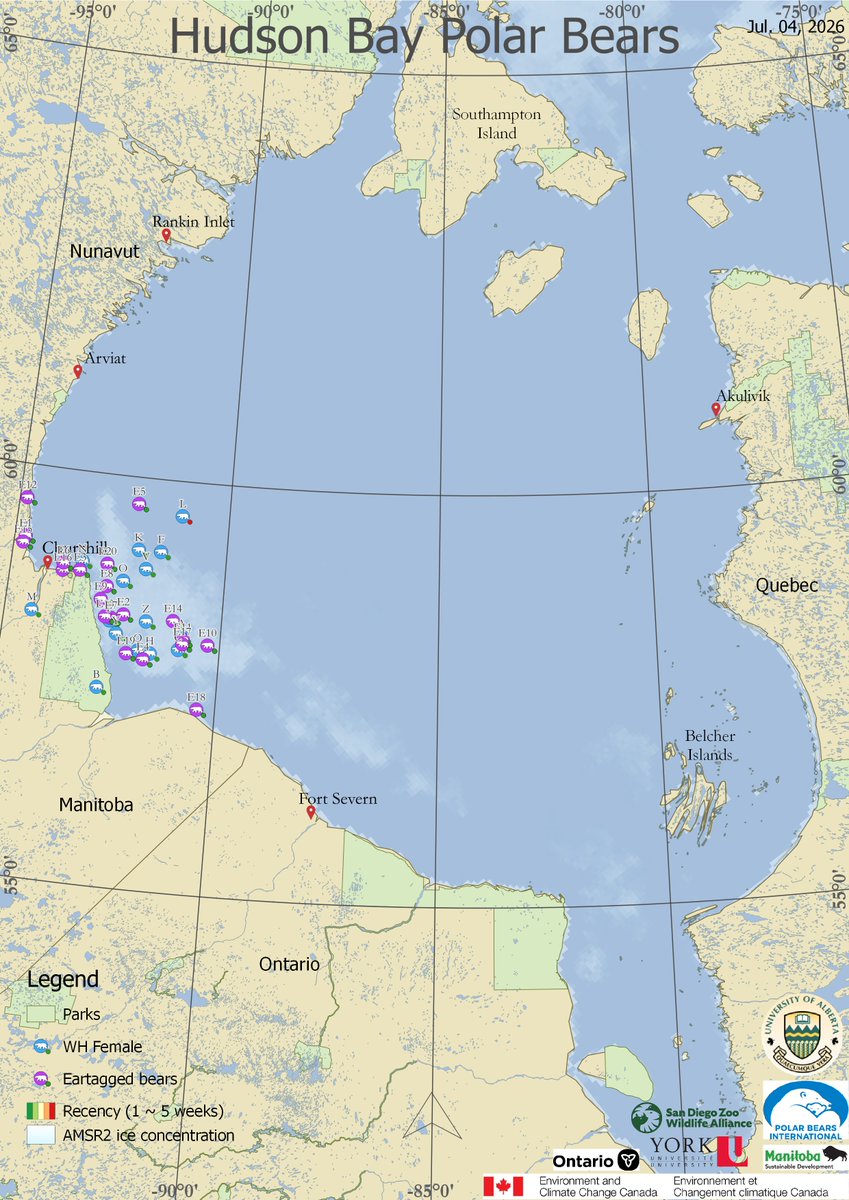
The last sea ice in Hudson Bay is rapidly melting. Polar bears are starting to show up on land now. We won't know the condition of the bears until monitoring occurs in August-September. I hope they fattened up after my work in April-May because they were pretty lean.
Hudson Bay is melting & bears are moving onshore a bit early than optimal but depends on their condition & how long until freeze-up in autumn. Bears were lean in April-May when I was out sampling in spring but a lot can change later in spring (the most critical feeding period).
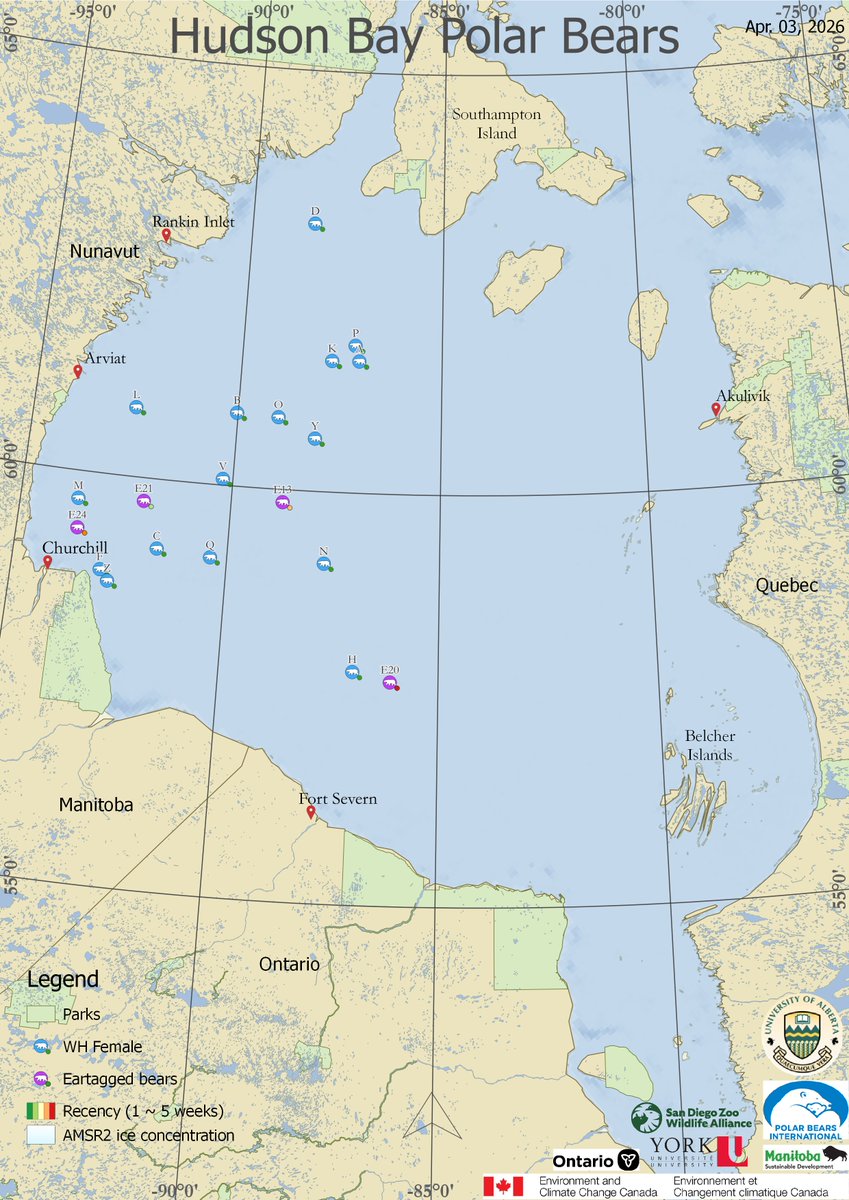
Most W. Hudson Bay polar bears stay close to Churchill this spring. Can the bears sense an early break-up & are keeping close to home or is the hunting good there? Unseasonably warm in Churchill today (17 C above normal) & sea ice will melt fast with such weather.
W Hudson Bay polar bears are sticking close to home this spring. Huge areas of thin sea ice could be non-habitat for them (few seals) so they've all gathered into the better habitat. We may see an early break-up but that now depends on weather conditions in the coming weeks.
Western Hudson Bay polar bears are packing in nearshore. Typical distribution. Purple dots are eartag radios I deployed in April-May. Blue are adult females collared in autumn.
New map of w. Hudson Bay polar bears. Purple dots are new eartag radios deployed this spring. There would be more but the weather here in Churchill has been really bad. The bears are in their "normal" area for this time of year. Huge area of thin ice in NW keeping bears offshore.
Western Hudson Bay polar bears are in their usual spring hunting area. I'm in Churchill now waiting to start field research & deploy eartag satellite radios but no helicopter (stuck in Igloolik in a white out) & the weather here is snowy. Hoping for a helicopter & sun.
Western Hudson Bay polar bears are getting back to the NE of Churchill area. This is a consistent hot spot for the bears in spring. The combination of ringed seals in stable ice & bearded seals / harbour seals in the more active nearshore ice make this a prime hunting area.
Most Hudson Bay polar bears are NE of Cape Churchill - a "normal" distribution. Our ear tag radios (purple dots) are slowly disappearing - it's usually antenna failure that's the problem. Prime feeding season about a month off but mating season is in full swing.
Some Hudson Bay bears have shifted south but they're still rather spread out. The 5 bears lines up NE of Cape Churchill is a bit odd - maybe a large lead has opened up.
Hudson Bay polar bears are distributed widely but on the western side of the Bay. Fairly typical. 2 mothers, presumably with new cubs, came out of dens this week. They'll soon head out to the ice: it's a critical time for them as they need to rebuild fat reserves for summer.