Dear Minister Sa’ar, I am truly grateful for the opportunity to engage in an extensive conversation about the challenges and opportunities we face in a process that is already moving Venezuela toward democracy.
Our country will be a reliable and stable partner for the world’s democracies and will offer major opportunities for investment and exchange. Venezuela’s reintegration into the democratic world will also allow us to build global alliances in the face of those who threaten our security.
Israel and Venezuela have historically shared very close ties, which we will reclaim and strengthen in this new era of democracy and freedom.
-
Estimado Ministro Sa’ar, le agradezco mucho la oportunidad de conversar extensamente sobre los desafíos y oportunidades que enfrentamos en el proceso que ya avanza hacia la democracia en Venezuela.
Nuestro país será un socio confiable y estable para las demás democracias del mundo, y ofrecerá enormes oportunidades de inversión e intercambio. Además, la reinserción de Venezuela en el mundo democrático permitirá forjar alianzas globales frente a quienes amenazan nuestra seguridad.
Israel y Venezuela han tenido históricamente lazos muy estrechos, que rescataremos y fortaleceremos en esta nueva etapa de democracia y libertad.
@MDirie_ @ianmiles The TRUTH is you have no idea of what you are saying. Youth unemployment in Spain is one of the highest in the developed world and unemployment is at almost 10%. Also many of them don’t even know the language, this is all a political stunt to blur all of the corruption scandals.
BREAKING: Brave Iranians are now openly taking to the streets with the real Iranian flag, the Lion and Sun, placing it on top of a statue as they rise up against the Islamic regime.
The ENTIRE free world needs to see this.
Venezuelan man:
“Those who say that the U.S. is only interested in our oil, I ask you: What do you think the Russians and the Chinese wanted here?
The recipe for arepas?"
Yo, honestamente, llegué a pensar que jamás vería esta imagen.
Que jamás los veríamos así.
Que aunque hay vida por delante, el tiempo no alcanzaría.
Aún no lo creo.
Dios nos quiere.
THE RECKONING
Wall Street’s oldest warning system just triggered.
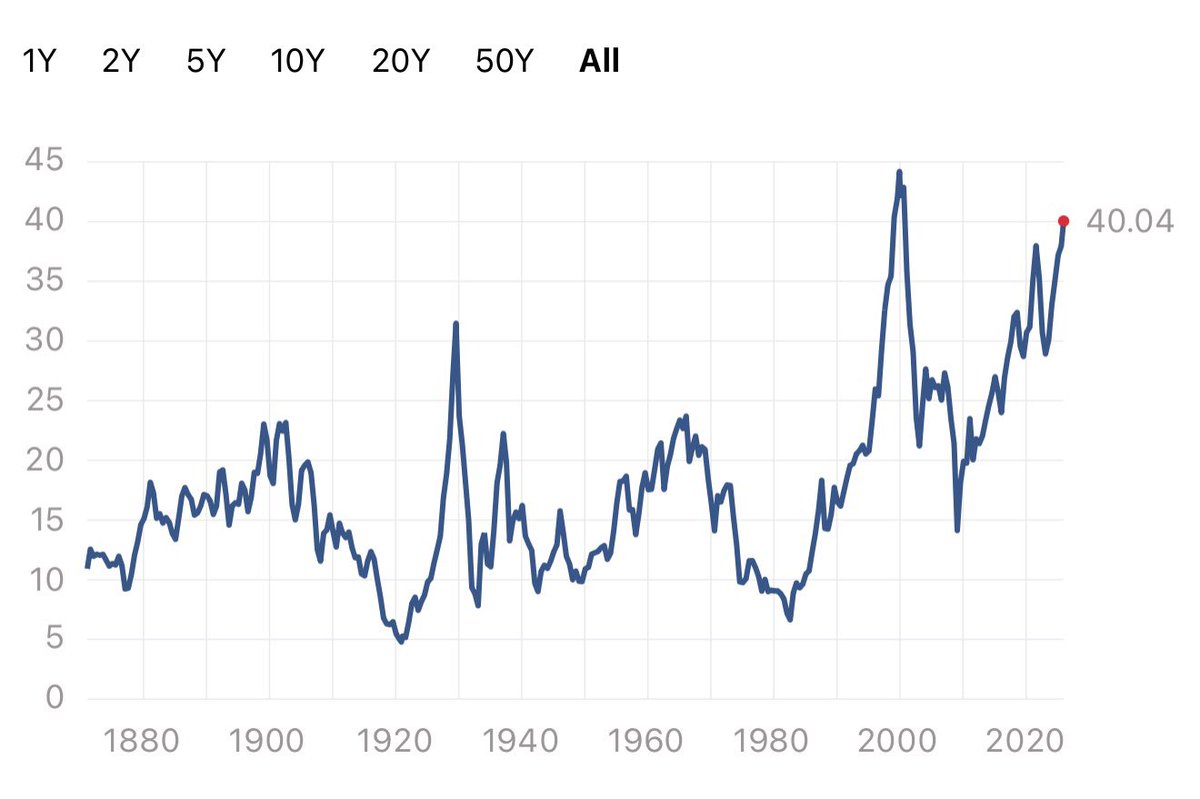
The Shiller PE ratio crossed 40.16 this week.
In 154 years of recorded market history, this threshold has been breached only three times. The first was December 1999. The second was November 2021. The third is now.
What followed the first: a 49% collapse.
What followed the second: a 25% drawdown within ten months.
What follows the third: you are living it.
Consider what 40 means. The market now trades at 2.3 times its 154 year average valuation. Stocks have been cheaper than today 98.9% of all recorded history. The only comparable moments preceded the two most devastating corrections of the modern era.
The mathematics are unforgiving. Vanguard’s century long analysis confirms a 0.43 correlation between current CAPE and decade forward returns. At 40, the implied annual real return through 2035 falls to 1.6%. Not negative. Not catastrophic. Simply… exhausted.
But here is what the headlines miss: CAPE does not predict crashes. It predicts gravity. The difference between a 49% collapse in 2000 and a 25% correction in 2022 was not valuation. It was the catalyst.
The catalyst today remains unknown. Trade policy. Credit contraction. Earnings disappointment. Geopolitical rupture. Any spark finds abundant fuel.
What this means for you: Recalibrate expectations. A decade of 10% returns is mathematically improbable from current levels. Diversification is not caution. It is arithmetic.
The market is not broken. It is priced for perfection in an imperfect world.
History does not repeat. But it rhymes in numbers that do not lie.
The clock at 40 has started.
1) Repo fixed, check: Fed launches Reserve Management Purchases (liquidity injections)
2) Treasury cash flood begins, check: TGA balance down $78BN in one week (3rd biggest liquidity injection of 2025)
3) Meltup, check: stocks close at all time high
It was only a matter of time. Though it took longer to drain the Reverse Repo Facility than I expected, the result remains the same: With the government running multi-trillion dollar deficits, once the RRF slush fund is drained, the ability for the Fed to reduce its balance sheet is nullified, and the Treasury's need for additional liquidity must come from somewhere. And that 'where' is, in fact, the Fed again. As predictable as a tide that goes out and comes back in, the Fed must print again.
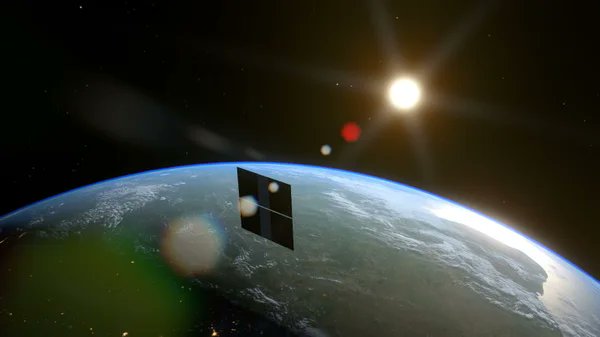
🚨🇺🇸 ELON AND BEZOS RACE TO PUT DATA CENTERS IN ORBIT - BECAUSE EARTH'S POWER GRID CAN'T HANDLE AI
SpaceX is raising $30 billion at a $1.5 trillion valuation to build space-based data centers. Blue Origin's had a team working on orbital AI infrastructure for over a year. Sam Altman tried buying rocket startup Stoke Space this summer to join the race.
The pitch: move power-hungry AI compute into low Earth orbit where there's unlimited solar energy 24/7, natural cooling from the vacuum of space, and no real estate costs.
Earth's electrical grids can't scale fast enough for AI's exponential compute demands. Space sidesteps the constraint entirely.
Here's the economics that might actually work:
Terrestrial data centers face three brutal costs-power, cooling, and land. A 300 GW data center on Earth requires massive electrical infrastructure, cooling systems that consume 40% of total power, and expensive real estate near power sources.
In orbit: solar panels generate continuous power with no weather or nighttime. Space's near-zero thermal environment cools chips passively. No land to buy. And SpaceX's reusable rockets just made launch costs drop by 90%.
Google and Planet Labs are testing satellite-mounted AI chips in 2027. Early systems will need thousands of satellites to match one large terrestrial data center's capacity-but that's the starting point, not the limitation.
Why SpaceX wins this race:
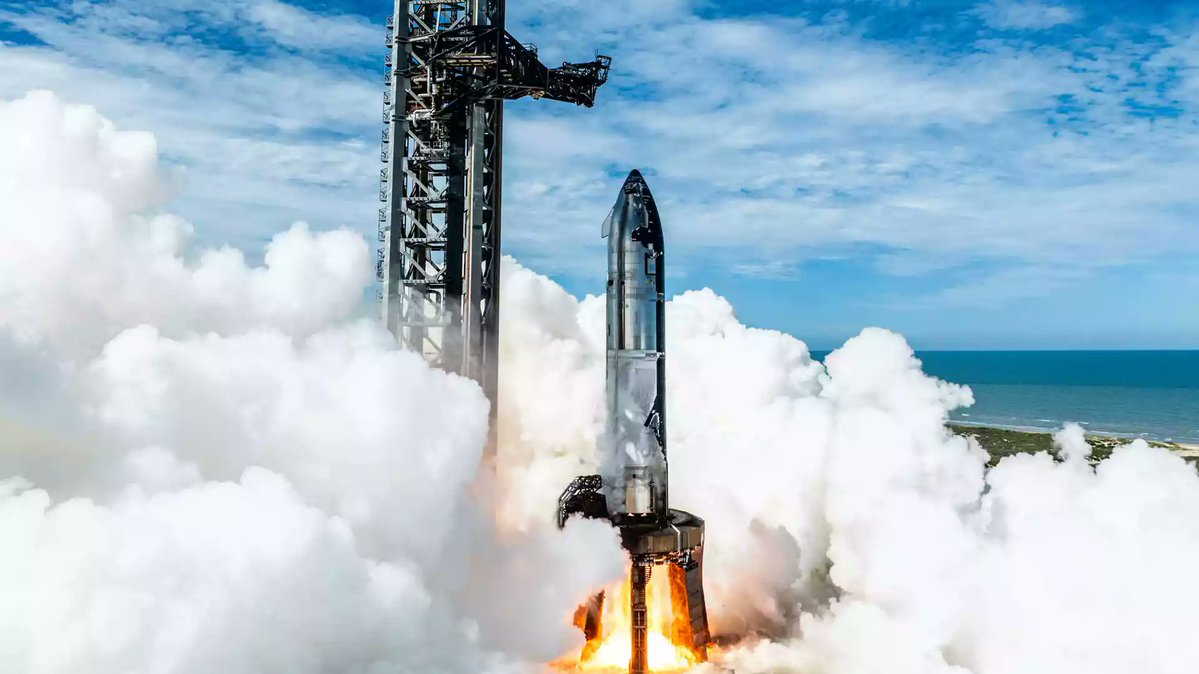
Elon controls the only operational heavy-lift reusable rocket system on the planet. Starship-when fully operational-will drop launch costs another order of magnitude. China, Russia, and Blue Origin can't match that deployment speed or cost structure.
SpaceX also has Starlink's existing orbital mesh network. They're planning to use upgraded Starlink satellites as AI compute nodes-leveraging existing infrastructure instead of building from scratch.
Bezos has Blue Origin and AWS but no operational heavy-lift capability yet. Altman has capital but no launch system.
Elon has both the rocket and the AI company (xAI) and the satellite network.
That's a structural advantage nobody else can replicate quickly.
The actual technical challenges nobody's discussing:
Latency. Speed of light from orbit to Earth creates baseline delays that kill real-time applications.
High-frequency trading? Autonomous vehicles? Not happening from space. This works for batch processing, model training, long-inference tasks-not interactive applications.
Maintenance. A failed server on Earth gets swapped in hours. A failed satellite needs a service mission or replacement launch.
You can't hot-swap components in orbit easily or cheaply yet.
Scale. Thousands of satellites needed to match one terrestrial data center. That's massive coordination, space traffic management, and collision avoidance complexity.
Plus space debris concerns multiply.
Upfront capital. Building and launching thousands of compute satellites costs tens of billions before first revenue. Only a handful of entities can finance that.
But here's why it might actually work:
AI training runs are getting so massive they're consuming entire power grids. Microsoft just bought a nuclear power plant to run data centers.
Google’s considering building dedicated power plants. At some point, moving compute off-planet becomes cheaper than building more Earth-based infrastructure.
Launch costs are dropping exponentially. Starship aims for $10-20 per kg to orbit-versus thousands per kg on traditional rockets. At that price, space-based compute becomes economically competitive for specific workloads.
Solar is unlimited and free once panels are deployed. No fuel costs. No grid dependency. No outages from weather or infrastructure failures.
Within 5 years, we'll see the first operational orbital data centers handling AI training workloads that can tolerate latency.
Within 10, they could represent 10-20% of global AI compute capacity.
This isn't science fiction anymore people. The economics are approaching viability.
The technology exists. The capital is mobilizing. And Elon controls the critical bottleneck-cheap access to orbit.
The wildest part? If this works, the next step is lunar data centers with even more power and cooling advantages.
And yes, crypto mining on the moon becomes economically rational once you have cheap transport and abundant solar.
Welcome to the era where space isn't just exploration-it's infrastructure. Earth's power constraints just created a $100+ billion orbital industry.
Source: Bloomberg, WSJ, ZeroHedge, @elonmusk, @SpaceX
THE NUMBER OF 401(K) MILLIONAIRES HITS A RECORD
Fidelity reports 654,000 401(k) accounts with balances over $1 million in the third quarter, the highest level since records began in the early 2000s. Many of these savers fall into what UBS Global Wealth Management calls “moderate millionaires,” individuals holding between $1 million and $5 million in assets.