In 1984, 16-year-old Mary Lou Retton made history as the first American woman to win Olympic all-around gold in gymnastics, becoming a beloved national icon.
Nearly 40 years later, in October 2023, Retton was admitted to an intensive care unit with a rare, life-threatening form of pneumonia. The public was stunned to learn that "America's Sweetheart" did not have health insurance. Retton cited a costly 2018 divorce, lost speaking income during the pandemic, and the financial toll of 30 past orthopedic surgeries as the reasons she could not afford coverage.
Her daughters launched a $50,000 crowdfunding campaign to help cover her medical care. The response was overwhelming, raising over $450,000 in a matter of weeks.
While Retton survived, returned home on oxygen, and subsequently secured health insurance, her ordeal ignited a broader national debate about the American healthcare system, the Affordable Care Act, and the startling reality that a historic Olympic champion had to rely on the charity of strangers to stay alive.
Potter wasps are tiny architects that build mud nests for their young.
They stock each chamber with paralyzed caterpillars to provide fresh food. The larvae safely grow inside, feeding before emerging as adult wasps.
This female lobster is estimated to be 40–60 years old (based on her impressive large size and massive egg load of up to 70,000–80,000 eggs). She is truly a strong and rare "grandmother" of the ocean. That’s exactly why Jacob immediately released her back into the sea to help protect the gene pool and maintain the population. 🦞🌊
🔥Yosemite National Park showing off like only Yosemite can. 🔥🌕
This rare “firefall” effect happens when the light hits the waterfall at the perfect angle, making it look like molten lava pouring off the cliff. But catching it like this is not luck alone. It takes clear skies, the right season, the right water flow, the right position, and seriously perfect timing.
Miss it by a few minutes and the magic is gone.
Nature doesn’t perform on demand.
But when it does… the whole world stops scrolling. 🏔️
Nearly 3,800 years ago, the ancient Babylonians carved standardized weights into the shapes of animals. This grasshopper-shaped example was used to help ensure fair and consistent trade.
She was only twenty-seven years old. In the final minutes of her life, she did not ask her family to comfort her.
Instead, Honor Elizabeth Wainio used her last phone call to prepare them for a grief she knew she would never have to carry.
Everyone knew her as Lizz.
Just days before September 11, 2001, she had returned from the trip she had always dreamed about.
She celebrated a friend's wedding in Florence.
She walked the streets of Paris.
She even lit a candle in a church for her grandmother.
Lizz once told her mother that seeing Paris would make her life complete.
She believed the rest of her life was still ahead of her.
At just 27, she was already a successful district manager for Discovery Channel Stores, overseeing locations across New York and New Jersey.
Friends remembered her as energetic.
Organized.
Full of warmth.
On the morning of September 11, she boarded United Airlines Flight 93 in Newark, bound for San Francisco.
There were forty passengers and crew on board.
Along with four hijackers.
At 9:28 a.m., the hijackers stormed the cockpit.
The plane plunged suddenly.
Passengers were thrown toward the back.
Then the phone calls began.
One by one, they learned the truth.
The World Trade Center had been attacked.
The Pentagon had been hit.
Their flight wasn't headed for negotiations.
It had become another weapon.
At 9:53, Lizz called her stepmother, Esther Heymann, using an Airfone.
Her voice was calm.
She spoke about the people she loved.
She tried to comfort Esther instead of asking for comfort herself.
She even said what was happening would be much harder for her family than it would be for her.
Then she quietly added that she was going to be with her grandmother.
The conversation lasted about four and a half minutes.
Near the end, she heard passengers gathering.
They were preparing to fight back.
"I have to go," she said.
"They're breaking into the cockpit. I love you."
At 9:57, the passengers and crew launched their courageous counterattack.
They knew exactly what failure would mean.
Six minutes later, at 10:03, Flight 93 crashed into a field near Shanksville, Pennsylvania.
Everyone on board was killed.
Investigators later concluded the hijackers were likely heading for the U.S. Capitol.
The passengers never let them get there.
Today, forty wind chimes stand at the Flight 93 National Memorial.
One for every passenger and crew member.
One for every life.
Lizz had dreams.
She had people waiting for her.
She had a future.
But even when everything else was taken away, her compassion remained untouched.
In her final moments, courage didn't sound like fearlessness.
It sounded like love.
I will never forget the first time I walked into St Peter's Basilica...
None of it is painted. Everything overhead that appears to be a fresco is a mosaic: millions of small glass tiles, cut and set into place by hand.
Michelangelo pierced the drum with sixteen windows, and beneath them runs a band of text, black on gold: TU ES PETRUS ET SUPER HANC PETRAM AEDIFICABO ECCLESIAM MEAM. "You are Peter, and upon this rock I will build my church."
From the floor it reads like an ordinary inscription but each of those letters is two metres tall...
Above the windows the dome divides into sixteen segments, and within them six tiers of figures rise in rings: the popes buried in the basilica, then Christ, the Virgin Mary, St John the Baptist and the Apostles, then angels carrying the instruments of the Passion, then the faces of cherubim and seraphim. Above all of them, a blue sky scattered with gold stars, and at the summit, in the lantern, God the Father.
The man who designed it, Giuseppe Cesari, was a painter. Between 1603 and 1612 he produced sixty-five life-size cartoons setting out the whole scheme, and every one of them was then translated into glass by mosaicists.
The reason is actually pretty unglamorous. The basilica was damp, and candle smoke and incense from centuries of liturgy were eating the pictures alive. So the Vatican began converting the building into glass, dome by dome, and from the end of the 1600s the painted altarpieces too, one at a time. By the basilica's own reckoning, around ten thousand square metres of mosaic.
The workshop that did all of this is still open: twelve artists work in the Vatican Mosaic Studio today, cutting tesserae by hand in nearly 28,000 shades and fixing them with a linseed-oil stucco whose recipe has been in use for four centuries. Earlier this year its director, Paolo Di Buono, described the work:
"We have the idea that we are working for something that is almost eternal."
In 1897, the U.S. Army wanted to know if bicycles could replace horses for infantry. So they took 20 Black soldiers of the 25th Infantry – the Buffalo Soldiers – and gave them a mission: ride from Fort Missoula, Montana to St. Louis. 1,900 miles.
The “Iron Riders” carried 60-pound packs, rifles, and one spare tire each. They crossed the Rockies, the Badlands, and the Great Plains on heavy, single-speed bikes with no roads. Private John Findley fixed flats with strips of his own shirt. They drank from cattle tanks and were refused water in Wyoming towns.
It took 41 days. They averaged 52 miles a day. When they rolled into St. Louis, the white newspapers called it a “stunt.” The Army said “impractical” and shut the program down. But the Iron Riders proved it could be done.
Their commanding officer wrote: “No horse could have made it. These men did.”
In December, an 85-year-old North Carolina widow called a tree company begging for firewood, she said she was cold and couldn't heat her home.
The owner delivered it free and then fixed her roof, her heat, her car, raised $20,000 for her Christmas... and STILL maintains her property free, checking on her every week.
Her name is Nana Abernathy. She had just lost her husband and was struggling to survive on her own when she made that call last December.
Paul Brittain, the owner, showed up with the firewood himself. No charge.
But while he was there, he noticed things: a leaking roof, a broken heating unit, a car that needed tires.
So he came back, this time with his whole crew.
They fixed the roof.
Replaced the heat.
Put new tires on her car.
All for free.
Then, for Christmas, Paul raised $20,000 for her.
To this day, he maintains her property at no charge and checks on her every single week, just to make sure she's okay.
He has never charged her a dime.
This is the America I love!!!! 🇺🇸🇺🇸
"Red ghosts" have been captured on camera over Tibet—one of the rarest types of lightning on the planet.
You might think it’s AI, but this phenomenon is real: the camera caught a burst of red sprites—cold plasma electrical discharges that strike above storm clouds.
Every morning in Frankfurt's Fechenheim district, a white Arabian mare named Jenny would leave her stable without a rider, without a lead rope, and without anyone walking beside her.
She wasn't lost.
For 17 years, Jenny followed the same familiar route through the streets, parks, and along the Main River before making her way back home on her own. People knew her by name. Tram drivers slowed down when they saw her. Police recognized her. She even wore a note on her halter that read, "My name is Jenny. I didn't run away. I'm just going for a walk. Thank you."
Jenny belonged to retired florist Werner Weischedel. When age made it impossible for him to ride with her anymore, he chose not to take away the routine she loved. Instead, he opened the gate each morning and trusted her to find her own way.
That trust never failed.
In 2022, Jenny died at the age of 26 after a long battle with melanoma. By then, she had become far more than a horse to the people of Frankfurt. After her passing, residents gathered for a torchlight procession along the very streets she had walked for years, saying goodbye on the route she knew by heart.
For nearly two decades, one horse quietly reminded an entire city what trust can look like when it is earned day after day.
Rick Rescorla: The Man Who Saved 2,687 Lives on 9/11
Rick Rescorla was the head of security for Morgan Stanley at the World Trade Center and a highly decorated Vietnam War veteran. Through his relentless preparation and refusal to follow fatal directives, he saved nearly all of his colleagues on September 11, 2001.
Early Warnings: In 1990, Rescorla identified the World Trade Center's underground garage as a major vulnerability. After a truck bomb detonated there in 1993, he predicted the next attack would come from the air and urged Morgan Stanley to leave the towers.
Rigorous Preparation: When the firm decided to stay, Rescorla instituted mandatory, highly unpopular evacuation drills. Every few months, he forced all 2,700 employees across 22 floors to practice descending the stairs two by two, despite complaints from executives and traders.
September 11, 2001: When the North Tower was struck at 8:46 a.m., Port Authority announcements instructed South Tower occupants to remain at their desks. Rescorla immediately ignored the directive, grabbed his bullhorn, and ordered a full evacuation.
The Ultimate Sacrifice: After successfully evacuating 2,687 employees, Rescorla and four members of his security team turned around and went back up the stairs to ensure no one was left behind. All five men perished when the South Tower collapsed at 9:59 a.m.
Because of one man's stubborn commitment to caution and preparedness, thousands of people walked out of the South Tower and returned home to their families.
The female blanket octopus unfurls a long cape when threatened to intimidate predators, and will tear tentacles off the poisonous Portuguese man-of-war to use as weapons.
📽: Joseph Elayani
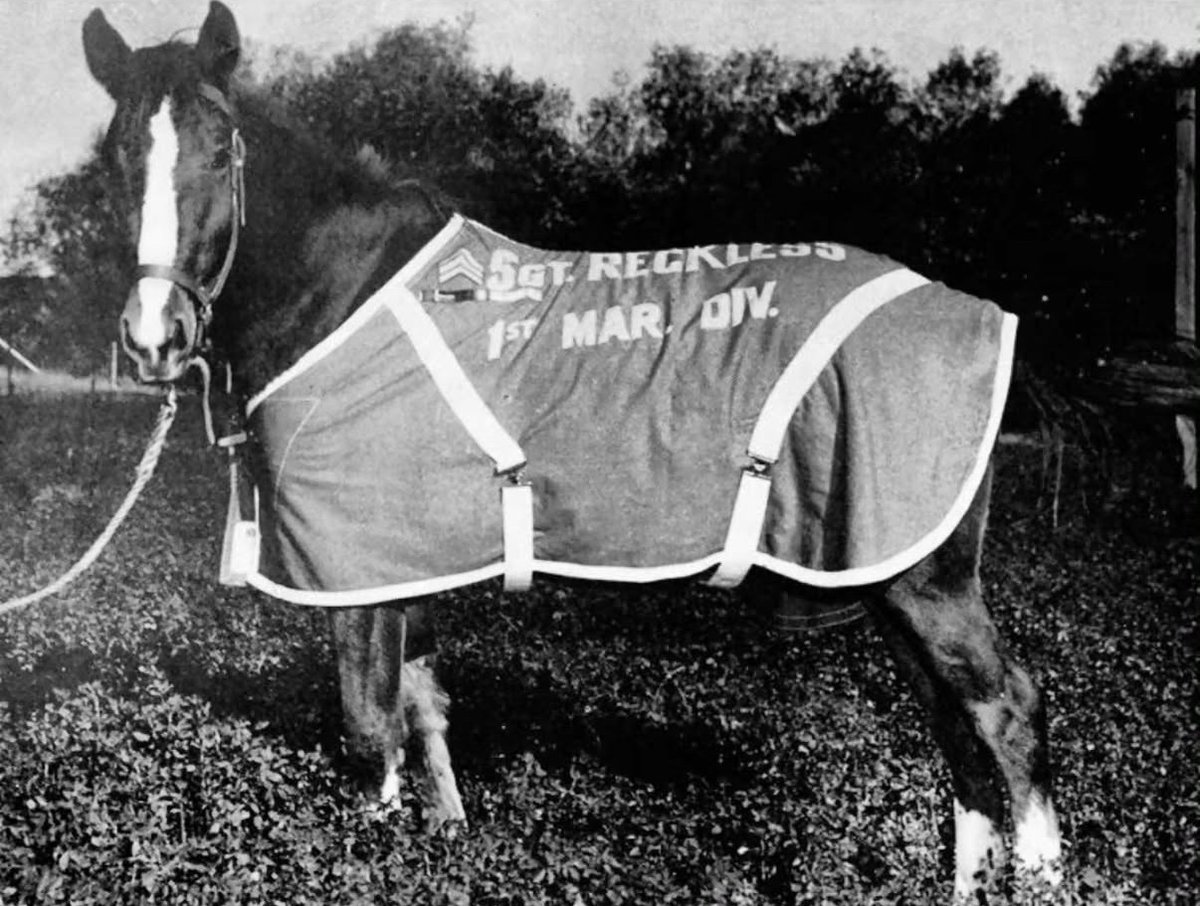
Sergeant Reckless was a horse who served with the U.S. Marines during the Korean War. She could carry ammunition across the battlefield on her own without a handler, instinctively took cover during enemy fire, and earned two Purple Hearts for her remarkable service and bravery.
Purchased in South Korea for $250 in 1952, Sergeant Reckless was originally trained as a racehorse before the U.S. Marines bought her to transport ammunition. She quickly memorized supply routes, often making trips alone, instinctively taking cover during artillery fire, and even helping evacuate wounded Marines.
During the Battle of Outpost Vegas in March 1953, Reckless made 51 trips in a single day, carrying more than 9,000 pounds (4,100 kg) of ammunition over roughly 35 miles (56 km), much of it under intense enemy fire. Although wounded twice, she continued her missions without stopping.
The Marines treated Reckless as one of their own. She slept in their tents, ate alongside the men, and became famous for her unusual appetite, enjoying everything from scrambled eggs, bacon, candy bars, beer, and Coca-Cola to poker chips and even blankets.
After the war, Reckless was brought to the United States, where she received multiple promotions, eventually reaching the rank of Staff Sergeant. Awarded two Purple Hearts, the Marine Corps Good Conduct Medal, the Korean Service Medal with three bronze service stars, the United Nations Korea Medal, and many other honors, she remains one of the most decorated animals in U.S. military history.
The platypus is one of nature's greatest mysteries. It lays eggs, produces venom, hunts using electroreception, and was once thought to be a scientific hoax because its appearance seemed too strange to be real