Can you quantify human emotion?
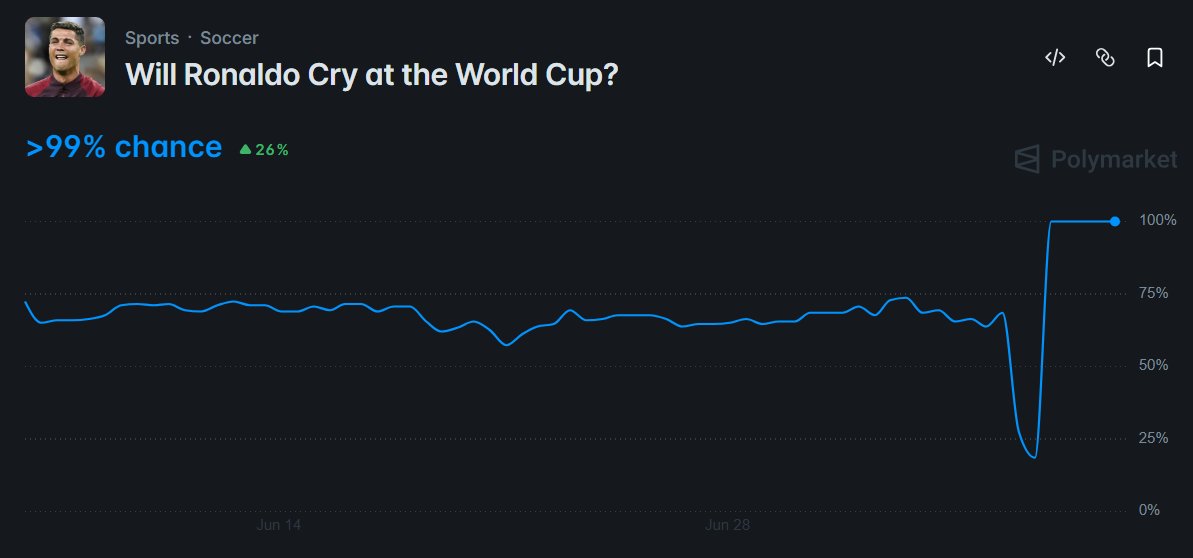
During the World Cup, the "Will Ronaldo Cry?" contract became a landmark case study in prediction market volatility, surpassing $883M in volume and exposing the gap between retail panic and quant data.
Here’s how Dubstrata captured a 344% return:
We published a short microstructure post-mortem analyzing false-flag sweeps and prediction market alpha (Sortino 1.71, 0.37% max DD).
Data dictionary and 30-day point-in-time sample feed are open on S3. Let me know if you'd like reader credentials. (4/4)
Legacy risk models measure how assets moved in the past under previous macro regimes.
This means they fail precisely when you need them most: during unprecedented regime shifts and structural liquidity cascades. (2/4)
Dubstrata provides forward-looking, point-in-time causal intelligence.
By measuring live prediction market consensus shifts against interconnected corporate dependency graphs, risk officers can see the dominoes while they're still in mid-air. (3/4)
We're building a causal engine that extracts real-time signals from prediction markets, giving you the speed to act before the rest of the market catches on.
Caps are set for the first 50 institutions.
Secure early access: https://t.co/RMfAxjbD6p
(4/4)
A headline mentioning 'Interest Rates' and 'Semiconductor Fabs' doesn't tell you whether one causes the other or if they share an unobserved common driver.
Vector similarity creates the illusion of intelligence while hiding causal directionality. (2/4)
We're on a mission to cut through noise across prediction markets and news to extract clear causal signals.
We recently published our flagship paper.
Read it here: https://t.co/GGDp8RwYUN
(4/4)
When sentiment bots react to ungrounded headlines, they get front-run by institutional market makers.
Ungrounded LLMs summarize the rumor. They cannot verify if the actor making the claim has capital at risk or verifiable authority. (2/4)
Dubstrata solves this through dual-layer verification:
• Ingested claims are mapped to ontological entities with trust ratings
• Narrative catalysts are cross-checked against real-time Polymarket CLOB depth
Contradictions are flagged instantly. (3/4)
We've been researching how to extract consensus signals from prediction markets and map them to underlying assets using a causal knowledge graph to Kelly-size positions.
Backtests yielded Jensen's Alpha of 2.34% and Sortino of 1.71. DM us to take a look! (4/4)
The problem is structural: traditional risk desks store macro data in one silo, sentiment in another, and orderbooks in complete isolation.
When an upstream fault line cracks, flat models cannot trace the second-order blast radius. (2/4)
Dubstrata constructs a sub-second, point-in-time causal knowledge graph.
By uniting prediction market orderbooks with grounded institutional ontologies, we illuminate structural fault lines before they snap. (3/4)
We published a short microstructure post-mortem analyzing false-flag sweeps and prediction market alpha (Sortino 1.71, 0.37% max DD).
Data dictionary and 30-day point-in-time sample feed are open on S3. Let me know if you'd like reader credentials. (4/4)
Lookahead bias destroys systematic strategies.
If your model ingests an SEC filing timestamped at 4:00 PM as if it existed at 9:30 AM, your backtest metrics are meaningless. You're executing against historical hallucinations. (2/4)
Dubstrata enforces zero-lookahead point-in-time state hydrations.
Every edge in our causal graph, every whale position vector, and every regulatory amendment is immutable and timestamped to the exact millisecond of discovery. (3/4)
We're building a causal engine that extracts real-time signals from prediction markets, giving you the speed to act before the rest of the market catches on.
Caps are set for the first 50 institutions.
Secure early access: https://t.co/RMfAxjbD6p
(4/4)
A disruption happens at a Tier-1 fab. 14 days later, European regulatory energy subsidies shift. 3 days after that, a single whale re-allocates on logistics.
Then tech baskets drop 7% at open. It wasn't an accident—it was an invisible causal cascade. (2/4)
Standard risk engines only see isolated headlines. They can't trace the blast radius because flat models cannot perform multi-hop graph traversals.
Dubstrata maps upstream sovereign filings, whale vectors, and multi-tier supply exposures before dominoes fall. (3/4)
We're on a mission to cut through noise across prediction markets and news to extract clear causal signals.
We recently published our flagship paper.
Read it here: https://t.co/GGDp8RwYUN
(4/4)
By the time a supply crunch or geopolitical shock hits a Bloomberg terminal, the dislocation is already settled history.
Institutional capital moves quietly across prediction market CLOB orderbooks and subtle regulatory gazettes long before press releases. (2/4)
Traditional quantitative risk models view data in silos: macro in one table, news in another.
Dubstrata bridges this by mapping real-time Polymarket whale conviction vectors to underlying asset balance sheets via sub-second causal graph traversals. (3/4)