@gdb@gdb This bug was found by albertnetymk, who proposed the fix in OpenJDK PR #32781 on Sept 9, 7 weeks before Codex “found” it on Oct 30. Was the discovery independent, or did Codex pick up from the open PR? Either way, credit should go to Albert!
https://t.co/ZSc9SKAaJV
AI is commoditizing vulnerability discovery. It's now becoming a race of who can prompt frontier cyber model with what first, then brand a conditional RCE with a fragile PoC as the next '2Shell' Vulcapocalypse.
These AI findings are often real and technically impressive. But a lab PoC ≠ reliable, widespread exploitation. Most recent *2Shell exploits are neither reliable nor easy to exploit, nothing like the wormable exploits we saw in the 2000s (remember Slammer, Blaster, Conficker, Code Red, Nimda,...). No, the internet isn't collapsing nor worse than it was before.
Security isn't measured by CVEs, flashy demos, or headlines. It's measured by what works and the actual impact in the real world.
Unfortunately, Headlines sell better!
react2shell is truly react to shell. you take a payload, spray it across vulnerable next.js or other affected applications, and get shells.
i think we need to tone down the hype around every new 2shell and 4shell. when every vulnerability is portrayed as impending doom but little actually happens in the wild, it dilutes the discussion around what ai is capable of.
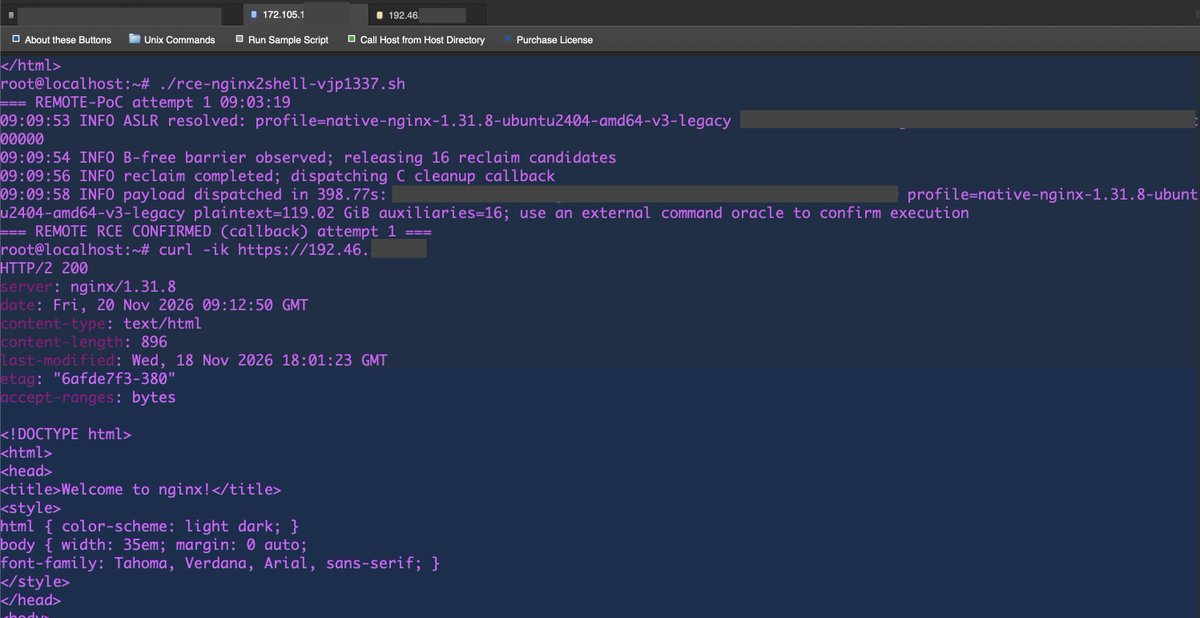
java4shell and nginx2shell are not react2shell. the bugs are cool, but what is the actual impact? do we seriously think a threat actor can spray a payload across thousands of servers and get shells? absolutely not.
you need a frontier model, a shit ton of tokens, and significant target specific exploit development. even then, getting a working exploit can be extremely difficult, sometimes impossible. there's potential, but exploitation is far from guaranteed.
we used php2shell to exploit cloudflare waf and get flags, but that took a solid amount of tokens and host specific grooming. the exploit wasn't trivially portable between targets. i'm even more skeptical about java4shell and nginx2shell, given their additional exploitation requirements.
these bugs absolutely need to be patched, but there's a huge difference between a vulnerability that can theoretically lead to RCE and one that can be reliably exploited at scale.
My two cents after dealing with Java4Shell and Nginx2Root / Nginx2Shell with our customers:
I think it is more important than ever that security firms and frontier labs be critical on the vulnerabilities being published. Especially if there are hardware constraints, scenario constraints or anything that reduces the chances of exploitability.
At least for the next few months (if not more), we are going to see rise on these kind of vulnerabilities being released. If we keep crying wolf on every “devastating” bug, defenders will stop listening. And when a genuinely exploitable RCE hits something like Apache or React again, vulnerability management teams won’t respond with the urgency it demands.
Security firms and frontier labs need to stay grounded. Every disclosure should come with honest, specific context about exploitability. Our job is to help defenders, not to shout from the mountaintop.
OpenAI models helped researchers—operating as part of our Patch the Planet initiative—discover critical security flaws in PHP, an open-source programming language used to run an estimated 70% of websites.
Over the past two months, we led a coalition of maintainers, researchers, and security providers to prepare fixes and protections ahead of disclosure. This duration was necessary because the fix was quite intricate and required a major change to the PHP engine. Every site using PHP can now safely upgrade their version to stay secure, in addition to applying mitigations from various security vendors.
Due to the severity of these flaws and PHP’s widespread use, we consider this bug to be one of the most impactful vulnerabilities in recent memory. It also marks a new phase, where AI can find security bugs with internet-scale impact.
This is an example of the Defender’s Window in action: to our knowledge, frontier AI was able to find this vulnerability ahead of attackers, giving defenders time to prepare.
https://t.co/TW3jrSbB3f
PHP Remote Code Execution (CVE-2026-109618 & CVE-2026-109619)
Information about two new remote code execution (RCE) vulnerabilities in PHP, tracked as CVE-2026-109618 and CVE-2026-109619 (CVSS v3.1 10 / 10), has leaked ahead of their coordinated disclosure, and security firm Watchtowr Labs confirmed that the flaws are real. Both vulnerabilities are due to be disclosed on Thursday, October 22, alongside patches. Until those advisories land, no fix is available, which leaves the flaws as zero-days in PHP installations everywhere.There is currently a scheduled release of an advisement and possible patch on Wednesday, October 21 2026 at 14:00 UTC.
Below is a video of a researcher, maybe the original researcher, showcasing the exploits.
#CTI #BlueTeam #ThreatIntel #CVE-2026-109618 #CVE-2026-109619
Friends ask: “You’re a consultancy with no product, why STAR Labs?” Today’s my answer: 5 RCEs on Pixel 10 & 11, all patched by Google, from a team you could fit round 1 table. We don’t sell a box. We break the unbreakable and tell you how. 👇
Google Chrome. Full break-in.
Your product isn't secure. it's just been expensive to break. those are not the same thing, and a lot of founders are about to learn the difference.
One AI just ran the full chain into Chrome for $1,597. weeks of expert human work, done for the cost of a weekend trip.
The wall around your code was never "how good is this." it was "how much does it cost to find the crack." that cost is collapsing.
If breaking in is getting this cheap, checking your own code before someone else does can't be the thing you skip.
That's the gap we sit in. we run this on your code first.
We published every number. Read the full benchmark: https://t.co/pb8kxgik1U