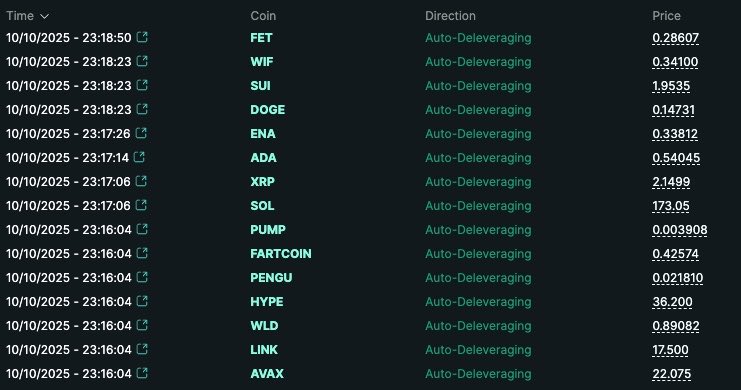
1/ Since a lot of people are waking up to see their perps positions closed and wondering what the hell “Auto-Deleveraging” means, here’s a quick and dirty primer.
What is ADL? How does it work? And why does it exist?
Everyone wants to get rich quickly.
But 99% of the people who truly made it have spent years grinding while no one was watching.
It takes countless late nights to become an overnight success.
Tips to improve your on-chain UX:
• Use @Rabby_io for DeFi interactions
• Trade spot & perps with @defiapp
• Use @jumperapp to bridge fast
• Automate DeFi positions and prevent liquidations w/ @DeFiSaver
• Track your EVM portfolio on Debank
• Execute complex DeFi transactions with AI using @Infinit_Labs
• Track your Solana DeFi positions using @JupiterExchange Portfolio
• Get gas on any chain w/ @gasdotzip
• Swap, lend or trade DeFi perps on mobile using @massdotmoney
Any other tools I should check out?
JUST IN: @chainlink has officially launched the Chainlink Reserve 👀
This economic upgrade creates a strategic LINK reserve funded by onchain & offchain revenue
Institutional adoption → protocol revenue → LINK purchases → Reserve
Here's what this means for $LINK 🧵👇
What's the upside for L2 tokens?
Fee sharing?
Even if they turned on fee sharing, it's not much:
Arbitrum made $19.5m in fees in a year. Optimism $18.3m.
zkSync just $1.3m and Starknet $600k.
This Price(FDV)-to-Fees ratio puts Arbitrum at 137.8x, and Optimism at 205.7x
Starknet - 4204x
In context, TSLA trades at 187x P/E ratio so Arbitrum might even look cheap.
But Tesla is an exception. S&P500 trades at ~ 29x the earnings.
This makes L2 tokens overvalued by a lot. Unless we expect their adoption and fees to pick up massively.
Maybe governance?
Hoarding tokens gives voting power to direct incentives.
But projects like @lobbyfinance make bribing cheap. Recently one user paid 5 ETH (~$10k) on Lobby to buy 19.3M ARB (~$6.5m) voting power.
I believe that most projects issue tokens for two main reasons:
- To raise capital
- To bootstrap adoption
L2s are bootstrapping adoption, like the Arbitrum DRIP proposal, which allocates 80M $ARB.
The goal is to attract sticky liquidity, outlive, and outcompete other L2s.
If we apply the Pareto principle, 80% of the liquidity will eventually concentrate in 20% of the L2s.
So, perhaps we need to wait until the L2 winners become clear and then invest in them.
This implies waiting for most L2s to naturally phase out.
Yet as more L2s launch with new tokens, the timeline for clear winners to emerge is extended.
(Except for Base... Which doesn't have a token (just a stock)).
$INK is about to launch a token with liquidity mining to inflict even more pain on the remaining L2s.
A cursed sector to invest.
I just claimed my SXT tokens from @Chainlink Rewards: Season Genesis on https://t.co/whR98s9fvF!
If you're a LINK staker, check your eligibility and claim your portion of the 100,000,000 SXT tokens made available in Season Genesis by @SpaceandTimeDB
Introducing Onchain Labs, in partnership with @arbitrum.
While we continue to innovate scaling infra, today we also look to empower the Arbitrum app layer. 👇
2025 is THE year it finally happens.
If the United States is FOR DeFi, who can be against it?
THENA, too, is making bold moves. We're finally ready for V3,3 and the total transformation that comes with it.
And to get ready for that, it's always good to go back to the basics. Have you seen our guide yet?
📜 https://t.co/XfeZUIU9Lj
✨ THE Memecoin Renaissance has begun!
We’ve partnered with @RealFlokiInu, @SimonsCatMeme, and @dogwifcoin for an EPIC Story on @BNBCHAIN.
Complete Chapter 4 for a chance to win prizes like 8.THENA ID valued at $10,000!
Collect all fragments to mint an exclusive NFT.
📜 https://t.co/3RX0t9FT00