In early 2007, Michael Dell sat down to write a memo to his employees.
He had been away from the CEO job for three years. He'd handed the role to Kevin Rollins in 2004, and in his absence, things had gone sideways — declining market share, an SEC accounting investigation, a stock price that had fallen from its dot-com peak of $55 to under $10. The company he'd started in a University of Texas dorm room with $1,000 and three guys with screwdrivers was drifting.
Dell was coming back. And the memo he sent that day contained a single sentence that, in retrospect, explains everything that happened over the next seventeen years — the $24.4 billion leveraged buyout, the $67 billion acquisition of EMC, the VMware spin-off, the AI server boom, the $147 billion net worth.
"The direct model has been a revolution, but it is not a religion."
That's it. Fourteen words.
The direct model was the thing that had made Dell dominant. Sell directly to the customer. Build to order. Carry no inventory. Collect payment before you pay your suppliers. It was so efficient that Dell operated with negative working capital for much of the 1990s — every additional dollar of revenue generated cash rather than consuming it. By 1992, at twenty-seven, Dell was the youngest CEO to run a Fortune 500 company. By 1997, the market cap exceeded $120 billion.
And now the founder was standing in front of his own organization, saying out loud that the thing they'd built their identity around was no longer enough.
The direct model's advantages had attenuated. Broadband made online ordering universal — everyone could sell direct now. Component commoditization meant Dell's procurement leverage mattered less when margins were already approaching zero. Lenovo had acquired IBM's PC division. HP had overtaken Dell as the world's largest PC maker. The iPhone launched that same year. The iPad would follow three years later. PC shipments were about to begin a secular decline.
Most founders, confronted with the erosion of their founding advantage, do one of two things: they double down on the old model, or they sell the company. Dell did neither.
He spent the next six years quietly acquiring companies that had nothing to do with PCs. Perot Systems for $3.9 billion. Compellent Technologies for $960 million. SonicWALL for $1.2 billion. Quest Software for $2.4 billion. Each acquisition was a brick in an enterprise infrastructure platform that nobody in the media was paying attention to, because every quarter the analysts just wanted to talk about PC shipment data.
Then, on February 5, 2013, he took the company private.
The $24.4 billion leveraged buyout — the largest since the Great Recession — gave Dell something the public markets could not: time. Time to invest without quarterly earnings pressure. Time to rationalize the product portfolio. Time to prepare the balance sheet for the next move.
Two years later, he announced the $67 billion acquisition of EMC — the largest technology deal in history. The combined debt reached $57 billion. Meg Whitman, then CEO of HP, called it a recipe for "chaos." Analysts predicted the debt would crush the company.
The VMware piece alone — inherited through the EMC deal — was later sold to Broadcom for $69 billion. More than the entire EMC purchase price.
On March 1, 2024, Dell Technologies' stock jumped 38% in a single day. Michael Dell's net worth crossed $100 billion.
A Fortune reporter sat down with him at the company's headquarters outside Austin. Dell was wearing dark slacks and a navy blue denim button-down — Texan for business casual. The reporter asked how big the AI opportunity could be.
Dell paused.
"It feels every bit as big as previous waves, but probably bigger. You know, maybe quite a bit bigger."
Another pause.
"I don't know for sure. Nobody knows."
The most honest answer in technology, from a man who had bet $700 million of his own fortune on a going-private deal that everyone said was a mistake. Who had taken on $57 billion in debt to buy a storage company. Who had started with three guys and screwdrivers at six-foot tables.
He still wouldn't put a number on the upside.
---
Takeaway 1:
Dell's line about the direct model — 'a revolution, but not a religion' — keeps coming back to me because it's the rarest thing a founder can do: publicly distinguish between the principle and the implementation. Jeff Bezos talks about this differently. He says Amazon is 'stubborn on vision, flexible on details.' The principle behind Dell's direct model was customer intimacy and operational efficiency. The implementation was telephone orders and build-to-order assembly. When Dell saw that the implementation had been commoditized but the principle still held, he didn't mourn the old model. He went looking for a new way to execute the same principle — and found it in enterprise infrastructure.
Takeaway 2:
I keep thinking about the fact that Dell acquired $13 billion worth of enterprise companies between 2007 and 2013, while every analyst on Wall Street was grading him on PC shipments. He was building the floor for the EMC deal years before anyone knew the EMC deal was coming. Warren Buffett has a line about this: 'Someone's sitting in the shade today because someone planted a tree a long time ago.' Dell planted the trees while the market was telling him the forest was dying.
---
"If you want to really make it big, you better come up with something unique. It better be differentiated — that nobody else is doing." — Michael Dell
Novak Djokovic:
"I told my kids to go to sleep after the 4th set but they wouldn't listen to me. 😂 I'm glad they stayed because this was one of the best matches I have ever been a part of."
Um amigo que fabrica semi-joias no Brasil e fatura R$ 150 milhões ano, não aguentou o peso dos tributos, burocracia e leis trabalhistas.
Está transferindo toda a produção para a China.
Se nada for feito pelo próximo gorveno, o Brasil só vai ser agro, minério e petróleo.
Eu tô me sentindo em Marte que eu não sabia da ligação do Gilmar Mendes com a CBF, mas agora que eu li a história toda eu só posso dizer pra vocês: PUTAQUEPARIU, tudo tem a mão pútrida do ministro nesse país hein, misericórdia
@DjokerNole@Wimbledon There are 4 CLEAR Sports GOATs 🐐: Michael Jordan, Tiger Woods, Muhammad Ali, & Novak Djokovic. That’s it, that’s the list. GOAT Mount Rushmore. #MtRushmore#GOATs The Best Athlete of these 4 is #MichaelJordan; a close second NOVAK. But, Nole is closing in on #1. Still GOATing!!!
Incredible Egyptian goal is disallowed because of a foul far away, then same situation a few minutes later and goal for Argentina not disallowed! No VAR, nothing? FIFA again looks like a corrupt joke, playing favorites for stars.
O helicóptero do Neymar custa R$ 50 milhões. Ele paga com salário de Neymar.
ENQUANTO ISSO a governadora de Pernambuco circula num Airbus da mesma faixa de preço.
Adivinha quem paga esse?
E nos documentos oficiais, ele tem até nome.
segue o fio dessa doideira.
### URGENTE: LÍDER DA DIREITA BRITÂNICA, NIGEL FARAGE RENUNCIA AO MANDATO DE DEPUTADO APENAS PARA FORÇAR UMA NOVA ELEIÇÃO EM SEU DISTRITO E HUMILHAR AINDA MAIS O ESTABLISHMENT.
está ficando insustentável a esquerda britânica não convocar novas eleições
PEC que limita IPVA pode ser votada nesta semana 🚘📉
💬 A PEC do IPVA, que limita a alíquota do imposto a 1% e prevê cálculo com base no peso do veículo, deve ser votada na CCJ da Câmara nesta semana.
APENAS PRESSÃO DA POPULAÇÃO PARA FREAR A EXTORSÃO TRIBUTÁRIA QUE VIVEMOS
### URGENTE: JUSTIÇA FRANCESA VOLTA ATRÁS E REMOVE INELEGIBILIDADE DE MARINA LE PEN, QUE AGORA PODERÁ SER CANDIDATA EM 2027.
até a bostofrança percebeu que seu judiciário estava indo longe demais "em defesa da democracia", mas no brasil seguimos com um líder preso e inelegível
O silêncio imposto dentro da cela não foi o que mais doeu. O verdadeiro golpe foi perceber que o dia a dia da sociedade seguiu em frente, esquecendo pessoas que tinham nome, família e uma vida antes de entrarem ali.
MARCOS VANUCCI
Pré-candidato a Deputado Federal pelo PL-SP
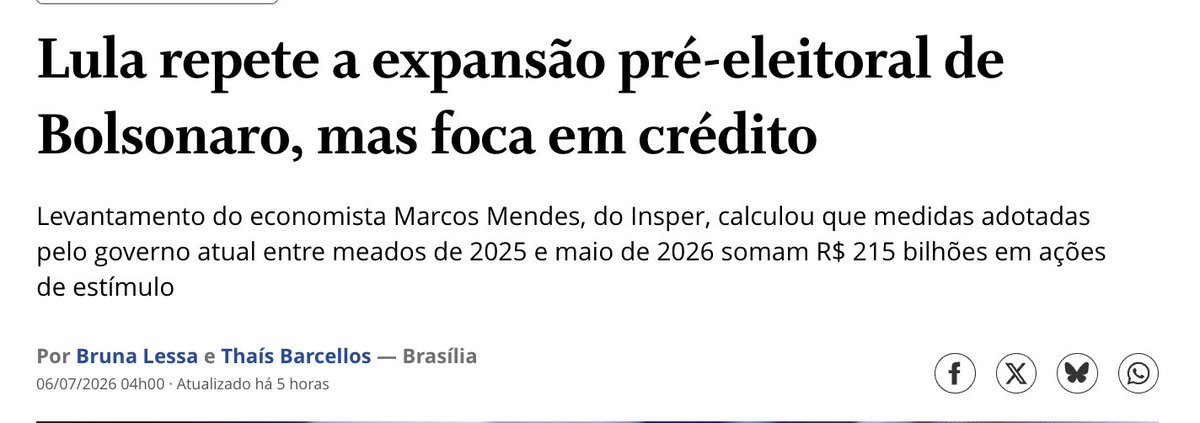
Marcos Mendes, do Insper, fez a conta: o governo Lula já anunciou R$ 215 bilhões em estímulos desde meados de 2025. Isenção de IR, Desenrola, Gás do Povo, Luz do Povo, crédito subsidiado. A PEC Kamikaze do Bolsonaro era R$ 41 bi e escandalizou todo mundo.
A diferença é o método. Bolsonaro gastou direto e furou o teto. Lula empacota tudo em crédito subsidiado que não entra no arcabouço fiscal. Do total, apenas 4% passa pelo teto de gastos. O resto é fundo extra-orçamentário e linha subsidiada que não aparece no resultado primário.
No fim, os dois aumentam a dívida pública, que é o termômetro real. O contorcionismo fiscal muda, o resultado não.
💎Ministros do STF estão ganhando dinheiro com a CBF? É isso mesmo? Além de juízes, acusadores, investigadores, carcereiros, e vítimas, juízes do Supremo agora promovem cursos para treinadores e gestores esportivos na CBF Academy? Em que momento a Constituição brasileira passou a permitir que juízes de direito passem a atuar como empresários e cartolas e juízes de futebol? Isso é o mais completo despautério.