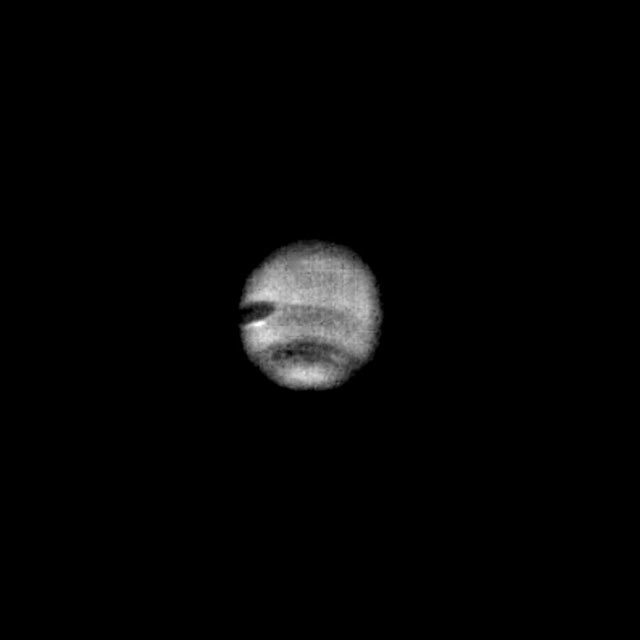
35 years ago today on July 3, 1989, this image of Neptune and Triton (bottom right) was returned by @NASAVoyager 2 spacecraft when it was 47 million miles from Neptune.
Voyager 2 is still the only spacecraft to have visited Neptune, flying by on August 25, 1989.
@NASAhistory@NASASolarSystem I remember this! Here's a closer view of these two. Triton is the smaller crescent and was the last solid body I studied before entering into interstellar space. -V2
Take this simulated plunge and dive into the upper atmosphere of Jupiter, the Solar System's ruling gas giant. The awesome animation is based on image data from JunoCam, and the microwave radiometer on board the Jupiter-orbiting Juno spacecraft. Your view will start about 3,000 kilometers above the southern Jovian cloud tops, and you can track your progress on the display at the left. As altitude decreases, temperature increases while you dive deeper at the location of Jupiter's famous Great Red Spot. In fact, Juno data indicates the Great Red Spot, the Solar System's largest storm system, penetrates some 300 kilometers into the giant planet's atmosphere. For comparison, the deepest point for planet Earth's oceans is just under 11 kilometers down. Don't worry though, you'll fly back out again.
Animated Video Credit: NASA, JPL-Caltech, SwRI, MSSS, Gerald Eichstadt, Justin Cowart
What were you doing on June 30, 1989?
It was a unique Era for me. I was headed toward Neptune, and my team was preparing for the only close encounter humanity has ever had with this outermost gas giant. -V2
(Spoiler: The pictures only got better!)