@twit4thot@lpky@jeremykauffman If you permit aggression (the State) against innocent persons/property, even for supposedly good ends (taxation, regulation, redistribution, monopoly courts/police), then you have already abandoned the core libertarian principle.
@twit4thot@lpky@jeremykauffman America as a State by nature is anti-libertarian
The State asserts jurisdiction and control over persons and property without a valid chain of title
As such the State is always a rights violator / aggressor
Javier Milei: “I thought being on the left was a mental problem. The empirical evidence is so overwhelming that it never worked anywhere, and they refused to accept it.”
“But what I discovered is that being on the left is a disease of the soul. The left is built on envy, hatred, resentment, and unequal treatment under the law. They are very violent, and since they have no way or arguments to answer, they go for physical violence.”
@Fishythefox2 The entity (the Capitalist) producing the product gets the money.
A process input (labor) doesn't produce the product.
It is the Capitalist's product.
"Aunque es una exagerada generalización decir que los economistas del siglo XIX fueron incondicionales defensores del laissez-faire, sí es cierto que la teoría económica producto del método deductivo demostró ser un poderoso baluarte contra la intervención del gobierno. Esa teoría económica mostró la eficacia y virtud inherentes al libre mercado, así como las contraproducentes distorsiones y los lastres económicos fruto de la intervención estatal. Para que el estatismo dominase la profesión económica, entonces, era importante desacreditar el método deductivo. Una de las formas más importantes de hacerlo fue hacer avanzar la noción de que para ser 'verdaderamente científica', la economía tenía que evitar la generalización y las leyes deductivas, y simplemente trabajar sobre investigaciones empíricas, sobre los hechos de la historia y las instituciones históricas, esperando que, de alguna manera, las leyes emergerían de estas investigaciones."
—Murray N. Rothbard
The South Sea Company demonstrates how government creates the very financial disasters it later claims to solve.
In 1711, the British government handed the South Sea Company an exclusive monopoly on trade with South America. The company received the right to manage £10 million of government debt in exchange for annual interest payments of £600,000. You already see the problem: politicians picking winners and losers, creating artificial scarcity through legal barriers to entry.
The company's directors understood their position perfectly. They held a government-backed monopoly with guaranteed income streams. Why bother with actual trade when financial engineering offered better returns?
By 1720, company insiders had perfected their scheme. Directors received stock allocations at below-market prices. They leaked hints about fictional trading opportunities in Peru and Mexico. Share prices exploded from £128 in January to over £1,000 by August. Company secretary John Blunt personally made millions while ordinary investors mortgaged their homes to buy shares at peak prices.
The government made everything worse. Chancellor of the Exchequer John Aislabie secretly purchased company stock while publicly endorsing its financial soundness. King George I became governor of the company. The Bank of England competed directly with South Sea for the privilege of managing more government debt, driving both institutions toward increasingly reckless promises.
You can see the disaster coming from a mile away. Legal monopolies breed rent-seeking parasites. Politicians who become business partners with their supposed regulatory targets make corruption inevitable. Monopoly privileges combined with government debt management guarantee fraud.
The crash came fast. By September, shares fell to £175. By December, they hit £124. Thousands of families lost everything they owned.
Parliament's response reveals the true nature of government monopolies. Instead of eliminating the system that created the bubble, they passed the Bubble Act, restricting corporate formation for ordinary entrepreneurs while preserving existing monopoly privileges for connected insiders. They prosecuted a few scapegoats while the political class kept their profits.
You still live with this pattern today. Governments grant exclusive licenses, patents, and regulatory privileges to favored companies. Politicians invest in the same firms they regulate(See: The Pelosian class). When the inevitable crashes occur, authorities blame "market failures" and "insufficient regulation" rather than their own interference.
The South Sea Company operated for another century after the bubble, earning modest returns from actual trade. Without government debt schemes and monopoly privileges, it functioned as a normal business serving real customers.
The lesson remains unchanged: markets work when entrepreneurs compete freely for consumer dollars. They fail when politicians pick winners, grant exclusive privileges, and mix public finance with private profit. Government creates the monster, then offers to slay it for a fee.
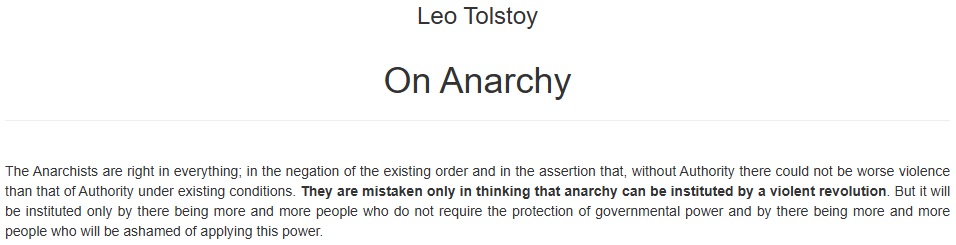
@JDStokes79@lord_jakub_@JimOstrowski From an anarchist (libertarian) point of view, using unethical means (the state) cannot be justified by any ends.
The @LPNational is lost when it abandons its purpose of social change for running candidates.
Society doesn't pay, doesn't exist, doesn't act
Only individuals pay, only individuals exist, only individuals act
Some shouldn't be forced to pay for others.
The only moral solution:
Individuals voluntarily pay for what goods / services they want
For people that believe we should not pay property taxes, how would you propose our society pays for the following?
Police and Fire Rescue
Public schools
Roads and infrastructure
Public parks
Libraries
“We have learned not to return blow for blow, nor to go to law with those who plunder or rob us. Instead, even to those who strike us on the side of the face, we offer the other side also.” Athenagoras, ANF II.129
"So not only is isolationism the logical corollary of libertarianism, which many libertarians don’t put into practice; in addition, as Randolph Bourne says, “war is the health of the state.”"
https://t.co/zdd8Gioo1v