It’s the world’s first #CPU!
Almost 54 years ago, on November 15th 1971, #Intel launched the first commercial single-chip microprocessor.
With the following tweets, let’s jointly explore the greatest milestone in #computing#history after the invention of the #transistor!
It’s #Oberon! ☠️
Desk research on vintage laptop repair sites hinted me to the first clue. These RAM chips were soldered as main memory in the IBM Thinkpad 380-XD from 1997. But also rare expansion sticks exist.
I checked more than hundred thinkpads in the last years…
2/4
It’s #Oberon ☠️!
This is a 30 years old DRAM module, and today, my long-lasting hunt for the silicon doodle Oberon is ending.
The die is very fragile and therefore best extracted via cooking in collophonium. After proper cleaning, the die can go under the microscope.
1/4
It’s #Oberon ☠️!
This is a 30 years old DRAM module, and today, my long-lasting hunt for the silicon doodle Oberon is ending.
The die is very fragile and therefore best extracted via cooking in collophonium. After proper cleaning, the die can go under the microscope.
1/4
It’s an #Eagle! 🦅
Can you imagine, to store a 256 GB iPhone’s capacity using IBM-era 1‑Mbit chips, you would need 2.1 million chips, occupying roughly 147 m² of silicon die area—about 1,580 square feet, or a bit less than a tennis court’s playing surface.
Metallurgical pics.
It’s an #Eagle! 🦅
Can you imagine, to store a 256 GB iPhone’s capacity using IBM-era 1‑Mbit chips, you would need 2.1 million chips, occupying roughly 147 m² of silicon die area—about 1,580 square feet, or a bit less than a tennis court’s playing surface.
Metallurgical pics.
It’s an #Eagle! 🦅
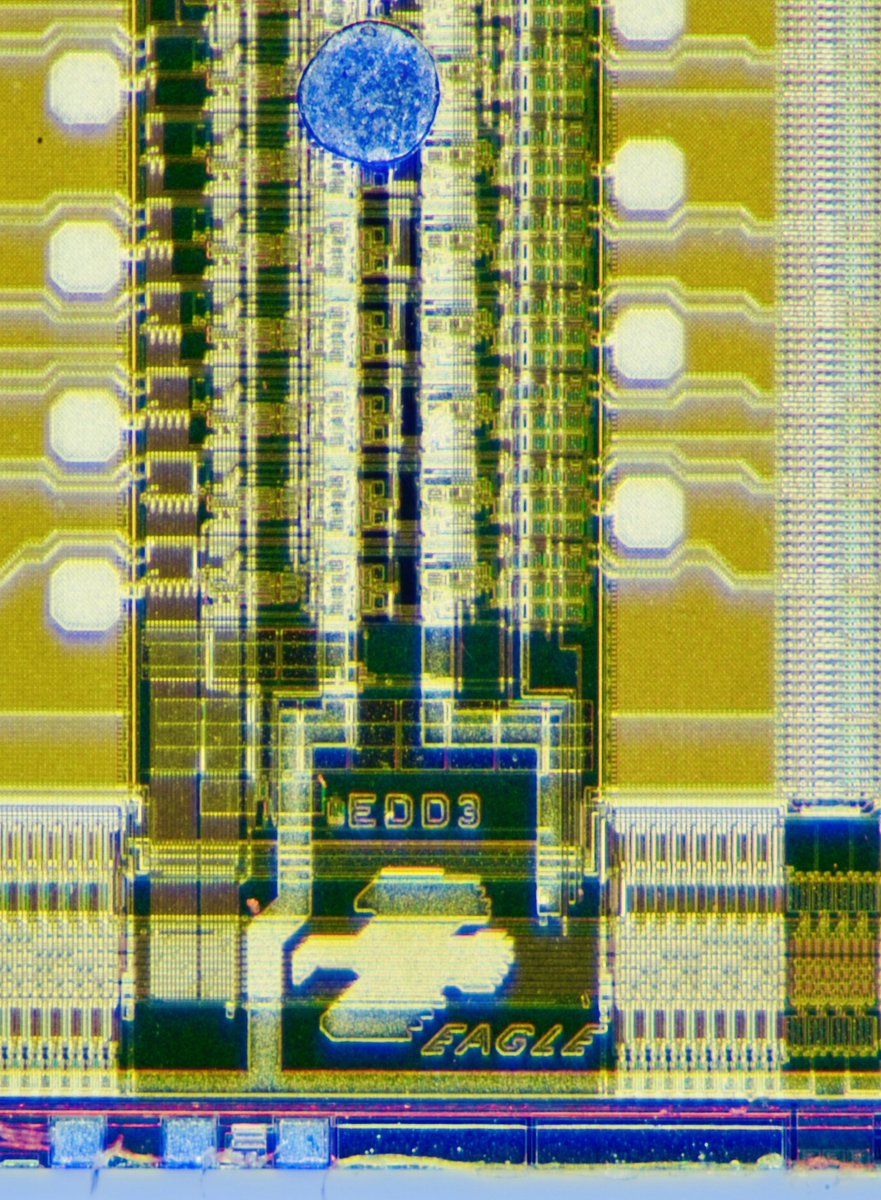
This early version of the 1Mbit DRAM was codenamed EAGLE, hence the rather large #Silicondoodle hovering on the top layer of the chip. Introduced in 1985 at ~1micron node size to power IBMs 3090 mainframes. Pictures from incident-light #microscopy.
It’s an #Eagle! 🦅
This early version of the 1Mbit DRAM was codenamed EAGLE, hence the rather large #Silicondoodle hovering on the top layer of the chip. Introduced in 1985 at ~1micron node size to power IBMs 3090 mainframes. Pictures from incident-light #microscopy.
It’s Fax, the 🐭!
I found this iconic GDR comic character mouse named Fax (from Fix & Fax) on a 4kbit SRAM designed by ZMD (U6548D).
Erinnert sich jemand???
It’s Fax, the 🐭!
I found this iconic GDR comic character mouse named Fax (from Fix & Fax) on a 4kbit SRAM designed by ZMD (U6548D).
Erinnert sich jemand???
@CluEdu70 the long, folded gate provides a large total channel width, allowing the stage to drive an external load more strongly than a small internal logic transistor could
It’s the MCS-4 shift register! The Intel 4003 expands the I/O for the i4004 CPU to drive peripheral devices like displays, keyboards, etc.
It was part of the original MCS-4 from 1971, this chip was made around Christmas 1980! 🎄
It’s a wrap! I stitched all ICs of the Busicom 141-pf which later became the MCS-4, the first 4bit chip set by Intel in the early 1970s.
It comprises the ROM 4001, 2 RAM 4002, 3 shift registers (or more) 4003, and the i4004 - all in 10 micron PMOS using Bor as dopant!
It’s the MCS-4 shift register! The Intel 4003 expands the I/O for the i4004 CPU to drive peripheral devices like displays, keyboards, etc.
It was part of the original MCS-4 from 1971, this chip was made around Christmas 1980! 🎄
The i286 was my first PC and before scrapping it I took the CPU out and started collecting CPUs 30 years ago…Decades later, I bought a microscope, decapped this very chip to make my first stitched canvas. Today, I can not stop being fascinated by peeking at transistors…
@hackerfantastic I went through the ordeal of installing IRIX 6.5.22 (needs at least 6 CDs, better 10), but hard drives are still available…and I will switch soon to a BlueSCSI SD system. This requires less power, is more flexible and calmer!! But yes please PM me for your thoughts…