Amazon founder Jeff Bezos, speaking at the 2015 Genius Gala in New Jersey (I do have questions about a self-proclaimed “Genius Gala”), said, “You have to have a certain childlike ability to not be trapped by your expertise. And that fresh look, that beginner’s mind, once you’re an expert, is unbelievably hard to maintain. (Wright, Craig. (2020) The Hidden Habits of Genius)
Having spent my adult life in ministry, I am challenged by his words. It seems the older we get, or the longer a church has existed, the more entrenched we become as “experts” on how ministry and church should be done.
But I wonder what would happen if we heeded Jesus’ words in Luke 18:17: “I tell you the truth, anyone who doesn’t receive the Kingdom of God like a child will never enter it.”
What if we allowed the Holy Spirit to fill our imaginations with the possibilities of ministry and church life? What if we let Him fill us with a Divine discontent with “church as usual” and inspire us with unique and effective ways to reach new generations? What if we laid aside our expertise and were willing to imagine with the One who says, “For I am about to do something new. See, I have already begun! Do you not see it? I will make a pathway through the wilderness. I will create rivers in the dry wasteland.” (Isaiah 43:19)
What would you call a minister or a church that followed God into “something new”? I’d call that “genius”.
In Matthew 28:8, we are told that the women who first witnessed Jesus' resurrection “were very frightened, but also filled with joy.”
“Fear” and “joy” are two diverse emotions rarely associated with one another. Most people have an aversion to things that frighten them, and they feel drawn to things that bring them joy.
But is it possible that the things that frighten us can often be the source of great joy? I think back to the birth of our first child. As I held that helpless child, I remember the dichotomy of emotions.
Fear - I was responsible for a little guy who, at the moment, depended totally upon me. I would not only have to provide for him physically, I would need to protect him emotionally, and guide him spiritually. That was a terrifying responsibility to take on.
Joy - as he gave out those first cries, this little human filled my heart with anticipation, excitement, and pride. This was my offspring, my legacy, my gift from God. The Father had entrusted me with the gift of fatherhood.
And on that day in 1982, like those early followers, I learned that sometimes you can be “very frightened, but also filled with joy,”
If you are facing a fear today, may I encourage you to remember that those things that often force us to face our greatest fears can, when placed in His hands, become the source of our greatest joys.
Eliza Edmunds Hewitt was a vibrant, active school teacher in the late 19th century. Her future looked bright. But a reckless student struck her in the back, leaving her with a spinal cord injury that left her immobilized. Confined to her bed for an extended period, her body in excruciating pain, Eliza could have given in to bitterness and despair.
Instead, she turned to her faith. In the quiet moments alone, she wrote poetry and songs. As one who understood the reality of struggles and the pain of crushed dreams, she wrote:
While we walk the pilgrim pathway
Clouds will overspread the sky
But when traveling days are over
Not a shadow, not a sigh.
When we all get to heaven
What a day of rejoicing that will be
When we all see Jesus
We’ll sing and shout the victory.
So, if there is a shadow on your day or a sigh on your lips, it just means your traveling days aren't over yet. Keep walking! One day, you will see Jesus! And you will “sing and shout the victory!”
What we suffer now is nothing compared to the glory He will reveal to us later.” (Romans 8:18)
Preachers have all kinds of pithy sayings that we use to explain theological truths. They flow naturally when we need to explain a life event.
One goes like this, “Where God guides, God provides.” That’s so true! In our desire to trust God when He leads us into uncomfortable situations, new ministries, or even extraordinary generosity, we declare, “Where God guides, God provides.”
But I’d also suggest that God guides us by what He withholds. God often withholds something you think you need, and you discover that you really need something else.
There’s a powerful story in scripture where a lame man was sitting by a gate called “Beautiful” begging for money. As Peter and John walked by, Peter looked at him and said, “Silver and gold have I none; but such as I have give I thee: In the name of Jesus Christ of Nazareth rise up and walk.” (Acts 3:6)
Peter prayed for him, God performed a miracle, and he could walk. But don’t miss this. If Peter had possessed what the man wanted (money), he may not have given him what he needed (a miracle). It was the constraint that led to a breakthrough.
Sometimes, what you don’t have or feel you can’t do is exactly what God calls you to do. That’s why it’s called a miracle. Who knows? Today just might be the day that “such as I have” includes the miraculous.
In 2012, 14-year-old Lola Anderson watched two UK rowers win Olympic gold. Lola wrote in her diary, “My name is Lola Anderson and I think it would be my biggest dream in life to go to the Olympics and represent Team GB in rowing and, if possible, win a gold medal.”
She felt embarrassed and threw away the note. Her dad found it in the trash, retrieved it, and stored it in a safe deposit box.
Fast forward seven years. Her dad was terminally ill with cancer. Two months before dying, he gave the note to Lola and said, “Don’t you dare give up on your dream.” (The Guardian).
Five years later, Lola made the British Olympic rowing team. In the race, her team fell far behind, but in the last few meters, they pulled even for a photo finish. Lola and her teammates won the race by 15/100’s of a second.
Lola’s father played a key role in encouraging her to keep going. While we all want to see our own dreams fulfilled, how often do we work to see others fulfill their dreams? Paul wrote in 1 Thessalonians 2:11-12, “For you know how, like a father with his children, we exhorted each one of you and encouraged you….”
It’s one thing to chase your own dreams, but those who leave a lasting impact are the ones who encourage others not to give up on theirs!
When reading the history of the Jewish patriarchs, we are often drawn to the relationship between Jacob and Rachel. We admire Jacob's dedication and commitment to winning Rachel's hand in marriage. When her father deceived him into a marriage with his older daughter, Leah, Jacob continued to work for seven years to gain Rachel's hand in marriage.
We often overlook how Leah must have felt through this ordeal. She was a pawn used by her father. She was never the object of Jacob’s deepest affection. Her story resonates with many who feel overlooked and insignificant.
However, Leah's story took a significant turn in Genesis 29:31: “When the Lord saw that Leah was unloved, he enabled her to have children, but Rachel could not conceive.” In her loneliness, “the Lord SAW that Leah was unloved,” and He blessed her. But after the birth of her first three children, she kept trying to find her significance through Jacob, hoping that he would love her now that she had given him sons (verses 32, 34)
But after the birth of her fourth son, Leah's focus shifted, and she declared, "This time I will praise the Lord." (verse 35) No longer striving for Jacob's affection, Leah found her significance in God.
Through her sons Levi and Judah, Leah’s legacy became monumental. Levi’s descendants became the priestly tribe of Israel, and Judah’s lineage led to King David and ultimately to Jesus Christ. Leah, once insignificant, played a pivotal role in God's redemptive plan. Though Jacob never gave her the affection she desired, she was never forgotten by God.
And might I add: Neither are you!
Conflict is inevitable, but divisiveness is avoidable. How we handle human conflict determines whether the outcome is unity or division. https://t.co/wwpIPDCPxW via @danreiland
A few days ago, I walked into our storage garage and unexpectedly hit a spider web. Instinctively, I backed up, frantically swatting my face and hair to remove the sticky strands. Even minutes later, I kept checking to ensure no spiders were crawling on me.
Then I wondered, “Why do those webs stick to me, yet the spider glides across them effortlessly?” It turns out that spiders are meticulous in their movements. Only the tips of their legs touch the web, and those tips are covered with tiny hair-like structures that reduce contact. Additionally, a non-stick chemical, similar to Teflon, coats their legs, preventing them from getting caught in their own webs.
It’s fascinating how the Creator designed them to be ON the web but not caught BY it. Perhaps Jesus had something similar in mind when He said, “They do not belong to the world, just as I do not belong to the world. I’m not asking you to take them out of the world, but to keep them safe from the evil one.” (John 17:16).
How do we live in the world but not be ensnared by it? “Walk in the Spirit, and ye shall not fulfill the lust of the flesh.” (Galatians 5:16). The Holy Spirit is like a divine non-stick coating, enabling us to live in this culture without becoming like it.
Think about that the next time you wipe a spider web from your face.
Talk about an awkward moment...a woman with a reputation entered a room full of religious people and begins to wash the feet of Jesus with her tears and her hair (Luke 7). I would have quickly stopped her and promised everyone I had never met her. After all, my reputation would be on the line.
Awkward moments make me uncomfortable and defensive. But Jesus heard her repentance and cry for help. He took advantage of the awkward moment to lead her to the peace of God.
He said in Luke 7:47, "I tell you, her sins—and they are many—have been forgiven, so she has shown me much love. But a person who is forgiven little shows only little love."
It’s humbling to realize how often I let my discomfort dictate my actions rather than seeing the opportunity for grace in the mess. Jesus wasn’t concerned about appearances; He was focused on the heart. He knew true transformation often begins in the most unexpected and uncomfortable places. His willingness to embrace those moments challenges me to reconsider how I react when life gets awkward.
If I’m honest, I can easily drift into attitudes like those who judged the woman. But Jesus’ response reminds me that social norms nor my discomfort hinder God’s love. His response to each of us is always from a heart of acceptance and grace.
A few years ago, during one of my sermons, I was using an illustration about crab traps, and I got tongue-tied, and instead of “crab”, I said a similar word. Now, understand that, as a kid, I was not allowed to say that word, and it is still not a part of my vocabulary. But it was one of those moments you couldn’t just move on because everyone in the congregation started giggling. I tried to correct it and said it again. The more I tried to correct it, the more giggles erupted.
I've got to say, more than being embarrassing, it was...funny. Especially to my kids, who knew I didn’t say that word and had just said it at least three times, from the pulpit, in my sermon.
Psalm 126:2 says: "We were filled will laughter, and we sang for joy. And the other nations said, What amazing things the Lord has done for them." Don’t miss the connection. Our ability to laugh testifies to those around us of God's amazing presence.
So today, why not take a little time to laugh? If you can't think of anything to laugh about, just pay close attention to yourself...you'll probably find something.
Last week was one of those weeks that jars me back to the reality that we live in a fallen world, and following Jesus doesn’t exempt us from all the consequences of the Fall.
A young family I know lost a small child in a tragic accident. My heart grieves with them. I also received the news that my dorm parents at the first college I attended lost their lives in a fire. It was one of those weeks where the world feels painfully broken, where all the words in the world seem inadequate. In moments like these, there are no eloquent prayers, no simple answers—just the gut-wrenching cry of the heart, “Oh, God, help us.”
As I reflected on these experiences this weekend, the ancient story of Shadrach, Meshach, and Abednego in the fiery furnace recorded in Daniel 3 came to mind. There’s a small but profound phrase in verse 26: “So Shadrach, Meshach, and Abednego stepped out of the fire.” This simple statement carries such a profound truth for us as followers of Jesus. In the furnace, the three young men walked in the fire—a period of suffering and trial—but they did not walk alone. Remember the fourth man in the fire (verse 35)? Nor did they stay in the fire indefinitely. They “stepped out of the fire.”
Every trial has three phases: the moment we step into the fire, the challenging time of walking in the fire, and the eventual moment we step out. The promise we embrace is that, like Shadrach, Meshach, and Abednego, there will always be a moment when we step out of the fire—changed, perhaps, but not consumed.
#TheExtraordinaryOrdinary
“Can you fix it, poppa?” One of the grands brought a little toy to me one day after a piece had broken off while she was playing with it. It was a new little toy Shirlene had picked up for a few dollars, so we knew it wouldn't last long. And I couldn't fix it. Immediately, huge tears began to fall down her cheeks without the slightest sound coming from her. I was as hurt as she was.
As I thought about her tears, I remembered the words of a Psalm that has come to mean a lot to me as I reflect on my six-decade journey on this planet. Psalm 56:8 says, “You keep track of all my sorrows. You have collected all my tears in your bottle. You have recorded each one in your book.”
What an amazing thought! God collected my granddaughter's tears that morning and wrote about each one in His journal. And like a five-year-old who weeps over a broken toy, there are days when all I know how to do is let tears flow. And God notices, God collects, and God records.
I'm not sure why, but that knowledge sure helps, even when I don’t always get answers for my tears.
#TheExtraordinaryOrdinary
While on the earth over 2100 years ago, Jesus did amazing things! But did you know, according to the four Gospels, He was only amazed twice?
Interestingly, there are no records of anyone making a statement that wowed Jesus with their wisdom. We never see Jesus being amazed by someone’s miracle-working power. Both are important. We need people who study and possess knowledge, and people who God uses for the miraculous. But, neither amazed Jesus.
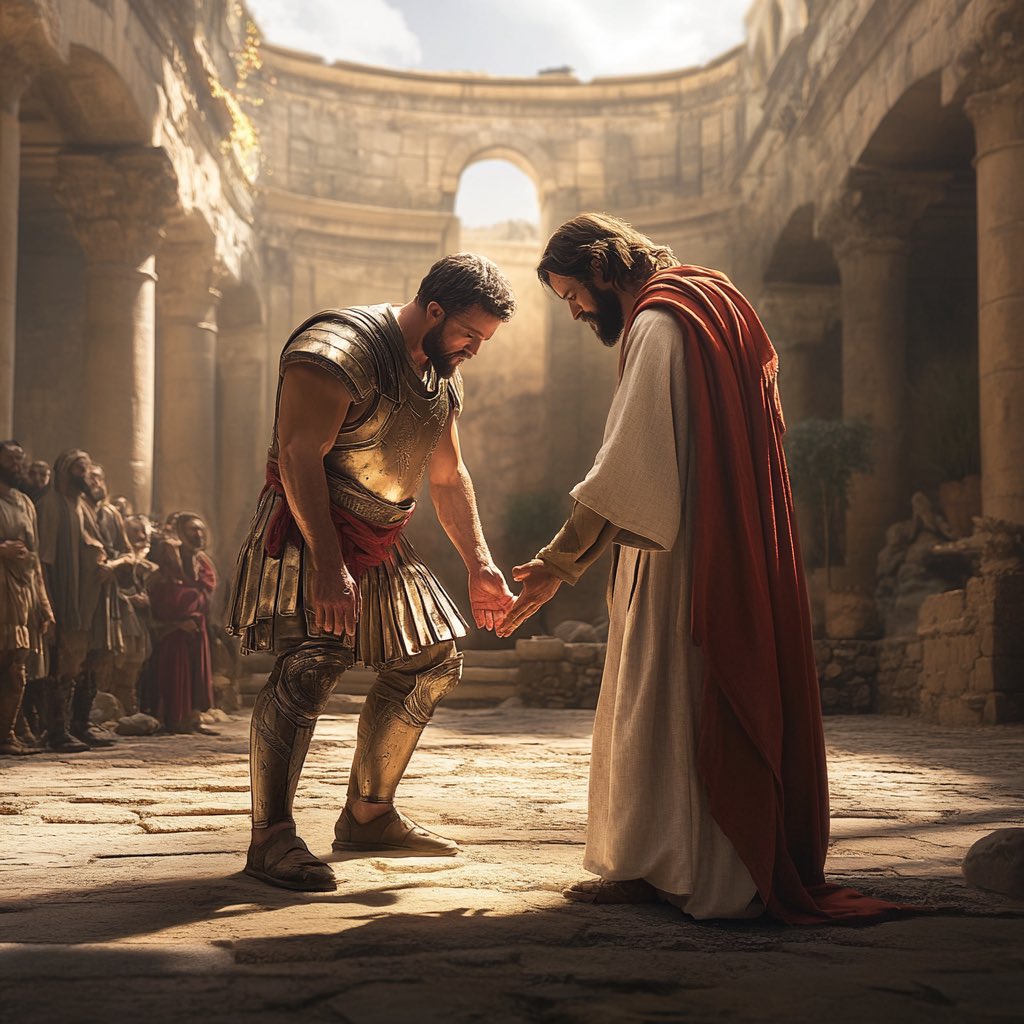
What was it that amazed Him? In both instances, it was faith! One was a centurion that came to Him and asked Him to heal his servant. After telling Jesus that He didn’t need to go to the servant but that he (the centurion) understood authority, “When Jesus heard this, He was amazed.” (Matthew 8:10; Luke 7:9)
The second was when He experienced unbelief, or a lack of faith, in His hometown of Nazareth. “And He was amazed at their unbelief.” (Mark 6:6)
It wasn’t knowledge or extraordinary power that amazed Him. Many of us may never exhibit either in our lives. But what amazed Jesus was something we can all have…faith.
“And it is impossible to please God without faith.” (Hebrews 11:6) When the enemy tries to persuade you to give up, do the amazing. Keep believing.
My dad, @dukelstone, has published his 1st book—a 90-day Christian devotional. I just ordered my copy. Gets yours at the link below. #ProudSon#MyHero
https://t.co/2lpF0cqclg
Join us for the final session in spring pilot of PEF's Innovative Leadership Series. @dukelstone will lead an inspiring workshop on how leaders can practice empathetic listening to enhance the visioning process. Learn more and register for free at https://t.co/wRQRluYM4A