In July 1941, the German Fallschirmjäger stationed in Halberstadt, a garrison town in the Harz region, were celebrated with a festive Blumenparade, or “flower parade,” to mark their recent airborne successes.
At the time, they were still seen as elite shock troops and national heroes, having built a strong reputation during the early war years. The event came just weeks after the Battle of Crete (May–June 1941), the largest airborne invasion in history and one of Germany’s most costly victories. Despite heavy losses, their capture of the island was widely promoted by the N*zi regime as proof of their bravery and tactical skill.
The flower parade in Halberstadt was part of a propaganda celebration meant to lift spirits, honour survivors, and project a triumphant image to the German public.
During the event, Fallschirmjäger units marched through decorated streets as crowds welcomed them with flowers, garlands, and cheers.
Soldiers were photographed riding in open vehicles or marching with bouquets pinned to their uniforms, symbolizing public appreciation. Many participants were veterans of Norway, the Low Countries, and Crete, though heavy losses in Crete had led to some units being reorganized with new recruits.
Halberstadt was an important Luftwaffe and paratrooper training center, housing airfields, supply depots, and reserve units.
Parades like this aimed to keep local support strong and uphold the image of the Fallschirmjäger as an elite, almost legendary force.
Ironically, this parade marked the height of their fame: after Crete, Hitler banned large-scale airborne missions, and from 1942 on, paratroopers mostly served as elite infantry rather than true airborne assault troops.
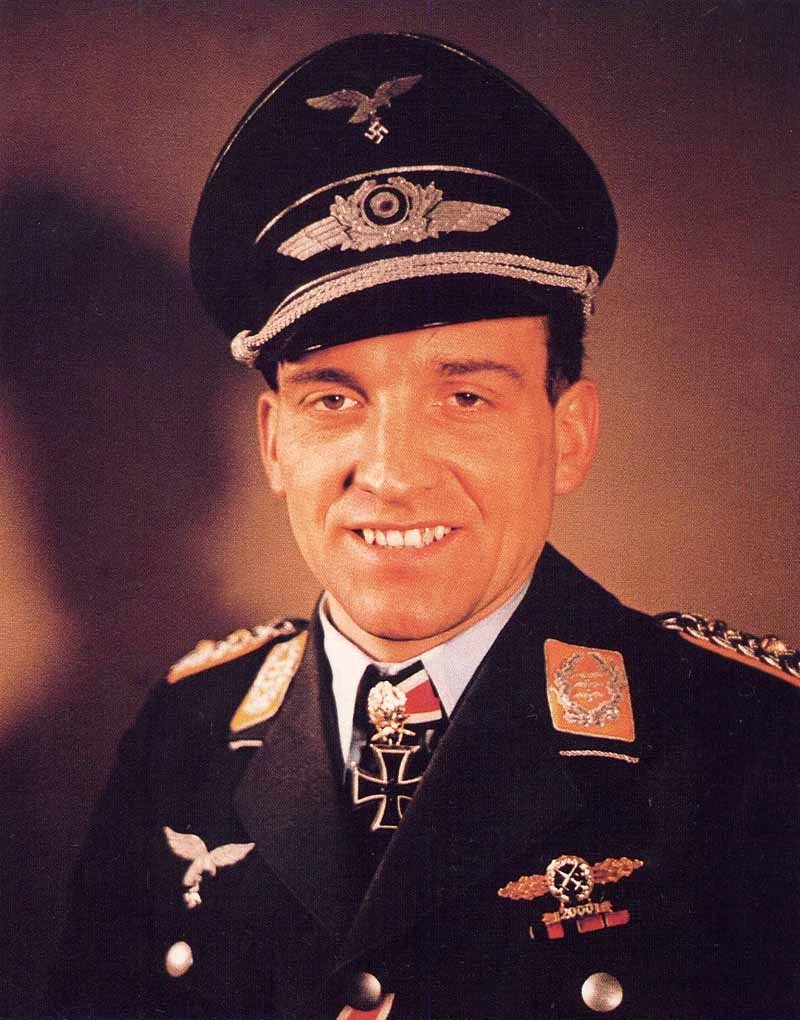
Hans-Ulrich Rudel flew 2,530 combat missions, was shot down more than thirty times, destroyed over 500 tanks from the air, sank a battleship, and became the only man ever to receive the very highest German decoration, a grade of the Knight's Cross created specifically for him because nothing else was high enough. As a ground-attack pilot he is in a category of one.
Rudel flew the Junkers 87, the Stuka, the gull-winged dive bomber with the screaming siren that had terrorized Poland and France early in the war. By the time he was in his prime, the Stuka was considered obsolete, too slow and vulnerable, but Rudel turned it into a precision tank-killing machine on the Eastern Front. He flew a version fitted with two long-barreled cannon under the wings, and he developed an almost unbelievable skill at diving on Soviet tanks and putting armor-piercing rounds through the thin plating on their engine decks, killing them one at a time, over and over, day after day.
His tally is staggering. More than 500 tanks destroyed, the figure usually given is 519, along with hundreds of other vehicles, artillery pieces, armored trains, bridges, and even a handful of aircraft shot down. In 1941 he sank the Soviet battleship Marat in Kronstadt harbor with a direct hit, a single dive bomber putting a bomb into a battleship's magazine. He flew more combat missions than any pilot in history, over 2,500 of them, most on the Eastern Front.
He was also shot down or forced down more than thirty times, wounded repeatedly, and yet kept flying. Late in the war his leg was shattered and had to be amputated below the knee, and he had himself fitted with an artificial leg and went straight back to flying combat missions, destroying tanks with one leg gone. The Soviets hated and feared him so much that Stalin reportedly put a large bounty on his head.
For all this he received the Knight's Cross and then every higher grade of it, and finally a unique decoration, the Knight's Cross with Golden Oak Leaves, Swords, and Diamonds, an award created for him alone, the only one ever given. He survived the war, having flown from the first year of it to nearly the last day, the most decorated German serviceman of the entire conflict, and one of the most successful combat pilots who ever lived by almost any measure you choose.
Un 10 de agosto de 1557, los ejércitos de la Monarquía española aplastaron a las tropas francesas en San Quintín, en una de las grandes victorias del reinado de Felipe II. Los franceses, comandados por el condestable Anne de Montmorency, intentaron cruzar el Somme para entrar en la plaza, pero quedaron atrapados y fueron destrozados por las tropas comandadas por Manuel Filiberto de Saboya. 12.000 franceses murieron o fueron hechos prisioneros, toda su artillería y más de 50 banderas capturadas. Las bajas hispánicas apenas fueron 500.
La victoria abrió a España el camino hacia París, hundió las pretensiones francesas en Italia y consolidó la hegemonía de la Monarquía española. Felipe II mandaría construir el Real Monasterio de El Escorial en conmemoración.
SÉ ABURRIDO
- Despierta temprano
- Sal a caminar
- Toma la luz del sol
- Levanta pesas
- Come sano
- Elimina los vicios
- Cocina en casa
- Ama a tu familia
El aburrimiento es lo nuevo y está de moda.
Ayn Rand lo advirtió hace casi 70 años.
Nadie le hizo caso.
Hoy es el pan de cada día.
“Cuando adviertas que para producir necesitas obtener autorización de quienes no producen nada; cuando compruebes que el dinero fluye hacia quienes no trafican con bienes sino con favores; cuando percibas que muchos se hacen ricos por el soborno y por influencias más que por su trabajo… entonces podrás afirmar, sin temor a equivocarte, que tu sociedad está condenada.”
— Ayn Rand, filósofa y escritora rusa, nacionalizada estadounidense
Conocía bien el socialismo
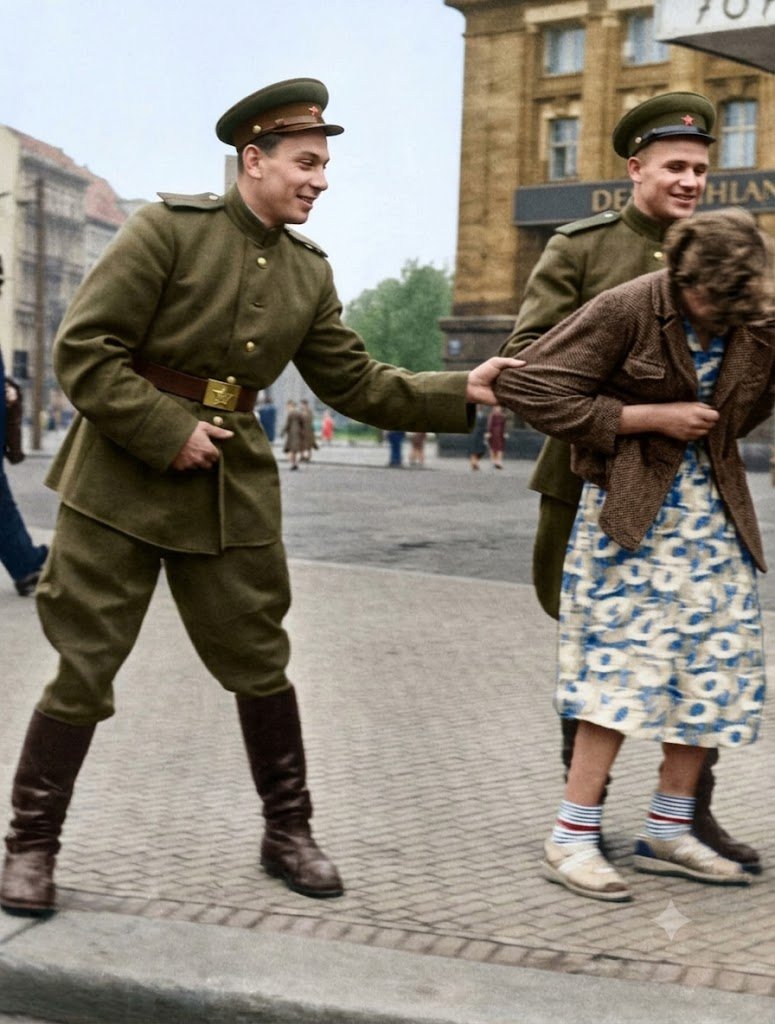
In 1945, as the Red Army pushed into eastern Germany and took Berlin, historians estimate that close to 2 million German women were raped. Around 100,000 in Berlin alone. It is one of the largest mass rapes in recorded history, and most people have never heard a single word about it.
It did not begin in Berlin. As Soviet forces crossed into East Prussia in late 1944, whole villages were overrun. In places like Nemmersdorf, German propaganda splashed the killings and rapes across the papers, which only made civilians farther west flee in terror as the front moved toward them.
The victims were not only young women. Documented cases run from girls as young as 8 to women in their 80s. Age, illness, and pregnancy spared no one. Antony Beevor found records of women pulled from hospital beds and from the cellars where entire families were hiding together.
Many were not attacked once but again and again. Soldiers came through in waves, so a woman assaulted by one group would be found and assaulted by the next. Some endured it night after night for weeks once the occupation settled in. "Frau, komm" became a phrase Germans learned to dread.
The anonymous memoir "A Woman in Berlin" records women in one apartment block trying to work out who would be taken, hiding girls in attics, smearing their faces with dirt or faking illness to look untouchable. One survivor wrote that by the end the word rape had lost all its meaning.
Some women, with a grim kind of arithmetic, sought out a single officer to attach themselves to, reasoning that belonging to one man was protection from being taken by dozens. The diarist called it sleeping for food and safety. It was survival stripped down to its barest terms.
The aftermath was its own disaster. An estimated 10,000 women in Berlin died in connection with the assaults, many of them by suicide. Venereal disease spread fast through a city with almost no medicine left. Historians estimate well over 100,000 pregnancies, followed by waves of abortions and abandoned newborns.
Beevor also found that the violence did not stop at Germans. Soviet and Polish women freed from Nazi camps were raped by their own liberators. This had less to do with nationality than with a total collapse of discipline and command in the field as the war ground to its end.
Then came the silence. In the postwar East, under Soviet control, the subject was effectively forbidden. To speak of the Red Army as anything but a liberator was dangerous, so survivors carried it privately for decades. Many husbands returning from the war never asked, and many wives never told.
El general Felipe Navarro no sobrevivió al Frente Popular, lo asesinaron en Paracuellos junto a su hijo de veintiséis años. Fue uno de los héroes de aquellas terribles jornadas de Annual en 1921: dirigió la defensa de Monte Arruit y fue prisionero de los rifeños durante más de un año.
Pues el 7 de noviembre de 1936 milicianos del Frente Popular lo llevaron a Paracuellos, lo fusilaron y lo enterraron en una fosa común.
Tenía 74 años y no se había manifestado a favor de la sublevación comandada por el general Mola.
Su único delito era haber sido ayudante de campo del rey Alfonso XIII.
El general había sobrevivido a diez combates en Cuba, Filipinas y Marruecos, al asedio a Monte Arruit y a un cautiverio de año y medio.
Apresado en su casa de Madrid, en la calle Marqués de Riscal, el 14 de agosto del sangriento verano de 1936 por las milicias del Frente Popular, fue encerrado en la Cárcel Modelo.
El 22 de agosto, en la matanza de la propia cárcel, logró escapar en la confusión del incendio provocado por las turbas. Fue apresado de nuevo aquel mismo día, en su domicilio, mientras se bañaba.
Mereció durante su larga carrera la gran cruz de las Órdenes de San Hermenegildo, del Mérito Militar con distintivo rojo, y de María Cristina; fue caballero profeso de la Orden de Calatrava, gentilhombre de cámara de S.M. con ejercicio, comendador de la Legión de Honor francesa y de la Orden de Avis portuguesa, y caballero de la Orden de Leopoldo de Bélgica.
Ganó además una cruz de 1ª clase y dos de 2ª clase de la Orden Militar de María Cristina, cinco cruces de la del Mérito Militar con distintivo rojo, dos con distintivo blanco, una cruz del Mérito Naval, la medalla de Sufrimientos por la Patria pensionada y otras dos sin pensión, y las de las campañas de Cuba, Filipinas, Melilla, Rif y Marruecos.
No sobrevivió al Frente Popular.
“Es difícil imaginar una manera más estúpida o más peligrosa de tomar decisiones, que poner esas decisiones en manos de personas que no pagan ningún precio por equivocarse”
Thomas Sowell