Scientific machine learning, AI & data analysis, dynamical systems theory, applications in (computat.) neuroscience & psychiatry. @durstewitzlab.bsky.social
@Esychology@wgilpin0 Why it's so good in capturing the long-term behavior zero-shot we haven't fully understood so far, but a major part of it is likely the control-theoretic training techniques we are using, plus perhaps the ALRNNs as experts (see ablation studies in sec. 4.5 of paper)
Captivating perspective! The flexibility and adaptability of the human brain indeed set a high bar for AI systems. How do you envision the integration of these dynamical and plasticity mechanisms affecting future AI advancements? Could this also reshape our understanding of neurological disorders? For more in-depth reviews and discussions on topics like these, check out https://t.co/4Y9Imt8uIJ – a one-stop platform that answers every biomedical question and offers comprehensive biomedical reviews. #NeuroAI #Medicine
Now that the AI overlords all started publicly admitting defeat with the current architecture, I believe we are going to see more and more folks turn to neuroscience for clues. About time.. 😁
Unlike current AI systems, brains can quickly & flexibly adapt to changing environments.
This is the topic of our perspective in Nature MI (https://t.co/fg4NV0LR4O), where we relate dynamical & plasticity mechanisms in the brain to in-context & continual learning in AI. #NeuroAI
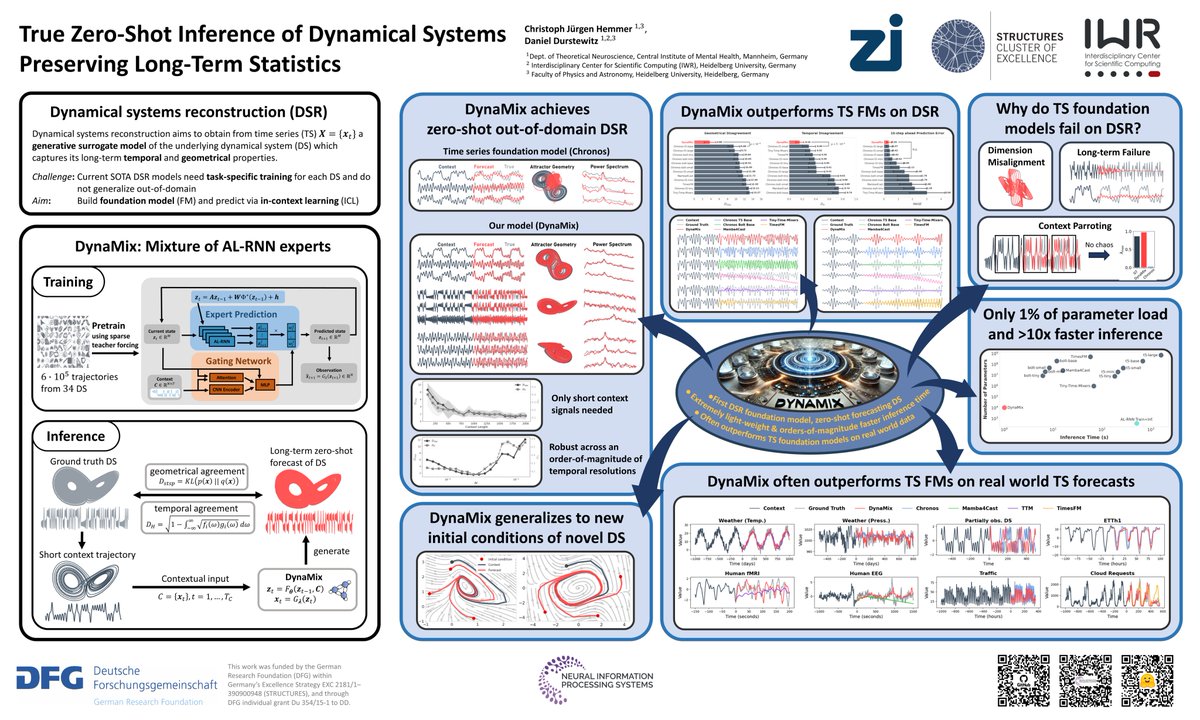
Despite being extremely lightweight (only 0.1% of params, 0.6% training corpus size, of closest competitor), it also outperforms major TS foundation models like Chronos variants on real-world TS short-term forecasting with minimal inference times (0.2%) ...
Our #DynamicalSystems#FoundationModel was accepted to #NeurIPS2025 with outstanding reviews (6555) – first model which can *0-shot*, w/o any fine-tuning, forecast the *long-term statistics* of time series provided a context. Test it on #HuggingFace:
https://t.co/FrbK5Kx9t2
...
Can time series #FoundationModels like Chronos zero-shot generalize to unseen #DynamicalSystems (DS)?
No, they cannot.
But *DynaMix* can, the first FM based on principles of DS reconstruction, capturing the long-term evolution of out-of-domain DS: https://t.co/fL1CLATTpB
(1/6)
We have openings for several fully-funded positions (PhD & PostDoc) at the intersection of AI/ML, dynamical systems, and neuroscience within a BMFTR-funded Neuro-AI consortium, at Heidelberg University & Central Institute of Mental Health (see below): https://t.co/CZNXECQETe
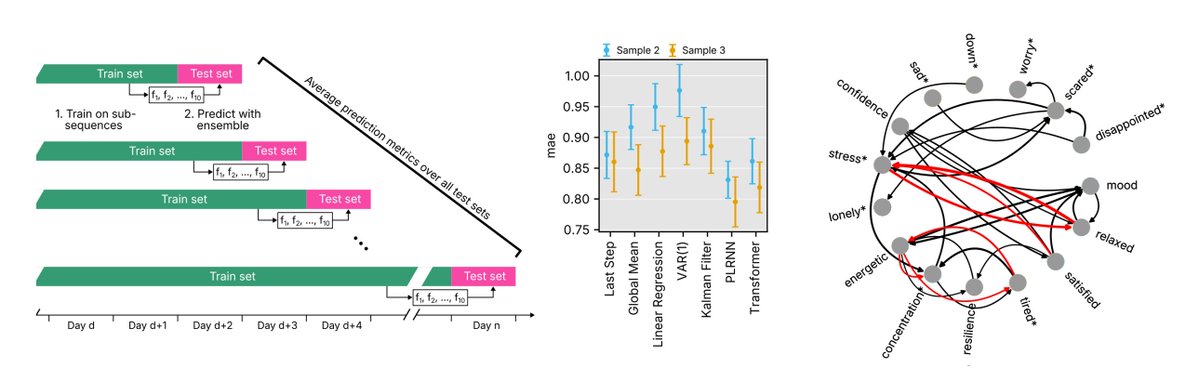
Our new preprint compares naïve baselines, network models (incl. PLRNN-based SSMs), and Transformers on 3x40‑day EMA+EMI datasets. PLRNNs gave the most accurate forecasts, yielded interpretable networks, and flagged “sad” & “down” as top leverage points. https://t.co/9trDupOR4A
Got prov. approval for 2 major grants in Neuro-AI & Dynamical Systems Recons., on learning & inference in non-stationary environments, OOD generalization, and DS foundation models. To all AI/math enthusiasts: Expect job announcements (PhD/PostDoc) soon! Feel free to get in touch.
We wrote a little #NeuroAI piece about in-context learning & neural dynamics vs. continual learning & plasticity, both mechanisms to flexibly adapt to changing environments:
https://t.co/UR20TGtJ8L
We relate this to non-stationary rule learning w rapid jumps.
Feedback welcome!
How do animals learn new rules? By systematically testing diff. behavioral strategies, guided by selective attn. to rule-relevant cues: https://t.co/Bxr8xalkmr
Akin to in-context learning in AI, strategy selection depends on the animals' "training set" (prior experience).
Into population dynamics? Coming to #CNS2025 but not quite ready to head home?
Come join us! at the Symposium on "Neural Population Dynamics and Latent Representations"!🧠
🗓️July 10th
📍@ScuolaSantAnna, Pisa (and online)
Free registration:
👉https://t.co/NMfX7U3LH4
Can time series #FoundationModels like Chronos zero-shot generalize to unseen #DynamicalSystems (DS)?
No, they cannot.
But *DynaMix* can, the first FM based on principles of DS reconstruction, capturing the long-term evolution of out-of-domain DS: https://t.co/fL1CLATTpB
(1/6)
We dive a bit into the reasons why current time series FMs not trained for DS reconstruction fail, and conclude that a DS perspective on time series forecasting & models may help to advance the #TimeSeriesAnalysis field.
(6/6)
Remarkably, DynaMix not only generalizes zero-shot to novel DS, but it can even generalize to new initial conditions and regions of state space not covered by the in-context information.
(5/6)