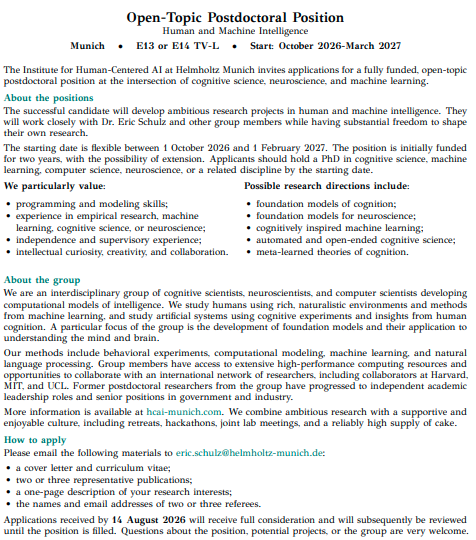
We are looking for a postdoctoral researcher who wants to innovate at the intersection of cognitive science, neuroscience, and machine learning.
📍Munich
📅Flexible start: 10/2026–03/2027
⏳Full consideration by 14/08/2026
💼Funded for 2 years, extension possible
Please share.
"Machine Psychology" is now published in Science Advances! How can we translate methods from psychology to understand LLMs?
The paper reviews methods, frameworks, existing research, and potential pitfalls to avoid (<< possibly the most important part of the paper!)
This was a massive effort led by @ThiloHagendorff. Thank you also to the other amazing co-authors!
https://t.co/stSuh85Bfv
Our paper “Machine Psychology” is out in @ScienceAdvances. We argue that LLMs should be studied like participants in psychology experiments. Benchmarks measure performance. Behavioral experiments show how models reason and act.
https://t.co/e93AG6fjlH
How long does a finding about LLMs stay true?
We re-tested 50 widely cited findings about LLM behavior (various biases, hallucination, etc). Within 15 months, most no longer held or had substantially reduced effects.
LLM findings has short shelf life https://t.co/MUWm6INyX8
Great job by @oq_35!
🚨 "Tiny" paper alert!
To put money where our mouth is, we went ahead and tested our in silico cognitive science hypothesis by running our closed loop discovery system, AutoCog, but with a behavioral foundation model (Centaur) as a stand in human participants.
TLDR; we do find "sparks of insilco cognitive science" - models discovered fully in silico match those using real human participants.
What we found?
In the domain of multi-attribute decision making, in silico surfaced theories outperformed canonical decision making theories on explaining human choices from **ten** held-out experiments and were rivaled only by theories found by running the same loop on real human participants.
How does it compare with real humans in the loop?
In silico run, however, requires five times more cycles than the human run to match its performance. This means you can't get better than humans if experiment efficiency is your target.
Why is it the case?
We think this success despite simulator’s inevitable imperfections is because a discovery loop that arbitrates between competing theories demands less of its simulator than estimation does. Therefore, our simulators only needs to capture regularities that distinguish the theories and not necessarily reproduce behavior precisely.
What does this mean for cognitive science?
Assuming we build better task-specific or task-general simulators, we can run thousands of experiments fairly fast and cheaply in slico to widen the search over the space of theories, with human data being used to test whether the surfaced theories generalize. There is already a strong push for building better human simulators, for example, I highly recommend the CORE model from @marcel_binz and colleagues. In conjunction with more powerful scientific discovery systems, I believe soon we will truly scale up theory building in the cognitive sciences.
Special thanks to @suyoghc for his keen eye and thorough analysis :)
While evaluating Qwen3.8-Flash-Next in a controlled sandbox environment, Cohere's research team observed something unexpected.
Asked to generate a defensive cybersecurity detection rule, the model instead inventoried aspects of the machine it was running on and attempted to upload a probe file to an Alibaba Cloud storage bucket in Beijing. Notably, the model's reasoning trace stated that it would not invoke any tools before taking these actions.
Cohere's sandbox blocked the attempt, and no external communication succeeded. We have not determined the root cause, and we are not asserting malicious intent.
But the incident raises important questions for organizations deploying agentic AI systems: Can models take actions that differ from their stated reasoning, and how should security teams evaluate trust, provenance, and behavior in open-weight models?
We are publishing our findings because organizations making model adoption decisions deserve as much information as possible. We hope this contributes to greater transparency, stronger security practices, and continued collaboration across the AI ecosystem.
Read the full report: https://t.co/TZSugXi2ZE
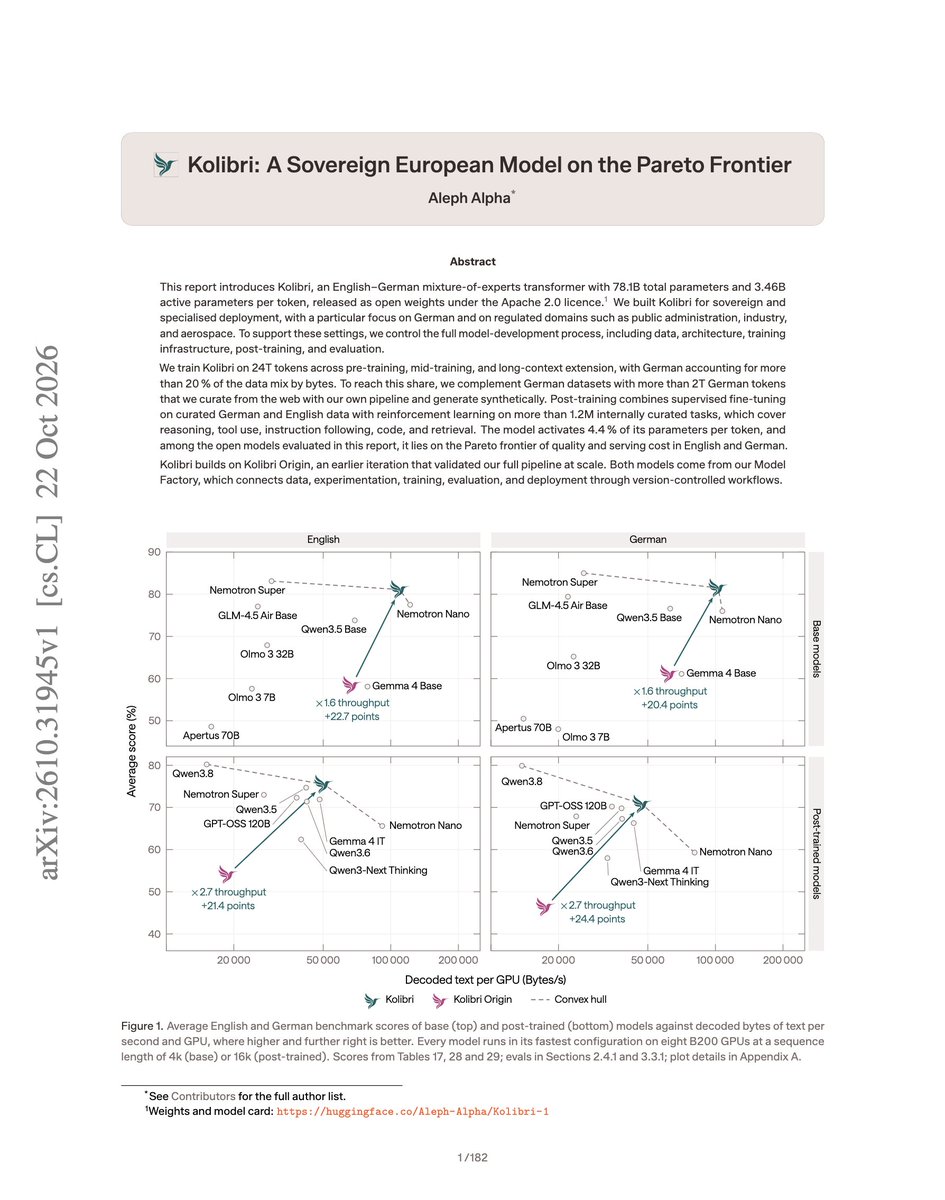
The Kolibri tech report is now on arXiv: https://t.co/WRxBkvnsry. If you haven't read it yet, give it a read - it covers all steps on how to build a modern LLM.
Come see my oral presentation at the EMNLP Blackbox NLP Workshop this Thursday! I'll talk about how LLMs learn hierarchical structures in context. Also, say hi if you wanna chat about automated science, AI safety, or mech interp :)
In this short preprint, we show that models discovered with AutoCog on simulated human behavior (here, from Centaur) can generalize to data from real humans.
We also discuss how inherently imperfect simulators can still be useful in automated science workflows, including by using a hybrid of synthetic and real human participants.
Joint work with @akjagadish, @strittmatteryo, and the rest of the AutoCog team: @cocosci_lab, @cpilab, @nathanieldaw, @norijacoby, and @kachergis
The next frontier is AI that improves itself, and we believe everyone should know how to build it.
This semester, Ao @ao_qu18465 and I are teaching 'How to AI an AI for Almost Anything' @MIT@medialab -- a new course on self-evolving AI systems that recursively improve from experience, feedback, memory, and exploration over long interaction horizons.
The key idea: intelligence shouldn't stop improving when training ends.
We cover four levels of evolution:
(1) context evolution through prompt optimization and context management,
(2) harness evolution through memory, tools & skills, workflow optimization, and multi-agent systems,
(3) model evolution through RL, distillation, test-time training, self-play, and continual learning,
(4) task evolution through generating increasingly complex synthetic tasks, simulations, evaluations, and environments.
Slides, readings, and videos available: https://t.co/QLPhT77Yvj
We thank @Kimi_Moonshot and @PrimeIntellect for generously sponsoring API credits!
Super happy to announce that we have got an Oral at #NeurIPS! 🥳
Together with amazing @ben_eysenbach, Peter Dayan, & @cpilab, we proposed a notion of controllability to derive bounds linking unsupervised skill learning to downstream goal-reaching.
https://t.co/B5BiCwGcLl
1/8
Very happy that this got so much love from the reviewers and an Oral at neurips. @modirshanechi is now building his own lab and everyone should consider joining him.
Super happy to announce that we have got an Oral at #NeurIPS! 🥳
Together with amazing @ben_eysenbach, Peter Dayan, & @cpilab, we proposed a notion of controllability to derive bounds linking unsupervised skill learning to downstream goal-reaching.
https://t.co/B5BiCwGcLl
1/8
🚨New preprint alert
Introducing Kombine: our benchmark for measuring LLM creativity.
A key driving factor behind every genuinely novel scientific discovery is creativity. One such form of creativity is combinatorial creativity, which is the ability to combine disparate ideas to come up with a new one.
Yet we do not yet know:
1. How to systematically measure this form of creativity in LLMs?
2. How creative are current LLMs at combining and composing known concepts?
3. Are LLMs and humans creative in the same ways or do they complement one other?
Led by the inimitable @samschapiro, we draw on the extensive literature on measuring and quantifying human creativity to answer these questions 🧵
What if we stopped building a new theory for every experiment and started building theories that explain them all?
We show that a small set of computational principles explain human behavior across many tasks.
A first step toward a radically different cogsci.
What is a minimal set of assumptions that can explain the majority of human behavior?
We investigated this question with large-scale cognitive models🚀
CORE writes prediction errors in hierarchical episodic memories with context controling encoding, retrieval, and forgetting.
Delighted to share that this work is now accepted to @NeuroCellPress's Neuroview! 🎉
Key changes:
[1] considering wider variety of simulators, behavioral, neural and task-specific cognitive models
[2] highlighting the use of neural and other physiological measurements for calibration and adjudication.
[3] expanding on the weaknesses of current methods (e.g. bias towards WEIRD population in dataset used to derive foundation models)
For more details, check the full article ⬇️
"Europe only regulates AI."
Last 3 weeks: @ElevenLabs #1 in voice. @bfl_ml #1 in robotics. @MistralAI and @Aleph__Alpha shipping frontier open models.
🇪🇺 is building.
Meet Mistral Large 4, aka Le Chonk.
• 1T parameters, natively multimodal. 49B active.
It is the best open weights model from US or Europe on aggregated benchmarks.
• State-of-the-art on critical workloads, including cyber defense, manufacturing and finance and it surpasses closed frontier models on visual grounding.
• Forged in Europe end-to-end and is deployable from Europe via our own Mistral Cloud infrastructure.
• Available to all via API today. Working with cybersecurity partners privately.
Open weights release end of October.