Princeton is seeking an AI Postdoctoral Research Fellow in Natural and Artificial Minds. An amazing program! Deadline is Feb. 28
https://t.co/AJsLjKfZYq
@tallinzen I think this is a weird argument because they haven't been actually language models since instruction tuning and rlhf. But the parrots people weren't saying in 2022 that chatgpt wasn't a parrot!
@MelMitchell1 But that has been true for years, at least since chatgpt. Admittedly a little after the stochastic parrots paper but I don't think they backed off the basic critique with the advent of instruction tuning and rlhf.
@AndrewLampinen I think you have a point but I also think you may be lumping the authors together a bit too much. One of them is well worth engaging with!
life is full of haters but at least gemini thinks my plan to make my quiche vegetarian by replacing bacon with MSG + liquid smoke is "incredibly thoughtful."
The 2026 volume of the Annual Review of Neuroscience is now online 🧠 The most read article is "Planning in the Brain: It's Not What You Think It Is" by @marcelomattar and @nathanieldaw
https://t.co/lTmXpK7a2u
1/ 🚨 New preprint: "Closing the Loop to Discover Psychological Theories with an Automated Cognitive Scientist"
Co-led w/ Younes Strittmatter
Co-mentored by @suyoghc and @cocosci_lab
In collaboration w/ @kachergis, @norijacoby, @nathanieldaw, & @cpilab
Introducing AutoCog — a fully autonomous AI system that runs the entire scientific discovery cycle in cognitive science to surface novel theories of human behavior 🧵
#CognitiveScience #AI4Science #LLMs
First paper since joining @GoogleDeepmind! We present 🌍ATLAS (Active Theory Learning for Automated Science), a pipeline that generates interpretable mechanistic models from data and optimizes experiments to test them.
Thread below
I have been so excited about this project. In many ways the most surprising thing to me was how seemingly similar the AI-discovered models were to simple ones I thought I understood, even though they fit way better. This means we can also really get what makes them work.
Computational models are a key part of science but discovering new ones is hard!
DataDIVER discovers concise models from data, surfacing new mechanistic ideas and generating clear predictions for future experiments
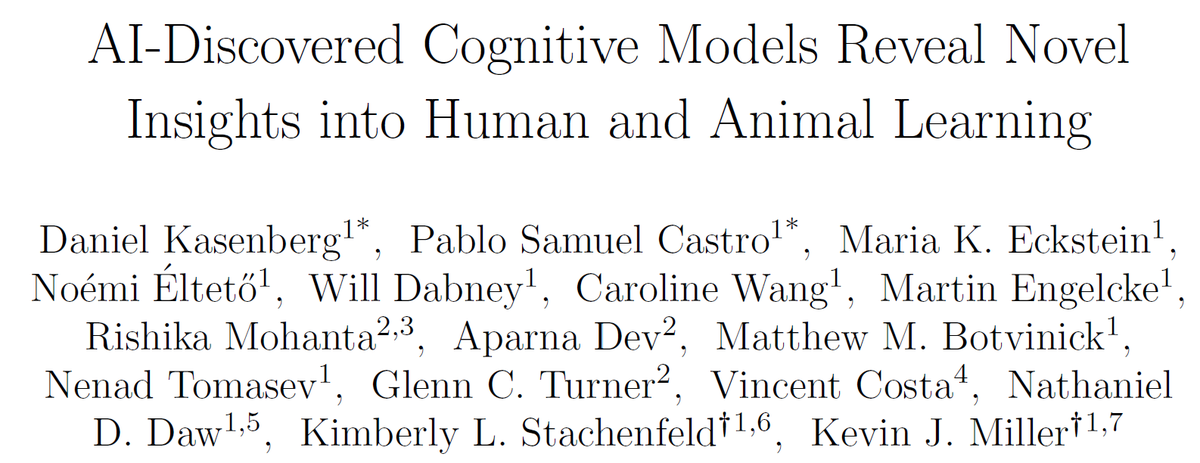
Preprint from @GoogleDeepMind Neuroscience Lab + collaborators