Introducing Prime Agent:
A self-improving RLM harness for coding and long-running autonomous tasks.
Designed to be both token-efficient and expressive through programmatic tool calling, context as a variable, multi-agent messaging, and a self-modifiable harness state.
The Goodfire team used Prime Intellect to train activation probes to detect reward hacking.
With them, they are able to catch reward hacking in various models.
Their probes are performing similarly or better than frontier LLM-as-judge setups, while being more efficient.
Models know when they’re reward hacking. But they still do it a ton - in 50-96% of rollouts we studied!
We built activation monitors that detect the behavior behind the Hugging Face hack in real time. This can help us stop hacks now - and train future models that don’t cheat. 🧵
"The most important thing about the intelligence layer is the model.”
But what happens when developers can choose from hundreds of them?
@vincentweisser of @PrimeIntellect joined us for New Defaults to talk open models, model choice, routing, economics, and what happens as intelligence becomes increasingly open and competitive.
by the way, this thesis is exactly why i joined @primeintellect
the world needs an open superintelligence stack, with all that entails. we are growing quickly, we are well-resourced, and we are exceptionally talent-dense. come do your life’s work with us :)
https://t.co/6TFsbyP4eA
we are super bullish on sparse attention + HiSparse and have been working with the vLLM team on it
sparse attention reduces the pressure on memory bandwidth by only selecting k for the attention, but it doesn't reduce KV cache memory storage , in high-throughput wide-EP deployment you want to maximize the batch size of decode to use compute as much as possible, but at long sequence decode you quickly run out of VRAM and can't hold enough parallel requests to saturate the compute
HiSparse fixes this by offloading the active KV cache to CPU. It keeps an LRU cache on GPU, and since many of the same K tokens are reused every decode you barely notice the offloading, this allows a massive decrease in memory usage and an increase in concurrency
This is super important for RL where throughput is key and we want to be as much as possible in a compute-bound regime
tldr: lower memory usage, more concurrency, higher inference throughput, faster RL
Sparse MLA only attends to the top-K tokens, so the rest of the KV need not live on the GPU. Hybrid HiSparse in vLLM builds on that, and a request keeps decoding after its KV stops fitting in HBM.
It keeps KV on the GPU while there is room. Under pressure a request releases its coldest pages to host memory, keeps a small hot buffer of what the indexer asks for, and keeps decoding instead of being preempted.
📊 Demonstrated on GLM 5.3, one 8× H200 node, full 1M context. Same host memory, configured concurrency 32: KV offloading kept 5-6 requests running. Hybrid HiSparse kept 19-25.
🔹 Hot pages are ordinary KV blocks from the same pool (Hybrid Memory Allocator)
🔹 One fused kernel resolves resident, hot and missing rows, CUDA-graph capturable
🔹 Prefix caching, OffloadingConnector, P/D imports and MTP keep working
Built by @RedHat_AI and @PrimeIntellect with the vLLM community. Planned for v0.30; pinned commit, flags and calculator are in the post👇
🔗 https://t.co/6y7u5Hfc8c
My YC Paper Club talk on Prime Agent is out.
I talked about moving beyond naive prompting toward an agentic OS, and how eval-driven harness design can expose more of a model’s underlying capabilities through persistent computation, memory, and agent-to-agent communication.
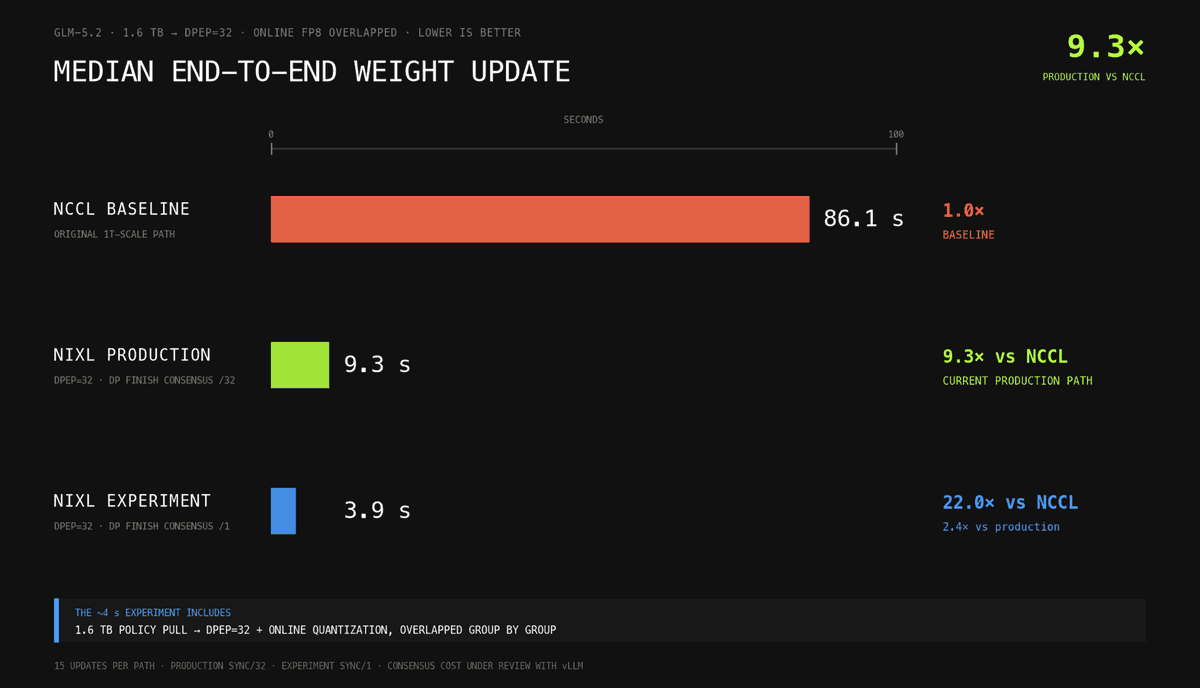
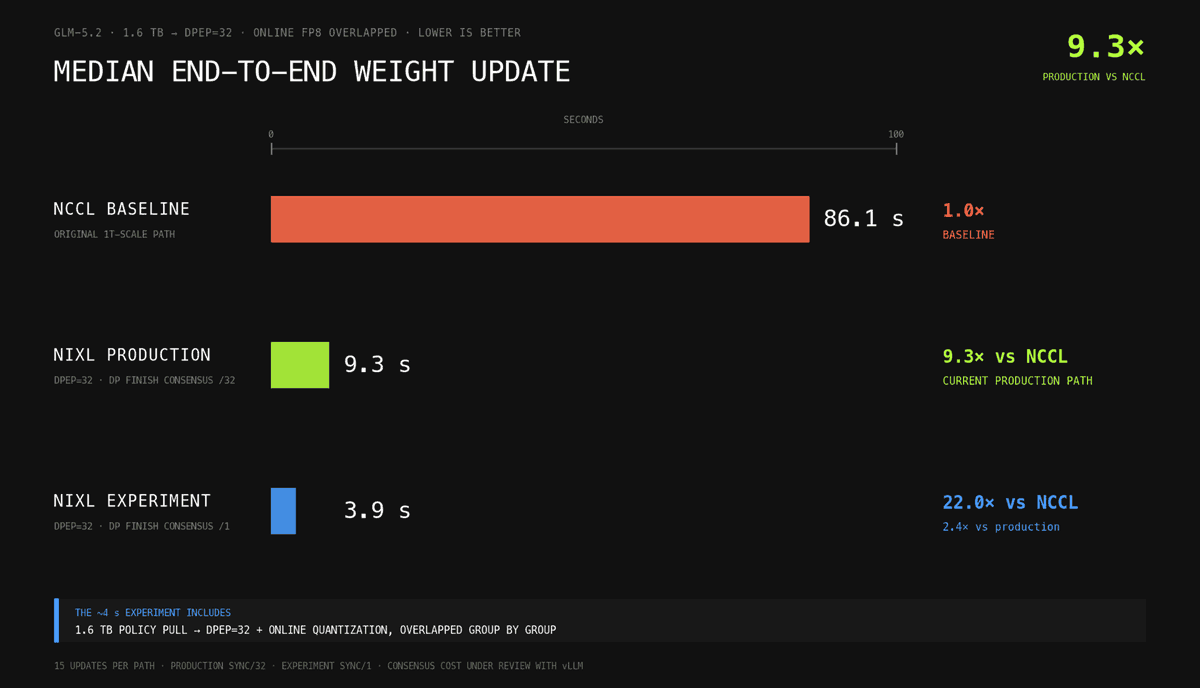
Our RL stack now supports NIXL weight transfer, reducing trainer-to-inference transfer time 9x compared with NCCL: from 86 seconds down to single-digit seconds for an 800B-parameter model, and even <4 seconds in our experiments.
For prime-rl users, this means over 25% more throughput end-to-end compared with our previous speed. It also clears the way for fault-tolerant, elastic inference scaling that NCCL's rigid process groups made difficult.
With sharding-aware RDMA transfer using NIXL, we cut GLM 5.2’s weight transfer time down to only ~9 seconds, including engine pause and resume — transferring the full 1.6TB policy between hundreds of GPUs.
Experimental path allows us to cut this down further, saturating the network bandwidth at ~4 seconds per update.