@cryppimagic anyone in control of a trade-only API key can steal funds by picking an illiquid market and making scam wicks where their other account is the counterparty
good long term mitigants: scoping permissions more narrowly, IP whitelisting, market whitelisting, volume rate limit, etc
@5dayoldburrito good question
- there are benefits to transparency as well
- doesn't work as well if it's opt in. If you are the only person opted in, everyone can still see who you are
- it's cleaner on a fresh deployment where there is no historical state that is already public
In the case of Lighter:
1. All data is verifiable - you don't have to trust the operator. Withdraw your funds via escape hatch if Lighter stops operating. There are CLOBs for other products like spot/options where realtime settlement makes a difference, and it is synergistic via portfolio margin
2. Lighter can trivially offer privacy to traders by encrypting data (with the trader's public key) before it's posted to Ethereum. This does not affect the escape hatch. Position level privacy can be mandatory, opt-in, or opt-out. Trades, volume and open interest can remain public, verifiable info while individual trader positions remain hidden
3. No priority fees on Lighter.
4. Combining onshore/offshore orderbooks is technically possible but that's up to the regulators.
5. Lighter matching engine is centralized and highly performant. There is no tradeoff between speed and security. If there is inefficiency, it is the cost of generating and publishing proofs of correct execution, which is low and continuing to drop quickly.
Further to my post about @NYSE working to bring @HyperliquidX onshore, major credit to @ChairmanSelig and the Trump administration for making all of this experimentation possible.
There’s only one way of finding out if something is useful to the marketplace and I’m excited for us to find out. I do have some questions:
1. What is the benefit of trading perps on-chain on a regulated exchange? Isn’t the main benefit of trading on-chain to operate in a trustless (aka non-kyc’d) environment in order to minimize friction, and/or to be able to enter into atomic transactions in order to receive what you are buying in realtime? Since a perp is not an asset, that obviously isn’t helpful.
2. @standuquesne - are you aware that if you trade on Hyperliquid, the world will be able to track your positions and trades in real time? Do you see that as a benefit?
3. Hyperliquid has priority fees - a mechanism that enables market participants to pay to see information first, or even prioritize orders in front of the queue. Is this consistent with CFTC core principles?
4. Will it be possible to combine the liquidity of the offshore order-book with the onshore order-book?
5. If not, wouldn’t it be better to list perps in a traditional (centralized) order-book on a regulated exchange and not have the inefficiencies that on-chain matching introduces?
Lighter proofs enforce price-time priority and the matching rules.
It's true that you can't directly prove order censorship/delay on the networking layer, but bad behavior would be obvious to traders who can measure latency etc.
OP is comparing Lighter to a regulated CEX - you get verifiable execution and the escape hatch so it's pareto better.
Social trading apps command high margins, especially compared to the cost of capital for bridging / mint / redeem type flows
Can't let capacity or scaling issues get in the way of viral growth! And the beauty of noncustodial architecture is that you can choose between all available bridge/swap paths as needed
study aggregation theory
Introducing the fastest crosschain swaps on the market. Crosschain transactions on @fomo now land in <1s.
A week ago, we rolled out our own internal bridge to a small % of users.
Public rollout of fomo bridge begins now.
Lighter EVM devnet is live! An EVM-equivalent rollup built in collaboration with @axiom_xyz, powered by OpenVM. It runs alongside Lighter Core, and the two are designed to settle jointly to Ethereum with a single ZK proof 🧵
What was the economic incentive to solve any of the OpenAI problems?
Meanwhile ECDLP has had over 3k researchers with 800+ published papers, and it never stopped. There are yearly conferences held to discuss failed attempts at breaking ECDLP, so people can learn from each other and try to break it better.
The NSA is the world's greatest hirer of mathematicians. They got caught trying to backdoor Discrete Logarithm systems three times. The last being caught in 2015.
After each one, waves of the most competent cryptographers scoured for new attacks. Most things that improve attacks by like 10% are really the same things that make implementations of EC operations faster.
Theres armies of people, on the latest frontier models, making their cryptography blazingly fast, like us @ZakuraZcash. You see open research projects constantly improve the state of the art.
No human or AI has had any elliptic curve speedup approaching even a 2x, yet folks are freaking out that cryptography is broken?
The OpenAI problems being broken is not remotely the same as ECDLP having a real improving attack.
Even if there was an attack, its insane to imagine it becomes "Break ECDLP on your laptop". It would go from "impossible" to "possible with all the world's GPU's dedicated for a decade", to "possible with 1 year".
Any of those is a real warning shot to go trigger the ECC freeze.
cryexc is now the top zero-fee integrator on @Lighter_xyz
$10m in the last 7 days alone
trade from the chart, then grade and review it in the journal right after
everything from one single tab, free and client side
onwards
pretty cool tool from the team at defillama. looks at the book before a $10k market order, calculates expected slippage, checks the actual fills, then adds taker fees. actual execution cost has been debated at length and i dont think it is a +ev thing to debate anymore. but something worth noting is that lighter was built to ensure retail got the best price possible on a trade. as this metric from defillama shows, users on average receive a slightly better fill than the book implied. this is something we are very proud of. our slippage is still higher than we would like, but the all-in cost remains competitive. we want users to have the best possible trading experience, and we want builders to be able to offer that same experience to their users. we recently open sourced lighter-ts, which gives them a quicker path to offering best in class perps. from there, they can focus on serving their users and growing their own business.
We just created a new metric for exchanges: realized perp slippage
1. We take a snapshot of the orderbook right before market orders execute
2. Calculate the slippage at which it should fill ($0.94 on Binance)
3. Compare against actual slippage on the fill (actually $1.63)
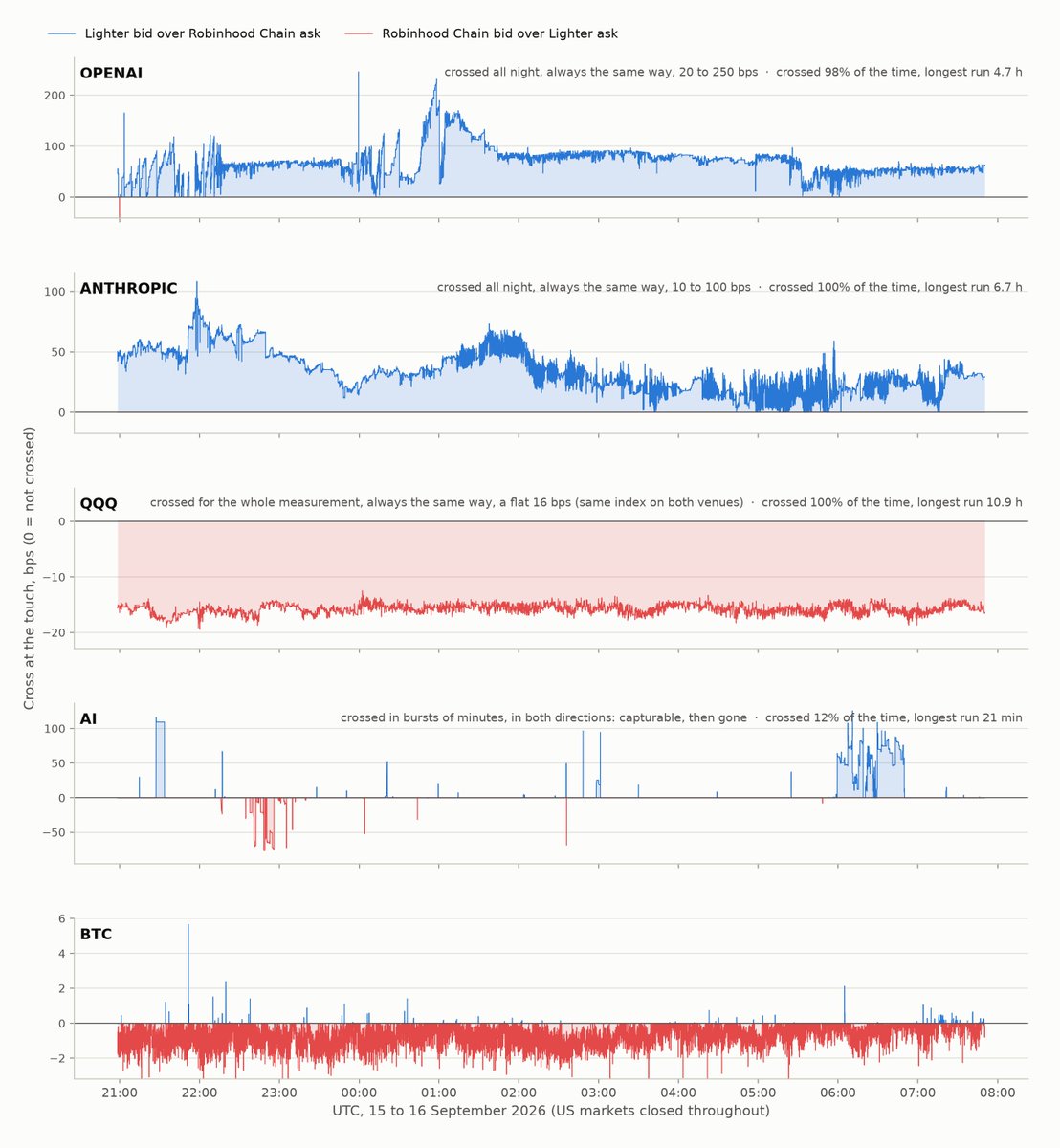
I was looking over some Litscan data for the two Lighter instances and found some arbs lying around, so I thought I would open source a basic arb bot to take advantage of it. Details below
despite their best attempts to mislead you and hide the fact they're advertising kalshi's lowest fee tier, they're still more expensive than @Lighter_xyz
🚮 🚮 🚮
we have found out that asking a small team to build a full perp frontend from an SDK is still a pretty big lift, even with ai. we just open sourced lighter-ts, which gives builders the state, websocket pipeline, trading math, utilities, and types needed to build on Lighter. it should remove a lot of the hard work. the goal is to make integrations much faster. would love feedback from anyone building wallets, bots, or trading apps.