When we’re gone, most of what we spent will mean nothing.
But the Prophet ﷺ told us there are three things whose reward continues after death - and ongoing charity is one of them.
£1 a day. £5 a week. A deed still running long after you’re in your grave.
We need 250 daily supporters and 50 weekly supporters to keep Masjid Daar us Sunnah open every single day - for prayer, for knowledge, for the community. Right now we’re a long way off.
Don’t let this masjid close for want of a pound.
📲 https://t.co/yTOsnhmExN
Shaykh ‘Abdul-Hakīm Dahhās Hafidhahullāh:
“From the most important matters regarding the raising of children is that you are concerned with who enters your home and make du’a for anyone who enters your homes. It is important that everyone who enters your home upholds the guidelines of Islam. The evil and corruption of others could harm years of good work that you have done in your home.”
Listen live now on https://t.co/jWCCCoNqVM !
📢 A Gathering of Knowledge
🎙 Shaikh Dr. Abdul-Khaliq Madi, from the Scholars of Algeria
🕌 Live in Person at Masjid Bin Bāz East Road London E15 3QR
🗓 Thursday 25th June 2026
🕗 8PM BST
👥 All Welcome
🌐 Tune-in Live https://t.co/RLPdOQLOYG
Shaykh ‘Abdul-Hakīm Dahhās Hafidhahullāh:
“From the most important matters regarding the raising of children is that you are concerned with who enters your home and make du’a for anyone who enters your homes. It is important that everyone who enters your home upholds the guidelines of Islam. The evil and corruption of others could harm years of good work that you have done in your home.”
Listen live now on https://t.co/jWCCCoNqVM !
📢 Upcoming Conference at Markaz us-Sunnah
We are pleased to confirm a 3-day conference with Shaykh Dr. Abdul-Khaliq Madi (may Allah preserve him), live in person.
The Shaykh will be completing his teaching of the book:
The Fundamentals of Islamic Belief, by Imam Abdur-Rahman al-Sa'di
26th - 28th June, after ʿAsr (6:00 PM)
All Welcome!
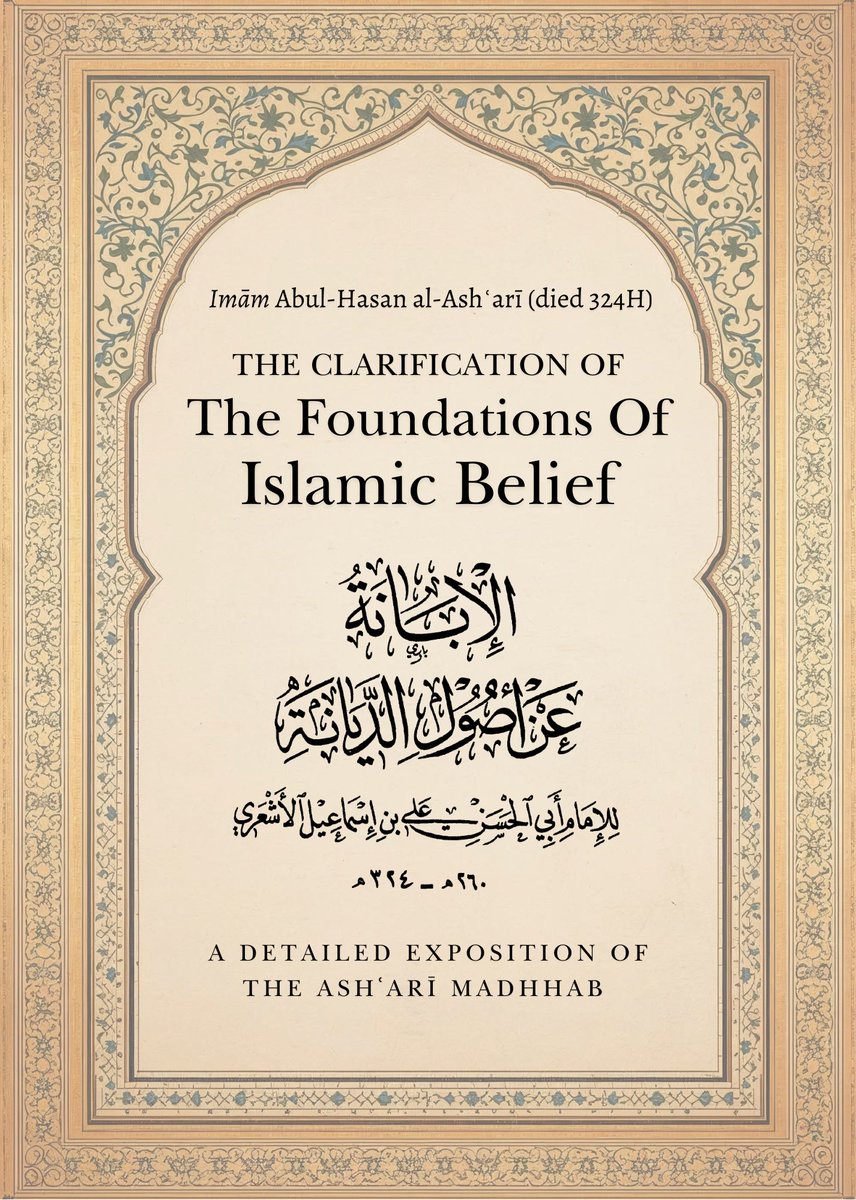
COMING SOON (inshā'-Allāh) @SalafiPubs
The Clarification of the Foundations of Islamic Belief
Al-Ibānah ʿan Uṣūl ad-Diyānah
By Imām Abul-Hasan al-Ashʿarī (Died 324H)
At a time when the Muslims were united upon one creed and one methodology, there were no sects and no competing “forms” of Islam. The Muslims simply called themselves Muslims, as Allah had named them.
Then deviations began to appear. The Khawarij emerged, followed by the Qadariyyah and other deviant groups. These titles were used by the Sahabah to distinguish such groups from the Muslims who remained upon the truth.
Later came the Rafidah, the Murji’ah, and many others. These names were given by the Sahabah and their students to identify and clarify these deviations.
As time passed, the Ummah spread across lands and more sects emerged. Meanwhile, the number of Sahabah and their students steadily decreased until those adhering to the original understanding became one group among many. The Prophet ﷺ foretold this when he said:
“My Ummah will split into seventy-three sects. All of them will be in the Fire except one.”
Those who remained firmly attached to the way of the Prophet ﷺ, his Companions, and their students became known by names such as Ahl al-Sunnah, Ahl al-Hadith, and Athari. These names were not adopted out of partisanship, but to distinguish the people of Sunnah from the people of innovation.
This is the principle Shaykh al-Islam Ibn Taymiyyah articulated:
“There is no fault upon one who openly professes the doctrine of the Salaf and ascribes himself to it; rather, it is obligatory by consensus to accept this from him, for the doctrine of the Salaf can only be truth.” (Majmu‘ al-Fatawa, 4/149)
When Ibn Taymiyyah himself was examined by the scholars of Damascus regarding his creed, Ibn ‘Abd al-Hadi records:
“Agreement then settled upon the conclusion that this was a sound Salafi creed.” (al-‘Uqud al-Durriyyah, p. 212)
Likewise, twenty years ago, you would hardly find anyone calling themselves Salafi except the students and followers of Shaykh Ibn Baz, al-Albani, Muqbil, and Ibn ‘Uthaymin.
At that time, many people of bid‘ah objected to the term, saying, “Allah called us Muslims.” Yet they had no issue using labels such as Khariji, Rafidi, Murji’, or Sufi. The reality is that names become necessary when deviations arise and distinctions must be made.
Today, however, all kinds of people claim Salafiyyah. But the issue was never merely about a name. The purpose was always to distinguish oneself from the people of innovation and to identify with the methodology of the Salaf.
A Salafi is one who follows the Qur’an and Sunnah according to the understanding of the first three virtuous generations: the Sahabah, the Tabi‘un, and the Tabi‘ al-Tabi‘in.
Al-Dhahabi used the term in exactly this sense. About Ibn al-Salah he wrote:
“Salafi in his general orientation, sound in creed.” (Siyar, 23/142)
About al-Daraqutni:
“Rather, he was Salafi.” (Siyar, 16/457)
And regarding the qualities of a scholar of hadith:
“…pure, modest, and Salafi.” (Siyar, 13/380)
In every instance, the term is a description of a person’s creed and methodology, not merely a claim.
The way to determine whether someone is truly upon Salafiyyah is not by the label they adopt, but by comparing their beliefs and methodology to the books and statements of the Salaf. Whoever agrees with them is upon their way., and whoever opposes them has departed from their path to the extent of that opposition.
In India, many of these people became known as Ahl al-Hadith. Elsewhere they were called Athari. Al-Dhahabi described Ibn Hubayrah as:
“Salafi and Athari in creed.” (Siyar, 20/317)
The names differed according to time and place, but the methodology remained one.
As the well-known saying goes:
“Between us and you are the books of the Salaf.”
The criterion is not personalities, slogans, organisations, or mere claims. Rather, it is adherence to the understanding and methodology of the Salaf, preserved in their books, narrations, and teachings.
The lecture with @AbuHakeemBilal will begin at 8PM insha’Allaah.
The lecture Will be live streamed on Mixlr and TikTok for those unable to attend.
TikTok: @DusDawah
Mixlr: https://t.co/e0Yb7n4zwn
📣 Live Tele Lecture with Shaykh Abd al-Hakīm Dahhās (From the Mashayikh of Algeria 🇩🇿)
🗒️ Advice Raising a Family with the Correct Islamic Upbringing.
📅 Sunday 21st June 2026
🕰️ 7.00 PM
📍 3 Warple Way, W3 0RX
All welcome.
___
When we’re gone, most of what we spent will mean nothing. But the Prophet ﷺ told us there are three things whose reward continues after death - and ongoing charity is one of them.
£1 a day. £5 a week. A deed still running long after you’re in your grave.
We need 250 daily supporters and 50 weekly supporters to keep Masjid Daar us Sunnah open every single day - for prayer, for knowledge, for the community. Right now we’re a long way off.
Don’t let this masjid close for want of a pound.
📲 https://t.co/9ALkyvX5sV