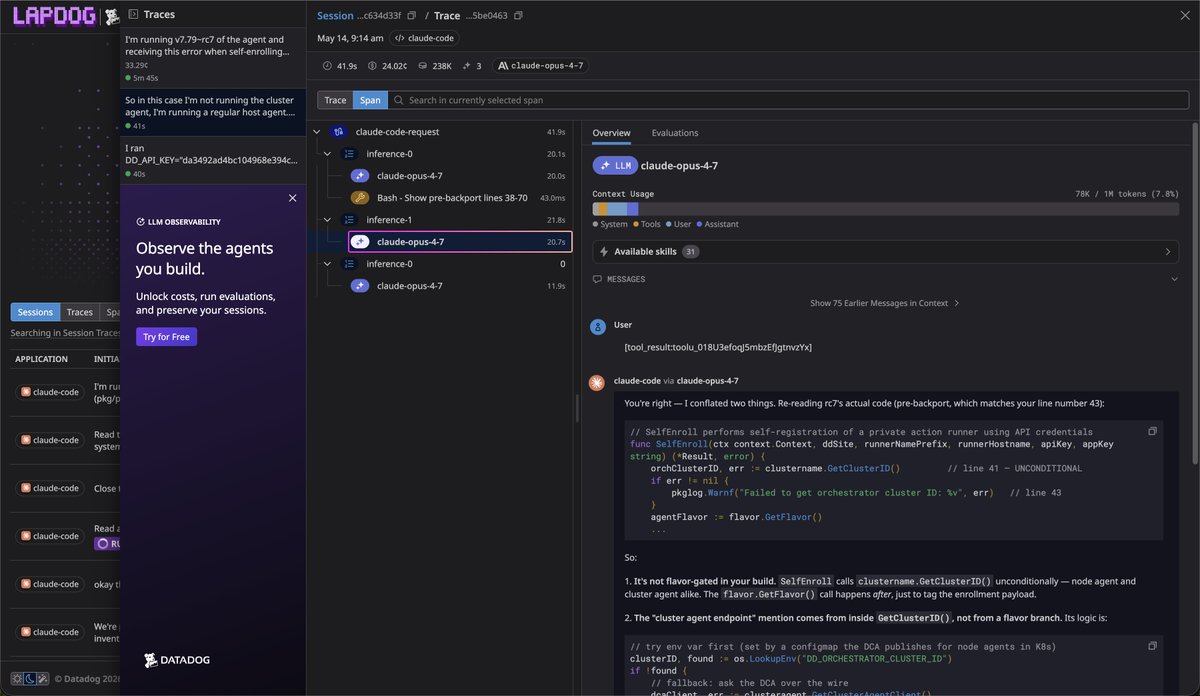
NEW from Datadog: it's Lapdog!
Ever wondered what your AI agent was actually doing?
Our latest free project runs locally and traces reasoning and tool calls in Codex, Claude Code, and Pi.
You can now see what your agent is REALLY doing, live: https://t.co/3dVBozFlPx
The succession everyone called for years just happened, and it's the most revealing personnel decision in tech this year. Apple is the company most behind in AI: Siri delayed three times, Apple Intelligence launched with hallucinated news headlines, and the upgraded assistant is reportedly going to be powered by Google Gemini under the hood. The obvious move was to put a software or AI executive in the CEO seat. Instead the board picked the guy who runs hardware engineering.
Ternus has been at Apple 25 years. He's a mechanical engineer. He's never run software, services, or AI. His resume is iPhone, iPad, Mac, AirPods, Apple Watch, Vision Pro, and the M-series silicon transition. He is the silicon-and-systems candidate.
Cook leaves with the receipts. Market cap from $350B to $4T, a 10x in 14 years. Revenue from $108B to $416B, nearly quadrupled. Services from a footnote to a $100B business. He inherited a hardware company and built a recurring-revenue platform on top of it. The market said thanks by selling AAPL down 1% after hours.
The Ternus pick tells you what Apple's board actually believes about the next decade. The AI race won't be won at the model layer where Apple is hopeless and renting from Google. It'll be won at the silicon layer (on-device inference, custom NPUs, thermal envelope, battery), the form factor layer (glasses, wearables, ambient computing), and the integration layer (the chip talking to the OS talking to the model). All hardware-adjacent problems. All Ternus problems.
The bear case is straightforward. Apple just promoted the executive least connected to the technology that's eating the world, at the exact moment software-native companies (OpenAI with Jony Ive's device, Meta with Ray-Ban, Google with Gemini-everything) are coming for the iPhone's distribution. A mechanical engineer running the most valuable consumer software platform in history. That's a real bet.
The bull case is the same fact framed differently. Every competitor is converging on the realization that AI hardware (the device the model lives on) is the next platform, and Apple has spent 25 years building exactly that. Ternus shipped Apple Silicon, the only credible non-Nvidia AI chip in a consumer device. He runs Vision Pro. He inherited the robotics team in the April reorg.
The boring read is succession planned years in advance, no surprise. The interesting read is that Apple just told you it doesn't think the AI race ends with the best chatbot. It thinks it ends with the best device. And it picked the person who builds devices.
Designers suddenly feel the need to explain that «design is more than just outputs». That itself is a bad sign.
Unfortunately, designers cooked it themselves.
Designers had a problem I called Figmaism – an obsession with tools and visuals at the expense of other (and more important) skills.
We knew hard skills are only a fraction of designers’ competencies. But we still kept talking mostly about new Figma features and pretty visuals to impress other designers (instead of customers).
One reason is a defence mechanism - it's easier to hang out in Figma than to face KPIs, OKRs, and roadmaps (AKA the things that actually matter).
Designers shouldn’t be surprised that design is being reduced to output because they helped create that reduction.
So if designers failed to make the case when the profession had more leverage, I’m not sure why we expect others to buy it now.
After advising 50+ consumer companies over the last year, the one thing that separates those who can execute and those who can't:
Having a full-time designer in the room at all times
I've met with countless companies that have raised millions—and even one that has raised billions—that do not even have a designer on payroll.
This makes product development broken:
1/ You simply cannot have constructive conversations about ideas without visualizing them in real-time
2/ Your experiments will frequently have inconclusive results because users cannot discover features or they misunderstand how they work
3/ There is no one who can galvanize the team with a vision of what the product could look and feel like
And to be abundantly clear: I'm not referring to visual UI or graphics. I'm talking about someone who can think through the fundamental building blocks of product comprehension—like navigation, interaction and copywriting—and is technically savvy enough to visualize those components in high resolution.
There can certainly be exceptions to not having a designer, like where the CEO is an exceptional visual thinker, but that does not scale beyond a small team.
At the end of day, products live and die in the pixels: it's what the users see and tap. And without someone shepherding that process, you are effectively wandering the desert blind.
I keep thinking I miss having someone like Steve Jobs in the industry.
He had some standards. He cared about quality, coherence, and making great products. He could be ruthless and he had plenty of flaws, but it still felt like he and Apple were trying to make something genuinely great above all else. They had their opinions and you could respect that. They didn't try to force you, but make their case why they think it's good.
Now tech feels driven by trend chasing, fear, scale, revenue comparisons, endless games and everyone talks their book. Investors come first, business goals next, and users last if not at all.
I wish there would still someone like Steve still around
Google is now asking PM candidates to open Cursor and build a working prototype in 45 minutes.
Not engineers. Product managers.
Figma does it. Perplexity does it. v0 does it. It's been confirmed on Blind and I've had candidates come back from these rounds stunned because nothing in their prep covered it.
The round doesn't test whether you can code. It tests whether you can think through a product problem and make it real while someone watches. Scoping, trade-offs, what to build first, what to skip, how you handle the moment something breaks. All the product judgment that used to happen in a whiteboard case now happens in a live IDE.
No framework saves you here. CIRCLES doesn't help. A product sense structure doesn't help. You either have reps in these tools or you freeze for 45 minutes while the interviewer writes their notes.
Google removed the standalone technical interview for PMs entirely. They replaced it with this. The bar moved from "can you talk about technology" to "can you build with it while we watch."
The candidates practicing behavioral answers and product cases are preparing for 4 out of 5 rounds. This is the round they don't know exists yet. And it's the one with a zero percent recovery rate. A mediocre behavioral answer still passes. A blank screen doesn't.
My boomer uncle saved $1.2 million for retirement.
- drove a 2003 Honda until it felt apart
- packed his lunch everyday for 33 years
- had a whole list of things he was going to do
He died 2 weeks before retiring
Over the past two months, my most impactful move as a design manager has been encouraging and supporting every designer to start building with Claude Code.
Designers used to create a “source of truth” in Figma which was used for QA and accountability.. if anything was wrong, you’d point to the designs and say, “This is how it’s supposed to look.” The designers would take this artifact hand it off to engineers to build another “source of truth” on GitHub that would become the repo where other engineers can fork and build on top of.
Now — the designer creates the source of truth on GitHub, and it’s closer to “the designs” because it is the designs. Less gets lost in translation, and everyone speaks in code. Figma remains useful for napkin sketches and quick visual experiments, but we are clearly moving beyond Figma as the primary document.
The hardest part is getting set up—it’s daunting and scary leaving the things you love behind. People just need a little bit of emotional support to get started. But after taking the leap, everyone is feeling empowered and excited. They are all literally 10x’ing their productivity. The worst part is that engineers are a bit overwhelmed because they have way more PR’s to review.
insane that we tolerate living in a society where you can go see one dentist
and he's like "ya u have 13 cavities, will be $4000 to fix them all"
then see another and he's like "that guy was full of shit and trying to scam you, you're fine"
???
new model for engineering team structure in 2026:
2 people only
one pirate and one architect
the pirate's job is to move as fast as possible to develop valuable, shipped product features by vibe coding.
the architect's job is to turn the product surface discovered by the pirate into a reliable, structured machine—also by vibe coding, but at a slower, more well-reasoned pace.
every product needs a pirate but most product's only need an architect once they some form of PMF, and in that case they usually don't need one full-time. architects can work across many codebases and solve interesting technical challenges. pirates go hard on a product that they own end-to-end.
Ticket-driven software development is slowly dying.
For years, the workflow looked like this:
- PM writes the ticket
- Engineer picks it up
- Engineer ships the code
Repeat.
That model made sense when writing code was the bottleneck. But it isn’t anymore.
AI tools can generate large chunks of implementation.
Scaffolding, tests, refactors, even entire features.
The constraint moved. The hard part is now:
- Choosing the right problem to tackle
- Structuring the system correctly
- Deciding what not to build
That is why engineers are increasingly expected to own outcomes, not tickets.
Instead of:
- “Implement this API endpoint.”
The work becomes:
- What problem are we actually solving?
- What’s the smallest thing we can ship that users will use?
- How do we know it worked once it’s live?
The engineers who adapt to this shift will thrive.