Marxism has a schism between the falling rate of profit school & the 'underconsumptionists'. My understanding is that both have correct elements, but the full explanation requires an understanding of what Marx meant by 'overproduction'.
The basic idea was that production gets ahead of what the market can fully realise due to the credit system enabling leverage (credit money/debt). People & organizations can buy today & promise to pay latter. Credit notes become a form of credit money. This credit money represents future labour time. This means that todays aggregate market prices get inflated above their value equivalent. The job of crises is to bring prices back to their values. Not only does the excessive leverage get cleared out, but also capital gets devalued & destroyed, as well as wages falling due to unemployment. This then lays the foundation for the recovery & so the business cycle.
Under a gold standard where token money (currencies) are tied to a weight of gold that takes a fixed amount of labour time to produce, central banks have to raise interest rates to maintain the value of their currencies. The relationship between currency & labour time is fixed & the credit system can only stretch it so far. But under today's fiat money regime of King $, central banks can keep printing to keep prices from falling back to their values. This means ever greater amounts of govt debt, especially US govt debt. Hence, 'overproduction' keeps getting bigger & bigger as they try to avoid the crash. But they are buying time at the cost of an even bigger future crash. This is why govts/central banks cannot keep printing money. It will likely lead to hyper-inflation.
@fteconomics But even Volcker wouldn't be able to save King $ this time.
Higher interest rates just make the US debt even more obviously unsustainable.
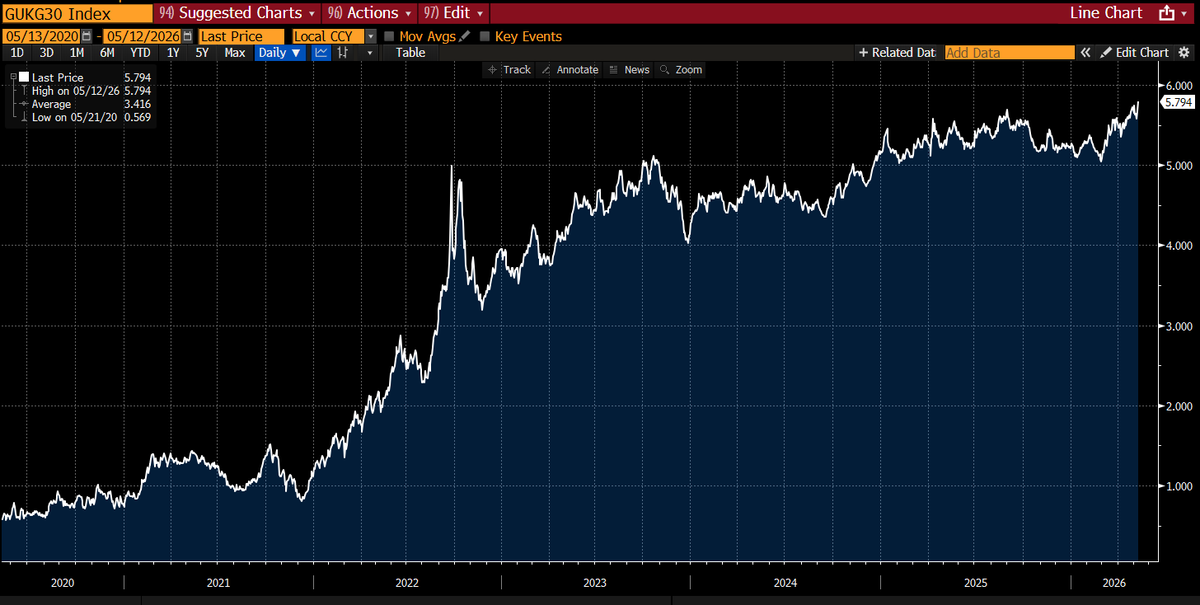
"This week at a US Treasury auction of $25 billion of government debt, the yield on the 30-year bond went above 5 percent for the first time since 2007."
The stagflation of the 1970's was more to do with the end of Bretton Woods than just the oil embargo.
That time it took the high interest rates of the Volcker Shock to break gold & save King $.
Now we have slumpflation & the likely popping of the biggest asset price bubble in history. The asset price bubble that has given US finance capital its profits & so world power. That bubble has ultimately rested upon the creation of ever greater amounts of US govt debt.
There's no Volcker this time to save King $ & a new international monetary system is being built by BRICS+.
After half a century neo-liberalism has reached its end.
@LindseyAGerman The conclusion needs to be, as always, build a genuine direct, participatory democratic movement.
It's what the Peoples' Assembly movement was supposed to be but never was.
We need to try again.
The "Liz Truss moment" of 2022 has turned into the UK's political reality, with 30-year yields soaring to their highest levels since 1998 and the pound weakening. "No matter who is in power, no matter their political leaning, there does not appear to be a credible plan to restore the country’s finances." https://t.co/b0CkumyQ3f
The mess that the UK is in after almost half a century of Tory spivs (& that includes the New Labour ones of the Blair, Brown & Starmer govts)...
📽️ This isn't just about Keir Starmer and whether he'll be PM in a few days/weeks.
It's about the economic quandary the UK's faced with and whether any future govt can or will confront it.
My primer on why markets are quite so fretful about the UK👇
@robin_j_brooks By disrupting energy supplies around the world some Texans along with Trump & his cronies may get richer, but the rest of the world turns against US world hegemony, & so ultimately pricing their trade with one another in $'s.
Bye, bye King $.
Nixon's decoupling from gold in 1971 & the subsequent Volcker Shock to save King $ gave us the reign of US finance capital, all based upon an asset price bubble inflated by ever greater amounts of US govt debt.
At the time the USA was still the economic superpower & had the military power to enforce commodities like oil being sold around the world in $'s. The war in Iraq was about maintaining that. The blowing up of Nordstream was too. And today, that's what the war in Iran is about. China & the wider BRICS+ are fighting back this time.
The USA is not the economic superpower it was, & is perhaps being found out to be not the all-powerful military power many thought it was. That spells danger for everyone holding $ denominated debt.