After a long and rewarding IT career, I'm devoting my time to helping make the world a kinder place. I also try to encourage critical thinking and listening.
The French Revolution would soon descend into terrible violence, but this particular moment expressed an enduring principle: no human being should be born destined to serve another.
This Day in the History of Kindness, August 11
On this day in 1789, France's National Assembly completed the August Decrees, a sweeping series of reforms dismantling much of the country's centuries-old feudal system.
It represented a profound change in the idea of what one person was entitled to demand of another simply because of the family into which each had been born.
This Day in the History of Kindness, August 10
On August 10, 1846, the Smithsonian Institution was officially founded through a bequest from a British scientist, James Smithson, who had never visited the United States.
Today, the Smithsonian includes museums, research centers, libraries, and the National Zoo, sharing art, history, science and culture with millions of people each year.
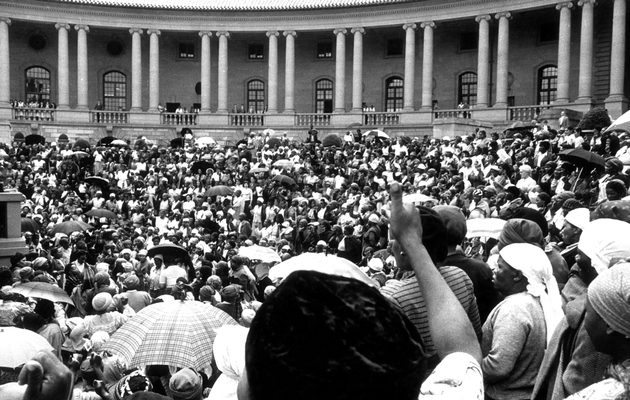
The march became a landmark in South Africa's struggle against apartheid. Today, August 9 is celebrated there as National Women's Day, honoring the courage and kindness of the women who stood together against discrimination and injustice.
This Day in the History of Kindness, August 9
On this day in 1956, approximately 20,000 women marched to the Union Buildings in Pretoria, South Africa, to protest the apartheid government's effort to require Black women to carry identification passes that severely restricted where they could live, work, and travel.
The march brought together women of different races and backgrounds, led by Lilian Ngoyi, Helen Joseph, Rahima Moosa and Sophia Williams-De Bruyn. They delivered petitions containing roughly 100,000 signatures and then stood together in silence for 30 minutes, a remarkable peaceful demonstration of solidarity and resolve.
Over the years, the refuge has provided habitat for enormous concentrations of ducks, geese, and other waterbirds, as well as bald eagles and many other species.
This Day in the History of Kindness, August 8
On this day in 1908, President Theodore Roosevelt established the Lower Klamath National Wildlife Refuge along the Oregon-California border. It became the nation's first refuge created specifically to protect migratory waterfowl.
The wetlands of the Klamath Basin are an important stopping place along the Pacific Flyway, providing food and shelter for birds traveling thousands of miles between breeding and wintering grounds.
The swim had an impact far beyond athletics. Later that year, Soviet leader Mikhail Gorbachev mentioned Cox during the signing of the INF nuclear arms treaty with President Ronald Reagan, praising her for demonstrating the closeness of the American and Soviet peoples.
This Day in the History of Kindness, August 7
On August 7, 1987, long-distance swimmer Lynne Cox plunged into the 38°F waters of the Bering Strait, swimming 2.7 miles from Little Diomede in Alaska to Big Diomede in the Soviet Union.
Undertaken after a decade of writing letters to Soviet officials, her grueling swim across the heavily militarized "Ice Curtain" demonstrated that human connection could bridge the Cold War divide.
That act of openness allowed the Web to grow into a global resource rather than a proprietary product controlled by a single company. His decision to gift the Web to the world remains one of the greatest acts of digital stewardship and shared knowledge in history.
This Day in the History of Kindness, August 6
On August 6, 1991, British computer scientist Tim Berners-Lee officially launched the World Wide Web to the public by posting its underlying code online for anyone to use.
Driven by a vision of open access rather than personal profit, he deliberately chose not to patent his invention so it could serve as a free, universal tool for human connection.