Founding partner of EverBank, Casey Research, RiskHedge, Agustin Lanus Wines and, now, helping spread the good news through the Rational Optimist Society.
Elon Musk just said the one thing about America they made sure you’d never learn.
The one thing that should’ve made you proud, not ashamed.
Musk: “After World War 2, the US could have basically taken over the world and any country. Like we got nukes, nobody else got nukes. We don’t even have to lose soldiers. Which country do you want?”
One nation held a weapon no civilization had ever possessed.
Total monopoly on destruction. No rival. No consequence. No limit.
Every empire in history that held that kind of power did the only thing empires know how to do.
They took until there was nothing left to take.
America had a greater advantage than all of them combined.
And rebuilt the nations it just defeated.
Musk: “The United States actually helped rebuild countries. So it helped rebuild Europe, it helped rebuild Japan. This is very unusual behavior, almost unprecedented.”
Not almost unprecedented.
It had never happened. Not once in 5,000 years of recorded civilization.
The nation with the power to take everything chose to rebuild instead.
Enemies became allies. Rubble became economies. Surrender became partnership.
Germany went from ashes to the economic engine of Europe in a single generation.
Japan went from unconditional surrender to the third largest economy on earth.
Three years after the war, America was flying food into Berlin.
Into the capital of the country that just tried to end the free world.
That decision reshaped every economy, every alliance, and every trade route on the planet.
Billions of people lifted out of poverty over the next half century trace back to one moment. One nation choosing restraint over domination.
No other country in history can make that claim. Not one.
Musk: “There’s always like, well America’s done bad things. Well of course America’s done bad things, but one needs to look at the whole track record.”
Every nation on earth has blood in its history.
But the measure of a nation was never its worst chapter.
It’s what it does when nobody can stop it.
When nobody could stop America, it fed its enemies and rebuilt their cities.
You’re being told every day that this country is something to be ashamed of.
By people who have no idea what the world looks like without it.
Every free market. Every open border for trade. Every democracy that took root outside Europe stands in the shadow of that single decision.
The values that built this country didn’t just shape America.
They shaped the modern world.
AI is about to hand a small number of people a power advantage that makes nuclear monopoly look primitive.
1945 was the first test.
AI is the last.
That power is going to exist. The only question left is who holds it.
The most powerful thing America ever did wasn’t building the bomb.
It was having the power to take everything and choosing not to.
The people trying hardest to tear that story down have never built a single thing worth defending.
How do I know media brainwashing is real?
Obama’s ICE Chief received an award for removing over 900,000 illegal aliens.
Trump’s ICE chief was called a Nazi.
It is the same person - Tom Homan.
The difference? What the media told people to believe.
Cathie Wood just explained why the establishment will never stop coming for Elon Musk.
And the reason is worse than they think.
Wood: “Tesla was an environmental move, which I think a lot of people attacking his cars… they’ve forgotten.”
They didn’t forget. You don’t forget thirty years of marching and petitioning and begging for the machine that saves the planet.
Someone built it. Forced every automaker on Earth to follow.
Then they turned on him the moment he delivered exactly what they asked for.
Not because he failed them. Because he made them unnecessary.
A solved problem is an existential threat to every institution built to solve it. Kills the funding. Kills the committee. Kills every career that exists to manage the crisis rather than end it.
Wood: “I think he’s the Thomas Edison of our age… he wants to do the right thing to transform the lot of most of humanity.”
Edison was hated too. By the people who sold candles. Every revolution looks like an attack to the people it makes obsolete.
Wood: “What we learn about material science and technologies… is going to help us here on Earth as well.”
SpaceX is not an escape. It is a forge. Build under the most brutal conditions in the solar system and every breakthrough comes home.
Most people at his level stop building and start protecting what they have.
Musk picks the hardest unsolved problem on Earth and runs straight at it.
That is not what terrifies them. What terrifies them is he does it without their funding, without their approval, without a single thing they can hold over his head.
A man you cannot buy is a man you cannot control. And a man you cannot control who keeps solving the problems you profit from is the most dangerous human alive.
They will spend their careers trying to tear him down.
Their grandchildren will live in the world he built anyway.
On America's 250th anniversary, read ROS co-founder Stephen McBride's love letter to America.
How it gave him, an inner city Dublin kid, a shot at a brighter future and continues to export its number one product, innovation.
https://t.co/G1X7z36zrc
In 1825, a rich Welsh industrialist bought an entire American town to prove that socialism could work.
He had the money, the buildings, the theory, and hundreds of eager followers waiting to move in.
Two years later, it was over. 🧵
So...
We're not allowed to buy air conditioners for our houses to cool them in hot summer weather, because we don't have enough electricity to power them, because the solar panels and wind turbines we installed to stop the planet getting hot in summer, don't work when it's hot and windless in summer, so we'd need to burn gas, oil and coal instead to power the AC to cool our houses, but we blew up the oil, gas and coal power stations to stop the planet getting hot in summer, but it's still hot in summer.
But it's still ok to install heat pumps in winter, heat pumps which are also air conditioners and use the same amount of electricity or more, but we still won't have enough electricity to power them on cold, dark, windless winter evenings, because solar panels and wind turbines don't work then either, and we blew up the gas, oil and coal fired power stations because they were making the planet too hot in winter as well as summer.
Have I missed anything?
🙄🤡🌍
Elon Musk just proved that ownership in America is a legal fiction.
Musk: “You get taxed on what you earn, you get taxed on what you buy, and you get taxed on what you own.”
Think about what property tax actually means.
You worked for decades. Paid it off in full. The deed is in your name.
Stop paying the government its annual fee. Watch them take it and sell it to someone who will.
You never owned that house. You were leasing it from an entity you never signed a contract with.
Income tax tells the same truth in softer packaging.
The government does not take a portion of your earnings. They decide how much of your own labor you are permitted to keep.
That is not semantics. It is a confession of who the system believes your time belongs to first.
Sales tax buries itself in the receipt. Two people exchange value voluntarily. A third party who contributed nothing takes a cut simply for allowing it to happen.
Now stack all three.
Taxed when you create. Taxed when you spend. Taxed when you hold. Taxed again when you die and try to pass it to your children.
At no point in that cycle does the system recognize your output as yours.
Because money is not an abstraction. It is crystallized human lifespan.
Every dollar taxed is an hour you already lived, already bled for, already gone.
The state is not managing an economy. It is claiming dominion over time you will never get back.
And spending it on systems you never asked for and actively oppose.
The institution extracting all of it faces zero obligation to perform. A contractor who delivers nothing gets fired. A bureaucracy that burns through trillions gets a budget increase the next fiscal year.
SpaceX pays taxes to the agencies that obstruct its launches. Tesla funds the regulators drafting rules to shield its competitors.
The builders are not subsidizing government. They are financing their own friction.
The tax code is 74,000 pages long. Not because the economy demands it. Because the extraction had to be buried in enough complexity that you would stop asking who it was designed to protect.
The past belonged to the people who taxed the world.
The future belongs to the people who build it.
On Aging. Over the past week I wrote a short essay with some personal reflections on the topic of aging. I wrote it for myself, but you might find it of interest. Here it is:
On Aging
Everyone ages, and no one gets out alive.
Those are absolutes.
Yet, many people look upon the future hoping their lives extend to something which approximates infinity. The very definition of a false hope.
They may be forgiven: the idea of a hard stop to everything is difficult to accept.
Until recently, I, too, have held out hope that good genes (my mother is 101 and still living on her own), assures my health and life span will continue for decades. And, then, who knows? With all the longevity research going on, maybe decades more?
One can hope.
Yet, at 73 with arthritis in my left thumb paining me as I type this, and a back which - thanks to three back operations last year - needs watching over like a toddler in a theme park, the time has come to be a bit more realistic.
I Was Young Once
In my mind, I am no older than forty-five. That’s good because medical studies find that those who feel younger than their chronological age tend to live longer. Which makes perfect sense because if you are sickly, you will naturally feel older.
That said, mentally, I’m not quite as agile as I was at forty-five. Sure, I can provide somewhat useful input in a meeting related to marketing, but increasingly I feel my input is outdated. Like a computer technician offering advice on MS-DOS when everyone else has moved on to AI.
Appearance? When young, I was apparently a somewhat dashing specimen (though I didn’t realize it at the time). Now, however, my appearance wouldn’t turn the heads of, well, anyone.
Motivation? Not so much. In my youth I had a powerful drive to succeed at all I laid eyes upon. Today, with the world conquered - or at least the part I care about - my ambition is more oriented towards things like posting a decent golf score, or beating challengers at the snooker club.
Even so, I could be a lot worse off than I am. A lot of people my age are weighed down with everything from obesity to diabetes, from depression to cancer, from heart disease to crippling arthritis. Or, just plain dead.
Proper Old
Yet, despite all my entirely normal delusions about mortality, I am, in fact, no longer young. Even a cursory glance in the mirror confirms that fact. Thinning hair, missing entirely in spots, wrinkles, scars and other wear and tear are there for all to see.
Facing that fact, I could hunker down into a well of worry and, wrapped in a warm scarf to keep out the sickening cold, shuffle along timidly lest my growing frailty bump into something hard and leave me a doddering old man armed with a cane, or riding in a mobility scooter, forced to see the world through the dimming lenses of cataract-degraded eyes.
Or, I can decide here and now to accept my chronological age, thank the powers-that-be (including my genealogic ancestors) for the fact I’m still quite robust. No high blood pressure issues, not obese, still able to do 30 push-ups without breathing particularly hard. Nada.
Well, except the occasional flare ups with the arthritic left thumb due to my penchant for video-gaming.
My back? I do regular exercises to strengthen the back muscles so I won’t have another disc herniation, but yet I am still playing golf two or three times a week, and can, on the occasion, manage to whack the ball 230 yards in the right direction.
So, I have all of that to be thankful for.
Yet, in ten years I’ll be 83 years old, and there’s no changing that. Other than expiring in the interim.
And the unassailable truth is that 83 is not young, middle-age, or merely elderly… it is properly old. Or, as the Chinese call it, “Rare Ancient”.
New Realities
I like to think that if I keep up the routine, day-in day-out, there’s no reason for me to be much less spry than I currently am at 83. But reality, and the Second Law of Thermodynamics, doesn’t work that way.
Which means that the next ten years will be the best years of the rest of my life.
All of which leaves me faced with the following list which might be filed under the heading of New Realities.
I am not going to get much stronger, no matter how much I work out. The trajectory for strength is very much in the opposite direction. The best I can do is slow the descent.
Absent the double-edged sword of plastic surgery, my appearance is not going to become more youthful.
No amount of mental exercise is going to keep my brain as sharp as it is today. Which is less sharp than it was 10 or 20 years ago.
New and unwelcome medical conditions are going to continually pop-up, no matter how much I look after myself. Today an arthritic thumb joint, tomorrow a hip issue, then a small cancer, then… who knows? There will always be ‘something’ just over the horizon, and the last thing will kill me. It’s a certainty.
How long do I have left to live? To enjoy my life?
Literally, no one can say. The news is overflowing with people dropping dead at a much younger age than I currently am. And the stats don’t get better going forward.
Living for the day seems to be about the right attitude.
Welcome to the Now!
Let’s get to the crux of these musings: how can I make the most of my remaining good years? The good news is that, despite increasing physical and mental limits, there are things I can do as I grow older that should remain entirely within my capability pretty much up until the end.
Going forward, these are the things I should focus on getting right.
I can appreciate every moment of reasonably robust health. Take advantage of my health to the best of my ability. Take a long walk, push myself within reason. Do laps in the swimming pool. Get up early and get to it every day for as long as I’m healthy enough to do it.
I can stop worrying about the inevitable. Rather than waiting around in fear of the next thing rolling down the hill in my direction, I can accept it’s coming and also accept that, when it hits, I will marshall the resources to deal with it the best I can. Sure, my thumb is bothering me at the moment, but with a bit of ibuprofen and rest, it will almost certainly be right within a day or two. It almost always is. Worrying about what’s next is a waste of time and energy.
I can contribute. Okay, maybe I can’t help shift the new couch up the stairs, but I can certainly provide advice learned from 72 years of lived experience (tilt the couch up to fit through the doorway). There are worthy people who need moral support, a little advice and, on the occasional, financial assistance. I can be generous with both my time and resources.
I can be entirely myself. I always find it incredible that as many (most?) people age they get more timid. More cautious lest they offend. I can speak my mind, when called for, stand up for the right as I see it.
I can resist complaining. It serves no purpose other than to drag others I care for into whatever the latest ailment might be. And why would I want to do that?
I can do the things I can, while I still can. Whether it is mental drills, or regular exercise, there are things one can do to stay as sharp and as healthy as possible, for as long as possible. Vitamins, eating and sleeping well, and not drinking to excess are also well within my capacity. That doesn’t mean obsessing about such things, because where’s the fun in that? .
I can avoid negatives. It is well studied that our attitudes and general sense of well-being are impacted by the media we consume, and the people we spend our time with. This is an easy one to act on. It’s as easy as not reading sensationalized news stories about this or that horrible event, and not hanging out with miserable people. Rather, embrace the abundant positives on display in the world, gravitate to fun and happy people, and stop to have a good laugh every day.
I can be creative. Writing has been my staunch companion since a very young age. When all else fails, I’ll still have it to fall back on. For other people it might be painting, sculpture or gardening. Find the things you love to do, and do them for as long as you can.
I can have fun! Golf, sure. A pint after golf, why not? There’s nothing to stop me from taking the untrod path, or… or… The world is still my oyster. No, I’m not going to summit Mt. Everest, but there is an almost infinite number of things I can still enjoy at a more reasonable altitude.
I can accept the things I can’t do. I can’t (or, shouldn’t) ride horses for 10 hours a day as I did until recently, or dive for a pickleball shot. Most importantly, I can’t turn back time, or fend off the inevitability of aging, poor health and, eventually, death. Accept the facts and move on.
Accepting I am no longer young, and was lucky to make it into the ranks of the Rare Ancient, I can focus on celebrating the remaining good years, empowered by the certainty they won’t last.
David Galland
June 1, 2026
@mattvanswol I cannot believe that everyone is taking this seriously. Obviously, at least to me, it was some local trying to do a bit of dynamite fishing. The idea that a grenade could damage a damn is laughable.
🚨 Starmer Announces Bold Mission to Reopen Strait of Hormuz… After Iran and Trump Just Declared It Open
Starmer's masterplan: “We will lead a multinational mission to open the Strait of Hormuz.”
Iran & Trump just announced it's already fully open today 😂
Brilliant timing, Keir. The ships are sailing while you're still scheduling the planning meeting. 🤡
A Story for the Ages
Grab a cuppa and I’ll tell you a story.
Soon, many people will be telling you a variation of the same story.
In fact, the story will become so commonplace, no one will bother telling it any more.
But for now, it’s a story you need to hear and, more importantly, make your own.
Technically Incompetent Meets Super-Tech
Like many, I welcomed the “ChatGPT Moment” with only a middling amount of interest. Curious, I mostly began using the newly available AI as a more convenient search engine.
As writing is an integral part of my life, I soon extended my usage to research projects, requesting links to sources to assure the research was accurate. In the beginning, AI hallucinations were not uncommon. Today, they are.
So far, so good.
But then something happened. Something that has changed my life, and will soon forever change the world.
The “something” came about because my associate, Stephen McBride of RiskHedge and the Rational Optimist Society, announced he had coded a website. And not just any website, but a complex, data-rich platform you’d previously have needed to spend tens of thousands of dollars in developer fees to build. You can check it out here.
But here’s the twist. Stephen has zero programming skills. Yet, he was able to build a very complicated website in only a few hours.
At that point, I began to realize there was far more to AI than I had previously considered.
Little Steps, then Fast
To join the AI age, which is the equivalent of trading your horse drawn cart in for a Mercedes, you need a top-grade AI engine. In my case, I went with Claude Max. It costs $100 a month and gives you access to Opus 4.6, Anthropic’s latest and greatest AI.
Armed with Claude, use cases began to present themselves.
The first came while reviewing my self-directed investment portfolio, a labor-intensive process involving revisiting each position, analyzing sector-level macro trends (e.g., trends affecting picks-and-shovels AI companies), perusing the latest financials and, for good measure, doing technical analysis on price action and momentum
“Hey, why don’t I let Claude handle this for me?” I thought. And so I went to my brokerage site, downloaded the basic data on my portfolio, pasted it into Claude and assigned it the task.
The results exceeded my expectations, providing everything I’d asked for, plus more, neatly organized into interactive tabs. Just for fun (and because I’m in publishing), I asked Claude to turn it all into a personalized newsletter called Portfolio Pulse. Now, at the end of each month, I simply grab the latest data, upload it to Claude, and five minutes later a fresh edition is ready to read.
To use an old metaphor, I was off to the races.
Next up, I used Claude to shed light on a complicated tax situation. Results in hand, I arranged a consultation with my very pricey accountant. Just a few minutes into the consultation, I realized that, thanks to Claude, I already knew everything she was telling me, the only difference being she was costing me $400 an hour.
Recently, I tasked Claude with organizing a management system for properties I own. After describing what I wanted, and sharing a computer folder containing various documents related to those properties with Claude, “he” created a professional management dashboard.
Now, each time I receive a document related to a property - say a tax bill - I simply drop it in the shared folder and Claude will automatically use the information it contains to update the dashboard.
A formerly time consuming process which now consumes next to no time at all.
My First Website
Some years ago, I purchased the URL for the small town in Argentina where we spend half of each year. The website was static, and because I keep fairly busy, I didn’t have time to muck around with updating it much. I had a programmer from Mendoza who was supposed to help, but he was the opposite of a promise-keeper, and so tasks that should have taken him a few hours could drag on for weeks or even months.
Last week I decided enough was enough and put Claude to work. In just a couple of hours, by following Claude’s step-by-step instructions, or giving it permission to do the work, the entire site was re-coded and moved onto new public servers where it is now live.
You can see the website here: https://t.co/J6vt3ZSeZ7. While I (i.e., Claude) will continue refining it, the site is live and already delivering useful information about our town. Even better, content such as upcoming events is no longer static, but automatically scraped from publicly available sources and updated.
This morning I remembered the site needed to be optimized for search engines, so I queried Claude on what was needed and gave it the permissions needed to move forward. Within 30 minutes the site was search engine optimized.
That I could pull all this off is no small feat, especially considering I was, without doubt, the worst student in my high school class. I then flunked out of my first and only year of university. Fortunately, I stumbled into a career where science and mathematical skills weren’t required or I might be driving a taxi.
In terms of the quality of my life, my new understanding of the many complicated tasks I can now have Claude handle represents something far more than a breakthrough. It’s as if I was bitten by a spider and woke up next morning with super-intelligence. Give me a task, any task at all, and with Claude as my near infallible collaborator, it will get done to a professional standard.
But note something else in this story: by gaining abilities I never dreamed possible, several jobs have been impacted and maybe eliminated. An expensive accountant, an easily distracted programmer, and an SEO specialist, for starters. All of those jobs were, until the ChatGPT moment, considered solid career choices. Now, for many, the academic and professional credentials required to pursue those careers may not be worth the paper they are written on.
Who Gains, Who Loses?
In this story for the ages, for the widespread adoption of increasingly competent AI will certainly resonate down through history, humanity gains in too many ways to count. Starting with billions of dollars saved on things like investment management, accounting, legal, programming, etc., etc. Then there’s the superhuman increase in productivity and knock-on time savings.
No more waiting around for Miguel from Mendoza to respond to a question, or for a second opinion on a blood test, or advice on a legal contract or accounting matter.
Need a website? A personalized investment management system? Just ask Claude.
Have an idea for a new business? Set Claude to work and in no time at all you’ll be launching.
As for the individuals whose jobs are about to be impacted, you need to embrace AI. Make it your friend ASAP, or start looking for work doing something AI can’t do quite yet. Perhaps learn how to be a plumber. Regardless, don’t be daunted at the prospect of a career change. With your favorite AI assistant at your side, learning your new career will be a snap.
David Galland
Cafayate, Argentina
April 4, 2026
P.S. Other than proof-reading, AI played no role in writing this missive. I enjoy writing too much to delegate that to Claude.
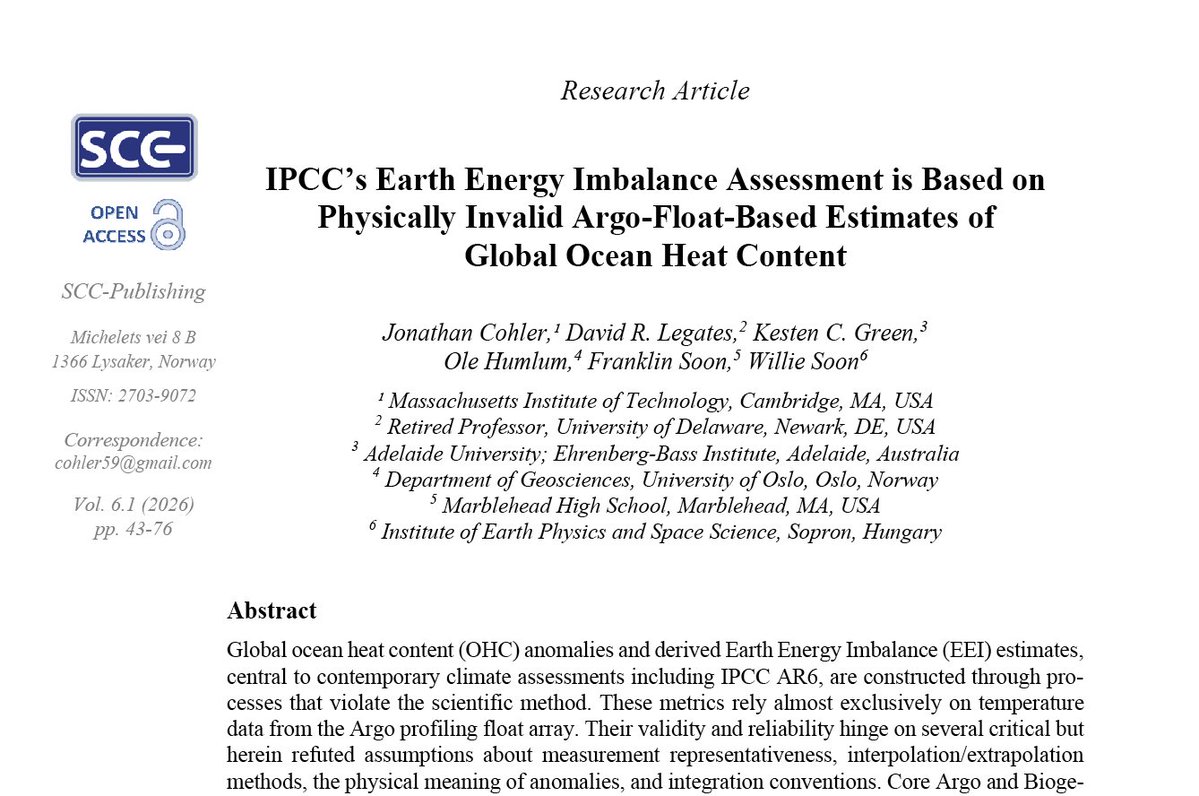
As promised, the climate science obliteration has arrived TODAY.
The IPCC's central claims have now been torn apart.
The oceans are not “warming” let alone “boiling.” That claim is false.
The claimed Earth Energy Imbalance is false. It's no different from zero.
Full demolition:
Cohler et al. (2026)
IPCC's Earth Energy Imbalance Assessment is Based on Physically Invalid Argo-Float-Based Estimates of Global Ocean Heat Content
https://t.co/s4JzeAQGyP
Press Release:
https://t.co/nhofkX1Rxj
Easy-to-Read Summary:
https://t.co/gZI0p1GopP
Why Electric Cars Will Win
About 12 years ago I decided to buy a golf cart here in Argentina. I was determined to buy a gasoline powered golf cart and was sorely disappointed when I learned that, due to Argentine import restrictions, the only carts available were electric.
I went ahead with the purchase and have never regretted it.
What I hadn’t calculated back in the day is the beautiful simplicity of electric vehicles. Finish a round of golf, plug the cart in, then unplug it the next time I’m ready to play and off I go.
On the other hand, if I had succeeded in buying a gasoline powered cart, I would have had 12 years of regularly refilling the tank with petrol, periodically changing the oil and otherwise dealing with the complex mechanics of a combustion engine.
Sure, I’ve had to change my batteries a couple of times, which in Argentina is not cheap. But it’s definitely not any more expensive than the 12 years of fuel and maintenance required for a gasoline powered cart.
As to the simplicity, a golf cart has about 20 moving parts. A gasoline powered one? Upwards of 1,000.
Of course, electric cars are a related yet different beast. Because rather than being a convenience for leisurely tooling around a golf course, a car is an integral part of our daily lives.
In the early days of electric cars, a political agenda tied to climate change tried to force electric cars down the gullets of the masses. But the technology wasn’t quite ready for prime time. Thus we heard stories of battery fires, EVs dying at the most inconvenient times, or long waits at charging stations. Range anxiety was a legitimate thing.
But once a worthy technology is out of the bottle, smart people with deep pockets spend long hours trying to fix any shortfalls. Thus the experience curve over the last decade has led to remarkable advancements in battery technology - in safety, in range, in speed of charging.
Superchargers can now have you on your way in about the time it takes to enjoy a cup of coffee. Or, even faster, a broader availability of battery swapping stations could have you in and out quicker than the time it would take to fill a petrol car. In China and parts of Europe, the Nio swapping stations are already automatically swapping out tens of thousands of batteries every day.
Simplicity equals easy manufacturing, equals lower prices. Toss into the mix the certainty that the nuclear renaissance will bloom in the years just ahead -- in tandem with increasingly effective solar -- and energy abundance is assured, bringing down the cost of recharging your EV to small change.
At that point, people will face the choice of complexity, and the need to constantly be refilling and servicing their petrol cars, or simplicity with a plug-in car. The right decision will increasingly be obvious.
The final nail in cars powered by combustion engines will be delivered by fully self-driving cars. It is impractical to service fleets of FSD cars using petrol, oil and with all their thousands of moving parts. It is entirely practical to do so with a plug in, or the new technology Tesla is working on that allows you to park over a charging plate and, voilà, next time you need the car, it’s topped up and ready to go.
It may take another decade for the victory to be complete, but in the end that electric cars will win is a certainty.
Act, and invest, accordingly.