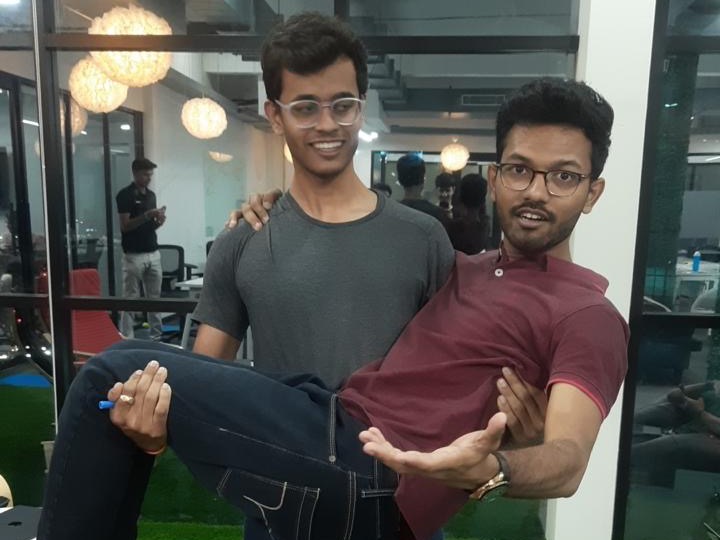
It took us 15 minutes to get a yes from the director of 3 Idiots, Mr. Rajkumar Hirani.
That made me realize something.
Japan is sitting on a gold mine of art and culture that much of the world still hasn’t discovered.
AI doesn’t replace artists.
It lowers the cost of experimentation.
More experiments lead to better stories.
That’s what we’re building for
story time: I introduced a friend of mine to @heywavelength back in December — at the time they were sponsoring dates in Bastian (Bastian?), and I just pushed my friend to go for it. fast forward almost 6 months now, they’ve been dating ever since, and obviously I’m the one getting all the praise for making them meet lol.
I’d 10/10 recommend wavelength to my single friends who genuinely want to find someone — just talk to wavelength and they’ll figure it all out for you.
we set up 1,000+ couples over the last few months,
and the biggest thing we learned is finding the match is just 10% of the job. the other 90% is everything after.
is he actually interested or just being nice. am i being too picky or is this an actual dealbreaker. what was that weird feeling after the date i can't explain. the things you text three friends to get an answer.
nobody built for that part. so wave became that person.
wave helps you find someone, then actually stays. she helps you reflect, get clarity, and work through the messy 90% no one talks about.
we were never meant to do this part alone.
wave is live today. link in comments.
we were never meant to find love solo.
we spent a whole year understanding people, learning how to represent them, setting two people up and helping them build strong relationships.
wave has been helping people find love and build it since our april beta.
launching wave tomorrow (25 june).
we've spent 15 years trying to fix dating with better algorithms. it was never an algorithm problem.
for most of history, you didn't find your own partner. someone else did. an aunt, a matchmaker, a friend who'd met both families and said "you two should meet."
and here's the part everyone forgets. they didn't just make the intro and disappear. they stayed.
they knew you. they vouched for the real you, not your best photo. they told you when you were being an idiot. they checked in after the first date. the introduction was maybe 10% of it. being in your corner was the rest.
then we handed all of that to a phone. and the phone gave you a deck of strangers and said good luck.
we didn't just lose curation. we lost the person who stayed. now you get a hundred matches and face every hard part alone. you perform instead of being yourself. you guess what they actually meant. you spiral at 2am with no one who knows the full story.
so finding someone was never a data problem. it's an emotional one. being understood. knowing the difference between what you want and what you actually need. having someone with you before, during and after, not just at the moment of the match.
think about the most underrated thing a real matchmaker ever did. she talked you out of your own snap judgment.
"i know you'd have written him off in two seconds. trust me on this one." and she was right, because she knew you better than your first impression did.
a swipe deck can't do that. it shows you a face and lets you judge in 0.2 seconds. someone who actually knows you can do the opposite.
that's the thing AI finally changes. for the first time, the friend who sees you from the outside can come back, at a scale no aunt ever had. it knows the real you, not your height filter. it represents you honestly. and unlike a human, it never runs out of time, never gets tired of you, is there at 2am and through the messy start of something real.
we stopped needing better algorithms a long time ago.
we needed someone back in our corner.
launching that friend this week. (apple gods, pls approve our build)
i have a friend named chandan. he is the guy everyone goes to if anyone needs a connect. need influencer marketing? chandan knows someone. need a CA, a designer, a flat, a gorilla for your party, a random favour in a city you've never been to? chandan always knows someone.
seeing two strangers create something cool after you’ve connected them, feels damn satisfying.
if chandan is scaled, this might be the most valuable thing you could build.
and that’s why we started by building a dating app.
youtube literally launched as a video dating site. the tagline was "tune in, hook up." facebook started as facemash. two of the biggest social platforms in history began by trying to get people to notice each other.
look where that got us. social media promised connection and turned us into performers. you don't open instagram to connect anymore. you open it to post a version of yourself and scroll through everyone else's. these platforms know what you'll click. they have no idea who you are.
so what if you went the other way? started with the hardest connection problem there is, and went deeper instead of pivoting away.
if you can understand someone deeply enough to make two strangers fall in love, you can connect anyone, to anyone, for any reason. a cofounder who thinks in the opposite direction. a roommate on their energy. a friend actually on their wavelength.
the next social network won't be built on feeds or screen time. it'll be built on actually understanding people.
we're starting with dating. we're not ending there.
i guess we're just trying to build a chandan. for everyone.
I was high on meds when I designed the first Wavelength app screens.
Not in a fun way.
I'd just joined, caught a fever almost immediately, and spent most of that first week at home. Bored and a little restless, I opened the file and started messing with the app screens from bed.
People loved what came out of that week. More than I expected.
I already knew feeling matters, every designer does. That week showed me how much it outweighs everything else.
A screen that feels right beats one that's just technically correct almost every time, and once you've seen that you can't really go back to designing the old way.
That's mostly what I think about now. Whether a flow is clean matters less than what the thing does to you in the first second.
There's a quiet assumption that anything with AI in it should feel a certain way. Efficient, a little clinical, obviously mechanical. I get why that's the default. But when you're asking people to be honest, sometimes about things they haven't said out loud to anyone, nobody does that for something that feels like a system talking back.
And so the choices are small and deliberate.
Warm color instead of clinical, because people open up in a space that feels safe. Motion that breathes instead of snaps, because the way a thing moves tells you whether it's alive.
None of it is styling. It's all the same argument: there's care behind this.
And the longer I work on it, the more I think the match was never the hard part.
Of course our AI goes through a crazy amount of information to find you the right person. But the harder part is everything that happens after: the figuring out, the staying. That's the part most products just leave you to handle alone.
So that's what we're building now. A friend you'd actually want to talk to, that knows you and stays with you through that whole part.
Finding someone is one thing. Being in your corner for everything after is different.
That's the thing we want to get right.